
You feel it halfway through the workday. Your neck gets stiff by noon, your shoulder blades feel glued down, and turning to check the next monitor takes effort. Or maybe you notice it at mile four on the Charles. One hamstring keeps tugging, your stride shortens, and no amount of stretching seems to change it.
That’s a common pattern in physical therapy downtown Boston. Active professionals, runners, lifters, and commuters often assume tightness means they need more stretching. Sometimes that helps. Often it doesn’t, because the problem isn’t just muscle length. It’s how the surrounding tissue is moving, or not moving, around that muscle.
Myofascial release is one of the most useful hands-on tools for that situation. It’s not a spa treatment and it’s not random pressure. It’s a targeted way to find tissue layers that have stopped gliding well and restore more normal movement. In a downtown setting, where people want to get through a workday comfortably and still train after work, that distinction matters.
A Targeted Solution for Pain and Stiffness in Downtown Boston
A Financial District professional comes in with a familiar complaint. The pain isn’t dramatic. It’s the constant, nagging kind. Tight upper traps, a stiff jaw by evening, headaches that build after hours at a desk, and a feeling that stretching only gives a few minutes of relief.
A runner’s version looks different but follows the same logic. Calf feels dense. Hip won’t open. Hamstring always seems “on.” They’ve foam rolled, stretched, and cut back mileage, but the same restriction returns on the next hard effort.
When stretching isn’t the fix
In both cases, the issue may be less about flexibility and more about fascial restriction. Fascia is the connective tissue that surrounds and links muscles, tendons, and other structures. When that tissue loses mobility, nearby areas start compensating. That’s when people say, “I just feel stuck.”
Myofascial release helps because it addresses that stuck feeling directly. Instead of chasing symptoms with generic stretching, the therapist works through the tissue layers that are limiting motion and feeding the pain pattern.
Practical rule: If you always feel tight in the same place no matter how much you stretch, the problem may be tissue restriction, movement compensation, or both.
Why this matters in a downtown clinic
In physical therapy downtown Boston, this comes up all the time with desk-driven neck pain, postural shoulder stiffness, marathon training aches, TMJ-related facial tension, and old injuries that never fully settled down. The right manual work can calm tissue irritation and make exercise “stick” because your body can finally move through the range you’ve been missing.
For people dealing with jaw tension along with neck symptoms, outside resources can be helpful too. A practical overview of physical therapy TMJ exercises can give you a sense of how jaw, neck, and posture often interact.
If you’re looking for a local starting point, the Downtown Boston clinic offers one-on-one treatment sessions where hands-on care and movement retraining can be combined in the same visit.
What Myofascial Release Feels Like and Why It Works
You feel it when you stand up from your desk in the Financial District and your neck will not turn fully, or when mile six on the Charles feels fine but your calf still seems blocked no matter how much you stretch. In both cases, the issue is often not simple muscle tightness. It is restricted tissue that is not sliding and loading well.

What you’ll actually feel
Myofascial release usually feels slow, specific, and sustained. A therapist contacts the tissue, takes up tension in the direction it is restricted, and waits for the area to soften or glide better. The sensation is often subtle at first.
You might notice:
- A gradual stretching or pulling sensation instead of aggressive pressure
- Warmth or a spreading release in tissue that felt dense or guarded
- A change somewhere else such as hip treatment making it easier to rotate your low back
- Cleaner movement afterward when you walk, reach overhead, squat, or turn your head
That slower pace has a purpose. Tissue that has been guarding for weeks or months often resists quick, forceful input. Steady pressure gives your system time to reduce protective tension so the area can move with less resistance.
Why it works
Fascia and muscle do not function in isolation. They help transmit load, coordinate movement, and give your nervous system information about position and tension. When one area loses mobility, nearby joints and muscles often pick up the slack. That compensation may keep you functional through a workday or a training block, but it usually comes with stiffness, pinching, or recurring pain.
Myofascial release can help by changing how the tissue moves and how your body tolerates motion in that region. In practice, the immediate goal is straightforward. Reduce local restriction, then retest the movement that was limited or painful.
That retest matters.
If shoulder motion improves after work through the chest wall and upper rib area, or if a runner's stride feels smoother after calf and plantar tissue treatment, we have useful information. It tells us the restriction was part of the problem. Then we reinforce the change with exercise, posture adjustments, or running mechanics so the body keeps the gain instead of slipping back into the same pattern.
Precision matters more than intensity
The best sessions are not the most painful sessions. They are the ones matched to the right tissue, the right amount of pressure, and the right follow-up exercise.
That is especially relevant in downtown Boston, where patients often need results that carry into a long commute, a full day of meetings, or a return to training. A Financial District professional with tension headaches needs a different dose and strategy than a marathoner managing hip stiffness late in a training cycle. The technique may look similar from the outside, but the intent is different.
Joint Ventures PT uses one-on-one sessions to make those adjustments in real time. If a tissue response is too guarded, pressure changes. If motion improves quickly, the visit shifts toward strengthening or control work. If symptoms do not change, the plan changes too. That is how hands-on care stays practical instead of becoming a relaxing but temporary intervention.
For a broader look at how hands-on treatment fits into rehab, our guide to manual physical therapy techniques and clinical use explains how we combine manual work with exercise to improve lasting results.
Expert Myofascial Techniques at Our Boston Clinics
A skilled myofascial session doesn’t rely on one trick. It uses a toolkit. The therapist chooses the method based on what the tissue feels like, how long the problem has been around, what movement is limited, and what your goal is.
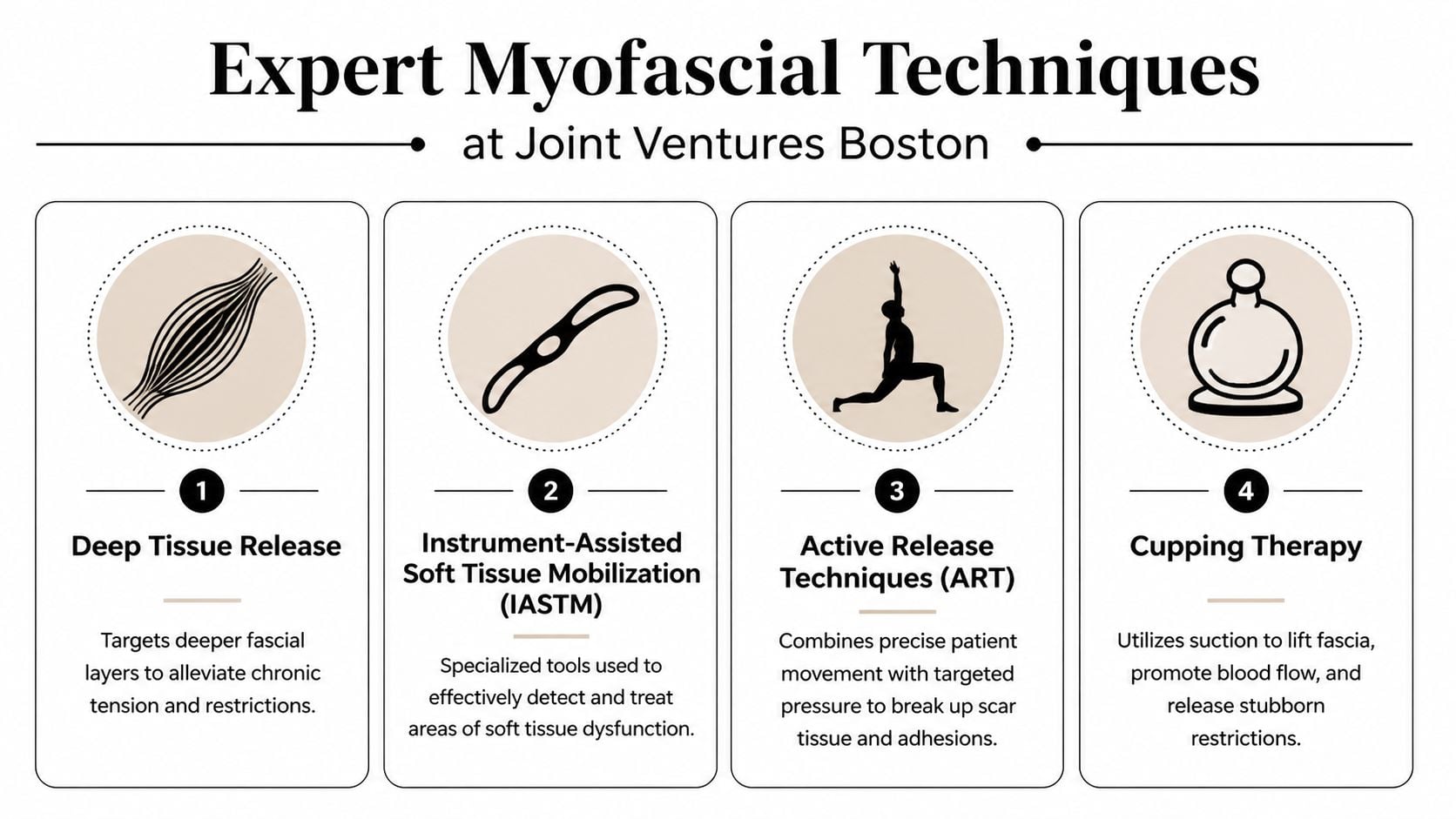
Different restrictions need different inputs
A superficial postural restriction from long computer hours doesn’t feel the same as dense tissue left behind after an ankle sprain or surgery. That’s why technique selection matters.
Here are several patterns clinicians use in practice:
Sustained directional pressure
This is often the foundation. The therapist finds the line of tension and loads the tissue gently but specifically, then waits for it to soften. It’s useful when tissue feels guarded, reactive, or globally stiff.Skin rolling or superficial fascial mobilization
This targets the top layers where the skin and underlying tissue aren’t sliding well together. It can be helpful for people who describe an area as “stiff and bound down” rather than painful.Cross-hand fascial stretch
The therapist contacts tissue on both sides of a restricted region and applies a slow stretch in opposite directions. This can work well over broad areas such as the thoracic spine, lats, hip region, or calf complex.Active release with patient movement
In this approach, the therapist applies pressure while you move the involved area through a controlled range. That combination can help when scarred or irritated tissue interferes with motion during a specific task such as running, lifting, or turning your head.
Expertise is more than technique choice
A key clinical skill is matching the right technique to the right problem. Downtown Boston clinics with Orthopedic Clinical Specialists use structured evaluation frameworks for spinal dysfunction and ACL injuries, which supports evidence-based care tied to tissue-healing timelines and load progressions, as described in this review of Boston physical therapists with advanced orthopedic specialization.
That matters for active adults because myofascial release isn’t meant to be isolated from the rest of rehab. A runner with lateral knee pain may need tissue work, yes, but also loading changes at the hip. A golfer with thoracic stiffness may need manual work, then rotational control. A desk worker with neck pain may need tissue release, then workstation changes and scapular retraining.
Clinical insight: Hands-on work should answer a movement problem. If it doesn’t improve a task you care about, it needs to be adjusted.
Is Myofascial Release Right for Your Condition
The right question isn’t whether myofascial release is “good.” The right question is whether tissue restriction is part of your problem. When it is, this approach can be very effective. When it isn’t, it should play a smaller role.

Common downtown Boston patterns
In physical therapy downtown Boston, myofascial release often fits well for people dealing with:
Desk-related neck and upper back pain
Long static postures can leave the chest, upper shoulders, jaw, and upper thoracic area feeling guarded. Manual release may help restore motion so posture and strength work become easier to tolerate.Running-related tightness
Calves, hip flexors, lateral thigh, and plantar tissues often become overloaded in Boston runners. If the tissue isn’t gliding well, stride mechanics can change and symptoms keep returning.Headaches linked to muscle tension
When headache patterns are driven by neck, jaw, or upper shoulder tension, addressing those restrictions can reduce the mechanical stress feeding the problem.Post-surgical or old injury stiffness
Tissue that healed after injury may still move poorly. In those cases, treatment aims to improve mobility without irritating the area.
Where specialized care matters most
Some of the clearest use cases are the ones many patients struggle to find downtown. Boston search results are crowded with general orthopedic options, but there’s a real accessibility gap for specialized services. Patients looking for pelvic floor therapy, vertigo care, or TMJ treatment often have trouble finding the right provider, as noted in this overview of specialty physical therapy access in Boston.
That gap matters because fascial restrictions can be highly relevant in these conditions:
| Condition | Why myofascial release may help |
|---|---|
| TMJ dysfunction | Jaw pain often overlaps with neck, facial, and upper chest tension patterns |
| Pelvic pain or postpartum dysfunction | Tissue guarding and pressure management issues may be part of the presentation |
| Vestibular and balance-related symptoms | Neck stiffness can contribute to movement avoidance and altered head motion |
| Persistent low back pain | Hip, trunk, and thoracolumbar restrictions may change how load is distributed |
Good candidates usually notice one of these signs
A myofascial approach is worth considering if you recognize yourself in any of these:
- You always feel the same “tight spot.”
- Warm-up helps, but the restriction comes back quickly.
- Massage gives temporary relief, but movement still feels off.
- Pain travels or compensates rather than staying in one clean location.
Self-Release Strategies to Support Your Recovery
Self-release can help between visits. It’s most useful when you use it to support a plan, not replace one.

Boston University’s Physical Therapy Center reports working with about 2,200 new patients and around 25,000 physical therapy sessions per year, and its outcomes tracking showed that for rotator cuff tendonitis, an average of seven visits increased the likelihood of meaningful functional improvement from 70% to 77% in the BU feature on better treatment through big data. That’s a useful reminder that structured care tends to outperform random self-treatment.
Three practical options that work well at home
Upper back release after a long office day
Place a foam roller across the mid-back, support your head, and take slow breaths as you gently extend over the roller. Don’t crank your lower back. The goal is to reduce thoracic stiffness so your neck and shoulders don’t do all the work.
Calf release for runners and walkers
Use a lacrosse ball or roller on the calf, pausing on dense spots without forcing it. Afterward, stand up and test a few heel raises or a short walk. You’re looking for easier motion, not a bruised feeling. If you want extra ideas, this guide on foam rolling for running muscle tightness gives runner-specific examples.
Chest and front-shoulder reset for desk posture
Lie on the floor with a small ball near the front of the shoulder or pec area, then make tiny arm motions. Keep the pressure moderate. If you feel numbness, tingling, or sharp pain, stop and get guidance.
What not to do
People often overdo self-release. They spend too long on the wrong area, push too hard, or chase soreness instead of better movement.
Use just enough pressure to create change. More force isn’t better if it makes you guard.
A better sequence is simple:
- Treat one area briefly
- Retest the movement that felt limited
- Follow with a corrective exercise or strength drill
For more local, clinic-style guidance on mobility and soft tissue work, this article on how to loosen tight muscles is a helpful place to start. If you want deeper anatomy and recovery education beyond this downtown-focused guide, visit Highbar Health at highbarhealth.com.
A short movement demo can also help you see pacing and positioning before you try it yourself.
Your Personalized Plan at Joint Ventures Downtown Boston
The people who do best with myofascial work usually aren’t looking for a quick rubdown. They want a plan that matches their actual life. They need to sit through meetings without neck pain, train without a recurring pull, recover after surgery with confidence, or deal with jaw, pelvic floor, or balance symptoms that haven’t responded to generic care.
That’s where individualized physical therapy downtown Boston makes the difference. The evaluation should identify whether your pain is being driven by fascial restriction, strength deficits, movement compensation, workload, or a mix of all four. Then the treatment should match that finding.
Administrative support matters too. One of the biggest frustrations for patients is poor insurance clarity. Public information is often vague, which makes it hard to predict the process before you call. Joint Ventures addresses that gap with attentive front-desk and billing support that verifies insurance and streamlines authorizations, as described in this overview of the insurance coverage transparency gap in Boston PT.
If you’re dealing with stiffness that keeps returning, pain that shifts from one area to another, or a body part that never feels fully free, it’s worth getting assessed in person. The goal isn’t just to loosen tissue. It’s to restore useful movement that holds up at work, in training, and in daily life.
If you’re ready for a personalized evaluation, book with Joint Ventures Physical Therapy. A one-on-one visit can help clarify what’s driving your pain, whether myofascial release fits your case, and what plan makes sense at our Downtown Boston, Kenmore Square, or Fort Point/Seaport locations.