
You wake up in Back Bay, swing your legs off the bed, and the first few steps tell you more than your calendar does. Your low back feels locked up. Your neck doesn't want to turn. Your heel complains before you've even made coffee. If you're training along the Charles, commuting to a long day at a desk, or trying to fit a lift in before work, that morning pain isn't a small annoyance. It changes how you move through the whole day.
For a lot of active Bostonians, the pattern is familiar. You loosen up after a shower, maybe stretch a little, and tell yourself you'll deal with it later. Then later turns into weeks. The problem isn't just discomfort. It's that your mornings start with a physical negotiation. You think twice about your run, sit differently in meetings, and avoid movements that used to feel automatic.
That Familiar Morning Ache A Boston Story
A common Back Bay scenario looks like this. A runner heads out toward the Esplanade and notices the first half mile feels stiff and awkward. A graduate student near Fenway wakes up with neck pain after another late night at a laptop. A finance professional on Dartmouth Street stands up from bed and feels a sharp pull in the low back that wasn't there the night before. By lunchtime, things feel somewhat better, which makes it easy to dismiss.
That pattern matters.
Pain that is worst in the morning usually means your body isn't tolerating either the way you're recovering or the way you're loading during the day. Rest alone doesn't always solve it. In many cases, waiting just gives irritated tissue and poor movement habits more time to settle in.

Morning pain also creates a quiet mental tax. You start testing your body before every normal task. Can I bend to tie my shoes? Will this loosen up before my commute? Can I finish a workout without making it worse? That's one reason many clinicians are drawn to the physical therapy profession. Done well, the work helps people stop organizing their lives around pain.
Why active people ignore it for too long
In Boston, high-functioning people are good at adapting. They modify the route, skip the speed work, stand instead of sit, switch shoulders when carrying a bag. Adaptation can keep you moving, but it can also hide a problem long enough for it to become more stubborn.
Morning symptoms are often your clearest clue because there are fewer distractions. You're not warmed up. You haven't had coffee. You haven't moved enough to temporarily mask the issue. What you feel in those first minutes is often the truest version of the problem.
Practical rule: If your body needs a long warm-up just to feel normal, don't call that normal.
Why specialized care changes the equation
General advice usually sounds harmless. Stretch more. Rest. Buy a new mattress. Those steps can help, but they're incomplete when the actual issue is movement quality, workload, jaw tension, pelvic floor dysfunction, vestibular sensitivity, or a running mechanic that's driving stress into the wrong area.
That is where local, condition-specific care matters. In physical therapy Back Bay Boston patients often need more than a handout. They need someone to look at the exact pattern, connect it to their routine, and build a plan that fits marathon training, desk work, parenting, lifting, commuting, or all of the above.
The Hidden Causes of Your Morning Pain
Morning pain rarely comes from one single cause. More often, it's the result of several smaller factors piling up. Some of them come from doing too much. Others come from not moving enough. The frustrating part is that both can create the same first-step stiffness.
Your body gets still overnight
When you sleep, you spend hours in one position with very little movement variation. If a joint is already irritated, that stillness can leave it feeling stiff by morning. This is similar to leaving a rubber band in one position for hours. It still works, but it doesn't like being asked to move quickly right away.
This is especially common with low back pain, neck pain, plantar heel pain, and some hip issues. You wake up, load the area immediately, and your body objects.
A few things can contribute:
- Inflammation from the prior day: A hard workout, a long walk in unsupportive shoes, or an intense lifting session can leave tissue irritable overnight.
- Sleep position stress: If you curl into one side, sleep twisted, or jam the neck into rotation for hours, morning symptoms can show up fast.
- Jaw clenching: Many people with TMJ symptoms don't notice what happens at night until they wake up with jaw tension, headaches, or neck pain.
Overuse and underuse can look the same
The Back Bay population often lands in one of two camps. One group is highly active. They run, bike, lift, play tennis, or train for races. The other group spends long stretches at a desk, then tries to squeeze workouts into the edges of the day. Both groups can wake up hurting.
Here’s the basic split:
| Pattern | What it often looks like in the morning |
|---|---|
| Overuse | Soreness or stiffness after a training block, especially in the foot, calf, hip, knee, or low back |
| Underuse | Tightness after sleeping and then sitting all day, often in the neck, shoulders, thoracic spine, and hips |
| Mixed load | Desk-bound during the day, then intense exercise at night, leading to a body that feels both stiff and overloaded |
If that sounds familiar, you're not alone. The issue isn't just activity level. It's whether your tissues have the capacity for the way you're asking them to perform.
Morning pain often means the body isn't recovering well from yesterday or isn't prepared well for today.
Sleep setup matters more than people think
Pillow height, mattress support, and the way your shoulders or hips are positioned can either reduce strain or keep feeding it. Neck pain is a common example. If the pillow doesn't support your head well, your neck can spend the night in a poor position and greet you with stiffness on waking. If you want a consumer-focused breakdown of support features, this guide to the best pillow for neck and shoulder pain is a useful starting point.
That said, people often over-focus on gear and under-focus on mechanics. A better pillow won't fully solve pain driven by running form, ribcage stiffness, weak hip control, screen posture, or nighttime jaw tension.
Stress changes how mornings feel
High-achieving adults often underestimate this piece. Poor sleep, long workdays, travel, and mental stress can all increase muscle guarding and make the body more sensitive. That's one reason someone can wake up feeling far worse during a stressful week even if training volume hasn't changed much.
Common clues include:
- Neck and jaw tightness on waking
- Shallow breathing
- Headaches that improve as the day goes on
- A feeling that the body is bracing before you've done anything
Why waiting can backfire
A lot of people say, "It loosens up, so it's probably fine." Sometimes that's true. Often, it isn't. A body part that needs twenty minutes, a hot shower, and repeated stretching just to feel acceptable is giving you information. It may still be functional, but it's not moving efficiently.
The goal isn't just to feel better after warming up. The goal is to stop needing a rescue routine every morning.
At-Home Strategies to Start Your Day Better
Mornings in Back Bay move fast. If your first steps feel stiff, your neck fights you in the mirror, or your low back needs a hot shower before the commute, the goal is simple. Calm things down enough to start the day, then pay attention to what your body does next.
A good home plan should lower the friction of the morning without turning into a 30-minute rescue ritual. If a few targeted changes help and the improvement holds, that is useful. If you need the same routine every day just to get to baseline, the problem usually needs a closer look.
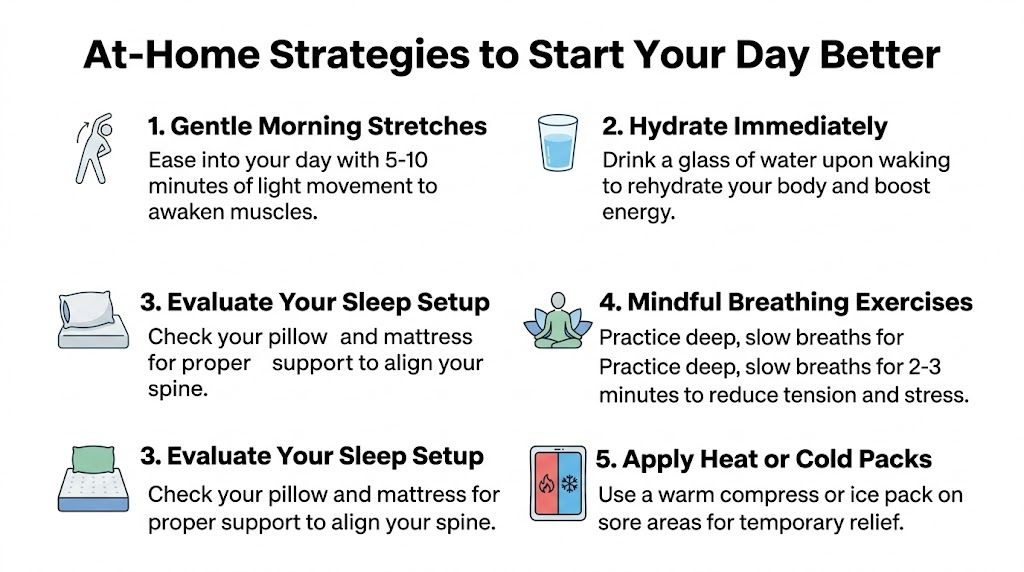
A five minute reset before your day starts
Start slower than your schedule wants you to.
Begin with breathing
Sit at the edge of the bed or stand with both feet planted. Take slow breaths for a minute and make the exhale a little longer than the inhale. That often reduces guarding through the neck, jaw, chest, and low back.Gently move the stiff area
Use small, easy motions. Neck turns, pelvic tilts, ankle pumps, or shoulder rolls work well. Early morning is not the time to force a deep stretch.Add one full-body movement
Try a chair squat, a supported split squat, or reaching both arms overhead while you exhale. One global motion often helps more than isolating the sore spot over and over.Walk before deciding how bad it is
A few minutes of walking gives you better information than judging the day from the first ten seconds out of bed.
Match the strategy to the pattern
The right first move depends on where the stiffness shows up.
- Low back stiffness: start with a short walk and gentle pelvic motion. Aggressive toe-touch stretching first thing often irritates people more than it helps.
- Neck pain on waking: use heat if it feels good, relax the jaw, and work through small rotations. Long end-range holds usually add tension.
- Heel pain with first steps: pump the ankle before standing and load the foot gradually.
- Hips that feel blocked: use a few supported squats or step-backs before sitting at breakfast or heading to the T.
Boston runners and lifters run into a common mistake here. They treat the first painful minutes as something to push through, then assume the body is fine because it loosens up later. That approach can work for a day or two. It is a poor long-term plan if you are training for a race, trying to stay consistent in the gym, or sitting through demanding workdays in a body that is already starting irritated.
Fix the sleep setup without overcomplicating it
People often hunt for a perfect mattress or pillow. Usually, the better question is whether your setup lets you stay in a neutral, supported position long enough to rest.
Use this quick check:
- Head position: your neck should not be tipped sharply up or down
- Shoulder support: side sleepers usually need enough pillow height to keep the head from dropping
- Hip comfort: a pillow between the knees can reduce twisting stress for some people
- Mattress reality check: if you wake up feeling folded, dipped, or rotated, the surface may be part of the problem
At the clinic, we see plenty of active adults spend too much energy on gear and too little on the movement problem underneath it. Sleep setup matters. It rarely explains the whole picture by itself.
Clinical perspective: The best sleep setup is the one that lets you wake up with less guarding and less need for a rescue routine.
Hydrate and recover like it matters
A lot of active adults go to bed under-recovered. Evening training, alcohol, high-salt meals, long workdays, and too much coffee can all show up the next morning as stiffness and low energy. Water first thing will not solve a biomechanical problem, but dehydration and poor recovery make the morning feel worse.
The same goes for sleep quality. If your system is already irritated, a rough night usually turns the volume up.
Warm up for real life in Boston
Warm-ups are not only for workouts. They matter before the activity that usually provokes you.
- Running along the Charles: walk briefly, then build into pace
- Desk-heavy workdays: move before the first long meeting
- Parents with young kids: do not let the first loaded movement of the day be lifting a child from the crib
- Lifters: the walk from your apartment is transportation, not preparation
This is one of the biggest trade-offs I talk through with patients in Back Bay. You can save five minutes in the morning and gamble on pain settling later, or you can spend five minutes preparing and usually move better for the next several hours.
Use symptom response as your guide
Home strategies should produce a clear pattern.
| Response | What it usually means |
|---|---|
| You feel better quickly and stay better | Keep the routine. The issue may be mild and responsive to a small change. |
| You feel better briefly, then symptoms return every day | You are managing the symptoms, but the driver is still there. |
| You feel worse or no different | Stop guessing and get the pattern assessed. |
Do not chase random stretches online
A sore area is not always the true source. Low back pain can be driven by hip stiffness or poor trunk control. Neck pain can be tied to jaw tension or upper back restriction. Heel pain often has as much to do with calf loading and gait as it does with the heel itself.
If your symptoms center around the back, this article on how to relieve chronic lower back pain gives a more targeted starting point than random exercise lists.
Know the financial side early
People also delay care because they assume the process will be complicated or expensive. In the Back Bay market, initial assessments typically range from $120 to $200 according to Health Hives' overview of Boston physical therapy pricing. Many private insurance plans, FSAs, and HSAs can offset costs, so checking benefits early is usually smarter than waiting and hoping the problem fades on its own.
When to Seek Physical Therapy in Back Bay
Self-care has a place. It should not become a holding pattern.
The right time to seek care is usually earlier than people think, especially if the pain is affecting how you train, work, sleep, or move through the city. If your body keeps asking for the same rescue routine every morning, that's a sign your current plan isn't enough.
Signs that home strategies aren't solving it
Pay attention to function, not just pain intensity. If symptoms are changing what you do, that matters.
Seek an evaluation if:
- The pain keeps showing up for more than a week. A brief flare can settle. A repeating pattern deserves a closer look.
- You feel sharp, radiating, or catching pain. Morning stiffness is one thing. Pain that shoots, zings, or grabs is another.
- Your normal routine is getting smaller. You're skipping runs, avoiding lifts, limiting your commute posture, or changing how you carry a bag.
- Your training goal is at risk. If you're building toward a race, tournament, or return to sport, don't wait until you've lost momentum.
- You need daily workarounds just to function. Heat, self-massage, stretching, and ibuprofen shouldn't be the entire plan forever.
Problems that deserve a more specific exam
Some patterns need specialty eyes because the cause isn't obvious from the sore area alone.
For example:
- morning dizziness can point toward a vestibular issue
- jaw pain and headaches may be tied to TMJ dysfunction
- postpartum pain may involve pelvic floor or pressure-management issues
- hand numbness on waking may involve more than the wrist alone
Those aren't situations where generic advice usually works well.
If your symptoms keep returning in the same way, your body is giving you a repeatable pattern. Repeatable patterns are assessable.
What waiting tends to do
Waiting feels conservative, but it isn't always low risk. People often compensate without realizing it. They shorten stride length, brace the neck, clench the jaw, or rotate around a stiff hip. That can shift stress elsewhere and create a second problem on top of the first.
A timely physical therapy evaluation in Back Bay is often less about severity and more about efficiency. It helps you stop trial-and-error management and start working from an actual movement diagnosis.
Specialized Care for Boston's Aches and Pains
You wake up in Back Bay already behind. Your low back feels locked up before the first coffee. Your neck is stiff before the commute. Your heel hurts on the first few steps, but you still have a run planned along the Charles or a long day at a desk that will demand more from the same irritated tissue.
That pattern matters because active Bostonians rarely have the option to slow down for a few weeks. Morning pain gets in the way of training blocks, office focus, and basic momentum. The right PT model should help you identify the driver fast and build a plan you can follow in a busy city schedule.
Why one on one care matters
Morning pain is usually not just about the painful spot. It is often a load-management problem, a mobility restriction, a sleep-position issue, a breathing pattern issue, or a movement control problem that shows up most clearly after hours of stillness.
That is why one-on-one treatment matters. A clinician needs time to watch how you get out of a chair, shift weight, rotate, squat, reach, and absorb load. Those details are easy to miss in a high-volume setting.
At Joint Ventures, patients spend the full session with a licensed physical therapist. That model supports faster decision-making, more precise exercise progressions, and quicker adjustments when symptoms change day to day. If you want a practical overview of how a PT visit is structured, our guide on how to prepare for your first physical therapy appointment lays out what helps patients get more from the first session.
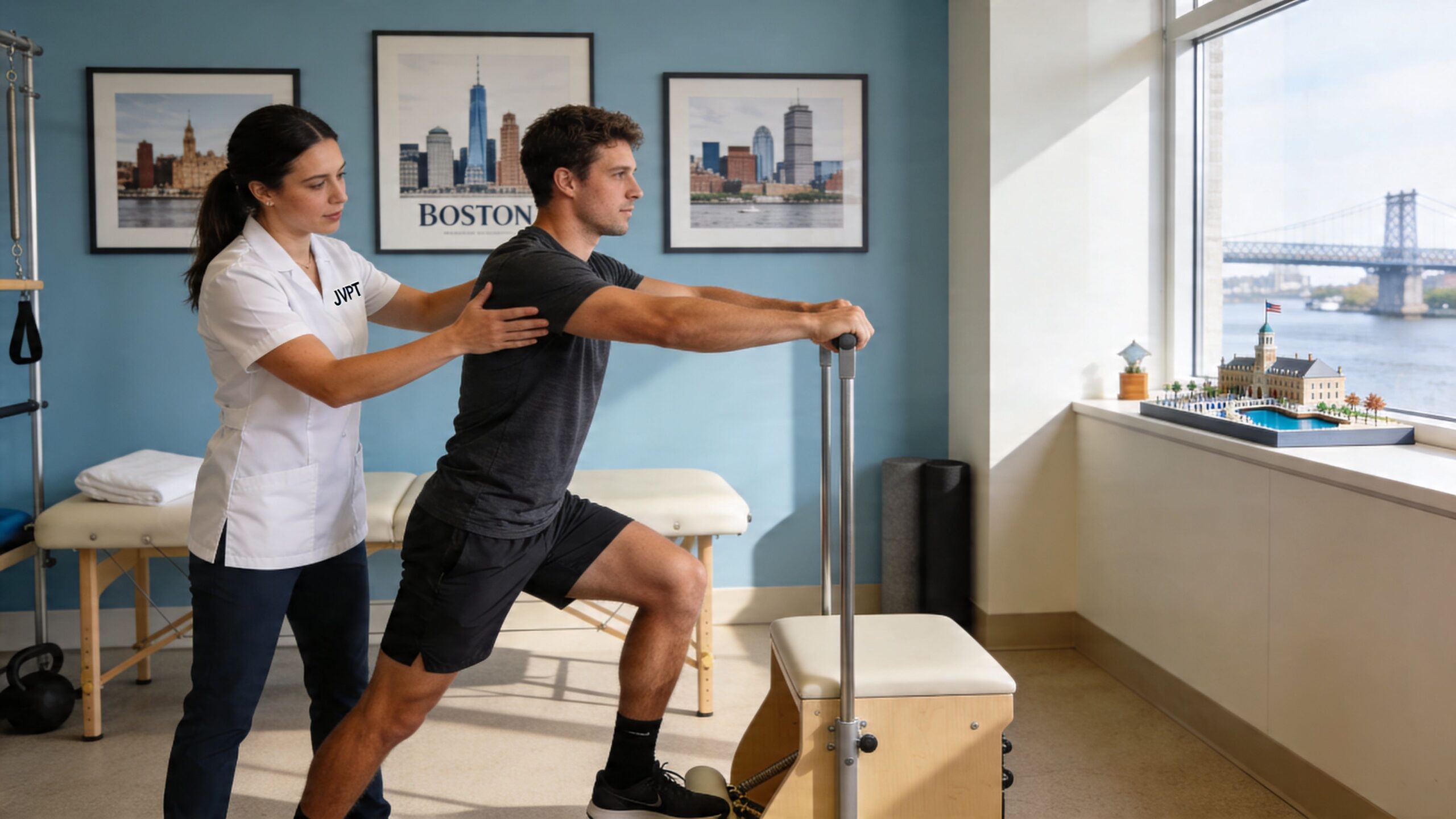
What works for common Back Bay patterns
In practice, the best treatment plan depends on what your mornings look like and what your days demand.
Desk driven neck and back pain
For professionals in Back Bay, morning stiffness often reflects the combination of long work hours, limited position changes, stress, and low tolerance for repeated sitting. The answer is rarely more stretching alone. It usually takes a mix of hands-on treatment, mobility work where you are restricted, and strength work that improves how you hold posture under fatigue.
Useful treatment often includes:
- manual therapy paired with movement retraining
- ergonomic changes that fit your real workstation, not an ideal one
- progressive strength work for the trunk, hips, and upper back
- TMJ-aware treatment if jaw clenching and headaches are part of the same pattern
Runners and active adults
A lot of Boston runners tell me the same thing. The first mile feels rough, then the body settles down. That does not always mean the issue is minor. It often means tissue tolerance is low when cold and still, then symptoms quiet once circulation rises and movement becomes more efficient.
Treatment needs to match the sport. For a runner, that may mean adjusting training load, checking ankle and hip mobility, building calf and glute strength, reviewing footwear, and deciding whether you can keep running while rehabbing or need a short modification block.
What helps is specificity:
- running gait and workload review
- strength work that improves stride mechanics
- loading progressions matched to irritability
- dry needling when it fits the diagnosis and the patient wants it
- a return-to-training plan tied to a real race or fitness goal
Dizziness, jaw pain, pelvic floor symptoms
These cases need targeted care from someone who treats them regularly. Morning dizziness when rolling in bed, jaw soreness on waking, postpartum pelvic pressure, or headaches that start before the workday can all look simple on the surface and still need a more specific exam.
At Joint Ventures, that often means pairing the patient with a clinician who focuses on vestibular rehab, TMJ, pelvic floor, hand therapy, or sports rehab rather than trying to fit every problem into the same template. Patients generally do better when the plan matches the actual diagnosis and the demands of their day.
What patients should ask before booking anywhere
Back Bay has several PT options, and the differences are not always obvious from a website. Ask direct questions before you book.
- Will I be with the same clinician for the full session?
- Do you regularly treat my specific issue, such as TMJ, vestibular symptoms, pelvic floor problems, hand pain, or running injuries?
- How do you adjust care when symptoms are worst in the morning but ease later in the day?
- What does progression look like if I want to keep working, commuting, or training while in rehab?
- How will insurance, scheduling, and follow-up work?
Good physical therapy in Back Bay Boston should fit the way you live. It should account for your commute, your training calendar, your work demands, and the fact that waiting out morning pain usually costs active people more time than a focused plan does.
Your First Visit What to Expect at Our Back Bay Clinic
It is 7:15 a.m. in Back Bay. Your back is tight getting out of bed, your first few steps feel off, and you are already doing the math on your day. Can you get through the commute, sit through meetings, and still make your run later, or is this another morning where pain sets the schedule?
That is the mindset many patients bring into a first visit. They want someone to listen carefully, make sense of the pattern, and give them a plan they can use right away.

What happens before you walk in
A strong first visit starts before the evaluation. Front-desk support should confirm benefits, answer scheduling questions, and clear up insurance details so care does not get delayed by avoidable paperwork problems.
Back Bay has a long outpatient rehab history. Physical therapy has roots in the local healthcare environment going back over 40 years through predecessor clinics, as described on Back Bay PT's history page. That history matters because rehab is not new to this neighborhood. It is an established part of how active Boston residents stay working, training, and moving.
What happens in the evaluation
At Joint Ventures, the first session is one-on-one and problem-focused. The evaluation starts with your history, but the useful part is the detail. Morning pain behaves differently than pain that shows up halfway through a run or after a long workday, so the timing matters. We want to know what the first ten minutes out of bed feel like, what loosens things up, what makes symptoms return, and what your day demands from you.
Then we test movement. That may include walking, getting up from a chair, balance, squatting, breathing, neck rotation, jaw motion, or strength and control at the joints that are likely driving the problem. For runners and lifters, that can include task-specific testing. For professionals spending long hours at a desk, it often includes the positions and habits that load the same irritated tissues every morning.
A useful evaluation does more than locate pain. It identifies why pain is worse in the morning and what has to change so your body is not starting each day behind.
What you leave with
You should leave with three things. A working diagnosis, a clear first-step plan, and a realistic sense of what improvement should look like.
That plan is usually simple at first. A few targeted exercises. Specific adjustments to sleep position, early-morning movement, training, or workstation setup. Clear guidance on what to keep doing, what to modify for now, and what would mean you need a closer look. Good PT is not passive, but it should fit real life in Boston, including commutes, work deadlines, and training goals.
If you want to know how to show up ready, this guide on how to prepare for your first physical therapy appointment covers the basics.
Boston Physical Therapy FAQs
Do I need a referral for physical therapy in Boston
Many patients in Massachusetts can start physical therapy without waiting for a referral. Insurance rules still vary by plan, so confirm your benefits before the first visit.
How long are appointments
Visit length depends on the clinic, the evaluation, and what needs to be addressed that day. If you want a realistic breakdown of evaluation and follow-up timing, read how long physical therapy appointments usually are.
What should I wear to a Back Bay PT visit
Wear clothes that let the clinician assess the involved area without a work wardrobe getting in the way. For low back, hip, or knee problems, shorts or flexible athletic pants usually make the visit easier. For shoulder, neck, or TMJ concerns, a T-shirt or tank top works better than a button-down or sweater.
Is physical therapy Back Bay Boston only for sports injuries
Back Bay clinics see plenty of runners, lifters, and marathon trainees, but that is only part of the caseload. We also treat active professionals with desk-related pain, postpartum patients, older adults who want to stay independent, and people dealing with dizziness, jaw pain, hand symptoms, or balance problems.
That matters in Boston. Morning pain does not just affect exercise. It can make the walk to the T feel longer, turn a commute into a grind, and leave you stiff before your first meeting starts.
What if my issue seems complicated
Complicated problems usually need a narrower clinical lens, not more waiting. If symptoms involve TMJ, pelvic floor issues, dizziness, recurrent flare-ups, or pain that has not improved with general exercise, ask whether your physical therapist works with that condition regularly.
At Joint Ventures, that often means one-on-one care with a clinician who understands the demands of your actual week, whether that is Charles River running mileage, long office hours, strength training, or all three.
Is PT in Back Bay only for people who live nearby
People come to Back Bay from nearby neighborhoods and other parts of Greater Boston because it fits real schedules. Close access to work, transit, and training routes makes it easier to show up consistently, and consistency usually matters more than finding a clinic five minutes closer to home.
If your mornings keep starting with stiffness, pain, or the sense that your body needs too much work just to get going, get the problem assessed directly. Joint Ventures Physical Therapy offers 1-on-1 physical and occupational therapy across Greater Boston for runners, active professionals, postpartum patients, and people dealing with orthopedic pain, TMJ, vestibular issues, pelvic floor symptoms, and more. Book an evaluation and get a plan built around how you live, move, and train in Boston.