Let's be direct. When people talk about manual physical therapy, they're talking about a hands-on approach. It’s a specialized field where a therapist uses their hands—their touch—to diagnose and treat the root cause of your pain and movement issues.
It's about getting you back to the life you want to live, without restrictions.
Your Body Isn't a Textbook Diagram
When you're in pain, you don't want a generic solution pulled from a book. You want a fix that understands your specific problem.
Think of it this way: if a single gear in a high-performance engine is stuck, you don’t need a total system overhaul. You need an expert mechanic who can get in there, feel the issue, and address that one specific part. That's our philosophy. We provide focused, one-on-one care that digs deeper than just the symptoms.
We use precise, hands-on techniques to figure out what's really going on—a stiff joint, a tight muscle, a restricted nerve—and treat it directly. This isn't a one-size-fits-all protocol. It’s a targeted plan built around your body's actual needs.
Manual therapy isn’t just about temporary relief. It’s about restoring how your body is supposed to move. That way, you can build strength correctly and keep the problem from coming back.
The Foundation of Hands-On Care
Using our hands to heal is an idea that has been around for a very, very long time. Its origins trace back more than 2,000 years to 435 BC, when Hippocrates used massage and hands-on methods to help his patients recover.
The practice we’d recognize today as modern physical therapy really started taking shape in Europe in the late 1800s. It proved its value during World War I, when “Reconstruction Aides” used massage and exercise to rehabilitate wounded soldiers, which ultimately led to the creation of what is now the American Physical Therapy Association.
This long history has given us a deep, evidence-based practice. A physical therapist's ability to be effective with manual therapy starts with a strong foundation in diagnosis. For those curious about the diagnostic side of things, a dedicated clinical assessment course shows just how deep that evaluation process goes.
A Focus on You
At the end of the day, manual therapy is a cornerstone of effective orthopedic physical therapy. It’s what lets us move past simply managing your pain and start actually correcting the underlying mechanical problems.
By pairing skilled hands-on work with the right exercises and education, we give you a plan that doesn't just feel good for a day—it delivers lasting results.
The Hands-On Techniques We Use
When we say “manual physical therapy,” we’re talking about the skilled, hands-on work that forms the core of our treatment philosophy. It’s a common question: what exactly do our therapists do during a session?
It’s not a one-size-fits-all routine. We use our hands as both an assessment tool and a treatment instrument. We’re feeling for the exact location of a restriction, the texture of a tight muscle, or the subtle catch in a joint’s movement. Then, we apply a specific technique to address it. This is where expertise and experience really matter.
Mobilizing Stiff and Restricted Joints
One of the most frequent problems we treat is a joint that simply won’t move the way it should. Think of a door with a rusty hinge—it gets stuck, it groans, and it certainly doesn’t swing freely. That’s what a restricted joint feels like, and joint mobilization is how we fix it.
This is a highly skilled technique where your physical therapist applies slow, targeted movements to a specific joint. The goal is to restore the joint’s natural “play”—the small, almost unnoticeable accessory motions that are absolutely critical for a full, pain-free range of motion.
Imagine wiggling a key that’s stuck in a lock. You don’t just jam it in harder. You use subtle, patient movements back and forth until it finds the right position and turns smoothly. That’s the core idea behind joint mobilization—gently coaxing a joint back to its normal, fluid mechanics.
This approach works wonders for a “frozen” shoulder, a stiff neck that resists turning, or the nagging stiffness that follows surgery. By restoring that essential glide and slide, we can dramatically reduce your pain and get you moving again.
Our entire approach is a cycle of diagnosing with precision, treating with skilled hands, and personalizing every single step.
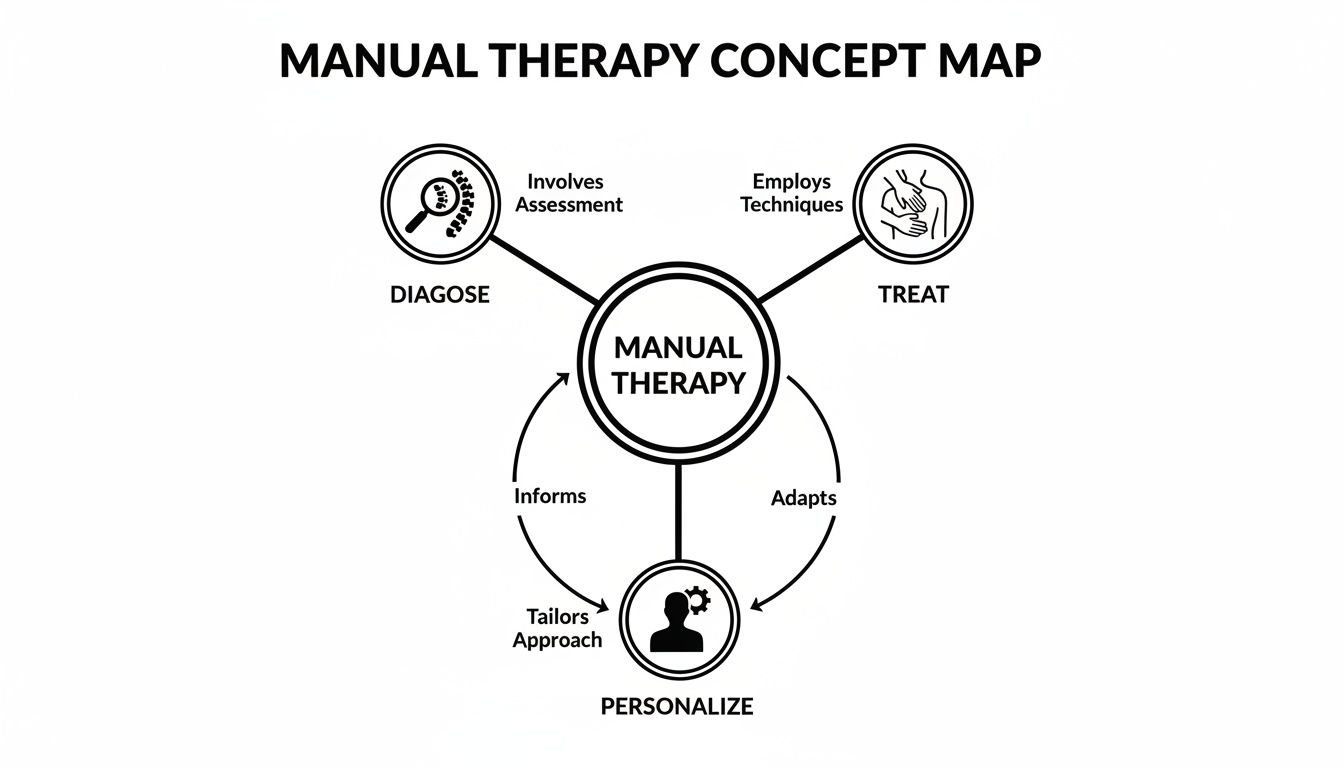
This process ensures your treatment isn’t static. It evolves right alongside your progress, adapting to what your body needs at each stage of recovery.
A Quick Guide To Common Manual Therapy Techniques
To give you a better sense of what these techniques involve, here’s a quick breakdown of what they are and what you can expect to feel during treatment.
Common Manual Therapy Techniques Explained
| Technique | What It Is | What It Feels Like |
|---|---|---|
| Joint Mobilization | Slow, rhythmic movements applied to a stiff joint to restore its natural glide and slide. | A gentle, specific pressure or oscillation at a joint. It should not be painful. |
| Soft Tissue Mobilization | A broad term for hands-on techniques (like kneading and stretching) on muscles, ligaments, and fascia. | Varies from a broad, relaxing pressure to a more specific, deeper kneading sensation. |
| Myofascial Release | Sustained, gentle pressure applied to the body's connective tissue (fascia) to release restrictions. | A slow, stretching sensation. You may feel a release of tension in areas you didn't realize were tight. |
| Trigger Point Therapy | Direct, sustained pressure applied to a specific “knot” or hyperirritable spot in a muscle. | A focused, intense pressure that may briefly reproduce your familiar pain, followed by a release of the knot. |
| Muscle Energy Technique (MET) | An active technique where you gently contract a muscle against the therapist’s resistance to reset its length. | You’ll feel a gentle contraction in your muscle, followed by a therapist-assisted stretch. It’s very controlled. |
These are just some of the primary tools we use. The art of physical therapy lies in knowing exactly which technique to apply, and when, for your specific condition.
Releasing Tight Muscles and Fascia
Joints don’t exist in a vacuum. The muscles and connective tissues surrounding them are often the true source of pain and dysfunction. This is where soft tissue mobilization comes in, and it's far more precise than a general massage.
Think of it like a baker working with dough. They don’t just press on it randomly. They use very specific kneading, stretching, and pressure to make it more pliable and resilient. We do the same for your muscles and the web of connective tissue, called fascia, that envelops them.
Two key techniques we use here are:
- Myofascial Release: This involves applying slow, sustained pressure to release fascial restrictions. When this connective tissue gets tight, it can pull and create tension patterns throughout the body. Releasing it helps restore mobility and ease that widespread tightness.
- Trigger Point Therapy: You know those tight, exquisitely tender knots in your muscles that can shoot pain to other areas? We call those trigger points. We apply firm, direct pressure to these spots to release the knot, improve blood flow, and essentially turn off that referral pain signal.
These techniques are incredibly effective for everything from chronic tension headaches to the low back pain caused by tight hip muscles. It’s all about getting into the tissue to break up adhesions and bring it back to a healthy, flexible state.
Using Your Own Strength to Heal
One of the most elegant tools we have is the Muscle Energy Technique, or MET. What makes it special is that it’s an active approach where you become a partner in your own treatment. We’re essentially using your body’s own neuromuscular system to create a change.
Here’s a typical example: your therapist will guide a joint to the edge of its restricted range and then ask you to gently contract a specific muscle against their hand for a few seconds. When you relax, that muscle lets go, and the therapist can guide the joint into a new, greater range of motion.
This sequence of controlled contraction and relaxation helps to “reset” the muscle’s resting tension, allowing it to lengthen. It’s a go-to technique for correcting alignment issues in the pelvis and spine or for restoring motion without any aggressive stretching. It truly shows how we work with your body, not just on it, to get the best results.
Who Can Benefit from Manual Therapy

"Is this right for me?" It’s a question we hear all the time. Many people think manual physical therapy is reserved for elite athletes or people recovering from major surgery.
While we absolutely help those patients, the truth is that a huge range of people can find life-changing relief with this hands-on approach. If you feel limited by your body and want to move freely again, chances are we can help.
More Than Just Post-Op Care
Let's get one thing straight: manual therapy isn't just for when you're coming out of the operating room. It's a powerful tool for all sorts of aches, stiffness, and dysfunctions that get in the way of your daily life.
Have you ever caught yourself thinking, "This is just part of getting older" or "I guess this is my new normal"? We're here to tell you it doesn't have to be.
Here are a few real-world examples of the people we help every single day:
- The Weekend Warrior: You love running, cycling, or staying active, but a nagging knee or hip pain keeps sidelining you. You’ve tried rest and ice, but it always seems to come back. We can get to the root of that mechanical problem.
- The Desk Worker: You spend your days at a computer, and that constant neck ache and upper back stiffness have become your unwelcome companions. Maybe you're even getting frequent headaches. Manual techniques can release that chronic tension.
- The New Mom: Pregnancy and childbirth are incredible, but they put your body through tremendous change. We help new mothers navigate pelvic floor recovery, address back pain from lifting a growing baby, and safely return to exercise.
In each of these cases, the problem isn't a lack of trying—it's a specific physical restriction that needs a targeted, hands-on solution.
We don’t believe you should have to build your life around your pain. Our goal is to fix the underlying problem so you can get back to living your life on your own terms.
Specialized Care for Complex Conditions
The power of manual therapy extends even further, into conditions that might surprise you. Because this approach directly addresses the mechanical relationship between your joints, muscles, and nerves, it’s remarkably effective for a variety of complex issues.
Many people don't realize how broad the applications are. The scope has grown significantly as more research validates its effectiveness. This isn't a new fad; the practice has deep roots, evolving from hands-on healing in ancient civilizations. Today, a strong body of evidence supports its use for more conditions than ever before. You can even learn more about by reviewing its historical development.
This means we can confidently help people with:
- TMJ and Jaw Pain: If you struggle with clicking, locking, or pain in your jaw, specialized manual techniques inside and outside the mouth can provide significant relief.
- Vestibular Issues: Dizziness, vertigo, and balance problems often stem from a mechanical issue in the inner ear or neck that can be addressed with specific hands-on maneuvers.
- Chronic Pain and Headaches: For those who have been struggling for years, manual therapy can help calm the nervous system and release long-held tension patterns, breaking the cycle of chronic pain and cervicogenic (neck-related) headaches.
Ultimately, if your problem involves pain with movement, stiffness that limits you, or a feeling that your body just isn't working right, there is a very good chance that manual physical therapy can help.
The Science Behind Manual Therapy
We get it. When you’re in pain, you want to know that the treatment you’re receiving isn't just a shot in the dark. It’s one thing for us to tell you manual therapy works—we see it transform our patients' lives every single day. It’s another for you to feel completely confident that your care is built on a rock-solid foundation of scientific evidence.
This isn’t some new trend. The hands-on techniques we use have real, measurable effects on your body. Think of it this way: for years, clinicians knew these methods worked simply because our patients got better. Now, modern science can actually show us why.
When one of our therapists applies a specific, skilled force to a stiff joint or a tight muscle, it does far more than just feel good. It sends powerful signals through your nervous system, changes how your brain interprets pain, and even helps dial down local inflammation. That's the real magic behind manual therapy.
The Growing Body of Evidence
For a long time, the proof was mostly anecdotal—stories of success passed from one patient to another. Today, high-quality research is finally catching up to what we’ve known in the clinic for decades. The field has seen an explosion of scientific validation.
For instance, one major review of the research showed that the number of studies on manual physical therapy has skyrocketed. The volume of articles published in the respected PEDro database jumped by 2.4 times in the last decade alone. More importantly, the amount of strong evidence validating these techniques grew by over ninefold, and now covers dozens of different conditions.
This surge in research confirms that when a skilled therapist applies the right technique to the right problem, the results are not just powerful—they’re predictable.
How It Works From the Inside Out
So, what’s actually happening on a biological level? It all comes down to a few key mechanisms. A deep understanding of the body's mechanics and fundamental muscle groups is essential for our therapists to apply these techniques effectively.
Manual therapy helps to:
- Re-calibrate the Nervous System: Specific hands-on techniques can help "quiet down" an overactive nervous system, which is often a key driver of chronic pain. By giving your brain new, positive sensory information, we can break that frustrating pain-spasm-pain cycle.
- Improve Tissue Health and Healing: Techniques like soft tissue mobilization boost local blood flow. This brings more oxygen and nutrients to injured areas and helps flush out inflammatory byproducts that are holding back your recovery.
- Restore Normal Mechanics: This is the big one. By restoring proper joint and muscle movement, we make it possible for you to perform daily activities and corrective exercises correctly. After all, it's pretty hard to strengthen a muscle if the joint it's supposed to move is stuck.
This mechanical restoration is a cornerstone of our treatment, just like a proper assessment of your movement is crucial for activities like running. You can see how this plays out in our guide on what a gait analysis can reveal.
Your treatment plan here isn't based on a hunch. It's built on a foundation of scientific principles and a deep commitment to proven, effective, one-on-one care.
What To Expect at Your First Session
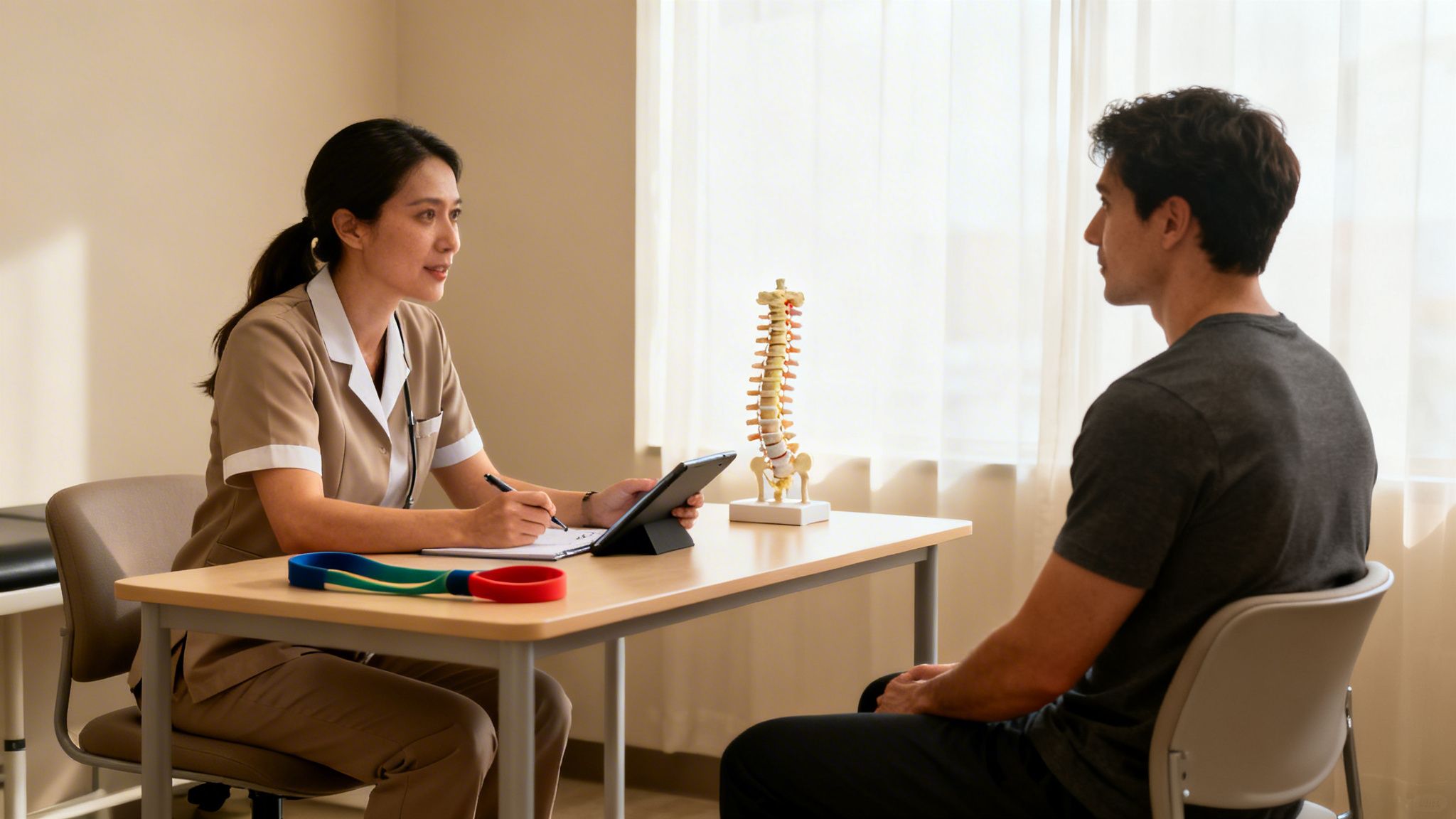
Walking into any new appointment can be a little unnerving, especially when you’re dealing with pain. We get it. So, let’s pull back the curtain on what your first visit with us actually looks like. Our goal is for you to feel comfortable and confident from the moment you walk in.
The most important thing to know is that your session is your time. It’s a dedicated, one-on-one appointment with your physical therapist, and it always starts with a real conversation.
We Listen to Your Story
Before we even think about touching the painful area, we sit down with you and just listen. This isn’t about quickly checking boxes on a form. We want to hear the story in your own words.
What do you want to get back to doing? What have you had to give up? How is this problem really affecting your life—from your work and hobbies to just getting a good night's sleep?
Honestly, this conversation is the most critical part of your entire visit. It gives us the context we need to understand not just what hurts, but why it matters to you. Your goals become our roadmap.
We believe the best treatment plan starts with listening. Your unique story is the foundation of the personalized, effective care you deserve.
After we’ve heard your story, we move into the hands-on part of the evaluation. This is where the "manual" in manual physical therapy comes to life, and where our clinical expertise really shines.
The Hands-On Assessment
Once we understand your goals, your therapist will guide you through a thorough physical assessment. Think of it as a hands-on investigation to uncover the root cause of your pain. This usually involves a few key things:
- Movement Analysis: We’ll watch you move. This could be walking, bending, or performing a specific action that brings on your symptoms. It helps us see the big picture of how your body moves as a system.
- Targeted Palpation: Your therapist will use their skilled touch to assess muscle tightness, joint stiffness, and sensitive areas. We aren’t just poking for tender spots; we’re feeling for the quality of the tissue and the mobility of the joints.
- Specific Tests: We’ll perform a few focused orthopedic tests to help pinpoint exactly which structure is the source of the problem, ruling other things in or out along the way.
This isn’t a passive experience where we just do things to you. We'll explain what we're doing and what we're finding every step of the way. We want you to understand your body as well as we do. For more tips on making your visit a success, check out our guide on how to prepare for your first physical therapy appointment.
Starting Treatment and Getting You Involved
Here’s the great thing about our one-on-one model: your treatment starts on day one. Based on what we find, your therapist will almost always perform your first hands-on manual technique during this initial visit. It might be a gentle joint mobilization to ease stiffness or some soft tissue work to release a tight muscle.
You’ll get to feel the difference that skilled, targeted care can make right away. And we'll be checking in with you constantly to make sure you’re comfortable.
Finally, we want you to feel empowered from the moment you leave. We’ll teach you one or two simple, high-impact corrective exercises to do at home. These are designed to lock in the progress we made in the clinic and give you an active role in your own recovery. You’ll walk out not just with some relief, but with a clear understanding of your issue and a solid plan to move forward.
Why Our One-On-One Approach Matters
When you’re in pain, you deserve a physical therapist’s full, undivided attention. That might sound obvious, but it’s not common practice everywhere. In many clinics, you’ll see therapists juggling multiple patients at once or handing you off to an aide.
Here, we do things differently. It's the foundation of our entire approach.
Every single appointment is a dedicated, one-on-one session with your physical therapist. You will never be double-booked. You will never be passed off to someone else to "finish up" your exercises.
This isn’t just about good service; it’s a clinical imperative, especially for the hands-on work of manual physical therapy. These techniques demand intense focus, constant feedback from your body, and the ability for your therapist to make tiny adjustments on the fly. That simply can’t happen when their attention is split.
Deeper Connection, Better Results
Our one-on-one model gives your therapist the time to truly listen and connect the dots. They're not just treating a sore shoulder or a stiff back; they're treating you—a whole person with a unique history and specific goals.
This focused time allows us to dig deeper. We can ask better questions and pick up on the small but crucial details that often get missed in a busy, overcrowded gym.
That connection builds trust, which is the secret ingredient to a successful recovery. When you feel heard and understood, you become a more active partner in your own care. We work together to not only fix the immediate problem but to build a long-term plan to keep it from coming back.
We’re not just another clinic; we’re your partner in recovery. Our commitment to focused, hands-on care is the most effective and efficient way to help you get back to the life you love.
This approach also makes your treatment incredibly adaptable. If a specific manual technique is providing a breakthrough, we can zero in on it. If a movement causes an unexpected twinge, we stop right away to figure out why. This real-time flexibility is key to getting you faster, more sustainable results.
Specialists Who Truly Understand You
Our team is made up of clinicians who are true experts and genuinely passionate about what they do. Their deep knowledge covers everything from orthopedics and sports injuries to pelvic health and vestibular disorders.
We don’t just assign you to the next available therapist. We pair you with a specialist who truly understands the nuances of your specific condition.
That specialized expertise, combined with our unwavering commitment to one-on-one care, is what sets us apart. We’re confident it’s the absolute best way to help you move better, feel better, and get back to doing what matters most to you.
Frequently Asked Questions
It’s natural to have questions before starting something new. We’ve put together some straightforward answers to the most common things people ask about manual physical therapy. Our goal is for you to feel completely confident and clear about the process.
Is Manual Physical Therapy Painful?
The honest answer is no. The entire point of our work is to reduce your pain, not add to it. That said, some of the techniques we use to work on tight, restricted tissue can create a temporary pressure or ache. Many of our patients call it a “good hurt.”
We’ll be talking with you the entire time. You are always in charge, and we’ll constantly adjust to work within your comfort level while still getting the results you need.
It’s normal to feel some mild soreness afterward, much like you’d feel after a good workout. That’s actually a positive sign that we’ve created change in the tissue, and it almost always fades within 24 hours.
How Is This Different From Massage or Chiropractic Care?
That’s a great question. While all three use hands-on techniques, the fundamental goal is different. As physical therapists, our hands-on work is just one part of a complete diagnostic and treatment process.
- Massage is generally focused on broad muscle relaxation and stress relief.
- Chiropractic care often centers on spinal adjustments to influence nervous system function.
- Manual Physical Therapy is used to diagnose the specific root cause of a movement problem. We then apply targeted techniques to fix it, reinforcing that work with exercises and education to restore function and keep the problem from coming back.
It’s one tool in a comprehensive plan designed for lasting results, not just temporary relief.
The real difference is in the diagnostic process. We use manual therapy to fix the specific mechanical fault we identified during your evaluation, and then teach you how to keep it from returning.
How Many Sessions Will I Need?
There’s no cookie-cutter answer here, because every treatment plan we build is 100% personalized to you, your body, and what you want to achieve.
After your one-on-one evaluation, your therapist will discuss a clear plan and an expected timeline with you. Some straightforward, acute issues can resolve in just a handful of visits. More chronic or complex problems will naturally take a bit more time.
Our goal is always the same: get you feeling better and empower you with the tools to manage your condition on your own as quickly and effectively as possible.
Do I Need a Doctor's Referral To Start?
Nope. Massachusetts is a Direct Access state, which means you have the right to see a physical therapist without a physician's referral. This is great news for you—it lets you get started on your recovery right away, without delay.
While most insurance plans cover physical therapy under Direct Access, a few might have their own rules. Our administrative team members are absolute pros at this. Just give us a call, and they’ll happily verify your benefits and handle the insurance side of things for you. We make the whole process seamless so you can focus on feeling better.
Ready to see how our one-on-one, hands-on approach can help you? At Joint Ventures Physical Therapy, we're committed to being your partner in recovery. Schedule your appointment today and let’s get you moving forward.