
That sudden, seizing pain in your lower back can be terrifying, especially during pregnancy. But when you feel those sharp muscle spasms in your back during pregnancy, take a breath and know this: you are far from alone. We see this all the time. These involuntary muscle contractions are incredibly common and often a direct response to the amazing changes your body is navigating.
It might feel random and alarming, but there’s a clear reason for those spasms. Think of it as your body sending a loud, clear signal that it’s working hard and needs a bit more support.
Your body is built to adapt, but the rapid physical shifts of pregnancy put your muscles, joints, and ligaments to the ultimate test. This brings us to the real reasons behind those painful back spasms.
The Main Culprits Behind the Pain
It’s rarely just one thing. Instead, a few key factors combine to create the perfect storm for back spasms to occur.
- Hormonal Shifts: Your body starts producing a hormone called relaxin. Its main job is to loosen the ligaments around your pelvis to prepare for childbirth. While crucial, this new laxity can decrease joint stability, forcing your back muscles to work much harder to keep you upright and stable.
- A New Center of Gravity: As your baby grows, your center of gravity naturally pulls forward. To compensate and keep you from tipping over, the muscles in your lower back have to pull back, increasing the curve in your spine and placing them under constant tension.
- Added Weight: The healthy, necessary weight you gain during pregnancy adds a significant new load for your spine and muscles to carry. This can lead to fatigue, strain, and a much higher chance of muscle spasms.
As your body changes, even something as simple as how you sit can make a world of difference. Understanding how pregnant: the way you sit matters can be a huge step toward finding relief.
Think of your body as a sailboat. As more weight (your baby) is added to the front, the mast (your spine) and its rigging (your muscles) have to pull much harder to keep everything balanced. A spasm is like one of those ropes fraying under too much tension.
This chart breaks down the progression from hormonal shifts and a new center of gravity to the muscle spasm itself.
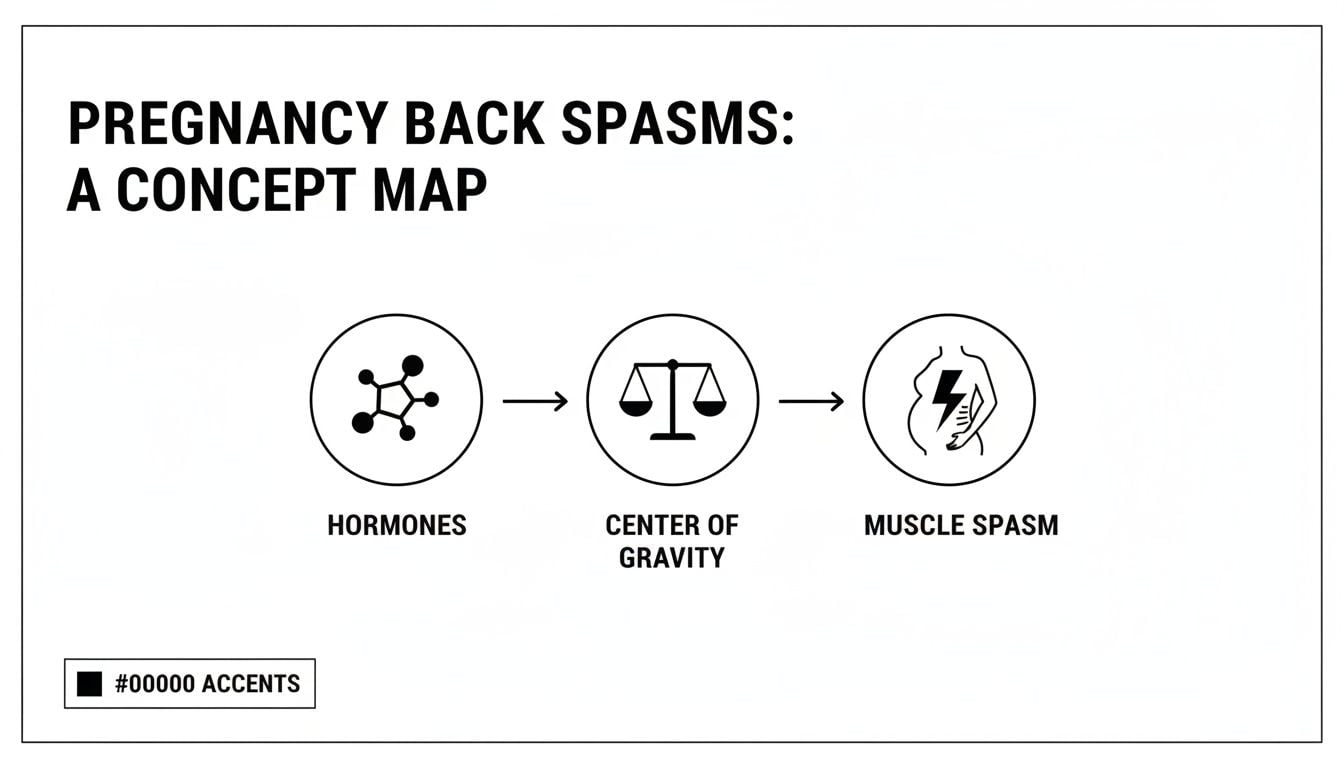
To get a clearer picture of what's going on and when, this quick guide summarizes the key drivers.
Quick Guide to Pregnancy Back Spasms
| Cause | What's Happening | When It Typically Starts |
|---|---|---|
| Hormones | The hormone relaxin loosens ligaments, forcing back muscles to overcompensate for joint instability. | Can begin in the first trimester but its effects increase throughout pregnancy. |
| Center of Gravity | Your growing uterus pulls your center of gravity forward, increasing the arch and strain in your lower back. | Becomes most noticeable during the second and third trimesters. |
| Weight Gain | The added weight of the baby, placenta, and fluids puts a direct load on your spine and back muscles. | A progressive factor that intensifies in the second and third trimesters. |
These factors work together, creating a domino effect that often leads to muscle overload and those sharp, unwelcome spasms.
And the research backs this up. Back pain is a reality for an average of 55% of women during pregnancy. For a lot of them, that pain shows up as spasms.
Studies show that among pregnant women with lumbar pain, 21.7% report spasms. That number climbs to 33.6% for those dealing with pelvic girdle pain, which can seriously disrupt daily life and sleep.
That sudden, clenching pain of a back spasm isn’t just a random annoyance—it's a signal. Think of it as your body's fire alarm. It's loud, impossible to ignore, and it’s telling you one thing loud and clear: a specific area is overloaded and needs a break, now.
Learning to understand what these signals mean is the first step toward getting real relief. It’s all about becoming a bit of a detective for your own body and figuring out what’s a spasm versus other kinds of back pain.

Decoding the Different Types of Back Pain
Not all back pain is the same, and knowing what you're feeling helps us figure out the best way to help. Here’s how to tell the difference:
- Muscle Spasm: This is a sudden, sharp, and involuntary muscle contraction. The muscle tightens into a hard knot you can often feel, causing an intense, localized pain that can literally stop you in your tracks.
- General Back Ache: This is usually a dull, persistent ache that spreads across your lower back. It feels more like soreness or fatigue, not that acute, seizing pain of a spasm.
- Sciatica: This is nerve pain, which is a completely different ballgame. It often feels like a sharp, shooting, or burning pain that travels from your low back, down your buttock, and into your leg—sometimes all the way to your foot.
When we can pinpoint that you’re dealing with a true muscle spasm in your back during pregnancy, it lets us focus on the exact muscles that are crying out for help. It points directly to muscular overload and fatigue.
Why Spasms Get Worse in the Third Trimester
If you’ve noticed your back has been acting up more as you get closer to your due date, you aren't imagining things. The third trimester is when the physical demands on your body really hit their peak. Your baby is growing fast, adding more weight out front and pulling your center of gravity even further forward.
Your back muscles have been working overtime for months, and now they’re being pushed to their absolute limit. This constant strain makes them incredibly irritable and prone to spasming with even a small "wrong move," like bending over to pick something up or just getting out of bed.
The third trimester often brings a surge in back pain, with a global prevalence reaching 47.8%. Spasms are a defining feature in 33.6% of pelvic girdle pain cases and can interfere with sleep and daily activities for 30-44% of women, making these final months particularly challenging. You can dive deeper into the research on how pregnancy affects back health here.
This isn't just about being uncomfortable. Ignoring these signals can have a real impact on your quality of life.
The True Cost of Ignoring the Signals
When your back is constantly spasming, it trickles into every part of your day. It can make it almost impossible to get comfortable enough to sleep, turning what should be a restorative time into a source of frustration.
That lack of sleep, combined with persistent pain, can understandably take a toll on your mood and make it harder to enjoy this special time. It can also limit your ability to stay active, get the nursery ready, or even just take a walk around the block.
Thinking of a spasm as a message is empowering. It helps you shift your mindset from "Why is this happening to me?" to "What is my body asking for?" This is where we come in—to help you answer that question and give your body the support it desperately needs.
Safe and Effective At-Home Relief Strategies
When a sudden back spasm hits, that sharp, seizing pain can be downright scary. Your first thought is probably, "How do I make this stop, right now?" The good news is that you have more control than you might think, and you can often find relief using simple, safe techniques at home.
This isn't about just gritting your teeth and pushing through it. It's about working with your body. A muscle spasm is your body's alarm bell, and answering with gentle care—not force—is the best way to quiet it down.
Gentle Heat Is Your Best Friend
Think of a muscle in spasm like a clenched fist—it’s locked up tight, and blood flow is getting squeezed out. Your goal is to gently coax that fist to open. Applying gentle heat is one of the best ways to do just that.
Heat helps boost blood circulation to the area, bringing in fresh oxygen and helping to clear out the waste products that are making the pain worse. It also directly soothes those tense muscle fibers, helping them finally relax.
- How to Apply: Use a heating pad on a low to medium setting, or grab a warm (not hot) compress.
- Duration: Keep it on your lower back for 15-20 minutes at a time.
- Safety First: Never put a heating pad right on your skin; always have a towel or a layer of clothing in between. And it’s critical to never apply heat to your abdomen during pregnancy.
This one step can make a huge difference in those first few minutes, easing the intensity and letting your body begin to recover.
Finding a Comfortable Resting Position
Trying to fight the pain or "walk it off" usually just makes a spasm angrier. Instead, give your body a real chance to rest in a supported position. This takes the weight off your overworked back muscles, giving them permission to let go.
Pillows are your most valuable tool here. You want to use them strategically to support your body's natural curves and keep your spine in a neutral, happy position.
Lying on your side is often the best bet. Tuck a pillow between your knees to keep your hips aligned, and slide another one under your growing belly for support. This simple setup stops your top leg from twisting your spine and gives your back a genuine break.
While you're there, take a few slow, deep breaths. Focus on letting your belly expand when you inhale and feeling your back muscles soften as you exhale. This has a physical calming effect and also helps soothe your nervous system, which gets put on high alert during a painful spasm. There are many well-researched effects of stretching and mindful rest that can contribute to your overall well-being.
Smart Movement and What to Avoid
Once that initial, intense pain from the spasm starts to fade, a little bit of gentle movement can be incredibly helpful. The key word, however, is gentle. It's crucial to know which movements help and which can set you back.
What to Do (Gently):
- Cat-Cow Stretch: Get on your hands and knees and slowly, gently move between arching your back toward the ceiling (like an angry cat) and letting it dip down. This movement coaxes your spine into moving without putting stress on the muscles.
- Pelvic Tilts: Lie on your back with your knees bent. Gently press your lower back flat against the floor by tightening your abs, then relax. This tiny movement helps "reset" the muscles around your pelvis and low back.
What to Avoid (Temporarily):
- Heavy Lifting: This one is non-negotiable. Don't lift anything heavy, and that includes older children or a big load of groceries.
- Sudden Twisting: Quick, jerky movements are a perfect recipe for re-triggering a spasm. Move slowly and with intention.
- Prolonged Sitting or Standing: Staying in one position for too long causes stiffness. If you have to sit, make sure you're in a supportive chair and get up to walk around frequently.
Consider this your immediate action plan. By responding with warmth, supported rest, and gentle movement, you’re giving your body exactly what it needs to recover from muscle spasms in your back during pregnancy and get you back on your feet.
Your Pregnancy PT Playbook

While at-home strategies are fantastic for managing a spasm in the moment, they're mostly playing defense. A personalized physical therapy plan is your offensive strategy—it’s how you get ahead of the pain, build real resilience, and work to stop those spasms from happening in the first place.
Think of it this way: at-home care is like putting a bucket under a leaky pipe. It contains the mess, but it doesn't fix the problem. Physical therapy is about finding out why the pipe is leaking and fixing the underlying pressure issue. We look at your body as a whole system to figure out the root cause of the spasms and correct it.
Your body is going through incredible changes, and a "one-size-fits-all" program just doesn’t work. Our entire philosophy is built on one-on-one care, which means you get a plan designed specifically for your body, your pregnancy, and your goals.
The Power of Posture Correction
The first thing we almost always address is posture, but not in a "just sit up straight!" kind of way. It's about learning how to stack your body to take the load off those overstressed back muscles. As your center of gravity shifts forward with your growing baby, it's natural to arch your back to compensate. The problem is, this puts your low back muscles on high alert 24/7.
We’ll show you small, powerful adjustments you can make in your daily life:
- Standing: How to find a "neutral pelvis" to stop your back from overarching, often with a slight tailbone tuck. It feels subtle but makes a huge difference.
- Sitting: How to use a small pillow or lumbar roll to support the natural curve of your low back. This is key to preventing that all-too-common couch slouch.
- Sleeping: Specific pillow strategies to keep your spine aligned, which is critical for giving your back muscles a chance to truly rest and recover overnight.
These small shifts help redistribute weight more evenly, giving your back muscles a much-needed break from the constant tension that leads to muscle spasms in back during pregnancy.
Building Your Body's Natural Support System
Your body has an incredible built-in back brace—your core. But during pregnancy, "core" means so much more than just your abs. It's a whole team of muscles working together.
We call this your "inner corset." It’s made up of your deep abdominal muscles (transverse abdominis), your pelvic floor, your diaphragm (your main breathing muscle), and the small muscles along your spine (multifidus). When these muscles are strong and coordinated, they stabilize your spine from the inside out.
Pregnancy naturally stretches and can weaken this support system. Our job is to help you safely re-engage and strengthen it. We focus on exercises that target:
- Deep Core Muscles: We’ll teach you specific breathing exercises to connect with and gently activate your transverse abdominis—the deepest layer of your abdominals.
- Glute Muscles: Strong glutes are your back's best friend. They are powerhouse muscles that support the pelvis and take a massive amount of strain off your lower back.
- Pelvic Floor: These muscles form the foundation of your core. Learning to both contract and, just as importantly, relax them is key for providing support and preparing for delivery.
A strong, functional core is one of the most important factors in preventing back spasms and setting yourself up for a smoother postpartum recovery.
Physical therapy during pregnancy isn't just one thing—it's a combination of approaches tailored to you. Here’s a quick look at some of the most effective treatments we use.
PT Treatments for Pregnancy Back Spasms
| Treatment | How It Works | Primary Benefit |
|---|---|---|
| Postural Education | Teaches you how to align your body to reduce strain on back muscles during daily activities like sitting, standing, and lifting. | Reduces the constant, low-level tension that leads to muscle fatigue and spasms. |
| Therapeutic Exercise | Strengthens key support muscles (core, glutes, back) to create a "natural brace" for your spine and pelvis. | Builds long-term resilience and stability to prevent future episodes of pain. |
| Manual Therapy | A therapist uses hands-on techniques like soft tissue massage and joint mobilization to release tight muscles and restore movement. | Provides targeted, immediate relief from painful muscle knots (trigger points) and joint stiffness. |
| Targeted Stretching | Focuses on lengthening specific muscles that have become tight due to postural changes, such as the hip flexors and low back. | Improves flexibility and relieves the "pulling" sensation on your lower back. |
Each of these plays a role in a comprehensive plan. We combine them to not only relieve your current pain but also to equip your body to handle the demands of pregnancy and beyond.
The Role of Hands-On Manual Therapy
Sometimes, muscles get so tight they develop trigger points—those dense, painful knots that just won't seem to let go on their own. This is where hands-on manual therapy can be a complete game-changer. It’s what separates a generic exercise plan from truly personalized care.
A trained physical therapist can use specific techniques to manually release these knots, improve blood flow to the area, and restore mobility to stiff joints. It’s targeted, precise work that you simply can’t replicate with a foam roller at home. This hands-on approach can provide significant, often immediate, relief from the persistent tightness that fuels back spasms.
If you're new to PT and not sure what to expect from a session, it can be helpful to know how to prepare for your first physical therapy appointment.
A Note on Advanced Treatments
We often get questions about other treatments like TENS (transcutaneous electrical nerve stimulation) and dry needling. While these can be very effective for general back pain, we are extremely cautious about using them during pregnancy.
- TENS: The safety of using TENS on the low back during pregnancy is not well-established. To be safe, we typically avoid it in this area.
- Dry Needling: Similarly, dry needling around the low back and pelvis is generally not recommended during pregnancy due to the lack of safety research.
Our approach is always "safety first." We stick to proven, evidence-based methods that are unequivocally safe for both you and your baby. By focusing on posture, targeted exercise, and manual therapy, we can help you feel better without taking any unnecessary risks.
Red Flags and When to Call Your Doctor
As physical therapists, we spend our days helping people manage pain. We want to be clear: most of the time, muscle spasms in your back during pregnancy are a normal—though incredibly frustrating—part of the journey. Your body is doing something amazing, and these spasms are often just a sign of hard-working, tired muscles adapting to new demands.
But our job is also to look out for you. That means being direct about the times when back pain might be signaling something more than just muscle fatigue. It’s absolutely crucial to know the difference between "normal" pregnancy discomfort and a red flag that means it's time to call your OB/GYN or midwife.
Think of it this way: your body is constantly sending signals. We're here to help you learn which ones you need to listen to most closely. While a typical spasm is sharp and then eases up, certain symptoms should never, ever be ignored.
Symptoms That Need Immediate Attention
These are non-negotiable. If you experience any of the following symptoms along with back spasms, you need to pick up the phone and call your doctor right away. Don’t wait it out or hope it gets better on its own.
These specific signs can point to serious issues that require a prompt medical evaluation, like nerve compression or, in rare cases, preterm labor.
- Numbness or Weakness: Any new numbness, tingling, or weakness in your legs, groin, or pelvic area. This might feel like a "dead" leg or make it difficult to lift your foot.
- Changes in Bladder or Bowel Control: This is a major red flag. If you suddenly have trouble starting or stopping urination, or if you experience any loss of bowel control, seek medical care immediately.
- Fever or Chills: Back pain that comes with a fever can be a sign of an infection that needs to be treated quickly.
- Sudden, Severe, or Rhythmic Pain: If the pain comes out of nowhere and is excruciating, that’s a sign. The same goes for pain that starts to feel rhythmic—coming and going in waves, almost like contractions.
These symptoms are rare, but knowing what to look for gives you the power to act fast and advocate for your health and your baby’s.
Your peace of mind is paramount. Never hesitate to call your healthcare provider if you're worried. It’s always better to get reassurance than to sit at home feeling anxious and uncertain. Trust us, they would much rather hear from you and confirm everything is okay.
When to Check In With a Professional
Beyond those urgent red flags, there are other signs that it's a good idea to seek professional advice, either from your doctor or a physical therapist like us. These aren't necessarily emergencies, but they are clear signals that your body needs more support.
You should schedule an appointment if:
- The spasms are becoming more frequent or intense.
- The pain is not improving with gentle at-home care like heat and rest.
- The pain is consistently disrupting your sleep or making it hard to get through your day.
- The pain feels sharp and one-sided, especially if it shoots into your buttock or down your leg.
Seeing a professional can help rule out any underlying issues and, most importantly, get you started on a plan that provides real, lasting relief. Learning to distinguish between normal pregnancy aches and something more serious is a key part of having a healthier, more comfortable nine months.
Postpartum Back Health and Recovery
Congratulations, the baby is here! Amidst all the joy and exhaustion, it's a common belief that the back pain you dealt with during pregnancy will simply disappear. But as so many new moms quickly find out, the "fourth trimester" brings its own unique set of physical challenges for your back.
Your body just accomplished something incredible, and it needs time—and the right strategies—to recover. The hormones that loosened your ligaments are still in your system, and your core muscles are stretched out and exhausted. Now, on top of all that, you're asking your body to perform a brand new, around-the-clock physical job.
The New Demands of Motherhood
Caring for a newborn is physically taxing work. The constant, repetitive motions of lifting, carrying, feeding, and bending over a crib put an entirely new kind of strain on your back and core.
Think about your new daily routine:
- Lifting and Carrying: That little bundle of joy gets heavier every single day. And that car seat? It’s surprisingly heavy. Each time you lift your baby or lug the carrier, your back muscles are working overtime.
- Feeding Postures: Whether you're breastfeeding or bottle-feeding, you’re likely sitting for long periods, often hunched over in the middle of the night. This posture can quickly lead to serious neck and upper back strain.
- Constant Bending: Changing diapers on a low surface, getting your baby in and out of their bouncer, and picking up dropped pacifiers a dozen times a day all involve bending, which can easily trigger pain if your core isn't supported.
These new tasks demand strength from a core and pelvic floor that are still in the process of healing. This is precisely why back pain and spasms, much like what you felt during pregnancy, can stick around or even feel worse after delivery.
This isn't about "bouncing back." It's about a smart, strategic recovery. The real goal is to rebuild your body’s foundation from the inside out so you can feel strong and capable as you care for your new baby—pain-free.
A Smart Approach to Postpartum Recovery
Your first priority is giving your body time to heal, which means being incredibly mindful of how you move. Good ergonomics can make a huge difference in preventing pain. For more ideas on how to feel better after delivery, exploring resources like a guide to postpartum back pain relief can be a game-changer.
A few simple adjustments can protect your back right now:
- Master the "Hip Hinge": When you pick up your baby or the car seat, bend at your hips and knees while keeping your back straight. Let your powerful leg muscles do the lifting, not your vulnerable back.
- Bring Baby to You: Set up your changing station at a comfortable height to avoid hunching over. When feeding, use pillows (lots of them!) to bring the baby up to your level. This allows you to sit upright with your shoulders relaxed.
- Rebuild Your Core Safely: Your core and pelvic floor need very specific attention right now. To understand why this is so important, you can learn more about why pelvic floor therapy postpartum is critical for a full and lasting recovery.
A postpartum physical therapy evaluation is one of the best investments you can make in your long-term health. We can properly assess your core strength, posture, and pelvic floor function to create a safe, effective plan to help you rebuild your strength. Our goal is to get you back to all the activities you love, feeling strong and confident, without back pain holding you back.
Frequently Asked Questions About Pregnancy Back Spasms

Expecting moms come into our clinic with a lot of the same worries. So, let’s tackle some of the most common questions we hear every single day, with the same straightforward advice we give our patients.
Are Back Muscle Spasms a Sign of Labor?
This is, understandably, the first question on everyone's mind. Thankfully, the answer is almost always no. An isolated muscle spasm in your back during pregnancy feels very different from labor. Spasms are sharp, sudden, and feel like one specific muscle is clenching uncontrollably.
Labor contractions are another beast entirely. They tend to feel like a wave of dull aching or cramping that spreads across your lower back or abdomen. Most importantly, they have a rhythm—they come, they build, they fade, and they repeat in a pattern that gets stronger and closer together over time.
That said, you should always trust your gut. If you’re in your third trimester and the pain feels rhythmic or you notice any other signs of labor, don't hesitate. Call your OB/GYN or midwife right away.
Can I Use a Massage Gun on My Back While Pregnant?
We get this question constantly, and our advice is always to proceed with caution. That deep, thumping percussion from a massage gun can be way too intense, especially near the lower back where so much is changing. We generally recommend against using one on your back without a professional's green light.
There are much safer ways to get relief:
- Gentle Manual Massage: Your partner’s hands are your best friend here. Gentle kneading on the tight muscles can work wonders.
- Foam Rolling (Upper Back Only): A foam roller is perfect for releasing tension in your upper and mid-back. Just be sure to stay away from the lower back area.
- Professional Care: A physical therapist with prenatal training knows exactly how to release those knots safely and effectively with hands-on techniques.
Will These Back Spasms Cause Any Long-Term Problems?
For the vast majority of women, these spasms are a temporary nuisance of pregnancy that disappears after delivery. The real concern is what happens if the underlying issues—the muscle imbalances and weakness that led to the spasms in the first place—are ignored.
If the root causes—like a weak core or poor postural habits—persist, they can sometimes lead to chronic low back pain postpartum. This is why proactive care during pregnancy is so important.
By working with a physical therapist now, you’re not just getting relief today. You’re building a stronger, more stable foundation to prevent pain down the road, making it easier to keep up with your new little one without wincing.
Don’t let back spasms steal the joy from this special time. At Joint Ventures Physical Therapy, we build personalized, one-on-one plans that help you feel stronger and more comfortable through every trimester and into postpartum life. Let our team of experts help you move with confidence. Schedule your appointment with us today.