
Welcome to Joint Ventures. We're here to talk about one of the most important things you can do for your long-term health: truly understanding your fitness level. This isn't about chasing some impossible ideal. It's about using specific fitness tests by age to get a clear, honest picture of your physical health so you can stay active, prevent injuries, and feel your best for years to come.
Why Your Fitness Level Matters at Every Age
Think of fitness testing as a regular check-up for your body's performance. It’s an objective way to see where you stand, giving you a solid baseline to track your progress. In our clinics, we see every day how this knowledge empowers people to take control of their health journey.
This isn’t just for elite athletes. Getting a handle on your physical capabilities gives you powerful insights into your overall health and even your biological age. A simple assessment can highlight your strengths, but more importantly, it can flag weaknesses that might lead to injuries or a decline in function down the road.
The goal is to move beyond guessing and start measuring. When you know where you stand, you can build a smart, effective plan to get where you want to go. It’s the difference between wandering in the dark and following a clear roadmap to your destination.
This guide is that roadmap. We'll walk you through the most important fitness tests for every stage of life, from childhood through your senior years. We’ll break down what they measure, what the results mean, and how you can use this information to own your physical health.
This diagram shows how we approach fitness testing across the lifespan, broken down by major age groups.
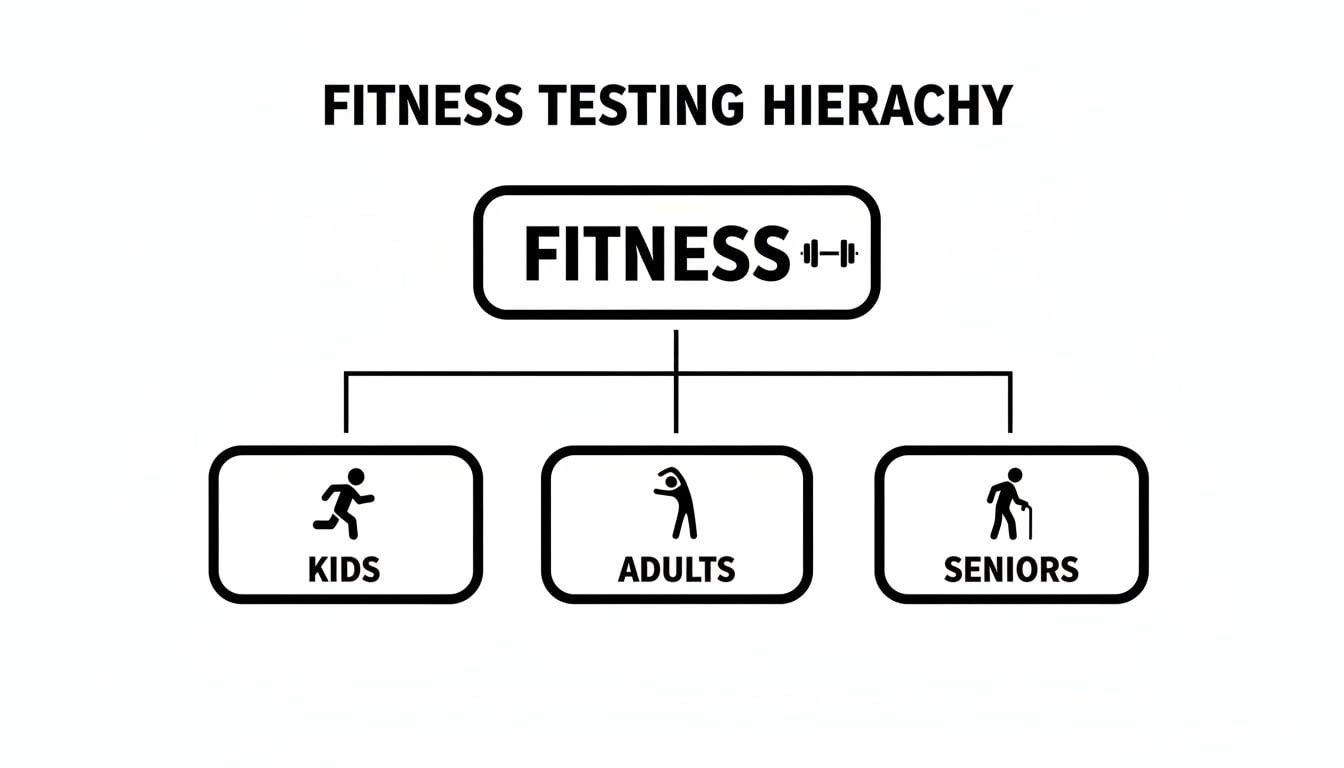
As you can see, the core goal of "fitness" is a constant, but the specific focus and tests evolve as we age. The priority shifts from building a strong foundation in youth to maintaining independence and quality of life in our later years.
Here is a quick summary of recommended fitness tests for different age groups, what they measure, and why they are important for long-term health.
Quick Guide to Key Fitness Tests Across the Lifespan
| Age Group | Key Fitness Component | Recommended Test Example | Why It’s Important |
|---|---|---|---|
| Children (6-12) | Coordination & Power | Standing Long Jump | Develops fundamental motor skills for lifelong activity and sport. |
| Adolescents (13-19) | Cardiorespiratory Fitness | PACER Test (Shuttle Run) | Establishes a strong cardiovascular base for health and performance. |
| Adults (20-64) | Muscular Strength & Endurance | Push-Up Test | Measures upper body strength, a key indicator of functional capacity. |
| Older Adults (65+) | Balance & Fall Risk | Timed Up and Go (TUG) | Assesses mobility and predicts the risk of falls, crucial for independence. |
These are just a few examples, of course. A physical therapist can help you build a testing battery that is right for your specific goals and health history.
The Power of a Baseline
Establishing a baseline is the first, most critical step. Without it, you have no real way of knowing if your hard work is paying off. It's like trying to get from the North End to Cambridge without knowing your starting point—you might get there eventually, but it will be inefficient and frustrating.
A fitness baseline gives you:
- Motivation: Seeing your numbers improve over time is one of the best ways to stay committed to your routine.
- Injury Prevention: Identifying imbalances or weaknesses early allows you to address them before they become a real problem.
- Personalized Programming: Your results tell us exactly what you need to work on, whether it's endurance, strength, flexibility, or balance.
For instance, some reports indicate that only about 25% of young Americans meet the physical fitness standards for military service. This statistic really drives home how crucial it is to start building healthy habits early on.
Fitness Is a Lifelong Journey
Your fitness needs and goals will naturally change over the decades. A 20-year-old might be focused on hitting a new personal record in the gym, while a 70-year-old’s priority is often maintaining the balance and strength needed for daily activities.
That's precisely why we don't believe in a one-size-fits-all approach. The tests we recommend are chosen to match the unique physical demands and health considerations of each life stage. From a child's first long jump to a senior's chair-stand test, every assessment tells a piece of your functional health story.
Our team is here to help you interpret that story—and write the next chapter.
Building a Strong Foundation with Tests for Kids and Teens
When we talk about fitness for kids and teens, it’s not just about sports performance. It’s about building a solid foundation for a healthy, active life. We see it every day in our clinics: establishing good movement patterns and physical capacity during these crucial developmental years is one of the best ways to prevent injuries down the road.
Think of it like building a house. You can't put up walls without first pouring a solid foundation. In the same way, testing key fitness areas in kids and teens makes sure their physical foundation is strong enough to support years of activity, from the playground to competitive sports.
The Core Tests for Youth Fitness
When we assess young people, we're not simply measuring how fast they can run. We're evaluating the fundamental pillars of their physical development—cardiovascular health, strength, and power. Looking at these areas gives us a complete picture of their physical capacity and helps us spot any red flags early on.
The goal isn’t to rank kids against each other. It's about understanding their individual physical profile so we can identify areas that need support. This ensures they build strength and skill safely, which is a core part of our approach to sports rehab.
Fortunately, there’s now a global consensus on how to best measure this. Researchers across 50 countries collaborated to identify four core fitness tests most strongly linked to health outcomes in kids and teens. You can read more about these global standards on children's fitness. These scientifically-backed tests form the basis of a reliable youth fitness assessment.
Breaking Down the Key Assessments
Here’s a closer look at the tests that really matter for kids and teens and what they tell us.
1. The 20-Meter Shuttle Run (PACER Test)
This is the gold standard for measuring cardiorespiratory fitness in youth. It involves running back and forth between two lines 20 meters apart, keeping pace with a series of beeps that gradually speed up.
- What it Measures: Aerobic capacity and endurance.
- Why it Matters: A strong heart and lungs are critical for everything from lasting through a whole soccer game to just having enough energy for a full day at school. Low scores can be an early warning sign for future cardiovascular health risks.
2. Handgrip Strength Test
Using a device called a dynamometer, this test measures the maximum force a child can squeeze with their hand. It sounds simple, but it’s a powerful overall indicator of strength.
- What it Measures: Total body muscular strength.
- Why it Matters: Grip strength correlates surprisingly well with overall strength. It's a quick and reliable way to assess a child's muscular development without needing a full gym.
3. Standing Long Jump
From a complete standstill, the child jumps as far forward as they can. We measure the distance from the starting line to the back of their heels where they land.
- What it Measures: Lower body explosive power.
- Why it Matters: Power is what's behind sprinting, jumping, and changing direction quickly—all crucial for most sports. This test shows us how well a young athlete can generate force in a split second.
These tests give us objective data to guide our recommendations. For young athletes in sports that demand precise, powerful movements, like golf, this data is invaluable. Our physical therapists can use these findings to build a targeted program, which might even complement a specialized assessment like our Titleist Performance Institute Evaluation to fine-tune their mechanics and prevent injury.
Peak Performance and Prevention for Adults (Ages 20-49)
For adults in their 20s, 30s, and 40s, life is a balancing act. You're building a career, maybe raising a family, and trying to keep it all together. It's easy for your own fitness to slip down the priority list.
But this is precisely when checking in on your physical health becomes most critical.
Fitness testing during these decades is all about two things: maintaining peak performance and preventing future problems. It’s about making sure you have the stamina to nail a presentation at work and the strength to chase your kids around the park. This is also the stage where the first subtle, natural, age-related declines in function can begin, making it the perfect time to be proactive.
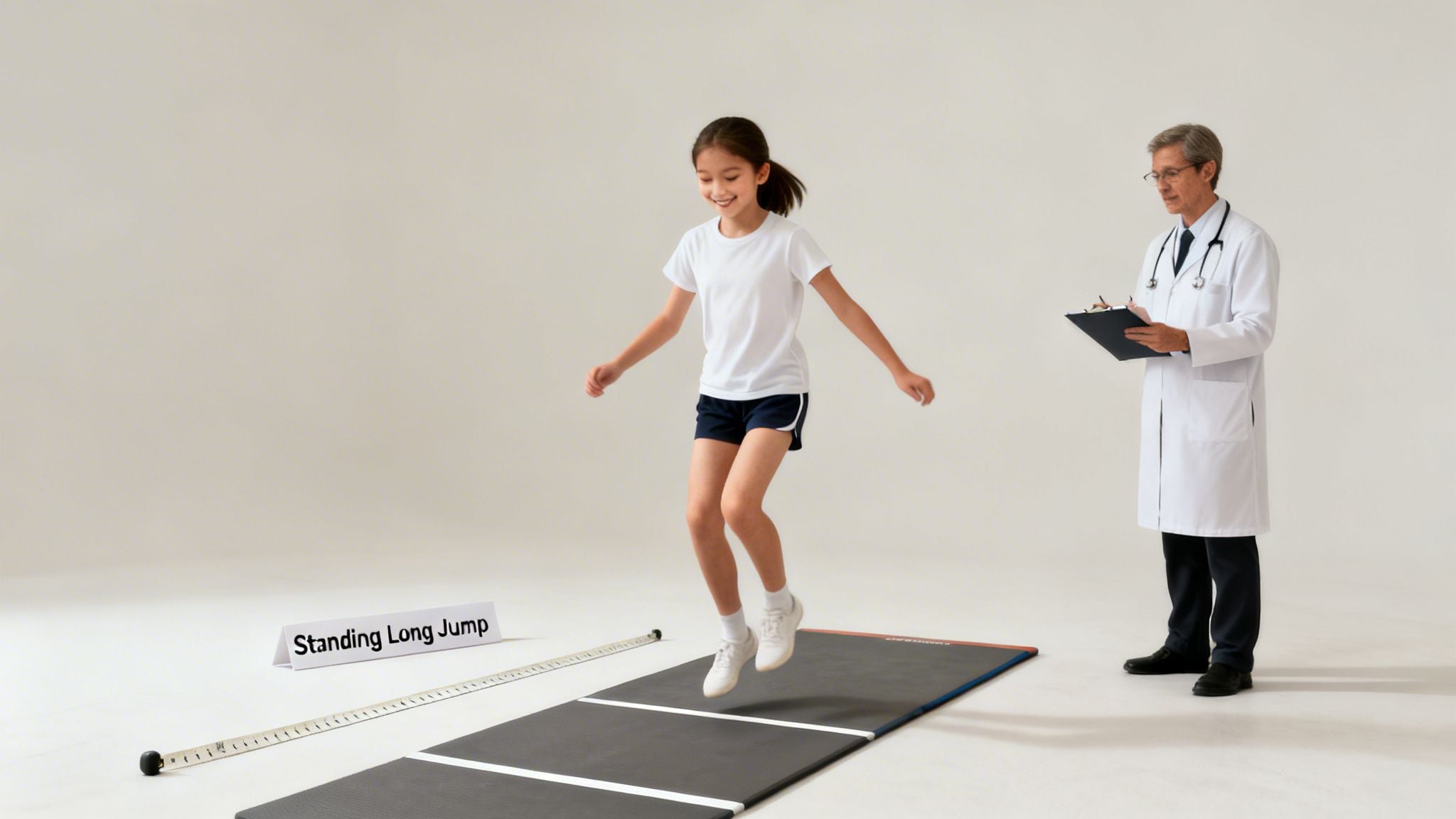
Key Fitness Tests for Adults
To get a clear picture of your physical health, we focus on tests that measure cardiorespiratory fitness, functional strength, and endurance. These are the building blocks of your ability to handle daily life and stay injury-free.
Here are a few essential fitness tests by age that we use for adults:
- 1.5-Mile Run/Walk: A fantastic, straightforward test of your cardiorespiratory fitness. The goal is simple: cover the distance as quickly as you can. This gives us a great estimate of your VO2max—or how efficiently your body uses oxygen during exercise.
- Push-Up Test: It's a classic for a reason. This test measures your upper body muscular endurance and core stability. You’ll perform as many good-form push-ups as you can, either from your toes or, as a modification, from your knees.
- Plank Test: This is a direct measure of your core strength and endurance. Holding a proper plank position for time shows us how well your core can stabilize your spine, which is a huge factor in preventing low back pain.
These tests give us a solid baseline. But the numbers are only useful when you understand the context behind them.
Understanding Your Results and Natural Declines
One of the most important metrics we track is your cardiorespiratory fitness. And the research is clear: this area shows a consistent, predictable decline as we get older.
Major studies show that mean maximal oxygen uptake (VO2max) drops with each passing decade. For men, this can mean a drop from an average of 54 ml/kg/min in their 20s. Women see a similar pattern, starting from an average of 43 ml/kg/min in their 20s. The decline tends to speed up over time, with an average loss of 10-12% of aerobic capacity per decade. You can explore more about these fitness findings to see the data for yourself.
Don't let those numbers scare you—think of them as a call to action. While some decline is natural, consistent activity can dramatically slow this process down, keeping you feeling younger and more energetic for far longer.
So, how do you stack up? Here are some general benchmarks for the push-up test to give you an idea.
Push-Up Test Norms (Toes)
| Age | Gender | Good | Excellent |
|---|---|---|---|
| 30-39 | Male | 17-21 | 22+ |
| 30-39 | Female | 12-19 | 20+ |
| 40-49 | Male | 13-16 | 17+ |
| 40-49 | Female | 10-14 | 15+ |
If your numbers are below average, it’s not a reason to panic. It’s just valuable information that tells us exactly which areas need more focus.
When Life Gets in the Way
As your local PTs, we get it—life happens. A desk job can lead to tight hips and weak glutes, making you more prone to back pain. Postpartum recovery brings its own unique challenges to core and pelvic floor strength. These real-life factors absolutely impact your test results.
This is why seeing a physical therapist for a "tune-up" isn't just for when you're recovering from a major injury. It’s for optimizing your health for the long haul.
If you feel a new ache after starting a running program, or notice you can’t quite lift things the way you used to, it’s a sign that your body could use a professional assessment. We can help you find the root cause and build a plan to keep you moving well through these busy, rewarding decades.
Maintaining Independence and Vitality for Older Adults (50+)
As we move into our 50s and beyond, our fitness goals start to look a little different. The focus shifts from pure performance to something far more meaningful: maintaining independence, vitality, and the freedom to do what we love.
It’s about having the strength to lift your grandkids, the balance to navigate an uneven sidewalk with confidence, and the stamina to enjoy a full day out with family. This is where functional fitness testing becomes a game-changer.
These aren't just abstract athletic benchmarks. They are some of the most important fitness tests by age because they directly reflect your ability to live a full, independent life.
Assessing the Pillars of Functional Independence
For our older clients, we focus on tests that give us a clear picture of three key areas: strength, balance, and mobility. These are the pillars that support your ability to stay safe, active, and self-sufficient.
A decline in any one of these can significantly increase the risk of falls and limit your ability to participate in the activities you enjoy. The data shows that staying active gets harder as we get older.
According to the National Health Interview Survey, while 41.3% of men aged 18-34 meet physical activity guidelines, that number drops to just 15.3% for men 65 and older. The trend for women is unfortunately similar. You can see the full physical activity data on cdc.gov. This is exactly why regular testing is so critical—it provides the data we need to push back against that decline.
We don't see these tests as just numbers; we see them as tools for empowerment. The results tell us exactly where to focus our efforts so you can build a proactive strategy to stay strong, stable, and confident for years to come.
Core Functional Tests for Older Adults
Here are two of the most effective and widely used tests we use in our clinics to assess functional fitness in adults over 50.
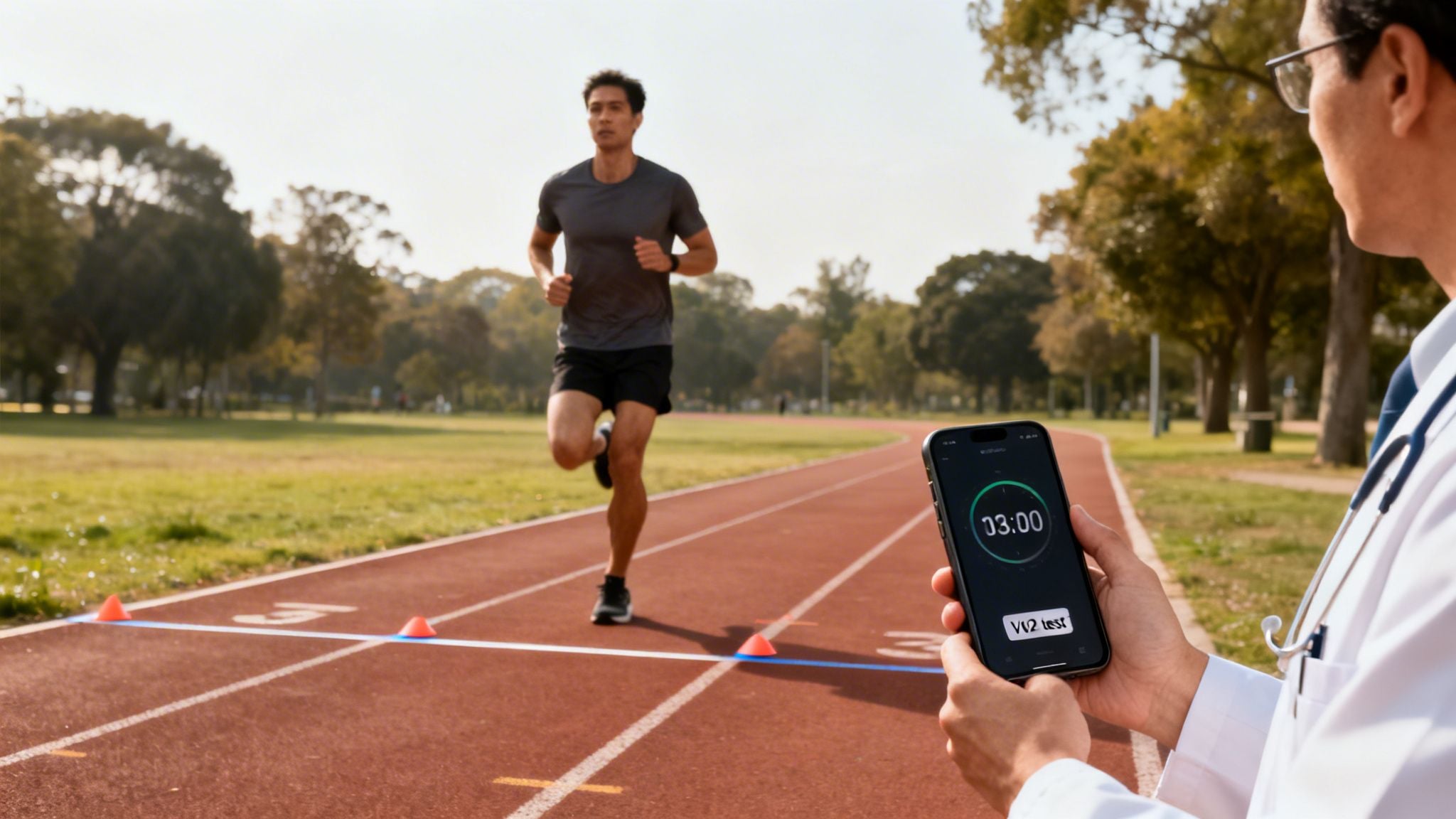
1. The 30-Second Chair Stand
This simple test is an excellent measure of lower body strength—the kind you need every day to get out of a chair, climb stairs, or exit a car.
- How it works: You’ll sit in a standard chair with your arms crossed over your chest. On "go," you stand up completely, then sit back down. We count how many times you can do this in 30 seconds.
- What it tells us: The number of repetitions is a reliable indicator of your leg strength and endurance. A low score often correlates directly with difficulty in basic daily movements.
2. The Timed Up and Go (TUG) Test
The TUG is a fantastic assessment of dynamic balance and mobility. It mimics the real-world task of getting up from a chair, walking a short distance, and returning to a seated position.
- How it works: You start seated in a chair. When we say "go," you stand up, walk 10 feet (about 3 meters), turn around, walk back, and sit down completely. We time the entire sequence.
- What it tells us: The TUG is a powerful predictor of fall risk. A time of 12 seconds or more often indicates a need for intervention to improve balance and prevent falls.
Functional Fitness Benchmarks for Older Adults
These scores are not just pass or fail; they provide a valuable snapshot of your current functional health. The table below offers a look at the normative data and risk cut-offs we use to interpret these common tests.
| Functional Test | What It Measures | Low-Risk Benchmark | Increased Fall Risk Indicated By |
|---|---|---|---|
| 30-Second Chair Stand | Lower Body Strength & Endurance | 12-14+ reps (depending on age/gender) | Fewer than 8 reps |
| Timed Up and Go (TUG) | Dynamic Balance, Mobility & Fall Risk | Less than 10 seconds | 12 seconds or more |
| 4-Stage Balance Test | Static Balance & Stability | Able to hold tandem stance for 10 seconds | Unable to hold tandem stance for 10 seconds |
| Single Leg Stance | Static Balance & Proprioception | Able to hold for 10+ seconds (eyes open) | Unable to hold for less than 5 seconds |
Seeing where you fall on this spectrum gives us a clear starting point.
If your scores are below the benchmarks for your age, it isn’t a reason to worry—it’s a signal to take action. It's a clear sign that it’s time to bring in a professional. You can also start by exploring some of the best balance exercises for older adults in our guide.
A physical therapist can translate these test results into a personalized program of strength and balance exercises that will directly improve your function, safety, and confidence.
How to Build Your Personalized Fitness Action Plan
Alright, you've done the tests and have your scores. Now what? This is the most important part—turning those numbers into a real-world plan that actually works for you. Data is one thing, but a smart action plan is what leads to real change.
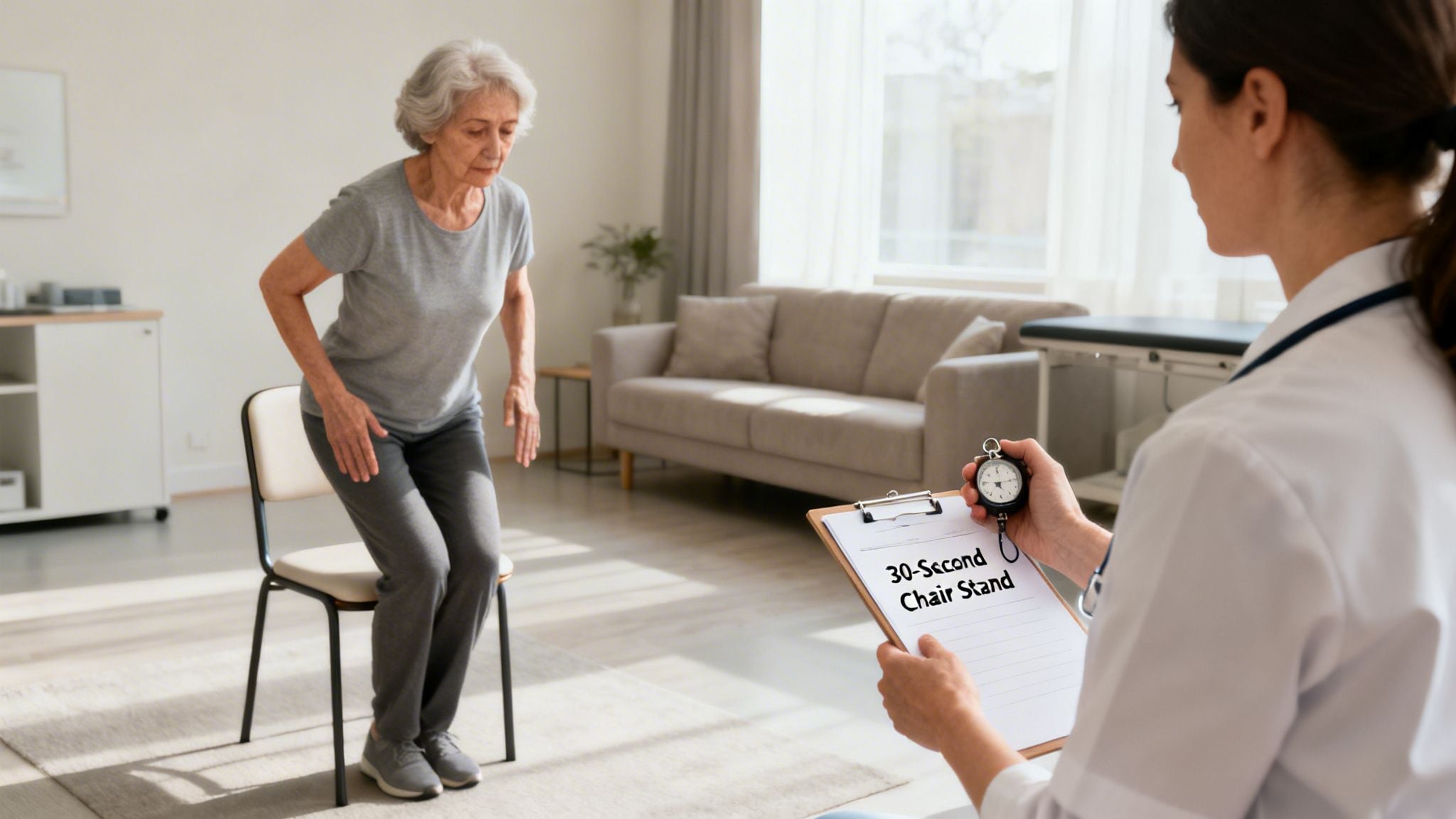
The tests that matter most depend entirely on your life and your goals. A 35-year-old training for a marathon has very different needs than a 65-year-old who wants better balance to keep up with the grandkids. The right plan always starts with the right focus.
Sample Test Batteries For Different Goals
A "test battery" is simply a group of assessments we choose to get a full picture of the fitness components that matter most for you. Here are a couple of examples of how we build these for different people in our clinics.
For a 35-Year-Old Marathon Runner:
- Primary Test: 1.5-Mile Run. This gives us a great estimate of VO2max and is perfect for tracking aerobic progress.
- Secondary Tests: We’d add the Plank Test (for core endurance needed to hold running form), a Single Leg Squat (to spot leg strength imbalances), and the Sit-and-Reach (for hamstring and low back flexibility).
- The Goal: Push performance while preventing the common overuse injuries we see in runners.
For a 65-Year-Old Focused on Balance:
- Primary Test: Timed Up and Go (TUG) Test. This is our go-to for assessing fall risk and how you move through daily activities.
- Secondary Tests: The 30-Second Chair Stand (for lower body strength needed for everyday function) and the 4-Stage Balance Test (for static balance).
- The Goal: Improve stability, build confidence, and protect independent living.
Turning Your Results Into Action
Once you have your results, it's time to address the areas that need a little work. If a score came in below the benchmark for your age, that's not a bad thing—it's your starting point.
Don’t look at a low score as a failure. See it as a clear instruction from your body telling you exactly what it needs. This is where you can make the biggest difference.
Here are a few simple ways to take action based on common test results:
- If Your Cardiovascular Score Was Low: Start with interval training. Try alternating 2 minutes of brisk walking or jogging with 1 minute of easy recovery walking. Aim for 20-30 minutes, three times a week, and you’ll see that aerobic capacity climb.
- If You Struggled with the Chair Stand Test: We need to build lower body strength. Bodyweight squats are perfect for this. Start with 2 sets of 10-12 reps, focusing on clean, controlled form.
- If Your Balance Was Unsteady: Practice single-leg stances. Just stand near a counter for a bit of support and try balancing on one leg for 10-15 seconds. Do this a few times on each leg throughout your day. For women in this age group, proper nutrition is also crucial for maintaining strength; you can learn more about essential vitamin supplements for women over 50 for a more complete approach.
When to Call In the Experts
Self-testing and at-home exercises are fantastic, but sometimes your results are a clear signal that it’s time to bring in a professional. You should absolutely book an evaluation with a physical therapist if:
- Your score on a test like the TUG points to a high risk of falls.
- You feel any pain, either during or after a test.
- You notice a big difference in strength or stability between your right and left sides.
- You’re putting in the work but just not seeing any improvement.
A physical therapist doesn’t just score a test; we diagnose the why behind the number. We use more detailed screens to find the root of the problem. You can learn more about our process in our guide to the Selective Functional Movement Assessment. This lets us find the true cause—like a weak hip causing poor balance—and create a targeted plan to fix it for good.
Your Questions About Fitness Testing Answered
In the clinic, we get plenty of questions about fitness testing. It makes sense. When you take the time to measure your fitness, you want to know what the numbers mean and, more importantly, what to do next.
Here are some of the most common questions our physical therapists hear, answered directly to give you the clarity you need to move forward.
How Often Should I Perform These Fitness Tests?
The honest answer? It depends on your goals.
For most people, a self-assessment every 6 to 12 months is a great rhythm. It’s frequent enough to track your progress and see how your fitness is evolving over time, keeping you accountable and proving your hard work is paying off.
If you’re training for something specific, like a 5K, a marathon, or a cycling event, you’ll want to check in more often. We recommend testing every 3 to 4 months in that case. This tells you if your training plan is actually working and gives you a chance to make smart adjustments.
For older adults concerned about fall risk, checking in on key functional tests like the 30-Second Chair Stand or the TUG test every 3 to 6 months is a smart, proactive strategy. Consistent data is what keeps you motivated and on the right track.
Can I Do These Fitness Tests At Home By Myself?
Absolutely. Most of the fitness tests by age we’ve outlined are designed to be done just about anywhere. Things like the push-up test, plank hold, wall sit, or the 30-Second Chair Stand can be done safely in your living room with little or no equipment.
That said, a little common sense goes a long way. Some tests are better with a partner or a professional. Any test that challenges your balance, for example, comes with some risk if you’re unsteady. Having someone nearby for support is just good practice.
More advanced assessments, like a true VO2max test, require specialized equipment and a trained professional to administer them.
The most important rule is to listen to your body. If you have an underlying health condition, chronic pain, or significant balance issues, your safest and most effective move is to schedule an evaluation with one of our physical therapists. We’ll make sure the tests are done right, help you interpret the results, and keep you safe.
My Results Are Below Average For My Age. Should I Be Worried?
First, don't panic. A test result is just a single snapshot in time. It's not a final verdict on your health or your potential. Think of it as a starting point—a piece of information that gives you a clear direction. It’s an opportunity, not a failure.
The human body is incredibly adaptable at any age. A low score doesn't mean something is permanently “wrong” with you; it just shines a light on an area that needs a little more attention. In our world, identifying a weakness is the first step toward turning it into a strength.
This is exactly where physical therapy shines. We can take that score, diagnose the "why" behind it, and build you a targeted program to bring that number up. Use it as fuel to take meaningful action.
What Is The Difference Between A Fitness Test And A PT Evaluation?
This is a fantastic question and gets right to the heart of what we do as clinicians.
A standard fitness test is a standardized measurement. It gives you a number. It tells you that you performed 15 push-ups or held a plank for 45 seconds. This is valuable data, kind of like knowing the horsepower of an engine.
A physical therapy evaluation, on the other hand, is a comprehensive diagnostic process. We don’t just ask “how many?”—we dig deeper to find out "why?" We’re the mechanics who look under the hood to see how the engine is actually running.
During a PT evaluation, we:
- Analyze Your Movement Patterns: We watch how you move to spot compensations, faulty mechanics, or imbalances.
- Assess Joint Mobility: We check for specific joint restrictions that might limit your strength or cause pain down the road.
- Test for Muscle Imbalances: We identify which muscles are overworking to compensate for others that are weak or inactive.
A fitness test might tell you your right leg is weaker than your left on a single-leg squat. A PT evaluation will figure out if that's because of a weak hip, poor ankle stability, or stiffness in your lower back—and then give you a specific plan to fix it.
A fitness test gives you the "what." A PT evaluation gives you the "why" and the "how-to-fix-it."
At Joint Ventures Physical Therapy, our goal is to empower you with the knowledge you need to move better, feel stronger, and get back to the life you want to live. Whether you have questions about your test results or need a comprehensive plan to address a specific issue, our team is here to help. Schedule your 1-on-1 evaluation with an expert clinician at Joint Ventures today.