
Hey there, neighbor. Here in Boston, people hear “pelvic floor therapy” and often aren't quite sure what to make of it. We get it. It’s a personal topic, but it’s a conversation worth having, and we’re here to make it a comfortable one.
So, what is pelvic floor therapy? Simply put, it’s a specialized area of physical therapy focused on the group of muscles that form a supportive ‘hammock’ at the base of your pelvis. When these muscles stop working the way they should, it can cause some very real, very frustrating problems. But here’s the good news: we can help.
Your Guide to Understanding Pelvic Health
At Joint Ventures, we believe talking about your pelvic floor should be as normal as talking about a sore knee or a stiff back. It's a critical part of your core system, and when it’s not functioning correctly, it can throw everything off balance.
So many folks, from new parents in the South End to runners training along the Charles, deal with these issues in silence. They often think it’s just a "normal" part of aging or life changes.
We're here to tell you that’s not the case. These conditions are common, but they shouldn't be your normal. You deserve to feel good.
What Is Pelvic Floor Dysfunction Anyway?
Pelvic floor dysfunction is a broad term for when these essential muscles aren't doing their job correctly. This isn't just about weakness. Sometimes, the muscles can be too tight (hypertonic) or simply uncoordinated.
Imagine your pelvic floor is a small, responsive trampoline at the base of your core. It needs to be strong enough to support your organs but also flexible enough to stretch and recoil when you cough, jump, or use the bathroom. Dysfunction happens when that trampoline becomes too stiff, too loose, or loses its bounce.
This can lead to a variety of symptoms that can really impact your day-to-day life.
Some of the most common signs include:
- Urinary or fecal incontinence: Accidentally leaking when you laugh, sneeze, cough, or exercise.
- Urgency and frequency: Feeling like you constantly have to rush to the bathroom.
- Pelvic pain: This can show up as pain in your low back, hips, genitals, or deep in your pelvis.
- Pain during intimacy: Discomfort that can make sex feel difficult or impossible.
- A feeling of heaviness or bulging: This is often associated with pelvic organ prolapse, where organs shift out of place.
To help you connect your symptoms to what might be happening with your pelvic floor, we've created this simple table.
Common Signs You Might Benefit From Pelvic Floor PT
| Symptom You Are Experiencing | What It Could Mean For Your Pelvic Floor |
|---|---|
| Leaking urine when you laugh, cough, or jump | This is stress incontinence, often from muscle weakness or coordination issues. |
| Feeling a sudden, strong urge to urinate | This is urgency, which can be a sign of overactive or tight pelvic floor muscles. |
| Pain in the low back, hips, or deep in the pelvis | Pelvic pain can be caused by muscles that are too tight (hypertonic). |
| Discomfort or pain during or after intercourse | Often related to muscle tightness or sensitivity in the pelvic floor. |
| A sensation of bulging or heaviness in the pelvis | This could be a sign of pelvic organ prolapse, where muscles can no longer support the organs. |
If any of these sound familiar, you're not alone, and there is absolutely something you can do about it. We see this every day, and we're here to help you find a solution.
The reality is that these issues are incredibly widespread. It's not just you. One striking statistic reveals that more than 1 in 3 women—over 33%—experience pelvic floor dysfunction during their lifetime, a number that climbs to over 50% for women aged 55 and older.
The numbers are significant, showing just how many people are walking around with treatable conditions. In fact, a U.S. study of over 25,000 women found that at least 32% had one or more pelvic floor disorders, proving this is a major health concern, not a minor inconvenience.
To start understanding how to address it, let's explore in depth What Exactly Is Pelvic Floor Therapy and the comprehensive approach it offers to improve your health.
Understanding Your Pelvic Floor Anatomy
To really understand pelvic floor therapy, you first have to know what the pelvic floor actually is. Forget the dense anatomy textbooks. We find simple analogies work best, and this is one of our favorites at Joint Ventures.
Think of your core as a canister—like a can of your favorite local Boston brew. The lid is your diaphragm (your main breathing muscle), the sides are your deep abdominal muscles, and the pelvic floor is the base. For this system to hold up under pressure, the top, bottom, and sides all have to work together perfectly.
This "floor" isn't a hard, static surface. It's a group of muscles, ligaments, and connective tissues stretched like a supportive hammock from your pubic bone in the front to your tailbone in the back.
These muscles are constantly working in the background, 24/7, without you ever having to think about it.
The Five Core Functions Of Your Pelvic Floor
So, what does this muscular hammock actually do? It has five critical jobs that are essential for everyday life. When your pelvic floor is working correctly, it:
- Supports your organs: This sling holds up your bladder, bowels, and (in women) your uterus, keeping them securely in place.
- Controls continence: It acts as a gatekeeper, contracting to hold in urine and stool until you're ready and relaxing to let them go.
- Stabilizes your core: As the foundation of that "core canister," it partners with your abs and back muscles to create a stable pelvis and spine.
- Aids in sexual function: For all genders, these muscles are key players in arousal and orgasm.
- Acts as a sump pump: It helps push blood and lymphatic fluid out of your legs and back up toward your heart, improving circulation.
This simple concept map shows how the pelvic floor provides support, but can also become the source of dysfunction—which is exactly what therapy is designed to fix.
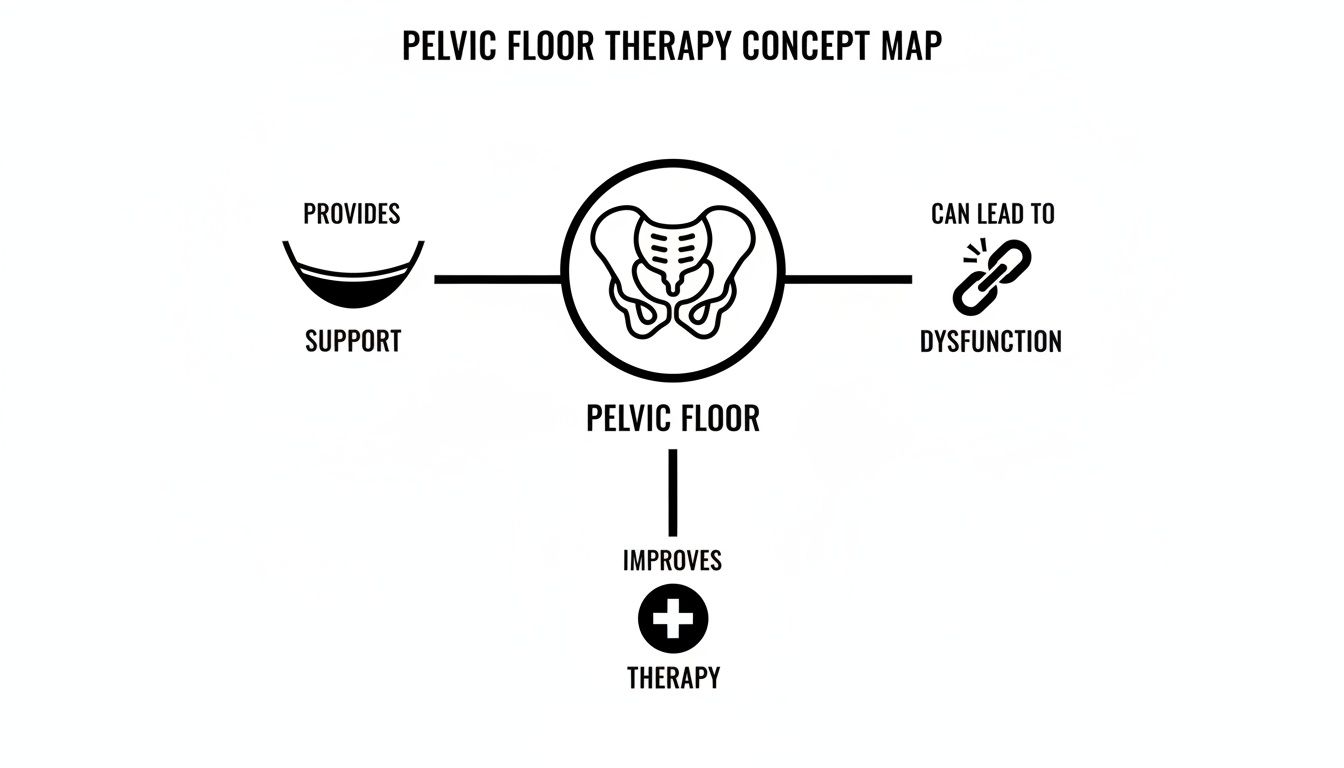
It all comes down to finding that perfect balance between strength and flexibility.
When The Trampoline Is Too Tight Or Too Loose
Here’s another analogy we love: picture your pelvic floor as a responsive trampoline. It needs just the right amount of tension—firm enough to support you when you jump, but flexible enough to stretch and recoil when you land.
Problems pop up when that trampoline gets either too tight or too saggy. This imbalance is what we call pelvic floor dysfunction, and it typically falls into two main camps:
1. Hypertonicity (Too Tight)
This is when the muscles are stuck in a state of constant contraction. They just can't relax. Imagine clenching your fist all day long—eventually, those muscles get exhausted, weak, and painful. This is often the real reason behind things like pelvic pain, urinary urgency, and painful intercourse.
For example, we might see an office worker from the Seaport who sits all day and has developed a nagging tailbone pain. That’s frequently caused by chronically tight pelvic floor muscles pulling on the tailbone, irritated by hours of constant pressure.
2. Hypotonicity (Too Weak)
This is the opposite problem. The muscles are too lax and don't have enough tension to provide support, especially when you add stress to the system. This is the classic cause of stress incontinence (leaking when you cough, sneeze, or jump) and pelvic organ prolapse.
We see this with athletes all the time. A runner training for the Boston Marathon might start leaking during their long runs. It’s not that they aren’t strong—it’s that the repetitive impact of running is just too much for their weakened or poorly coordinated pelvic floor muscles to manage.
Understanding which issue you're dealing with is the first step. Bowel health, for instance, is deeply connected to pelvic floor function. It's a key piece of the puzzle for many of our patients, and you can learn more about how routine can assist healthy bowel movements in our dedicated article.
Whether those muscles are too tight, too weak, or just not working together properly, the goal of pelvic floor physical therapy is to restore balance and get that "trampoline" functioning just right again.
Who Can Benefit From Pelvic Floor PT
When most people in Boston hear “pelvic floor therapy,” they immediately think of new moms. And while we love helping postpartum women recover, that’s only a small part of the story.
The truth is, if you have a pelvis, you can have pelvic floor dysfunction. The idea that it’s a “women’s issue” or just for post-childbirth recovery is a myth we’re here to bust. The people who walk through our clinic doors are as diverse as the city itself, coming from every neighborhood with a wide range of goals.
And it’s becoming more common. Widespread issues like urinary incontinence—which affects up to 50% of women over 55—are driving a huge need for effective treatment. This isn't just about postpartum recovery; it's about chronic pain management, athletic performance, and aging well. You can see just how much the field is growing by checking out this data on the pelvic floor therapy market.
Postpartum Mothers and Pregnant Individuals
Let’s start with the group most people think of. Pregnancy and childbirth are incredible, but they put enormous strain on the pelvic floor. The weight of the baby, hormonal shifts that soften tissues, and the delivery itself (both vaginal and C-section) can leave these muscles stretched, weak, or injured.
This is where pelvic floor PT becomes a game-changer. We help mothers:
- Heal Diastasis Recti: This common separation of the "six-pack" abs isn't something you have to live with. We teach safe, effective core exercises to close the gap and rebuild your strength.
- Manage Prolapse: We provide exercises and strategies to manage symptoms of pelvic organ prolapse, helping you feel supported and more like yourself again.
- Return to Exercise Safely: We’ll create a personalized plan to get you back to running, lifting, or your favorite spin class without leaking, pain, or worrying about injury.
Athletes of Every Level
From the rowers on the Charles to the runners training for their first 5K, athletes place huge demands on their core and pelvic floor. Think about it—every stride, jump, or heavy lift spikes the pressure inside your abdomen.
A healthy pelvic floor handles that pressure without a problem. But if it's weak or isn't coordinating properly, you might start to notice things like:
- Leaking urine when you run, jump, or lift heavy.
- Nagging hip, groin, or low back pain that just won’t go away.
- A feeling of heaviness or pressure in your pelvis during or after a workout.
We help athletes retrain this system to work in sync with their breathing and core. The goal is to improve performance and prevent injuries so you can keep doing what you love.
Men With Pelvic Health Concerns
Yes, men have pelvic floors too. And when they aren't functioning well, it can cause significant issues that are often overlooked or misdiagnosed. It's a topic that doesn't get nearly enough attention.
It's a topic that doesn't get enough airtime, but pelvic pain and dysfunction in men are both common and highly treatable. Ignoring symptoms often leads to years of unnecessary frustration and discomfort. We're here to change that conversation.
We see men in our Boston clinics for a number of reasons, including:
- Chronic Pelvic Pain Syndrome (CPPS): This is often misdiagnosed as "prostatitis" but is frequently caused by overly tight pelvic floor muscles.
- Post-Prostatectomy Recovery: After prostate surgery, many men struggle with urinary incontinence and erectile dysfunction. Pelvic PT is a critical step in regaining control and function.
- Pain With Ejaculation or Erection: This can stem from muscle tension or nerve irritation in the pelvis that we can directly address.
Individuals With Chronic Pain Conditions
Finally, pelvic floor therapy can be a source of profound relief for people with chronic pain conditions like endometriosis, interstitial cystitis (painful bladder syndrome), and even irritable bowel syndrome (IBS).
These conditions often create a vicious cycle. Inflammation and discomfort cause the pelvic floor muscles to tense up, which in turn creates more pain. Our job is to break that cycle. Using gentle manual therapy and targeted relaxation techniques, we can teach these overactive muscles to release, which can dramatically reduce symptoms and improve your day-to-day life.
Ultimately, understanding what is pelvic floor therapy is recognizing that it offers solutions for a whole spectrum of people and problems.
What To Expect At Your First Appointment
Let’s be honest: the idea of a first pelvic PT appointment can feel a little intimidating. It’s completely normal to be nervous. But we want to demystify the process and show you what this first visit is really all about: making you feel heard and hopeful.
From our Brookline clinics to the Financial District, your first visit is designed to be a comfortable, respectful, and productive conversation. It’s all about you.

Everything happens in a private, one-on-one treatment room. This time is dedicated entirely to you.
A Conversation, Not an Interrogation
The most important part of your first appointment is simply talking. We're not here to run through a generic checklist; we're here to listen to your story. Your therapist will ask about your history, your symptoms, what makes things better or worse, and most importantly, what you want to get back to doing.
This conversation is the foundation of everything that follows. Pelvic health issues are rarely isolated, so understanding the full picture is critical. Your story matters, and we’re here to listen.
For a few more tips, check out our guide on how to prepare for your first physical therapy appointment.
A Comprehensive Assessment of the Whole System
After we talk, your therapist will perform a thorough assessment. And we don't just look at the pelvis. Remember how the pelvic floor is part of a bigger system? We need to see how that entire system moves and functions.
This part of the evaluation might include looking at:
- Your Posture: How you stand and sit changes the load on your pelvic floor.
- Breathing Mechanics: We’ll check how your diaphragm and rib cage move—it’s directly tied to your pelvic floor’s rhythm.
- Movement Patterns: We may ask you to walk, squat, or bend to see how your body coordinates movement and manages pressure.
- Strength and Flexibility: We’ll assess the muscles in your hips, low back, and abdomen to find any related weakness or tension.
This whole-body approach ensures we aren’t just chasing symptoms. We’re digging for the root cause.
Your comfort and consent are our top priority, always. We will explain every single step of the evaluation before we do it, and nothing will be done without your explicit permission. You are in complete control of the session from start to finish. We've got your back.
The Pelvic Floor Muscle Assessment
With your consent, your therapist might recommend an assessment of the pelvic floor muscles themselves. While it's never a requirement, it gives us the most direct and valuable information about their strength, tone, and coordination.
This assessment typically has two parts:
- External Assessment: Your therapist will gently feel the muscles and tissues around your pelvis and abdomen externally, checking for tenderness, trigger points, or tension.
- Internal Assessment: This is nothing like a gynecological exam—there are no stirrups or speculums. Using one gloved, lubricated finger, your therapist gently assesses the pelvic floor muscles internally (either vaginally or rectally). This lets us feel exactly which muscles are tight, weak, or uncoordinated.
Throughout this process, your therapist is in constant communication with you, making sure you feel safe and in control. This hands-on assessment is what allows us to build a truly specific treatment plan that answers the question of what is pelvic floor therapy for you.
Common Pelvic Floor Therapy Treatments
So, you’ve had your evaluation—now what? Let’s talk about how we actually get you feeling better. The treatment plan we build for you at Joint Ventures is just that: yours. There's no one-size-fits-all script here.
First, let's clear the air on the biggest myth we hear: that pelvic floor therapy is just about doing endless Kegels. For many people, especially those with tight, overactive muscles, Kegels can actually make things worse. Our toolbox is much bigger and more precise than that.
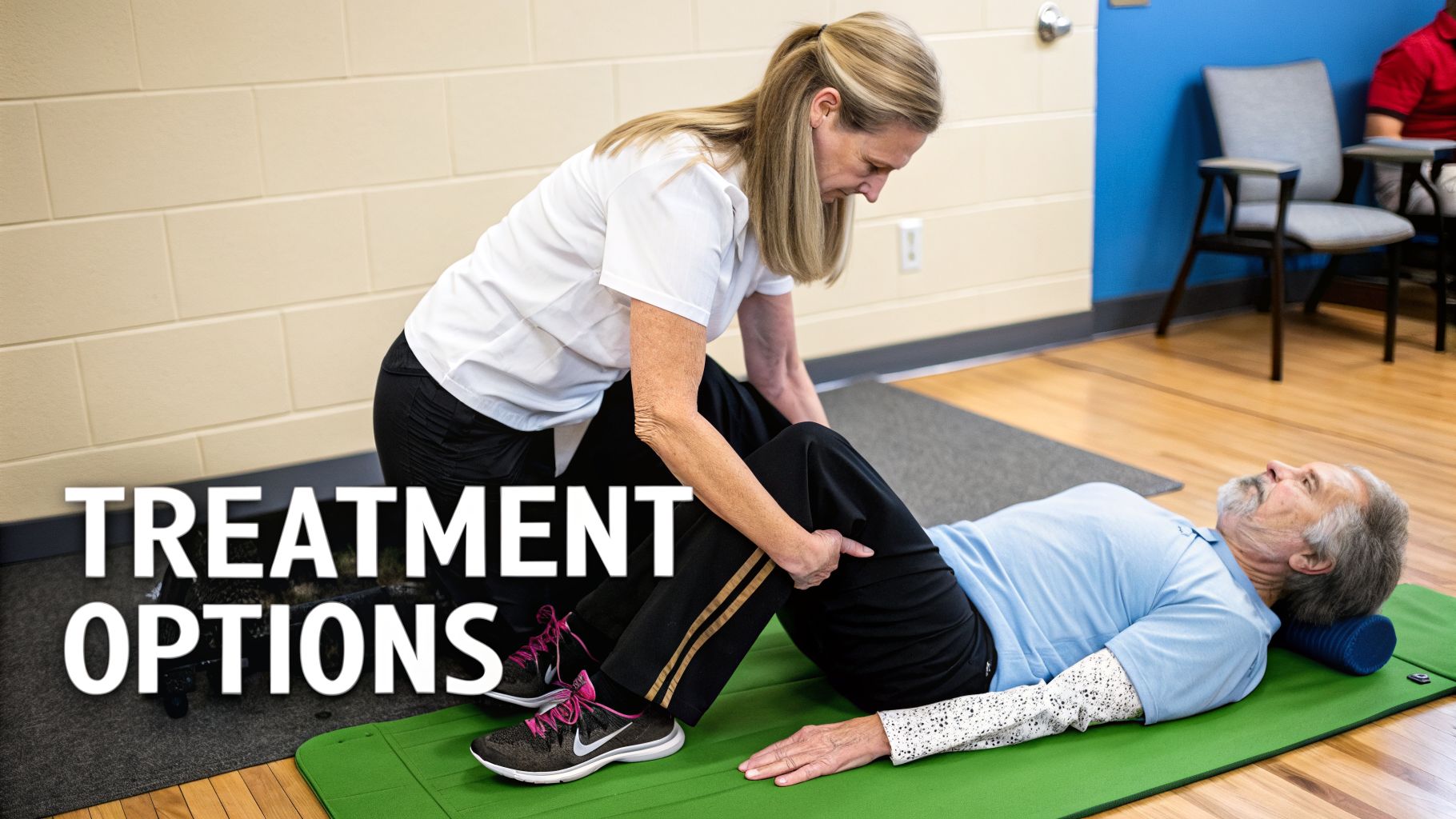
To give you a better idea of what to expect, we've broken down some of the most common and effective techniques we use.
Pelvic Floor Therapy Techniques Explained
| Treatment Method | What It Involves | Who It Helps Most |
|---|---|---|
| Manual Therapy | Using hands-on techniques like myofascial release and trigger point release to treat muscles and connective tissue, both externally and internally. | Patients with muscle tightness, trigger points, pain, or scar tissue. |
| Biofeedback | Using small sensors to give you real-time visual or sound feedback on your muscle activity. Think of it as a "mirror" for your internal muscles. | Anyone struggling to connect with their pelvic floor, whether it's for strengthening or learning to relax. |
| Therapeutic Exercise | A customized program of stretches, strengthening exercises, and functional movements for the core, hips, and pelvic floor. | Everyone! This is tailored to either relax overactive muscles or build endurance in weak ones. |
| Education & Strategy | Learning how your body works, understanding pain signals, and adopting new habits for bladder, bowel, and daily activity. | All patients. Lasting results come from understanding your body and having a plan for long-term health. |
Each of these elements plays a critical role in a comprehensive treatment plan, tailored specifically to what's causing your symptoms. Let's dig a little deeper into what these look like in practice.
Hands-On Manual Therapy
A huge part of what we do involves hands-on work. Just like you can get a knot in your shoulder, your pelvic floor muscles can develop trigger points, tension, and restrictions. Manual therapy is how we address that directly.
This can involve:
- Myofascial Release: Applying gentle, sustained pressure to ease tension in the fascia, the connective tissue that wraps around your muscles.
- Trigger Point Release: Using direct pressure on specific, irritable "knots" to help the muscle let go.
- Soft Tissue Mobilization: A variety of techniques to improve the movement of muscles externally (around your hips, abdomen, and low back) and internally (within the pelvic floor itself).
These hands-on methods are incredibly powerful for breaking the pain-tension cycle and getting your muscles working properly again.
Advanced Tools Like Biofeedback
Sometimes, we need a little extra help making that mind-body connection. That's where a tool like biofeedback can be a game-changer. It uses small, painless sensors to show you exactly what your pelvic floor muscles are doing on a screen.
This visual feedback helps you learn how to coordinate these muscles effectively—not just how to squeeze, but, just as importantly, how to fully relax them.
Personalized Exercise And Education
Finally, every treatment plan is built around a customized exercise program. This goes way beyond Kegels. Your program might include:
- Core stability exercises
- Stretches for tight hips and glutes
- Breathing techniques to calm the nervous system
- Functional movements that mimic your daily life
We’ll also educate you on how daily habits and other activities affect your pelvic floor, from posture and lifting mechanics to understanding the impact of exercise on hemorrhoids.
The most powerful tool we have is education. Our goal isn’t just to fix the problem for you; it's to teach you how your body works so you can take control of your own health for the long run. We want you to feel empowered.
By combining these approaches, we create a plan that gets to the root cause of your issues. Our focus is always on getting you back to living your life fully, whether that means running, playing with your kids, or just getting through the day without pain or worry.
How To Get Started With Pelvic Floor Therapy
If you've been reading along and nodding your head, please know you aren’t alone—and that real, effective help is available right here in the Greater Boston area. We know from experience that taking the first step is often the hardest part, but we’re here to make it as easy as possible.
At Joint Ventures, our entire model is built on one-on-one care. There's no "one-size-fits-all" plan here. Your therapist is your dedicated partner, someone who will actually listen to your history and build a plan that makes sense for your body and your life.
Your First Step Is A Simple Phone Call
Getting started is as easy as picking up the phone. Here’s what happens when you connect with our team:
- A Friendly Voice: You'll be greeted by our incredible administrative team. They are pros at making this process feel less intimidating and can answer any initial questions you might have.
- Scheduling That Works For You: With convenient locations across the city and flexible morning and evening hours, we'll find an appointment that fits your schedule.
- Insurance Handled: We'll take on the headache of verifying your insurance benefits. You'll know exactly what your coverage looks like before you even step through our doors.
Our goal is to get the logistics out of your way so you can focus on what really matters: your health.
Taking charge of your health is an empowering act. Learning how to speak up for your needs in a medical setting is a skill that serves you for life. It ensures your concerns are heard and that you are an active partner in your own care.
Feeling confident in medical appointments can be a real challenge for many people. We encourage you to check out our tips on how to advocate for yourself with your healthcare provider. A little preparation can make a world of difference.
You don’t have to just live with the discomfort or limitations. A better quality of life is absolutely possible, and we're ready to help you get there.
Frequently Asked Questions About Pelvic Floor Therapy
Here in our Boston clinics, we hear a lot of the same great questions from folks who are curious about what we do. It’s completely normal to have questions before you start something new, so we've gathered the most common ones to give you clear, straightforward answers.
We want you to walk in feeling comfortable and informed from day one.
Is Pelvic Floor Therapy Painful?
This is the number one concern we hear, and the answer is simple: no, it shouldn’t be. Our entire purpose is to figure out what’s causing your pain and help you relieve it, not create more.
Some of the manual, hands-on techniques might feel similar to a deep-tissue massage—a little intense, but in a productive way. We always work within your comfort level, and your therapist will check in with you constantly.
And if an internal exam is part of your plan? It's always done gently and only after we get your enthusiastic "okay." You are always in control.
How Long Until I See Results?
This is the classic "it depends" answer, but we'll give you the real story. Every person's body and history is unique, so there’s no magic number. That said, many of our patients start to notice a real difference and feel some relief within just a few sessions.
A typical plan of care might last anywhere from 6 to 12 visits. The biggest factors are how long you've had the symptoms, your specific goals, and how consistent you are with the home program we build for you. We’ll talk honestly about what to expect at your first visit so you have a clear picture right from the start.
Your progress is a partnership. The work you do between sessions is just as important as the time you spend with us. Consistency is your superpower on the road to feeling better.
Do I Need A Doctor's Referral To Start?
Good news! In Massachusetts, you can see a physical therapist directly without a physician's referral, thanks to a law called "Direct Access." This is a huge benefit—it means you can get started on feeling better right away.
However, some insurance plans do have their own rules and may still require a referral for coverage. Don't worry about the red tape. Our expert front-desk team will happily verify your specific benefits for you, so you'll know exactly what’s needed before your first appointment. We handle the logistics so you can focus on your health.
At Joint Ventures Physical Therapy, we're committed to being your partner in health. If you're ready to take the next step toward a life with less pain and more freedom, we're here to help. Schedule your one-on-one evaluation today.