
You're a few weeks into training. The Charles path is crowded, the long run went fine until mile eight, and now the outside of your knee talks back every time you head downhill. Or maybe your calf tightens near Beacon Hill, your heel hurts on the first steps out of bed, or you're trying to build back after a stress injury and you don't trust your body yet.
That's where Boston runners often get stuck. The problem usually isn't motivation. It's trying to solve a running problem with a generic plan.
Boston has a serious running culture, and the care around it has become just as specialized. At the 2024 Boston Marathon, about 100 physical therapists were stationed in five areas just beyond the finish line to treat runners on race day. That matters because it reflects how embedded running-specific physical therapy has become in this city. In Boston, PT for runners isn't an afterthought. It's part of the infrastructure.
Running in Boston Is Different and Your PT Should Be Too
A runner training in Boston deals with a specific mix of stressors. You're not just logging miles. You're navigating bridges, tight turns, brick, pavement, weather swings, crowded shared paths, and the temptation to push pace because everyone around you seems to be training for something.
The city also creates a certain mindset. Boston runners tend to be disciplined, goal-oriented, and willing to train through discomfort longer than they should. That can be useful for marathon prep. It's not useful when a small issue starts changing your stride.
What makes Boston runners different
The problems I see most often are not random. They usually show up where training demand and mechanics stop matching.
- Hill exposure: Downhill tolerance, calf capacity, and quad control matter more when your routes aren't flat.
- Hard surfaces: Repeated pavement miles can expose weak links fast, especially when training volume climbs.
- Compressed schedules: Professionals squeezing runs before work or after a long desk day often skip the recovery pieces that keep tissue load manageable.
- Race culture: Many runners here don't want to stop. They want a plan that keeps them moving safely.
Generic orthopedic PT can help a painful joint. Runner-specific PT asks why that joint became the limiter in the first place.
Why a standard PT template often misses the mark
If your knee hurts, the knee may not be the true starting point. A runner can have knee pain because of hip control, calf endurance, foot loading, training errors, or a stride pattern that keeps repeating the same stress. If the program stops at basic stretching and a few clamshells, it usually won't hold up once mileage returns.
That's why physical therapy for runners in Boston should feel different from standard injury care. It should account for your route choices, race calendar, workday demands, and whether your goal is to run pain-free or to line up in Hopkinton with confidence.
What Is Specialized Physical Therapy for Runners
A runner-specific PT plan starts with one question: what part of your system is failing under the demands of your training week? In Boston, that question matters because the answer is rarely just "your knee" or "your Achilles." It may be downhill loading on Beacon Hill, tight turnarounds between workouts, or a stride pattern that holds up for easy Charles River miles but breaks down once marathon pace work starts.
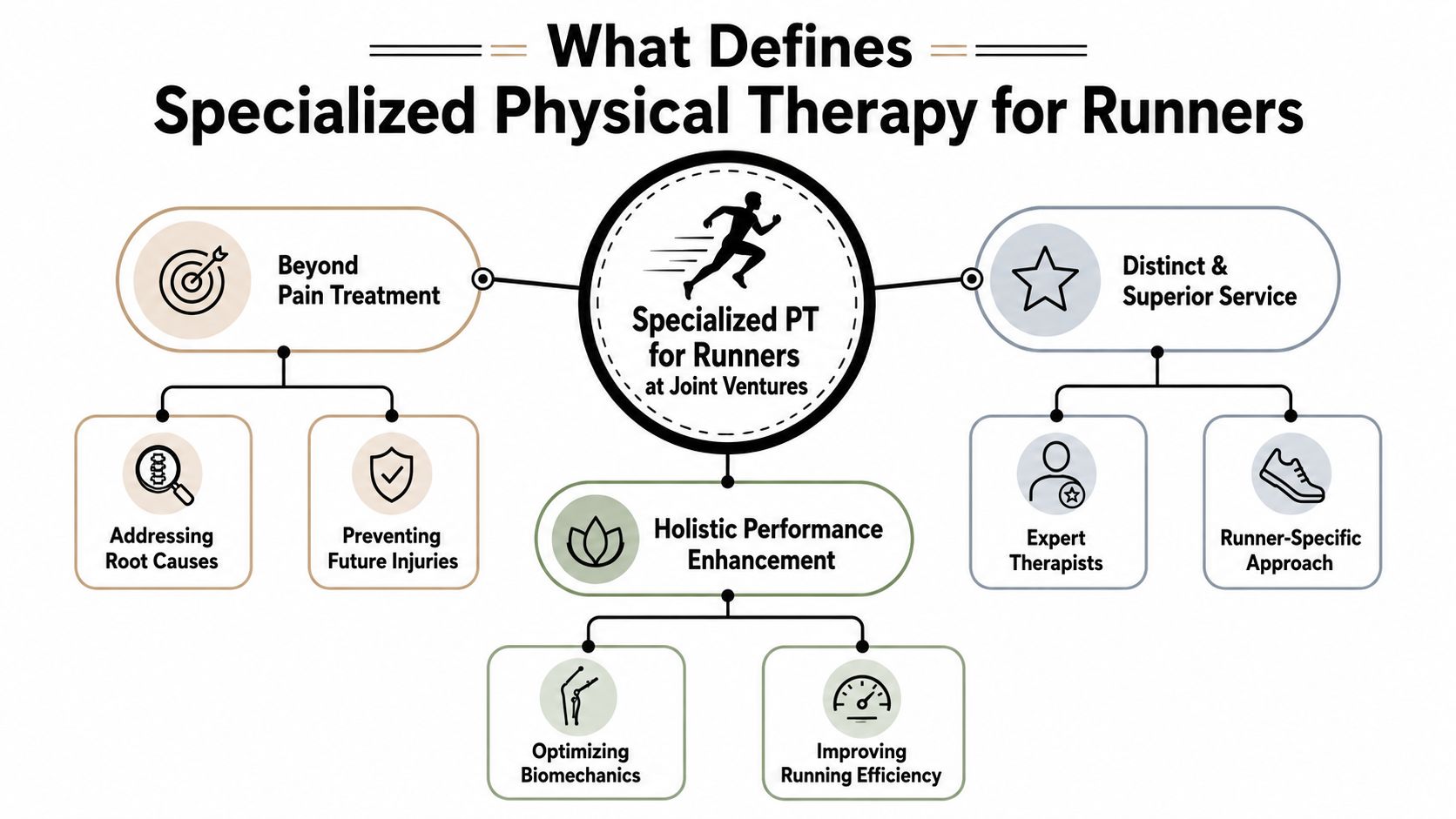
Beyond pain treatment
Specialized physical therapy for runners is built around load, tissue capacity, and running mechanics. The goal is to calm symptoms while keeping enough training in place to protect fitness and rhythm. Sometimes that means cutting volume. Sometimes it means keeping mileage but changing pace, surface, or hill exposure. Those decisions should match the irritability of the injury and the runner's actual goal.
That is different from generic orthopedic care. A marathoner with calf pain needs more than a handout and a few basic exercises. The plan should answer whether they can keep long runs, whether workouts need to shift to flatter routes, and how to rebuild tolerance without creating the same problem two weeks later.
At Joint Ventures, runner care may include a running performance evaluation in Boston to look at how strength, control, mobility, and gait connect to your training demands.
A strong runner-focused approach usually includes:
- Training modification: Adjusting mileage, intensity, terrain, and frequency based on symptom behavior, not guesswork.
- Tissue-specific strengthening: Building calf, foot, hamstring, hip, and trunk capacity so the weak link is no longer the limiter.
- Gait and movement analysis: Finding patterns that may overload one area, then deciding whether a change is useful or unnecessary.
- Recovery planning: Matching sleep, lifting, cross-training, and run scheduling to the stage of rehab.
- Return-to-performance thinking: Planning for the point when easy running feels fine, but tempos, hills, and long runs still need a progression.
Distinct care for real running goals
Boston runners usually want clear answers. Can I still run? Can I race? Do I need to stop hills for now, or just control the dose?
Those are the right questions.
A PT who works with runners should be able to sort through trade-offs. Keeping some running in the program can preserve fitness and confidence, but only if the tissue is tolerating it. Rest can settle symptoms quickly, but too much rest often creates a different problem when you try to resume normal mileage. Good rehab lives in that middle ground.
Here are the questions that shape the plan:
| Question | Why it matters |
|---|---|
| What does your training week look like right now? | Injury load often comes from the pattern of the week, not one isolated run. |
| When do symptoms start and how long do they last? | Pain at mile one, mile eight, or the next morning points to different tolerance limits. |
| What changed before the pain began? | Shoe rotation, hill volume, speed work, lifting changes, stress, and sleep all affect recovery. |
| What are you training for? | A Boston Marathon build, a local 5K, and a return to casual running each call for a different rehab timeline. |
Pelvic health can also matter more than runners expect, especially after pregnancy or during periods of pressure, leaking, or reduced impact tolerance. If that applies to you, this guide to pelvic floor therapy after birth offers a useful overview.
Specialized runner PT is specific by design. It should fit the body in front of you, the roads you run, and the race calendar you care about.
Your Comprehensive Running Assessment Explained
Your first visit should feel like an investigation, not a quick symptom check. If you come in with shin pain, a thorough assessment may spend plenty of time on your hips, calves, and feet. That isn't a detour. That's often where the answer is.
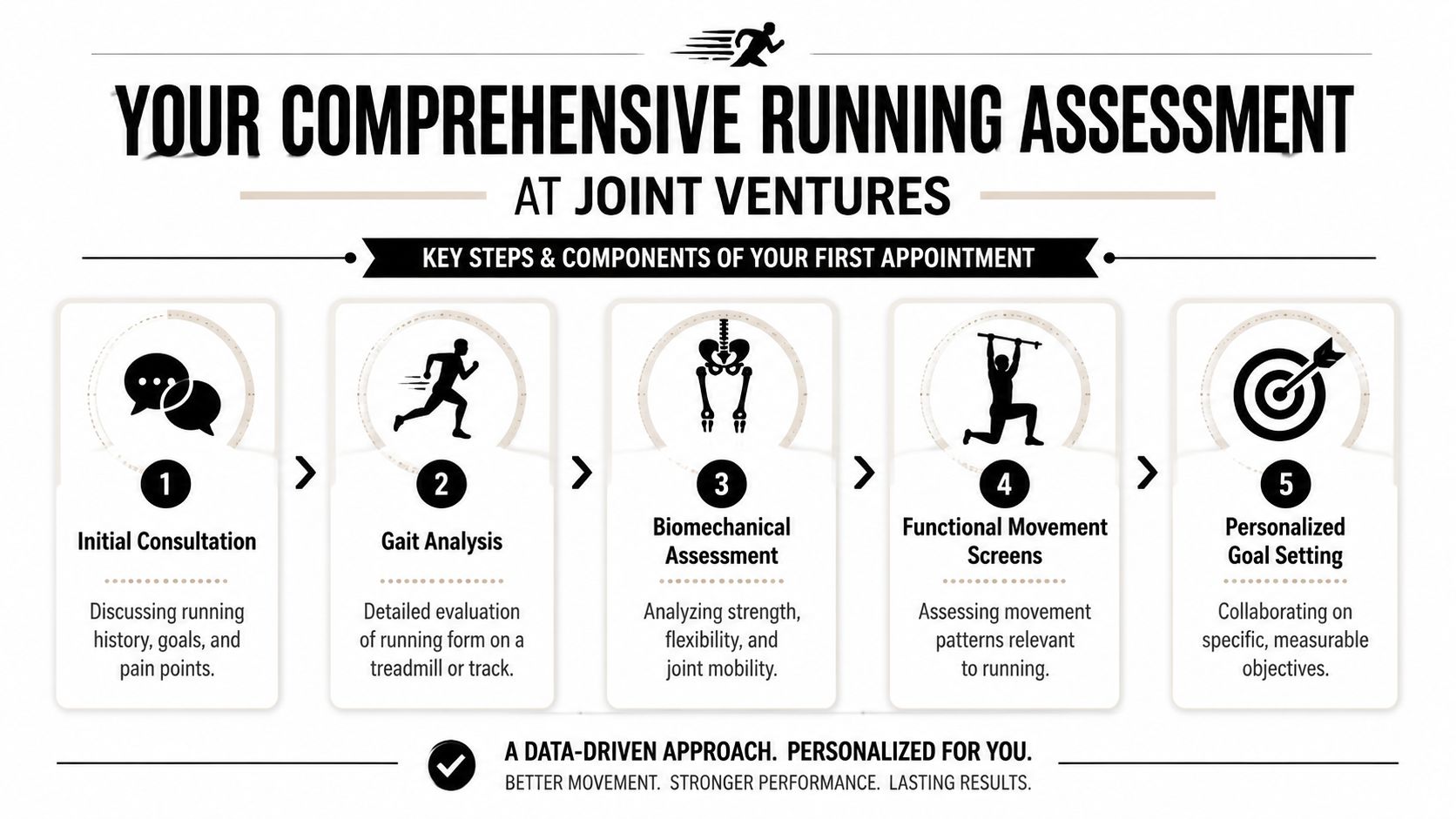
A strong runner exam looks at the full chain. A thorough evaluation assesses strength, endurance, flexibility, foot, knee, hip, and pelvis mechanics, footwear, and running gait to identify root causes of pain. That framework is especially useful for common running complaints such as patellofemoral pain, IT band irritation, shin splints, plantar fasciitis, and Achilles tendinopathy.
What happens in the room before you run
The history matters. I want to know what your weekly mileage looks like, where the pain starts, whether it warms up or worsens, what shoes you rotate, and what you're training for. A runner preparing for the Boston Marathon has different decision points than someone easing back into short Charles River loops.
Then comes the physical screen. This usually includes a mix of:
- Strength testing: Hip control, calf strength, trunk stability, and single-leg capacity.
- Mobility checks: Ankles, hips, big toe motion, and areas that may be forcing compensation.
- Endurance measures: Whether you can repeat quality movement, not just perform one clean rep.
- Footwear review: Shoes can be useful, neutral, supportive, stiff, soft, or entirely wrong for your current problem.
For a closer look at what a runner-specific visit can include, this running performance evaluation in Boston gives a practical local example.
Why gait analysis matters
Watching you run changes the conversation. Symptoms that sound identical in the intake can look very different once you're moving. One runner overstrides when fatigue sets in. Another collapses through the pelvis. Another protects a sore calf and overloads the other side.
This video gives a helpful visual sense of how movement assessment fits into runner care.
Practical rule: The site of pain tells you where the tissue is irritated. The assessment tells you why it keeps happening.
The goal isn't to create a perfect-looking stride. It's to find the few factors that matter most for your body and your training.
Advanced Treatment Techniques to Get You Back on the Road
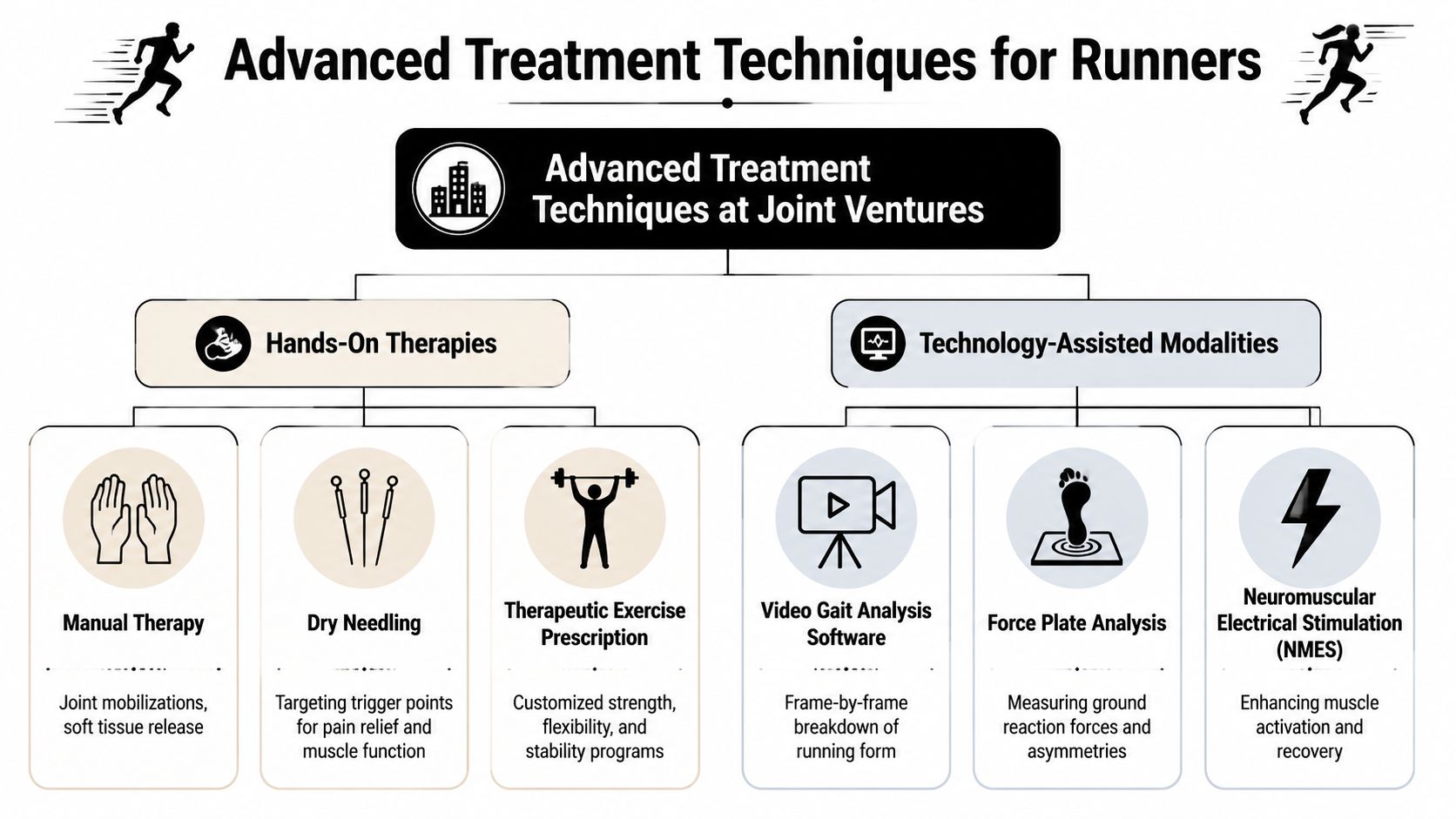
Once the assessment identifies the primary drivers, treatment should match them. That doesn't mean throwing every tool at the problem. It means using the right method for the stage of healing, the tissue involved, and the type of runner in front of you.
Manual therapy when movement is blocked
Manual therapy can help when stiffness, guarding, or pain is limiting useful motion. For runners, that might mean joint mobilization around the ankle, soft tissue work to the calf, or hands-on treatment to reduce protective tension that's altering your stride.
What it does well:
- Improves access to motion: Helpful when the body has become protective and movement feels restricted.
- Reduces irritability: Can calm a sensitive area enough for strength and gait work to become productive.
- Supports exercise progression: It works best when paired with active loading, not as a stand-alone fix.
What it does poorly is solve a capacity problem by itself. If your calf can't handle repeated push-off, massage won't build endurance.
Gait analysis and retraining when form is part of the issue
In Boston, advanced runner care often includes more detailed form analysis. At Mass General Brigham's National Running Center, gait retraining is used to adjust stride, posture, and footstrike, and runners receive a detailed report with videos, data, and recommendations. That reflects the broader shift toward quantified, motion-based care for issues like shin splints and stress fractures.
A few important trade-offs matter here:
- Changing form can help, especially if one loading pattern keeps provoking the same tissue.
- Changing too much at once can backfire, because the body has to adapt to the new strategy.
- Small cues usually work better than big overhauls, particularly in the middle of a training cycle.
At clinics such as Joint Ventures Physical Therapy, this kind of runner-focused treatment may be combined with one-on-one exercise progression and performance-oriented follow-up rather than isolated gait advice.
The best gait cue is usually the one you can hold onto when you're tired, not the one that looks clean for ten seconds on a treadmill.
Trigger point dry needling for stubborn overuse patterns
Dry needling can be useful when a runner has persistent muscle tone, protective spasm, or trigger point-driven pain that keeps interfering with normal loading. I think of it as a tool, not a plan.
It's often considered when runners describe:
- Calf tightness that returns quickly
- Deep gluteal tension that changes stride
- A hamstring or quad that stays guarded despite smart exercise
- Chronic muscle irritability that limits quality training
What works is using dry needling to open a window. Then you load the system differently with strength, coordination, and running progressions. What doesn't work is getting needled repeatedly without changing the reason the muscle keeps overworking.
Aquatic therapy when impact tolerance is low
Aquatic therapy is especially helpful when a runner needs to keep moving but can't yet tolerate normal ground reaction forces. That can matter after a stress-related injury, during a painful flare, or in an early return phase when pool running or water-based drills let you maintain rhythm without full impact.
It's also a good fit for runners who need confidence before they need intensity. Water gives them a way to rehearse mechanics, build tolerance, and keep training structure alive.
For runners who want a broader companion resource on reducing repeat problems, this overview of running injury prevention strategies is worth reading alongside a personalized rehab plan.
Performance Optimization and Smart Return-to-Run Plans
You finish an easy run on the Charles feeling decent, then wake up the next morning with a cranky Achilles or a shin that feels loaded before your first step downstairs. That pattern matters more than how the run felt in the moment.
Return-to-run decisions should match tissue capacity, training history, and the demands of Boston running. Flat treadmill miles are one thing. Handling the bridges, frequent turns, cold-weather stiffness, and late-race downhill fatigue that show up in local training is something else. At Joint Ventures, I want a runner to do more than get through one good day. I want them ready to string weeks together.
A useful progression has clear rules and enough flexibility to fit real training.
- Start with the right format: Run-walk intervals work well when continuous running still pushes symptoms too far.
- Control the setting first: Use flat, predictable routes before adding hills, camber, or uneven river paths.
- Build volume before speed: Easy mileage usually returns before tempo work, hills, and long intervals.
- Track the full response: Pain during the run, soreness later that day, and the next-morning baseline all help decide the next step.
- Match the plan to the injury: Bone stress injuries, tendon pain, postpartum return, and post-marathon flare-ups each need different loading progressions.
That last point is where runners often get in trouble. A calf that tolerates twenty easy minutes may not tolerate uphill work in Brookline or a fast finish on tired legs. A knee that feels fine on fresh pavement may react after back-to-back days. Good planning respects those trade-offs instead of guessing.
Performance work also matters for runners who are training, not injured. Boston runners usually notice the same patterns. Form falls apart late in a long run. One side takes more load on descents. Cadence drops as fatigue builds. Those issues rarely need rest alone. They usually improve with targeted strength work, stride adjustments, and a training plan that matches the runner in front of us.
For athletes preparing for spring racing, this guide to Boston Marathon physical therapy training shows how rehab, race build-up, and performance work often overlap in this city.
Readiness shows up in repeatability. If you can run, recover, and run again without symptoms building each time, the plan is working. That is how runners get back to consistent mileage and often come back stronger than they were before the setback.
Booking Your Visit at Joint Ventures in Boston
Once you decide to get a nagging issue checked out, the process should be simple. Good runner care starts before the first exercise. It starts with choosing a location that fits your actual routine, whether that means before work in Back Bay, near Fenway, or close to downtown.

What to do before day one
Bring the basics that make the visit more useful from the start.
- Running shoes: The pair you use most often, plus any alternate shoe if you rotate.
- Comfortable clothes: Shorts or fitted athletic wear help with movement assessment.
- Relevant records: Imaging reports or referral notes if you have them.
- Training details: A recent sense of mileage, workouts, and symptom timing is more useful than trying to remember on the spot.
If you're booking around work, commute, or game-day traffic, it can also help to choose a clinic close to where you already spend time. Runners near Fenway may find this page on physical therapy near Fenway Park useful when deciding what's most convenient.
Choosing the right Boston location
Joint Ventures serves runners across key Boston neighborhoods, including Back Bay, Kenmore Square, Fort Point and Seaport, Downtown Boston, and nearby communities. The most important factor is often practical consistency. The best clinic is usually the one you can get to for follow-up without turning rehab into another logistical stressor.
A few examples of who tends to prefer each area:
| Location area | Often convenient for |
|---|---|
| Back Bay | Runners working nearby, commuters, and people training along the Charles |
| Kenmore Square | Fenway-area residents, students, and runners already moving through the BU corridor |
| Fort Point and Seaport | Professionals working in the Seaport and runners who want care near home or office |
| Downtown Boston | Commuters using central transit routes and people who want midday appointment flexibility |
What to expect from the admin side
The experience shouldn't feel confusing. A strong front desk team can help verify insurance, sort through scheduling options, and reduce friction before the evaluation. That matters more than people realize. If booking is hard, runners delay care, and delayed care often means a smaller problem becomes a training interruption.
The first appointment should also leave room for questions. If you're training for a race, say that up front. If your main concern is being able to run the Esplanade without limping later, say that too. Your plan works better when it reflects your real goal.
Take the Next Step in Your Boston Running Journey
Running in Boston asks a lot from your body. The surfaces are unforgiving, the culture is ambitious, and most runners here don't need more motivation. They need a plan that makes sense for how they train.
That's why physical therapy for runners in Boston should be specific. It should look at movement, training load, strength, gait, recovery, and the trade-offs that determine whether you can keep building without tipping back into pain. Good rehab doesn't just calm symptoms. It helps you run with more confidence and more resilience.
Whether you're dealing with recurring shin pain, trying to trust your leg again after time off, or aiming to train smarter for your next race, specialized support can change the whole trajectory of your season. For deeper educational content on running injuries, anatomy, and recovery principles, visit Highbar Health.
If you're ready for a runner-specific evaluation in Boston, book with Joint Ventures Physical Therapy. Choose the location that fits your routine, bring your running shoes, and come in with your real goal. Whether that's getting back to easy miles on the Charles or preparing for your next Boston Marathon build, the right plan starts with a thorough assessment.