
That slight hip pinch usually starts small. You feel it on the first mile along the Charles, when you stand up after a long block of meetings in the Financial District, or when you test a faster pace and realize your stride doesn’t feel clean anymore.
Most active people in Boston don’t stop right away. They adjust. Shorten the run. Skip the hill session. Sit on an ice pack. Hope it settles down before the next long run, rec league game, lift, or commute-heavy workweek. Sometimes that works. Often it doesn’t.
Hip pain physical therapy Boston patients need isn’t just about reacting after an injury gets serious. It should also help active residents catch movement problems early, train more intelligently, and stay consistent through marathon prep, weekend tennis, cycling, strength classes, and everyday city life.
The Active Bostonian’s Hip Pain Problem
Boston asks a lot from your hips. Pavement miles on the Esplanade, stair-heavy commutes, spin classes in Back Bay, tight office chairs in Seaport, and the usual urge to do more because the weather finally looks good. Even if you’re in solid shape, that mix can expose weak links quickly.
The biggest issue is that many people wait until pain forces the decision. By then, the hip is often only part of the story. The underlying cause may be reduced hip mobility, poor single-leg control, overloaded hip flexors, underperforming glutes, or a training jump your body didn’t absorb well.
Why active Bostonians get stuck
A lot of local rehab content focuses on recovery after something already went wrong. That leaves a gap for runners, lifters, court-sport athletes, and active professionals who want to stay ahead of trouble. One review of the market notes that most Boston PT content focuses on post-injury recovery, but rarely addresses preventative screening for athletes and active individuals, even though 60 to 70% of running injuries stem from biomechanical inefficiencies that could potentially be identified and corrected through preventative physical therapy in that analysis from The Method PT on targeted treatment and movement issues.
That matters if you run before work, train for the Boston Marathon, or just want to make it through a full week of activity without your hip talking back.
Practical rule: If your hip only hurts during one activity, don’t dismiss it. Activity-specific pain often points to a movement or load problem before it becomes an all-day problem.
Prevention is more useful than waiting
Preventative care doesn’t mean babying your body. It means checking the pieces that usually break down first:
- Stride mechanics: Hip pain during running often tracks with how your body absorbs force.
- Workstation habits: Long sitting can leave the front of the hip stiff and the glutes underactive by the end of the day.
- Strength balance: A strong squat number doesn’t always mean good hip control on one leg.
- Mobility quality: More stretching isn’t always the answer. The right mobility in the right direction matters more.
If running is part of your week, this local guide to physical therapy for runners in Boston is a useful next read because it connects those movement issues to Boston-specific training habits.
A better plan starts before the hip pain becomes the reason you skip what you enjoy.
Smart Starts Effective Warm-Ups and Cool-Downs
A rushed start is one of the easiest ways to irritate an already cranky hip. The body doesn’t love going straight from desk posture to tempo run, pickup basketball, or heavy lower-body lifting. If your hips feel stiff at the start and better ten minutes later, that’s not a reason to ignore warm-ups. It’s a reason to take them seriously.

A warm-up that fits real Boston schedules
You don’t need a thirty-minute routine. You need something short enough to do consistently and specific enough to matter.
Use this before a run on the Charles, a gym session in Kenmore, or a fast walk to South Station:
Brisk walk or easy spin
Start with a few minutes of easy movement. The goal is simple. Raise body temperature and get out of static posture.Leg swings
Swing front to back, then side to side. Keep the motion controlled. This starts opening the hip without forcing it.Walking lunges with reach
Add a gentle overhead reach on each step. That opens the front of the hip and gets the trunk involved.Glute activation
Mini-band lateral walks or bodyweight bridges work well here. If the glutes don’t wake up, the hip flexors often take over.A few rehearsal reps
Before your workout, do a few easy versions of the activity. For runners, that might mean a few short relaxed pickups. For lifters, it means lighter setup sets.
Cool-downs that actually help
The cool-down is where many active people in Boston do nothing, then wonder why they feel locked up later. After hard effort, your nervous system and tissues need a cleaner off-ramp.
A useful cool-down is quieter and slower:
- Easy walk: Bring intensity down gradually instead of stopping cold.
- Hip flexor stretch: Good for the front of the hip after sitting and running.
- Figure-four stretch: Helpful if the outer hip or glute feels loaded.
- Adductor rock-back: A simple option if the inner thigh and groin area feel tight.
- Calm breathing: A minute or two helps your body shift out of go mode.
If a stretch creates pinching in the front of the hip, stop forcing it. Hip mobility work should create space, not compression.
What works and what usually wastes time
A better warm-up is dynamic. A better cool-down is controlled. Mixing those up is common.
| Phase | Better choice | Usually less helpful |
|---|---|---|
| Before activity | Dynamic movement and activation | Long passive stretching |
| After activity | Easy movement and targeted stretching | Dropping straight into the car or desk chair |
Done well, these bookends reduce the jolt from city life to athletic effort and back again. That’s a small habit with a big payoff.
Building Resilience with Hip Strengthening and Mobility
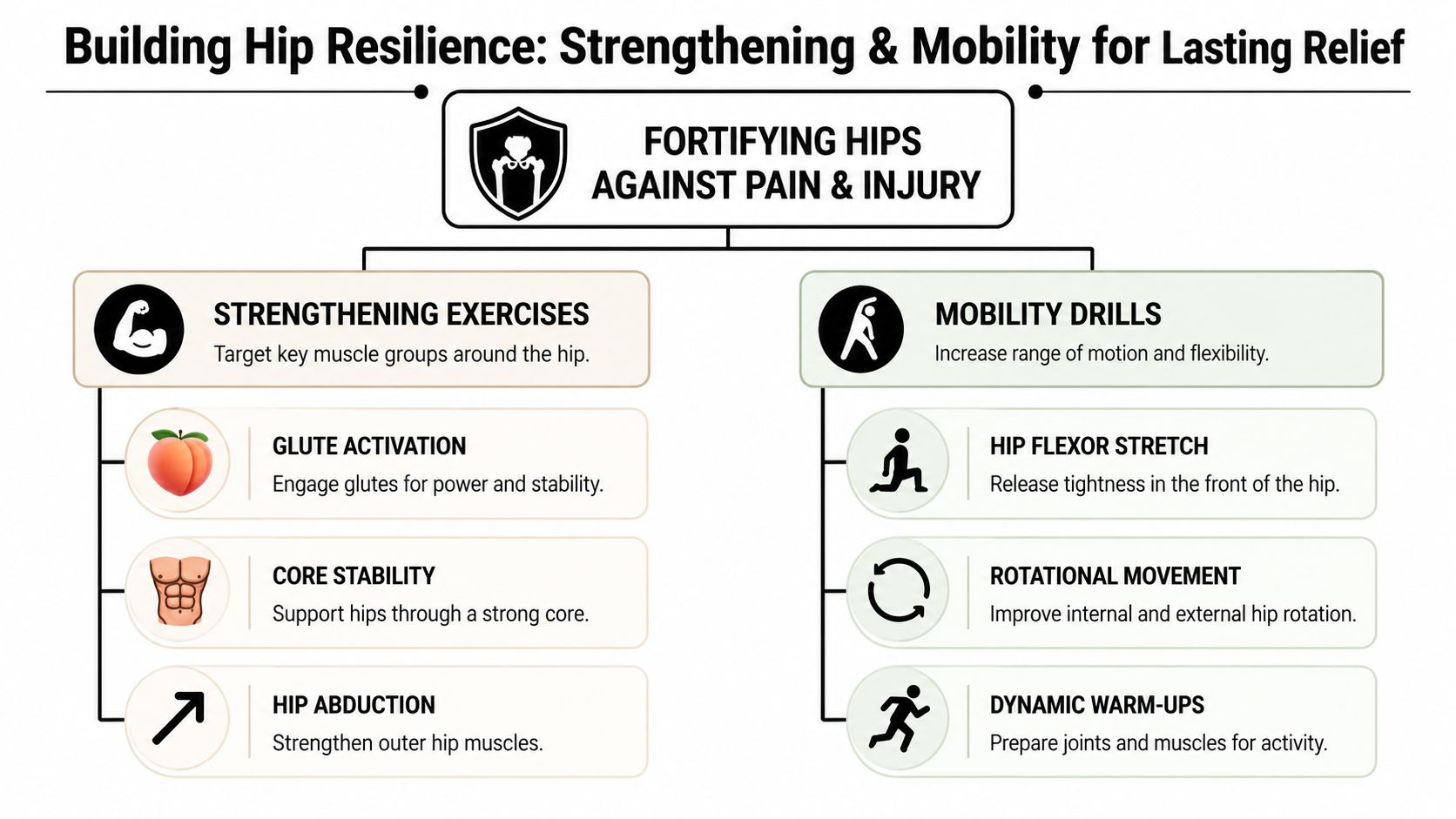
Hip pain usually improves when you build both control and usable motion. One without the other is where many home programs fall apart. People stretch a stiff hip but never strengthen the system around it, or they hammer strengthening drills while moving through poor positions.
Research supports the combined approach. In one review, manual therapy plus exercise showed an 81% success rate compared with 50% for exercise alone in hip pain care, as summarized in this research review on multimodal hip treatment. That doesn’t mean everyone needs hands-on treatment, but it does show that a more complete plan tends to outperform a one-dimensional one.
Strength drills worth keeping
The goal here isn’t novelty. It’s transfer to real movement.
Single-leg glute bridge
Lie on your back with one foot planted and the other leg lifted. Drive through the planted foot and keep the pelvis level. This builds posterior chain strength and exposes side-to-side differences quickly.Lateral band walks
Place a band around the ankles or just above the knees. Stay tall, keep tension on the band, and step without letting the knees cave inward. This helps the glute medius do its job when you run, climb stairs, or change direction.Step-downs
Stand on a low step and slowly lower the opposite heel toward the floor. Watch the stance knee and pelvis. This is one of the clearest ways to train hip control in a pattern that resembles life outside the clinic.Side plank with top-leg lift
This combines trunk stability with hip abductor work. It’s demanding, which is exactly why it helps active adults who need the hip and core to cooperate under load.
Mobility drills that usually earn their place
Mobility should help you move better, not just feel stretched.
90/90 hip rotations
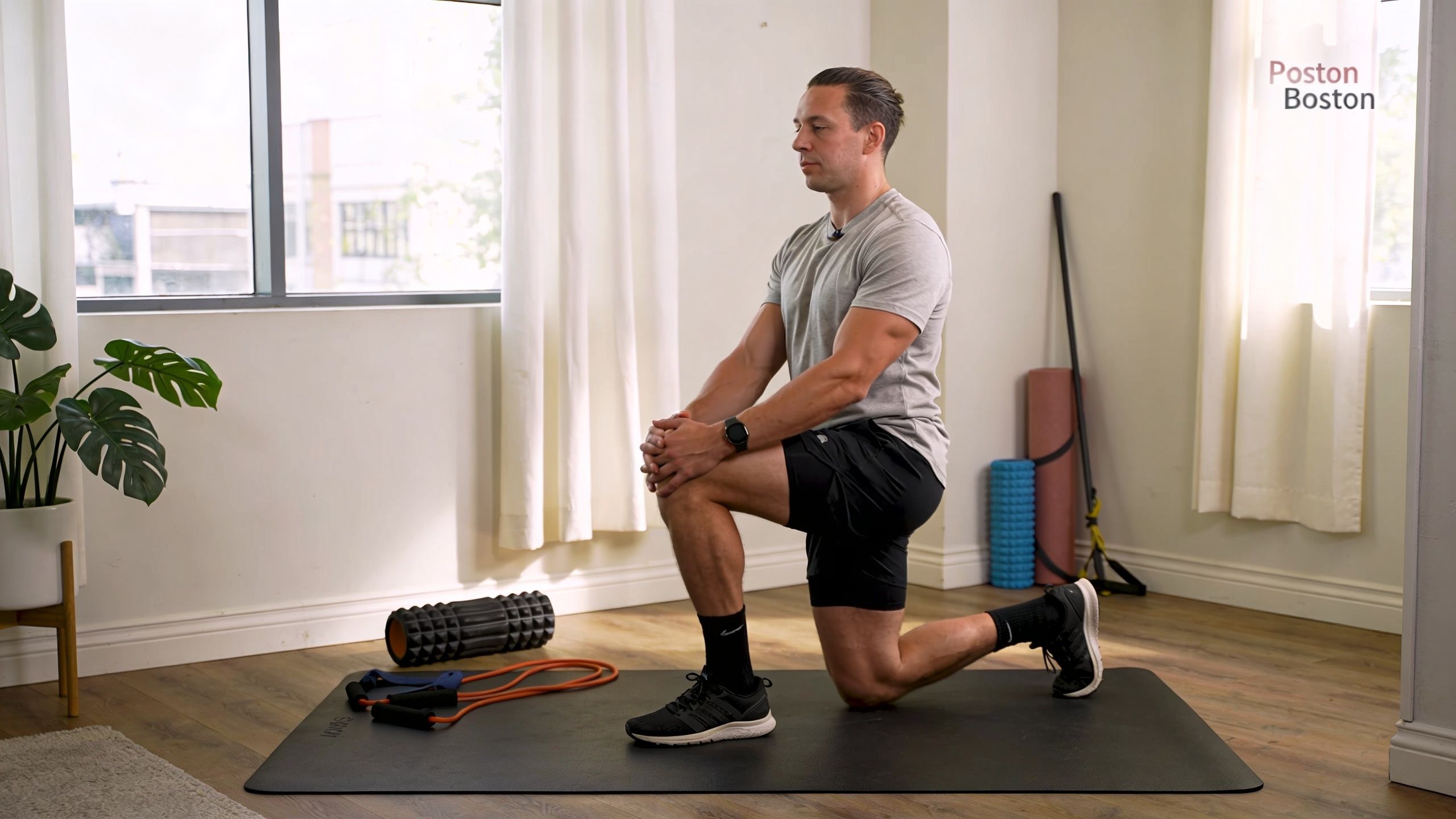
Sit with one leg in front and one behind, both bent. Rotate between sides with control. This targets hip rotation, which is often limited in people with lingering stiffness.Half-kneeling hip flexor stretch
Tuck the pelvis slightly and shift forward without arching the low back. This is more effective than cranking into a big lunge.Frog rock-backs
Knees wide, feet behind you, then rock back slowly. This can help if adductor stiffness is part of the restriction.Quadruped hip circles
On hands and knees, move one hip through a slow circle. Done well, this improves awareness and controlled range.
Better hip programs don’t chase fatigue. They build cleaner movement, then load it.
Where guidance matters
The right exercise is the one your body can perform well enough to train the problem, not aggravate it. That’s why movement screening matters. If you work with a coach or trainer alongside PT, broad standards like this pro's checklist for trainers can help you think about qualifications and oversight in a more practical way.
For a deeper look at movement options, this Joint Ventures article on how to improve hip mobility is a helpful local companion.
One useful option in Boston is Joint Ventures Physical Therapy, which offers one-on-one care and performance services such as Running Performance evaluations. That kind of setup can make sense when you need exercise progressions tied to real goals, like getting back to marathon training or lifting without pinching.
Pacing for Boston's Pace A Guide to Load Management
Boston athletes are good at pushing through. That mindset helps in bad weather and long training blocks. It also causes plenty of hip flare-ups.
The problem usually isn’t effort. It’s timing. A hip that tolerates a certain amount of running, lifting, or court time can still get irritated when the jump in demand outpaces what the tissue can handle.
Why pacing matters more than motivation
A smart plan respects what your hip is ready for this week, not what your calendar says you should be doing. Research on hip-focused care found that 46% of participants achieved substantial disability improvement, and hip-focused treatment also produced stronger gains in chair-rise performance and walking endurance at 8 weeks and 6 months, according to the University of Delaware summary of the MASH trial.
That matters because better function usually comes from appropriate progression, not from alternating between overdoing it and shutting everything down.
A simple way to manage load
Use a few decision rules:
- Change one variable at a time: If you increase mileage, don’t also add hills and speed in the same week.
- Watch the next-day response: Mild soreness that settles is different from pain that lingers, sharpens, or changes your gait.
- Keep rest days productive: Recovery days can still include walking, mobility, or light strength work.
- Respect work stress and sleep: A heavy week at the office changes recovery, even if your training plan doesn’t.
What overreaching usually looks like
Some patterns show up again and again in active Boston patients:
| Pattern | What happens |
|---|---|
| Big weekend effort after a sedentary week | Hip gets overloaded without enough base work |
| Fast return after a flare | Symptoms settle briefly, then rebound |
| Constant testing | Every run becomes an experiment instead of training |
| Ignoring non-training load | Commute, standing, travel, and poor sleep add up |
The best training block is the one you can actually continue. A heroic week followed by two compromised weeks isn’t a win.
If you’re training for a race, getting back to lifting, or trying to stay active through a demanding work schedule, pacing is a skill. It protects the gains you earn.
When to See a PT Recognizing Hip Pain Red Flags
Some hip discomfort is normal after a hard effort. Sharp, stubborn, or escalating pain isn’t something to just stretch through. The challenge is knowing the difference.
A good rule is to look at pattern, not just intensity. Muscle soreness tends to feel broad, predictable, and better as you warm up or recover over a day or two. More concerning hip pain often feels specific, mechanical, or increasingly limiting.
Should You See a Physical Therapist for Your Hip Pain?
| Symptom | Okay to Monitor at Home | See a Joint Ventures PT |
|---|---|---|
| General soreness after an unusually hard workout | Yes, if it improves steadily | If it keeps returning with normal activity |
| Mild stiffness after sitting | Yes, if movement loosens it quickly | If stiffness becomes daily or starts affecting walking or exercise |
| Sharp pinching in the front of the hip | Not ideal to self-manage for long | Yes |
| Pain that changes your stride | No | Yes |
| Pain that wakes you at night | No | Yes |
| Pain that radiates down the leg | No | Yes |
| Clicking, catching, or giving-way sensations with pain | Monitor briefly at most | Yes |
| Symptoms that block running, lifting, or stairs despite rest | No | Yes |
What evidence-based care usually looks like
Hip pain physical therapy Boston clinicians use shouldn’t be random. Clinical guidance for hip pain and mobility deficits describes structured care built around manual therapy combined with exercise at a frequency of 1 to 5 times per week for 6 to 12 weeks, with manual techniques such as thrust mobilization, nonthrust mobilization, and soft tissue release often used early, followed by progressive flexibility and strengthening work, according to Physiopedia’s summary of hip pain and mobility deficit guidelines.
That kind of plan is more useful than generic advice like “rest and stretch.” It gives the hip a progression.
What doesn’t work well
- Waiting through repeated flare-ups: If the same pain keeps coming back, your body is telling you the current strategy isn’t solving the cause.
- Only treating the sore spot: Hip symptoms can be driven by trunk control, gait mechanics, or movement restrictions above and below the joint.
- Going straight to worst-case thinking: Not every catch or pinch means surgery.
If you’re dealing with labral concerns and wondering where conservative care fits, this local piece on management of labral tears in the hip and shoulder and whether surgery should still be the gold standard is worth reading.
If your hip pain is changing how you move, it’s time for a professional assessment. Waiting usually teaches your body the wrong compensation.
Your Path to Pain-Free Movement with Joint Ventures
A strong first visit should leave you with more clarity, not more confusion. If you come in from Back Bay, Kenmore Square, Downtown Boston, or Fort Point after weeks of modifying workouts, you should walk out understanding what’s driving the pain, what activities you can keep doing, and what needs to change now.
That’s especially important with hip pain because the physical side isn’t the whole picture. Research on chronic hip-related pain highlights the role of fear of movement, pain catastrophizing, and pain self-efficacy, and describes integrated mind-body approaches as an important evolution in care, as discussed in this PMC article on psychological factors in hip pain rehabilitation.
What a useful evaluation should address
A thorough evaluation for an active Boston resident often includes:
- Your real goal: Running the Boston Marathon, getting through a workday without limping, returning to squash, or lifting confidently again.
- Movement testing: Not just where it hurts, but how you squat, step, rotate, balance, and control load on one leg.
- Lifestyle friction: Sitting all day, long commutes, uneven sleep, and the usual challenge of fitting rehab into an already busy week.
- Confidence with movement: Some patients need reassurance that the hip can handle graded loading again.
That last point matters more than people think. A hip can become less painful while you still don’t trust it. If you’ve started avoiding hills, longer walks, or faster running because you’re waiting for certainty, rehab has to rebuild confidence as well as strength.
Why local fit matters
Boston care should fit Boston life. Convenient scheduling, locations near where you live or work, and clinicians who understand local running and training culture make follow-through easier. That’s part of why local healthcare businesses invest in visibility and trust-building. From a marketing perspective, this overview of attracting high-intent chiropractic patients is a useful example of how location-specific healthcare content helps patients find the right kind of care faster.
For broader education on injury anatomy, recovery, and performance topics that go deeper than this local guide, visit Highbar Health.
If your hip pain has started shaping your schedule, your workouts, or your confidence, getting it assessed early is usually the cleaner path.
If you’re ready for a clearer plan, book an evaluation with Joint Ventures Physical Therapy. With one-on-one care across Greater Boston, including Back Bay, Kenmore Square, Fort Point/Seaport, Downtown Boston, and nearby neighborhoods, the team can help you sort out what your hip is telling you and build a practical path back to strong, confident movement.