
If you've noticed a lingering "pooch" or a gap in your stomach muscles after pregnancy—or even from years of intense training—you are definitely not alone. We see it all the time. The great news is that specialized diastasis recti PT treatment is the gold standard for healing this separation. It's a proven, non-surgical approach that helps rebuild your core from the inside out, and we’re here to guide you through it.
Your Guide to Healing Diastasis Recti with Physical Therapy
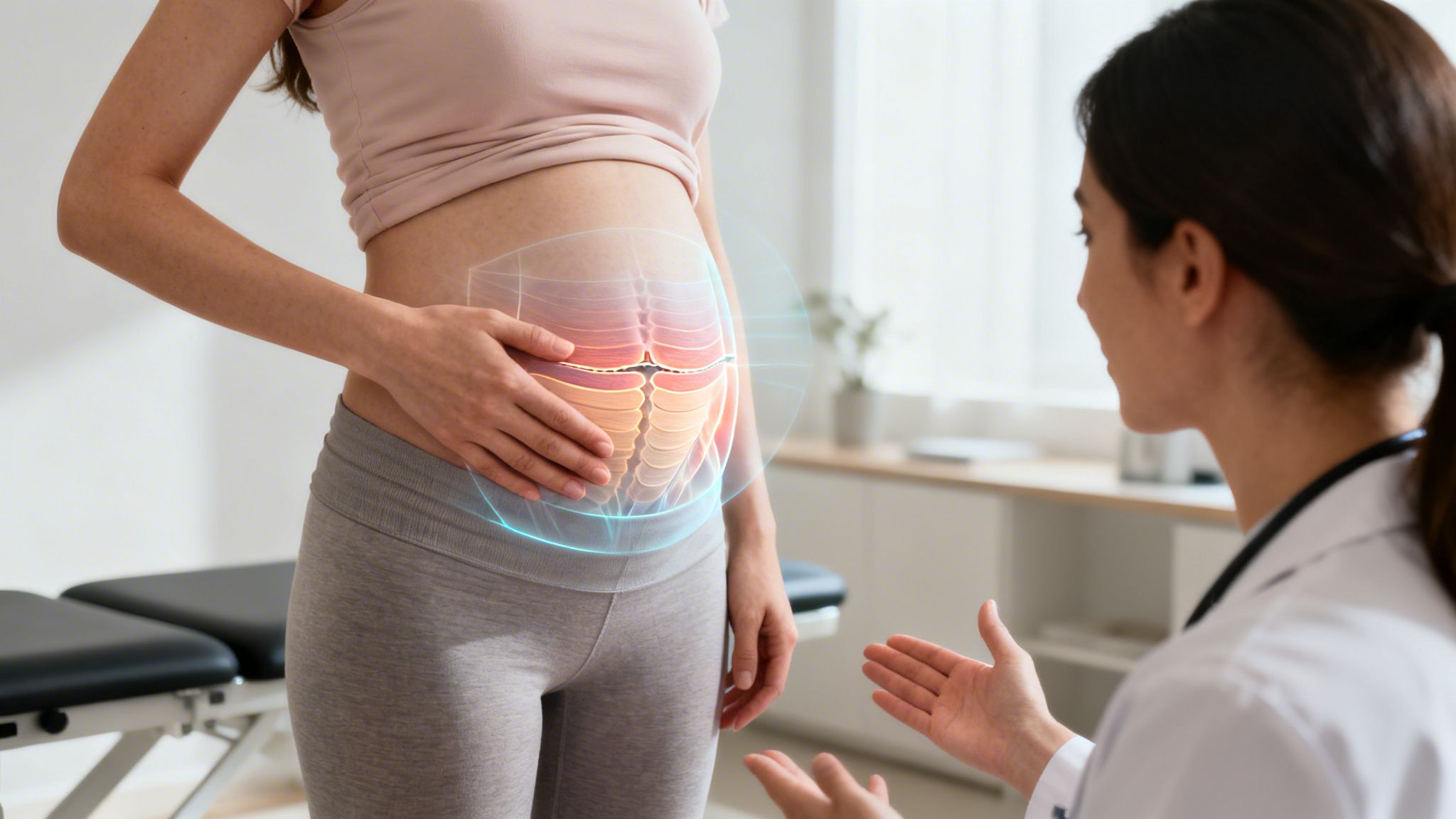
Here at our clinic, we work with people dealing with Diastasis Recti Abdominis (DRA) every single day. It's an incredibly common condition, yet it's surrounded by myths and confusing, often conflicting, advice you find online.
So many of our patients come to us having been told to "just live with it" or, even worse, to start doing hundreds of crunches—an exercise that can actually make the separation more pronounced.
We're here to set the record straight: you absolutely do not have to live with it. A focused, expert-led physical therapy program can make a world of difference in how you look, feel, and function. We've seen it happen time and time again.
What Is Diastasis Recti, Really?
Diastasis recti is the stretching and thinning of the linea alba—that's the connective tissue running right down the middle of your abdomen. This stretching causes the two sides of your rectus abdominis (the "six-pack" muscles) to move farther apart.
During pregnancy, this is a completely normal and necessary adaptation to make room for a growing baby. The issue arises when that tissue doesn't regain its tension and the gap doesn't narrow on its own after delivery. While most common postpartum, we also see it in men and women who haven't been pregnant, often due to improper pressure management during heavy lifting or certain exercises.
Key Insight: Healing diastasis recti isn't just about "closing the gap." The real goal is to restore tension and function to the linea alba and the entire core system, so it can properly support your body. That's what truly makes you strong.
The Power of Specialized PT Treatment
This is where a knowledgeable physical therapist becomes your greatest ally. We look beyond just the gap and assess the entire "inner core" system. This isn't just your abs; it's a team of muscles that includes:
- The Diaphragm: Your main breathing muscle.
- The Pelvic Floor: The muscular sling supporting your pelvic organs.
- The Multifidus: Tiny, but mighty, muscles that stabilize your spine.
- The Transversus Abdominis (TrA): Your deepest abdominal muscle that acts like a natural corset.
These muscles have to work together to manage pressure inside your abdomen. A proper diastasis recti PT treatment program teaches you how to coordinate them again, and it all starts with your breath.
The table below breaks down the essential components of our approach.
Quick Guide to Diastasis Recti PT Treatment
| Component | What It Is | Why It's Important |
|---|---|---|
| Comprehensive Assessment | Measuring the gap width and depth, assessing linea alba tension, and performing functional movement screens. | Establishes a baseline, identifies specific weaknesses, and ensures the program is tailored to your body's exact needs. |
| Breath & Core Coordination | Learning to sync your diaphragm and pelvic floor with deep abdominal muscle activation (the Transversus Abdominis or TrA). | This is the foundation. It retrains your core to manage pressure correctly, which is essential for creating tension in the linea alba. |
| Progressive Exercise | A carefully sequenced program that starts with foundational activations and gradually builds to more complex, functional movements. | Prevents you from doing "too much, too soon." It safely builds strength and stability without causing doming or coning. |
| Functional Integration | Applying core strategies to everyday movements like lifting your baby, carrying groceries, or returning to exercise. | The goal isn't just to do exercises on a mat; it's to make your core strong and reflexive for real life. |
This holistic strategy is designed to create lasting changes, not just temporary fixes.
Research consistently backs this up. Diastasis recti affects a huge number of postpartum women, with some studies showing a prevalence as high as 60-100% right after birth. A major review of 77 studies confirmed that exercise therapy is the cornerstone of effective PT. It specifically highlighted targeting deep core muscles like the TrA to reduce the gap and, more importantly, improve how you feel and function in your daily life. You can explore these findings further on the National Institutes of Health website.
Instead of jumping into aggressive ab work, we guide you through a deliberate process. We help you reconnect your brain to these deep, foundational muscles first. This ensures you regain true core control, feel strong again, and get back to the activities you love with confidence.
What to Expect at Your First Diastasis Recti Assessment
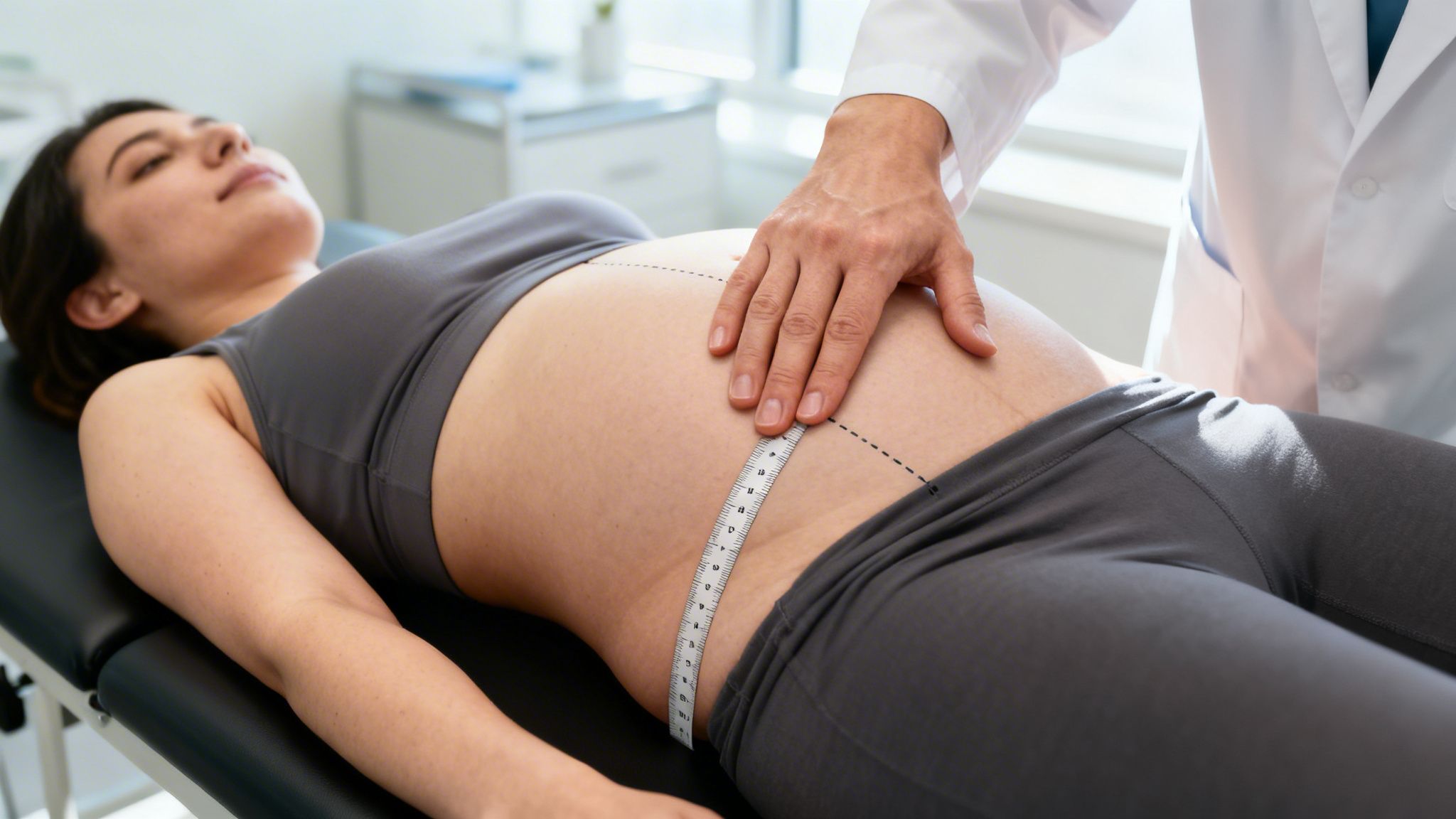
Before we can build a plan to help you heal, we need to get to know you and your body. For a condition as personal as diastasis recti, a generic program just won’t work. A thorough, one-on-one assessment is the only way to create a plan that actually gets you the results you deserve.
Let's walk through what happens during that first visit. We want you to feel completely comfortable and know exactly what’s coming—no surprises, just a clear path forward.
Measuring What Matters Most
A key part of your first appointment is measuring the separation, what we call the inter-recti distance (IRD). You might have tried the "finger width" test at home, which is a fine way to check in, but a clinical evaluation gives us a much clearer, more reliable picture.
We’re not just looking at the width of the gap. What we’re really interested in is the quality and tension of the tissue within that gap.
We'll assess:
- Width: We’ll measure how wide the separation is at a few key points, usually above, at, and below your belly button.
- Depth: We gently feel how soft or firm the connective tissue (the linea alba) is. The goal is to be able to create tension there.
- Tension: When you gently engage your core, does that tissue firm up? This is a critical sign of a functional core.
The goal of diastasis recti PT treatment isn't just to close the gap. It's to restore the core's ability to generate and manage tension, which is what gives you true strength and stability.
Looking for Clues in Your Movement
Beyond measuring the gap at rest, we need to see how your core responds to movement. This is where we look for common compensation patterns, particularly "doming" or "coning."
This is when the middle of your abdomen bulges outward into a ridge. It’s a tell-tale sign that your deep core isn't quite managing the pressure inside your abdomen during a specific movement. It's not a bad thing; it's just information that tells us where to start.
We might ask you to do some very simple movements, like:
- A small head lift while lying on your back.
- Lifting both legs.
- A gentle, controlled twist.
This isn’t a test you can pass or fail. It simply helps us see your body’s current strategy so we can find the perfect starting point for your exercises.
Seeing the Whole Picture
Diastasis recti rarely happens in isolation. The core is an integrated system, so a separation of the abdominal wall can have a ripple effect on your entire body. A huge part of our job is screening for these related issues because we believe in treating the whole person, not just a symptom.
Everything is connected. We’ll talk about and assess for things like:
- Pelvic floor dysfunction: Any leaking, urgency, or pelvic pain.
- Back pain: An unstable core often forces back muscles to work overtime.
- Breathing patterns: Many people develop shallow, chest-breathing habits that hinder core recovery.
- Posture and alignment: How you carry yourself all day directly impacts your core.
This comprehensive approach is where our one-on-one care really makes a difference. Unfortunately, this isn't the norm out there. One study found that while over 80% of postpartum women had symptoms of diastasis, only 9% ever received a formal diagnosis. We find that unacceptable. People are often left feeling lost, and that’s just not right.
We take the time to listen and connect the dots. We're here to make sure your treatment plan is built for your body, your symptoms, and your goals. To feel even more ready for your visit, check out our guide on how to prepare for your first physical therapy appointment.
Building Your Core Foundation with Breathwork
We’ve assessed your core, and now the real work begins. But it’s probably not what you’re thinking.
If you’re imagining endless crunches and intense ab workouts, I want you to hit pause. The very first, non-negotiable step in any effective diastasis recti PT treatment is rebuilding from the ground up. And it all starts with something you’re already doing: breathing.
This isn’t just about getting air in and out. It’s about reconnecting your brain to your body’s deepest support system. This foundational phase might not seem flashy, but mastering it is the secret to a genuinely strong and functional core. I promise.
Master Diaphragmatic or “360” Breathing
The first thing we teach is what’s known as diaphragmatic, or “360” breathing. So many of us fall into a pattern of shallow chest breathing, especially when we're stressed, tired, or in pain. We have to break that cycle.
Instead of seeing your shoulders rise and fall with each breath, I want you to think about your breath as an expansive force. As you inhale, your diaphragm—that big dome-shaped muscle under your lungs—should lower. This action will gently push out your belly, your sides, and even your low back. It’s like you’re inflating a small balloon in your midsection in all directions.
Then, on the exhale, you just let it all go. This simple act is your first tool for managing intra-abdominal pressure, which is absolutely critical for allowing that linea alba to heal.
Connecting Your Breath to Your Pelvic Floor
Once you get the hang of the 360 breath, the next step is linking it to your pelvic floor. These two muscle groups are designed to work together in a beautiful rhythm, almost like a piston.
- On your inhale: As your diaphragm goes down and your belly expands, your pelvic floor muscles should also gently relax and lengthen downward.
- On your exhale: As your diaphragm rises, your pelvic floor should naturally and gently lift and contract.
Think of it as a very subtle "lift" from inside your pelvis on the exhale. This is a coordination that many people lose, especially after pregnancy and childbirth. Re-establishing this rhythm is fundamental before we can layer on any other strengthening. You can learn more about this connection by reading about what postpartum pelvic floor therapy involves on our blog.
Finding Your Transversus Abdominis (TrA)
Now, let's introduce the star of the show: your Transversus Abdominis (TrA). This is your body's innate corset. It’s the deepest abdominal muscle you have, wrapping all the way from your back to your front to create stability. Activating it correctly is how we create the healthy tension needed to bring the two sides of your rectus abdominis back toward the midline.
Finding this muscle can be tricky at first. This is not about sucking your stomach in or aggressively hollowing out. It’s a much gentler feeling.
Try this while lying on your back with your knees bent: Take a relaxed 360-degree inhale, letting your belly expand. As you start a long, gentle exhale, think about one of these cues:
- "Gently hug your baby."
- "Imagine you're zipping up a low-rise pair of pants."
- "Think about bringing your two hip bones slightly closer together."
You should feel a subtle, low-level tension deep in your lower belly, well below your "six-pack" muscles. It’s a feeling of support, not a hard, bracing contraction. This is the connection we will build everything else on.
It's also important to recognize that a successful recovery often involves addressing related issues. For instance, understanding pelvic floor dysfunction can provide crucial context, as it frequently co-exists with diastasis recti.
Mastering this breathwork and TrA connection is the most powerful thing you can do to start your recovery. It lays the groundwork for every single exercise we'll add later, ensuring your core heals in a way that is strong, functional, and supportive for life.
How We Progress Your Diastasis Recti Exercises
Once you've nailed that foundational connection between your breath and your deep core, it’s time to start building real, functional strength. This is where we move past the basic activation drills and begin the careful, strategic work of progressing your exercises.
Let’s be honest: our goal isn't just to "close the gap." Of course we want to improve the integrity of your linea alba, but our real focus is on restoring your function and control. We want you to feel strong, stable, and completely confident in your body, whether you're picking up your toddler or heading back to the gym.
This is the core engagement sequence that underpins every single exercise we'll do together.
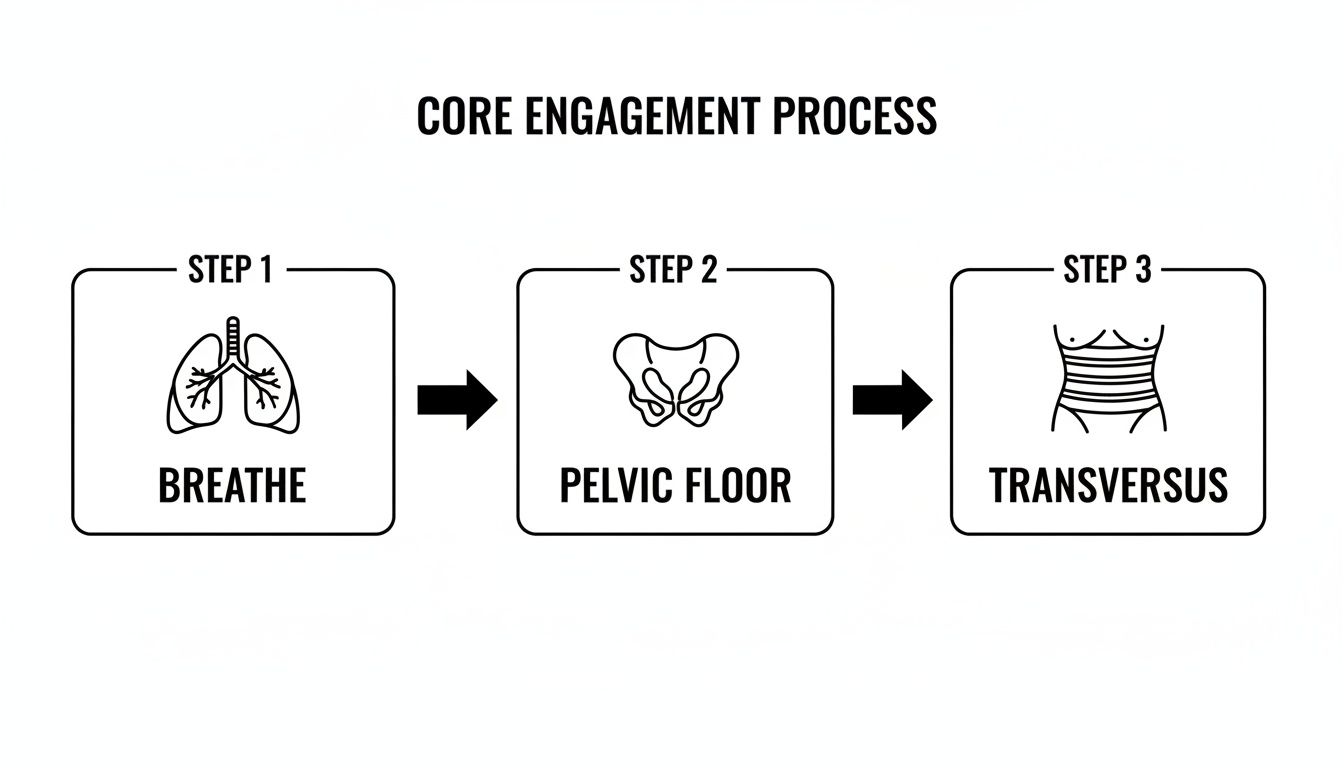
Think of this as your mental checklist before every single rep: Breathe, engage the Pelvic Floor, then engage the Transversus. This sequence is what protects and supports your midline as you start to move.
Phase 1: Nailing Down Foundational Stability
We start by layering simple limb movements onto the breathwork you've already mastered. This isn’t about lifting heavy; it’s about teaching your core canister to stay stable and engaged while your arms and legs are in motion.
Every exercise here is done slowly and with intense focus on your form. A few examples include:
- Heel Slides: Lying on your back, you'll use that gentle exhale and core cue to keep tension as you slowly slide one heel away from you and then draw it back in.
- Glute Bridges: The real work here is using your glutes to lift your hips—not arching your back—while keeping your core stable and preventing your ribs from flaring up toward the ceiling.
- Bent Knee Fall Outs: This is a subtle but powerful exercise that challenges your core to keep your pelvis perfectly still as one knee gently falls out to the side.
Throughout this phase, we are constantly coaching you to watch for any "doming" or "coning" along your midline. This is your body's built-in feedback system telling us the load might be too much for your current level of control.
Phase 2: Building Load and Abdominal Resilience
Once you can consistently hold your core control during those foundational movements, we start adding a bit more challenge. This is how we build true resilience in the abdominal wall and teach it to manage pressure under more demanding conditions.
This step is absolutely critical, and the research shows why having an expert guide you is so important. Some studies on generic postpartum exercise programs didn't find a significant reduction in the diastasis gap itself. However, other research strongly supports the kind of deep core stability program we design for effectively reducing the separation and, more importantly, improving quality of life. It’s proof that a personalized, progressive plan makes all the difference.
In this phase, you might see exercises like:
- Dead Bug Variations: We’ll begin with the classic opposite arm and leg extension and gradually progress by adding resistance bands or small hand weights.
- Modified Planks: You could start on an incline against a wall, or on your knees on the floor. The focus is always on maintaining a flat back and engaged core for short, perfect holds.
A Note From Our PTs: We would much rather see you hold a perfect 10-second modified plank than a sloppy 60-second full plank. Quality trumps quantity every single time.
Phase 3: Integrating Functional Strength
This final phase is where it all comes together. We take your newfound core strength and integrate it into movements that mimic your real life. This is what truly "heals" a diastasis recti—when your core can automatically fire to support you through your day without you even thinking about it.
Here, we move from isolated exercises on the mat to compound, functional movements that prepare you to get back to all the activities you love.
We’ll work on things like:
- Squats and Lunges: We’ll coach you on how to manage pressure on the way down (eccentric) and on the way up (concentric).
- Carries: Farmer's walks and suitcase carries are incredible for building that reflexive, "360-degree" core stability you need for daily life.
- Lifting Mechanics: We’ll practice lifting real-world objects—like a weighted ball that mimics a bag of groceries or even your baby’s car seat—off the floor with proper form and core engagement.
This slow, steady, and smart progression is the most reliable way to achieve long-term success. It ensures you don't just "fix" a separation but rebuild a core that is strong, resilient, and ready for anything life throws at you.
Special Considerations for Your Recovery Journey
Treating diastasis recti is never a one-size-fits-all process. A truly effective diastasis recti PT treatment plan is built around your unique history, your specific goals, and your life. It has to be.
We know you’re coming into this with your own story. Maybe you're navigating a C-section recovery, or you're an athlete itching to get back to high-intensity training. You might even be wondering if surgery is in your future. Let’s walk through these common scenarios, because we see them in the clinic every day.
If You're Recovering From a C-Section
A Cesarean birth is major abdominal surgery, plain and simple. It adds a whole other dimension to your core recovery. Your abdominal wall didn't just stretch; it was surgically separated. That means we have to be incredibly thoughtful about your healing incision and the scar tissue forming underneath.
In the beginning, we’ll work around any tenderness, focusing on gentle breathing and finding that pelvic floor connection. Once your doctor gives you the all-clear and the incision is healing well (typically around 6-8 weeks postpartum), we can start introducing scar mobilization.
This is a gentle massage technique that we’ll teach you to do on and around your scar. It’s a critical step. Why?
- It breaks up adhesions: Scar tissue can stick to deeper muscle and fascial layers, which can restrict how you move and even how your core muscles fire.
- It can improve sensation: Gently working on the scar helps desensitize the area and can help wake up the nerves.
- It supports core function: When the scar tissue can move freely, the abdominal muscles around it can contract much more effectively.
We’ll show you exactly how to start and how to progress the pressure, making sure your C-section recovery and diastasis recti rehab move forward together.
Returning to Sport for the Athlete
For any athlete, the number one question is always, "When can I get back to my sport?" We love hearing this. It means you’re motivated and focused on getting back to what you love, whether that's running, CrossFit, or tennis. Our job is to create the roadmap to get you there stronger and more resilient than before.
Jumping back into high-impact or heavily loaded movements without rebuilding your foundation is a recipe for setbacks. Instead, we use a benchmark-based approach. You have to earn your return to sport by showing you can handle the load.
You must be able to manage your intra-abdominal pressure without any coning or doming during exercises that mimic the demands of your sport. For a runner, that might mean showing control during single-leg hops. For a weightlifter, it's about executing a properly loaded squat with a stable core.
We'll systematically bridge the gap from foundational core exercises to sport-specific demands. You can learn more about how the pelvic floor is central to this process in our guide on what pelvic floor therapy is and how it helps.
The Truth About Abdominal Binders and Belts
There's a lot of conflicting information out there about abdominal binders. The short answer is: they can be helpful, but only as a very temporary tool.
In those first few weeks postpartum, a supportive wrap can provide some external support and gentle compression. This can give your brain better proprioceptive feedback—a sense of where your muscles are in space—which can make it a little easier to find and engage your deep core.
However, a binder should never become a long-term crutch. We don't want the wrap doing the work your muscles need to re-learn. We typically advise using one for short periods when you're up on your feet, but taking it off when you're resting or doing your prescribed exercises.
When to Consider a Surgical Consultation
For the vast majority of our patients, a dedicated diastasis recti PT treatment program is incredibly successful. It helps restore core function, eliminate pain, and significantly improve the appearance of the midsection.
However, for a small percentage of people with a very wide separation or significant damage to the connective tissue (the linea alba), surgery can be a valid path.
Physical therapy should always be the first line of defense. Surgery should only be on the table after you have committed to a comprehensive PT program for at least 6-12 months and have maximized your strength and functional potential.
A surgical consult might be the right next step if you have:
- Persistent and significant functional problems (like severe back pain or incontinence) that haven’t improved with consistent PT.
- A very large, unchanging gap that continues to impact your quality of life, even after you’ve built good strength underneath.
If we reach that point together, we’ll have a frank conversation and can refer you to a surgeon we trust. But for most, the key to healing is consistency. True change comes from turning your exercises and breathwork into daily practice, and understanding the principles of mastering habit formation psychology can make all the difference in that journey.
Your Diastasis Recti Questions Answered
Diastasis recti is one of those topics that comes up every single day in the clinic, and it's surrounded by a ton of confusing—and often conflicting—information online. It’s no wonder people feel lost.
Getting clear, honest answers from someone who actually works with this every day can be a huge relief. So, let’s tackle some of the most common questions we hear from our patients.
How Long Does Diastasis Recti PT Treatment Take?
This is probably the first question everyone asks, and the honest answer isn’t a simple number. Your recovery timeline is completely unique to you. It’s influenced by everything from the initial width and depth of your separation to how consistent you are with your program at home.
That said, we can give you a general idea of the milestones we look for.
Most people feel a real, tangible improvement in their core connection within the first 4-6 weeks of consistent PT. This is that "aha!" moment when you can finally feel your deep core muscles firing correctly, maybe for the first time in years.
Noticeable changes in the gap itself and your overall abdominal tone usually take longer, often developing over the next 3-6 months. But it's so important we redefine what "healed" actually means.
It's not just about closing the gap. A healed diastasis means you have a functional, strong, and responsive core that supports you through life without pain or dysfunction. We focus on those functional wins—like being able to lift your kiddo without a second thought—not just the numbers on the calendar.
Can I Fix My Diastasis Recti Years After Having a Baby?
One hundred percent, yes. It is never too late to address diastasis recti and improve how your core functions. We’ve helped patients who are 5, 10, even 20+ years postpartum get fantastic results.
There's a pervasive myth that if you don't "fix it" in the first year, you're stuck with it forever. That's just not true.
While the connective tissue might be a bit less pliable than it is in the early postpartum period, the principles of what we do in physical therapy are identical. We’re re-establishing the mind-body connection through neuromuscular re-education—basically, teaching your brain and muscles how to communicate effectively again. Your body is incredibly adaptable, and you can absolutely heal that core connection, no matter how much time has passed.
What Exercises Should I Avoid with Diastasis Recti?
This is a great question, but I’d rather reframe it. It's less about a specific list of "bad" exercises and more about how you perform movements and manage internal pressure.
The main thing you want to watch out for is any movement that causes your abdomen to "cone" or "dome"—that classic ridge that pops up along your midline. That’s simply a visual cue that the load of the exercise has overwhelmed your core’s ability to maintain tension.
In the early stages, this often includes movements like:
- Traditional crunches and sit-ups
- Full planks
- Double leg lifts
- Certain demanding yoga poses
But here’s the key takeaway: the goal of diastasis recti pt treatment isn't to make you avoid these things for the rest of your life. It's the exact opposite. Our job is to build your foundational strength and control so that you can safely handle these loads and get back to every activity you love. Your physical therapist is your guide, helping you progress safely until you can re-introduce these more challenging exercises with confidence and proper form.
If you're ready to get clear answers and start a plan that’s built just for you, we're here to help. The team at Joint Ventures Physical Therapy is dedicated to providing that one-on-one care that makes all the difference. Schedule your appointment with us today and let's get you moving forward.
Schedule Your Appointment with Joint Ventures Physical Therapy