
You notice it during lunch in the Financial District. Or halfway through a bagel near Back Bay Station. Your jaw clicks, maybe pops, maybe shifts a little, and your first thought is usually the same. Is there a cure for a clicking jaw, or is this about to turn into a bigger problem?
That question makes sense. A noisy jaw is unsettling, and people often don't know whether to ignore it, stretch it, Google it, or call a dentist. In Boston, I see the same pattern often with busy professionals, runners, students, and active adults who are juggling stress, long workdays, hard training blocks, and too much time at a desk.
That Clicking Jaw Sound and the Search for a Cure
The biggest misconception is that every clicking jaw needs to be “fixed.” Modern TMJ care has moved away from that idea. The National Institute of Dental and Craniofacial Research guidance on TMD says jaw sounds like clicking or popping without pain are common, considered normal, and may not need treatment. When pain is part of the picture, the focus shifts to conservative care such as softer foods, exercises, and reducing habits like clenching.
That changes the typical meaning of a “cure for clicking jaw.” The primary target usually isn't silence in the joint. It's getting rid of pain, stopping flare-ups, improving chewing and talking, and making the jaw feel reliable again.
Practical rule: If your jaw clicks but doesn't hurt and doesn't limit function, the sound alone usually isn't the problem. If it clicks and you're guarding, avoiding certain foods, waking with tension, or feeling pain, that's a different situation.
In the clinic, the most useful mindset is long-term management, not a one-time mechanical fix. That's especially true for Boston patients whose symptoms are tied to daily load. Stressful commutes, laptop posture, strength training, marathon prep, and sleep grinding all change what the jaw has to tolerate.
If you want a Boston-specific look at why this problem shows up so often locally, this overview of TMJ in Boston and why jaw pain is more common than you think is a good starting point.
Why Your Jaw Clicks and What It Really Means for You
A click is a symptom, not a diagnosis. For many people, it falls under temporomandibular disorders, often shortened to TMD. A clinical review notes that TMD affects 25% of people and lists physiotherapy as a main treatment approach, which is one reason noninvasive rehab is such a common path for jaw symptoms like clicking in everyday practice, as outlined in this clinical review of clicking jaw causes and treatment.
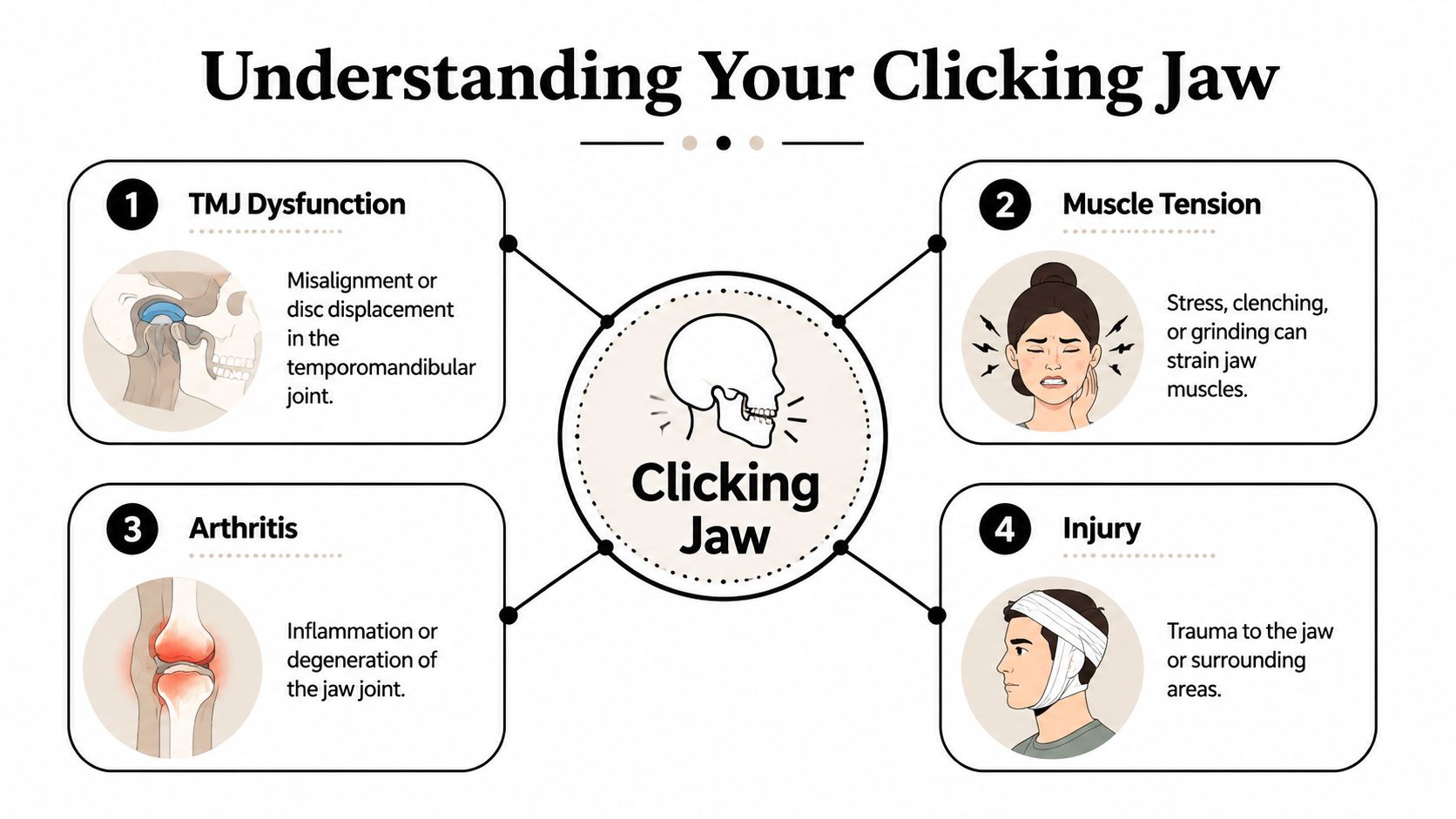
Common patterns seen around Boston
For a lot of people in Seaport, Downtown Crossing, or Kendall-adjacent office life, the jaw isn't acting up in isolation. It's part of a bigger pattern.
- Stress loading the system. You may not realize you clench until your teeth touch all afternoon.
- Posture and neck tension. Hours at a laptop can make the neck, face, and jaw work harder than they should.
- Training load. Runners and lifters often hold tension through the jaw without noticing it.
- Sleep habits. Night grinding can undo a lot of progress if nobody identifies it.
Sometimes the click has been there for years and barely matters. Sometimes it starts as a noise and becomes pain with eating, yawning, or longer conversations. That difference matters more than the sound itself.
The lifestyle link matters
Many patients get stuck because they keep treating the jaw as if it's only a joint problem. Often it's also a behavior problem, a load management problem, or a tension problem. If clenching is part of your pattern, practical guidance on how to manage teeth clenching can help you notice what's feeding the cycle between visits.
A click doesn't always mean damage. It often means the jaw isn't tolerating the way it's being used right now.
That's why a useful evaluation looks beyond the joint. It asks what your workday, sleep, workouts, stress level, and chewing habits are doing to the area.
Effective Self-Care Strategies for Jaw Relief in Boston
If your jaw is irritated, start simple. The basics still work well, especially when symptoms are new or mild. According to Mayo Clinic's TMJ treatment guidance, effective self-care includes avoiding clenching and gum chewing, choosing soft foods, practicing a relaxed jaw posture, and applying heat or cold for 15 to 20 minutes. Mayo also notes that ice is best for acute pain, while moist heat helps more with chronic dull pain.
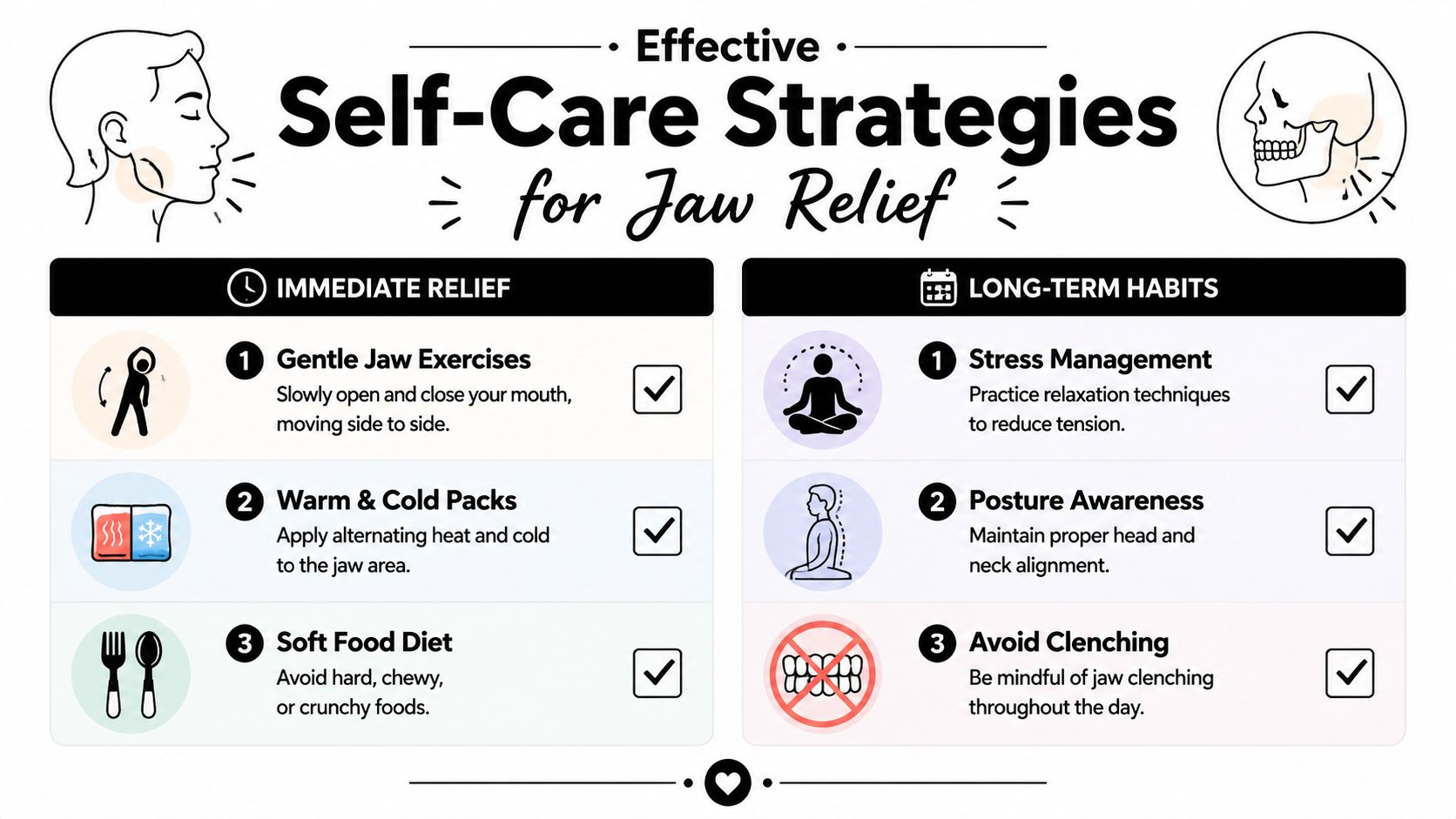
What to do today
These are the self-care moves that tend to help most.
- Reset your resting position. Keep your tongue on the roof of the mouth, teeth apart, and jaw relaxed. That reduces unnecessary compression at the joint.
- Change what you chew. For a stretch of time, pick softer foods and smaller bites. Skip chewy bagels, gum, steak tips, and hard snack foods if they spike symptoms.
- Use the right temperature. Ice fits an irritated, acute flare. Moist heat fits that dull, achy, tight feeling that builds over the day.
- Catch daytime clenching. Put reminders on your phone or laptop so you stop bracing your jaw while working.
How this works in real Boston life
Self-care only helps if you'll do it.
Try a jaw posture reset while waiting on the Green Line. Switch your usual crunchy desk snacks for softer options during a flare. If your jaw gets worse after long Zoom blocks, use heat after work and stop chewing gum on your commute home.
A lot of people also need help with nighttime grinding. If that's your pattern, this guide from DentalHealth.com on stopping grinding gives a practical overview of common habits to address alongside rehab.
For a movement-based starting point, these TMJ pain relief exercises can help you begin gently without overworking the joint.
The best home program is the one that lowers jaw load consistently. More exercises aren't always better.
What usually doesn't work
Some patients make the problem worse by forcing wide stretching, chewing through pain, or trying random online drills every day. If your jaw feels more irritated after exercise, that's useful information. The answer usually isn't to push harder. It's to adjust the plan.
Specialized TMJ Physical Therapy at Joint Ventures
When clicking comes with pain, tightness, limited opening, headaches, or repeated flare-ups, self-care often isn't enough by itself. That's where skilled TMJ rehab becomes useful.
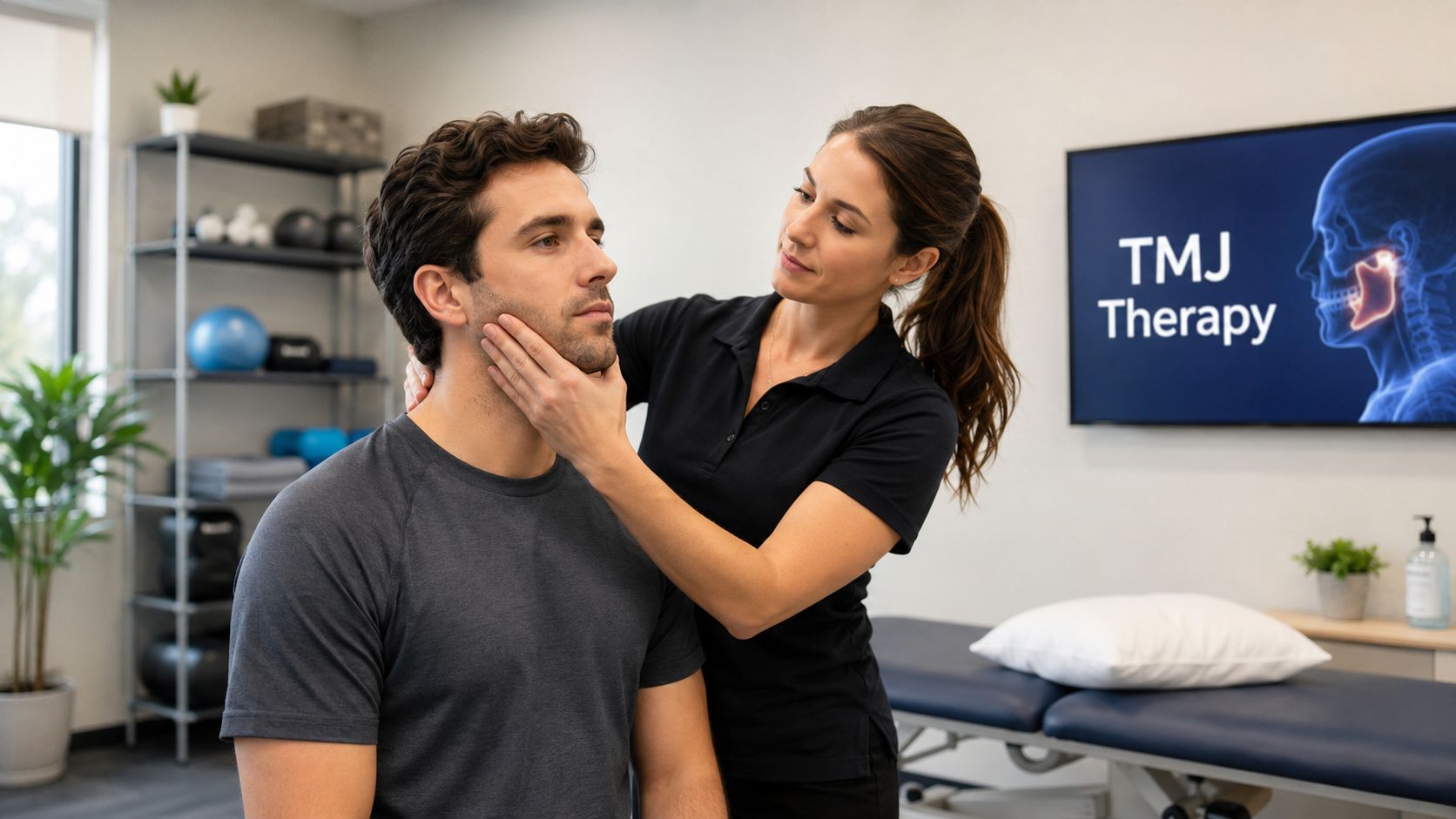
A strong TMJ physical therapy plan usually includes hands-on assessment of the jaw, face, neck, and upper cervical area, along with movement testing and habit review. The point isn't just to hand you exercises. It's to identify what keeps reloading the joint and what your jaw can't currently do well.
What treatment often includes
At a practical level, care may involve:
- Manual therapy for the jaw and neck to reduce stiffness and improve motion
- Motor control retraining so opening, closing, chewing, and resting the jaw happen more smoothly
- Load management around talking, chewing, workouts, and stress-heavy days
- Trigger point dry needling when muscle guarding is a major driver
- Home exercises that match your exact pattern instead of generic internet advice
This is also where one-on-one care matters. If your clicking is tied to asymmetry, overuse, or protective tension, the plan has to be adjusted in real time. The TMJ physical therapy service at Joint Ventures describes that type of care, including individualized evaluation and guided home programming.
PT and dental care often work better together
For painful clicking, especially when the joint is irritated, a combined approach can help. A controlled clinical study on painful TMJ clicking found that occlusal devices plus behavioral modification led to faster pain relief than behavior changes alone. In plain language, if a mouth guard is appropriate, it often works better when someone also addresses clenching, jaw mechanics, and movement habits.
That's an important trade-off to understand. A mouth guard may reduce load, but it usually doesn't retrain how you chew, rest your jaw, or carry tension through your neck and face during the day. PT fills in that gap.
A quick visual walkthrough can help if you're trying to understand how this type of rehab looks in practice.
What people often get wrong
The common mistake is chasing the click. Patients try to pop it back, stretch it wider, or repeatedly test it to see if it's gone. That usually keeps the area sensitized.
A better plan is to reduce aggravation, improve control, and build tolerance back into normal life. That includes eating, speaking, yawning, working, and training without feeling like your jaw might act up at any moment.
When to See a TMJ Specialist in Boston
Self-care is a reasonable place to start. It's time to get evaluated when the pattern keeps returning, gets more painful, or starts affecting daily function.
Signs you shouldn't ignore
Consider a specialist visit if you notice any of the following:
- Painful clicking that's becoming more frequent
- Jaw locking or catching
- Trouble chewing tougher foods or opening comfortably
- Morning jaw tightness that keeps coming back
- Symptoms spreading into the face, temple, or neck
- Short-term relief only from exercises, heat, or softer foods
According to Cleveland Clinic's overview of jaw popping, persistent clicking is often linked to drivers outside the joint itself, including stress and sleep-related teeth grinding. That matters because if exercises help only briefly, the missing piece may be bruxism, sleep disruption, or a clenching habit you haven't identified yet.
If your jaw keeps relapsing, it doesn't mean you failed at self-care. It usually means something upstream is still feeding the problem.
In Boston, that could be a demanding work schedule, long desk hours, exam stress, inconsistent sleep, or training load that never lets the system settle down. A TMJ-focused PT looks at those contributors instead of treating the jaw like an isolated hinge.
Your Next Step Toward a More Comfortable Jaw
If you're searching for a cure for clicking jaw, the honest answer is that a noise-free joint isn't always the goal. The better goal is a jaw that feels calm, functional, and dependable. For many people, that means starting with smart self-care, then getting more specific treatment if the clicking is painful, recurring, or paired with stiffness and locking.
Boston patients usually want a plan that fits real life. Something workable between meetings, workouts, commutes, and family obligations. That's exactly how jaw rehab should be approached.
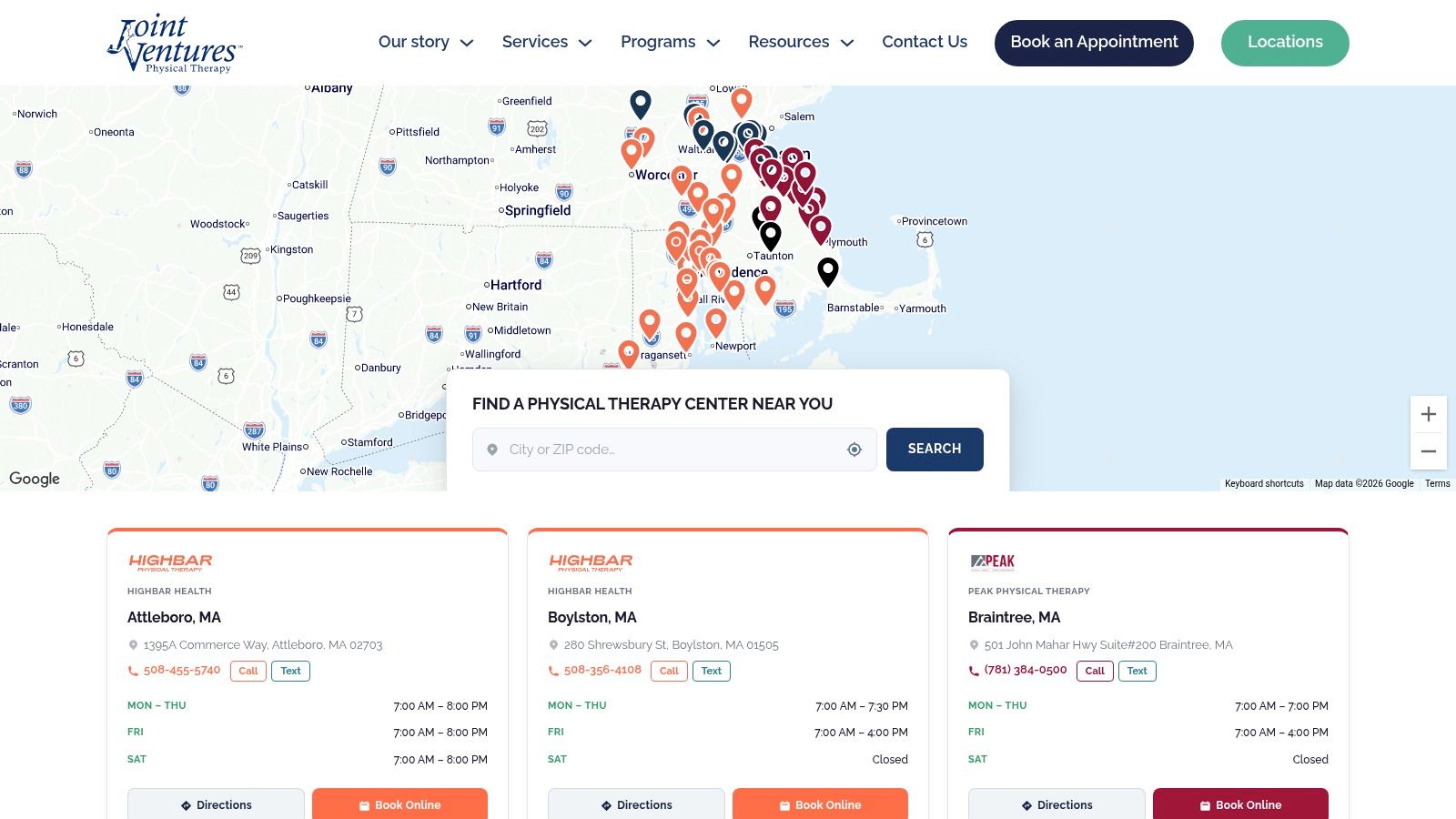
Where to get help locally
If you want in-person TMJ care in Greater Boston, look for a clinic that can assess jaw movement, neck mechanics, habit patterns, and the role of stress or grinding in one plan of care. Convenient options matter when you're trying to stay consistent, especially around Back Bay, Kenmore Square, Fort Point and Seaport, Downtown Boston, and nearby neighborhoods.
If you also want a look at how dental offices describe specialist TMJ care in other markets, this article on a TMJ Specialist in Memphis TN offers another perspective on when a more focused evaluation makes sense.
For deeper educational content on TMD anatomy, symptoms, and broader recovery concepts, visit Highbar Health.
If your jaw clicking is painful, keeps returning, or is starting to affect eating, talking, sleep, or training, book an evaluation with Joint Ventures Physical Therapy. With Boston-area locations including Back Bay, Kenmore Square, Fort Point/Seaport, and Downtown, it's easy to get one-on-one care that looks at the jaw, neck, habits, and daily triggers together.