You're probably feeling two things at once right now. Boston looks like one of the best places in the country to train as a future PT, and it also feels crowded with smart classmates, selective rotations, and clinics that seem to get a lot of student interest.
That tension is real. It's also workable if you stop treating Boston like a generic school city and start using it like a professional ecosystem. In this market, students who stand out usually aren't the ones who wait for the perfect placement to appear. They're the ones who learn the local professional environment early, reach out well, follow through, and match their interests to the neighborhoods, patient populations, and specialty services that define care in Greater Boston.
Your Guide to Thriving as a Physical Therapy Student in Boston
Boston rewards students who are deliberate. The region has multiple accredited DPT pipelines, and one local school reports a 100% six-month employment rate for its physical therapy graduates. The broader profession is also expanding, with the American Physical Therapy Association reporting about 225,350 physical therapists in the U.S. in 2021, up 13.63% from 2017, while population growth over the same period was 2.17%. In Massachusetts, one Boston-based PT compensation page cites median annual wages of about $98,000 to $105,000, depending on source and year, all summarized on the MCPHS School of Physical Therapy page.
That matters for physical therapy Boston students because this city gives you more than classroom access. It gives you concentrated exposure to hospitals, private practices, university populations, active adults, runners, desk workers, post-op patients, and specialty clinics within a short radius. In a place like Boston, your clinical judgment grows faster when you see different patient types early and often.
Why Boston is worth the pressure
Competition is part of the deal here. So is opportunity.
A student in a smaller market might need to accept whatever setting is available. A student in Boston can often be more strategic. You can look for environments that sharpen the skills you'll use, whether that's sports rehab, vestibular work, hand therapy, pelvic health, aquatic therapy, or performance-focused care.
Practical rule: In Boston, networking is not extra credit. It's part of your clinical education.
The students who build momentum tend to do three things well:
- They choose settings on purpose: They don't say yes to every option without thinking about fit.
- They learn clinic culture early: They pay attention to pace, documentation style, mentorship, and patient mix.
- They treat each placement like a job interview: Because often it is.
If you want the broader career case for staying local, read why Boston is one of the best cities to build a career in physical therapy.
Decoding the Boston PT Clinical Timeline
Boston students often make the same timing mistake. They wait until formal clinical placement season to start acting like future clinicians. That's late.
The stronger approach is to build your professional footprint before your program requires it. By the time full-time rotations are being discussed, you want faculty and clinic teams to already associate your name with reliability, curiosity, and follow-through.
Phase one builds your reputation
Early didactic terms are not just about surviving anatomy, biomechanics, and practicals. They're when you start laying down habits that later affect placement options and licensure readiness.
A useful benchmark comes from Tufts School of Medicine's Boston DPT program, which reports a 2-year average first-time NPTE pass rate of 68.0% on its DPT career pathways and outcomes page. That figure should push you toward consistency, not panic. A peer-reviewed study summarized there found that graduate GPA predicted NPTE performance, while admissions interview and undergraduate GPA predicted graduate GPA. In plain terms, strong day-to-day academic performance matters.
A practical timeline that works
Use this framework as a working model:
| Stage | What to focus on | What clinics notice |
|---|---|---|
| Foundation years | Coursework, observation, communication, basic professionalism | Whether you're dependable and coachable |
| Application window | Target clinic list, polished outreach, updated resume | Whether your interest sounds genuine or generic |
| Clinical rotations | Caseload growth, documentation, patient communication | Whether you make the day easier or harder |
| Post-grad readiness | NPTE prep, references, job search, specialty direction | Whether you're ready for the pace of practice |
What to do semester by semester
- Start with observation that has a purpose: Don't just collect hours. Compare settings. Notice flow, scheduling, patient education, and how therapists hand off care.
- Look for part-time clinic exposure if your schedule allows it: Tech and aide roles can teach you how an outpatient day runs.
- Keep a simple clinical journal: Write down what patient populations interest you, which environments energize you, and where you struggle.
- Meet your program deadlines early: Late paperwork is a fast way to look disorganized.
- Ask faculty specific questions: “What type of student does this clinic usually like?” is more useful than “Do you know any good places?”
Students who do well in Boston usually become easier to place because faculty trust them to represent the program professionally.
When you're targeting a specific setting, this guide on how to get the PT clinical rotation you want is worth reviewing before you start outreach.
Crafting Your Outreach to Boston Clinics
Most student emails fail for one reason. They sound copied.
Clinic directors can spot a mass email in a few lines. If your message could have been sent to a sports clinic in Fenway, a hospital department in Longwood, and a suburban neuro setting without changing anything, it won't land well.
Boston clinics already think about students
Some Boston clinics explicitly market physical therapy services for students and note access to Boston College, Boston University, Harvard, MIT, and Kendall Square via nearby locations and transit connections, as shown on Boston Sports Medicine's student physical therapy page. That tells you something useful. Clinics in this city are already tuned in to the student population, both as patients and future clinicians.
So your outreach should reflect local awareness. Mention neighborhood, patient mix, or specialty service. Don't just say you're interested in “learning more about outpatient orthopedics.”
What a good outreach email includes
A strong student email has five parts:
A direct subject line
“DPT student seeking observation or clinical conversation for Boston outpatient setting”A short introduction
State your school, current stage of training, and what kind of opportunity you're seeking.One clinic-specific reason for reaching out
Mention a specialty, location, patient population, or care model.A clear ask
Ask for a brief conversation, observation opportunity, or guidance on future student placement.A professional close
Attach your resume and give realistic availability.
A template you can adapt
Hello [Name],
I'm a DPT student in Boston currently in [term or year], and I'm reaching out to learn more about potential student opportunities with your clinic. I'm especially interested in [specific service, patient population, or clinic focus].
I'm drawn to your team because of [one specific reason tied to the clinic's work, location, or specialty]. My goal is to keep building outpatient clinical exposure in a setting where strong patient communication and hands-on reasoning matter.
If you're open to it, I'd appreciate a brief conversation about how your team works with students, or any advice on the best timing and process for future applications. I've attached my resume and included my availability below.
Thank you for your time,
[Name]
What students get wrong
- They write too much: Keep it tight. Respect the reader's time.
- They praise without specifics: “Your clinic has an amazing reputation” says almost nothing.
- They attach a weak resume: Clean formatting matters. If yours needs work, these internship resume tips are a practical place to tighten it up.
- They ask vague questions: “Any opportunities available?” is lazy. Ask something concrete.
One example of a local private-practice option is Joint Ventures Physical Therapy, which provides 1:1 outpatient physical and occupational therapy across Boston and includes specialty services such as running performance, Titleist golf evaluations, pelvic floor, vestibular and balance, TMJ, hand and upper extremity, aquatic therapy, dry needling, and workplace ergonomics. If that kind of environment fits your goals, tailor your outreach accordingly rather than sending a generic student request.
For a sharper sense of what clinic teams notice right away, review what clinical instructors actually want from PT students.
Networking and Interviewing in a Hyper-Connected City
In Boston, networking is usually quieter than students expect. It's less about formal mixers and more about repeated, thoughtful contact with the right people.
A strong connection often starts with a short LinkedIn message, a faculty introduction, or a respectful request for fifteen minutes to learn about someone's clinical path. Students who treat networking like relationship-building do better than students who treat it like collecting contacts.
How to network without sounding transactional
Start with clinicians whose work matches your interests. If you want to work with runners, performance athletes, post-op knees, vestibular patients, or desk-based professionals, say that clearly. Then ask questions that show you understand the setting.
Good prompts include:
- Ask about patient mix: “What kinds of cases make up most of your week?”
- Ask about growth: “What skills did you need most in your first year out?”
- Ask about clinic expectations: “What makes a student useful in your setting?”
- Ask about fit: “Who tends to thrive here, and who tends not to?”
A useful informational interview leaves the clinician feeling that you listened, not that you pitched yourself for fifteen minutes.
Follow up within a day or two. Keep it brief. Mention one thing you learned and one next step you're taking because of the conversation.
What Boston interviews often reward
Interviewers in this market usually care less about polished buzzwords and more about whether you understand how outpatient care works in real life. They want to know if you can communicate with patients, handle feedback, stay organized, and adapt to a busy clinic.
A short comparison helps:
| Interview approach | How it comes across |
|---|---|
| “I'm passionate about helping people.” | Generic and easy to forget |
| “I'm interested in active adults and runners because I enjoy movement analysis and exercise progressions.” | More credible |
| “I want exposure to a clinic where I can build patient communication, documentation speed, and clinical reasoning.” | Strong and practical |
Better answers and better questions
Before an interview, practice out loud. Don't just think through answers in your head. If you want a low-stakes way to refine pacing and wording, an AI interview prep tool can help you rehearse common questions and trim rambling responses.
Then prepare your own questions. Good student questions often sound like this:
- What does a successful student do in the first two weeks?
- How does your team give feedback during a rotation?
- Which patient populations define this clinic's day-to-day work?
- What documentation habits do you expect students to build quickly?
You don't need to sound advanced. You need to sound prepared, teachable, and honest about where you are.
If your interview is in person, arrive early enough to notice the clinic. Watch how the front desk communicates, how therapists move between patients, and whether the environment feels rushed, calm, highly athletic, or more general outpatient. Those details should shape your answers.
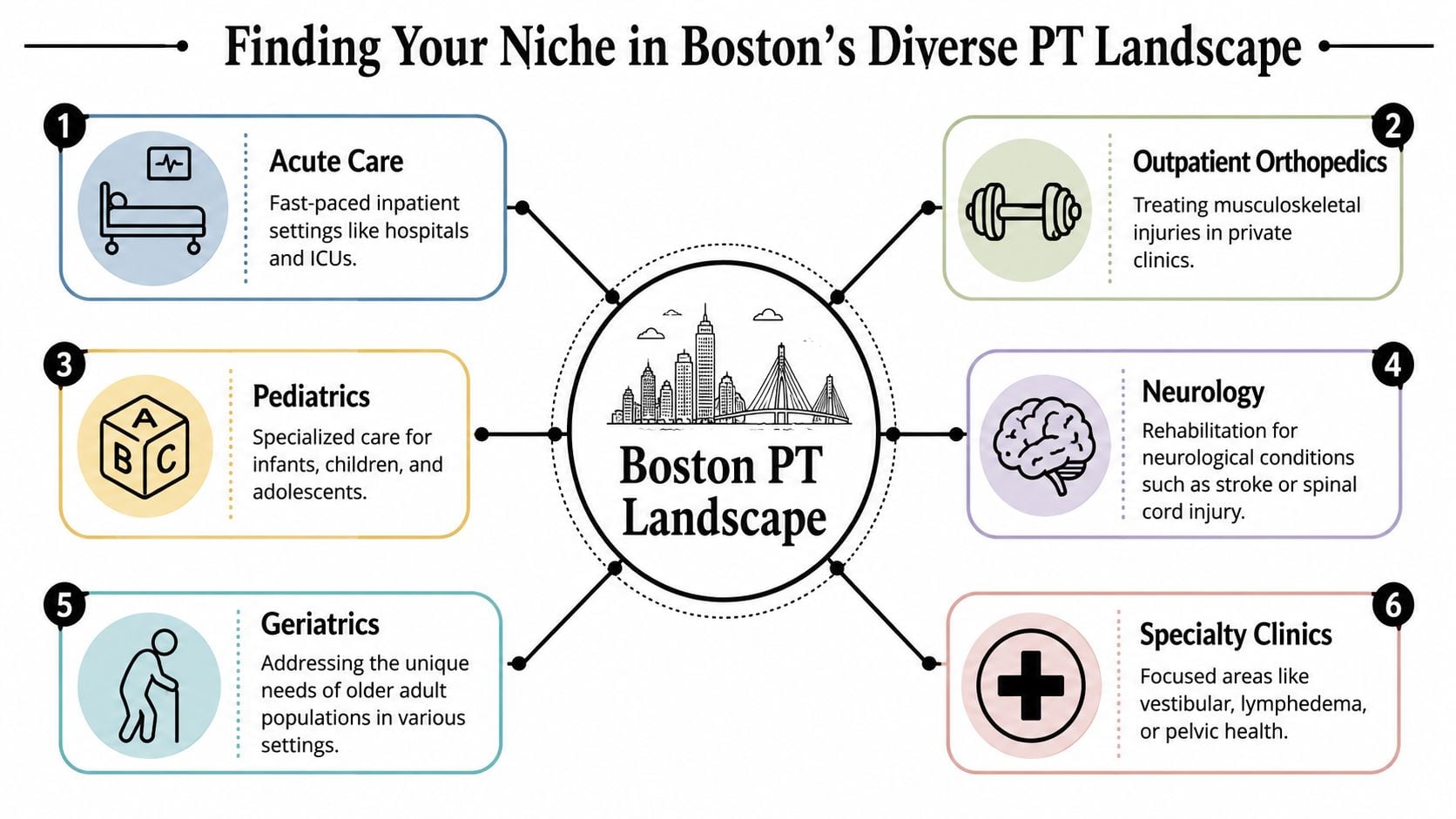
Finding Your Niche in Boston's Diverse PT Landscape
Boston can fool students into thinking there are only two lanes that matter. Big hospital systems and standard outpatient orthopedics.
That's too narrow. The stronger move is to look at Boston as a set of overlapping practice communities, each with different demands, mentorship styles, and patient needs.
The obvious lanes and the less obvious ones
The city gives students access to high-performance and specialty work that can shape a career early. If you're interested in active populations, Boston is full of runners, court-sport athletes, recreational lifters, golfers, and professionals trying to stay active around intense work schedules. That opens the door to niches like running performance, golf screening, concussion support, TMJ care, pelvic floor therapy, hand and upper extremity rehab, vestibular and balance care, and aquatic therapy.
But another element of the environment matters just as much. Community-based and underserved settings expose you to access problems that many student guides ignore.
What underserved care teaches you
Independent evidence summarized in a Duke source points to barriers in medically underserved urban communities that include proximity to PT clinics, cost, transportation, and incomplete knowledge of PT services. That same source describes a Boston community partnership in Roxbury where PT students were placed at sites serving 300+ children and 300+ adults, showing that real student learning can happen in neighborhood-based care, not just traditional flagship settings, as discussed in the DukeSpace material on underserved urban communities and PT access.
That's a major career clue. If you want to become a clinician who can work beyond ideal conditions, these placements matter. You'll learn how transportation, insurance friction, family obligations, language, and trust affect plan-of-care follow-through.
Some of the best clinical growth happens where care is hardest to deliver.
Representation also shapes the field
Another reality students should face early is who feels seen in the profession and who doesn't. Recent reporting notes that Black men remain underrepresented in physical therapy at less than 2%, and describes the pathway as narrow for men of color, according to this discussion of underrepresentation in physical therapy.
That matters in Boston because diversity is not separate from clinical care. It affects mentorship, retention, patient trust, and whether communities feel the profession belongs to them. For students from underrepresented backgrounds, the right mentor can change whether a difficult semester feels survivable. For all students, learning to practice in diverse neighborhoods is part of becoming employable and useful.
A better way to choose your niche
Don't ask only, “What setting sounds impressive?” Ask these questions instead:
- What patient population keeps my attention all day?
- Do I like fast turnover or deeper 1:1 interaction?
- Do I want performance work, chronic-condition management, or community-based care?
- What kind of communication style does this setting demand?
If you're unsure, use Boston itself as your testing ground. Spend time in more than one environment. A student who thinks they want sports may discover they love vestibular work. Someone set on hospital care may realize they thrive in specialty outpatient. Another may find their purpose in community-facing practice rather than performance rehab.
For anatomy and recovery explainers that go deeper than local clinic guidance, visit Highbar Health for broader educational content.
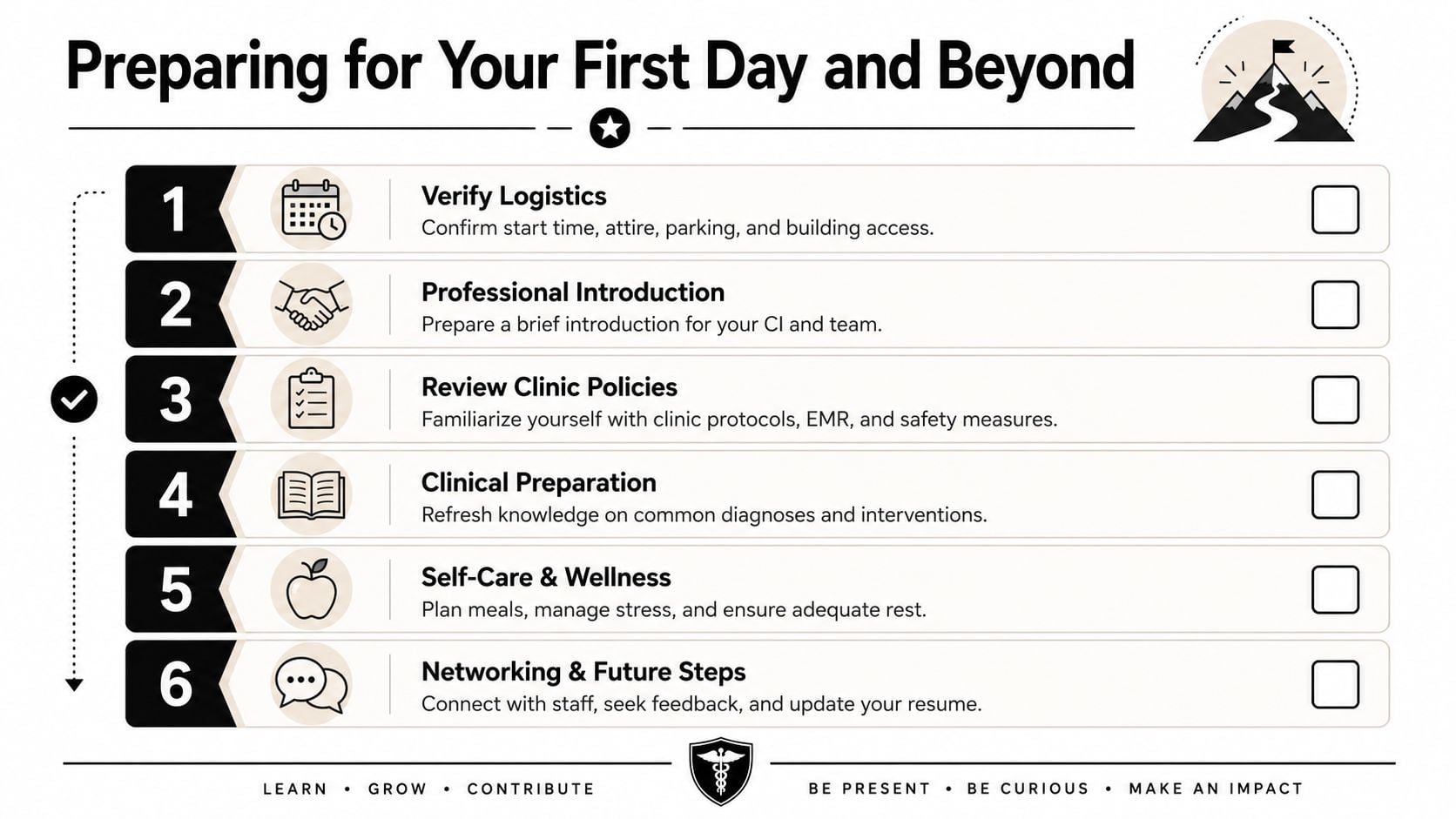
Preparing for Your First Day and Beyond
Once you secure the opportunity, the goal changes. You're no longer trying to get noticed. You're trying to become dependable fast.
That starts with logistics, but it doesn't end there. Good students reduce friction. They show up ready, communicate clearly, protect patient safety, and improve week to week.
What to have ready before day one
Use this checklist before the rotation starts:
- Confirm the basics: Verify start time, dress code, parking or transit plan, lunch setup, and building access.
- Know your paperwork: Make sure your school requirements, health records, and any clinic onboarding forms are complete.
- Review common diagnoses in that setting: Don't cram everything. Refresh what you're most likely to see.
- Prepare your introduction: You should be able to introduce yourself to patients and staff without sounding rehearsed.
- Bring a simple note system: You'll need a way to track feedback and questions.
Behaviors that help immediately
Your clinical instructor is watching more than your technical skill. They're noticing whether you can fit into clinic flow without creating extra work.
A few habits go a long way:
| Habit | Why it matters |
|---|---|
| Arrive early | You settle in before patient care starts |
| Ask for expectations | You remove guessing and reduce missteps |
| Write down feedback | You show that correction leads to change |
| Speak clearly with patients | You build trust and reduce confusion |
| Protect safety first | You show judgment, not just enthusiasm |
If you need a quick refresher on safe patient handling in practical settings, this guide on improving patient safety with transfer belts is a useful example of reviewing fundamentals before you're under pressure in clinic.
Early in a rotation, your job is not to impress people with how much you know. Your job is to be safe, organized, and responsive to feedback.
How to keep getting better
Don't wait for your CI to guess what you need. Ask direct questions.
Try these:
- What would make me more useful this week?
- Where am I slowing the day down?
- What should I lead next?
- What documentation habit should I fix first?
That kind of self-awareness matters in Boston because clinics are busy, patient expectations are high, and strong students often turn into future hires. If you handle feedback well, stay coachable, and learn the local rhythm of practice, you'll separate yourself faster than you think.
If you're looking for a Boston clinic environment where students can learn what modern outpatient care looks like across active adult, specialty, and performance-focused populations, Joint Ventures Physical Therapy is a practical place to start exploring local opportunities, locations, and services.