
Back pain can sneak up on you in Boston. One week you're logging miles along the Charles, hauling groceries up a walk-up in Allston, or sitting through long days in the Financial District. The next week you're timing every sit-to-stand, avoiding the Green Line stairs, and wondering if you should rest, stretch, or finally book an appointment.
That uncertainty is often the hardest part. Many people don't know whether their pain is a short-lived flare-up, a training problem, a work setup problem, or something that needs a closer look. Boston patients also tend to be busy. They'll tolerate back pain longer than they should because work, commuting, parenting, and training schedules don't leave much room for trial and error.
Your Guide to Finding Back Pain Relief in Boston
A common Boston pattern looks like this. A runner increases mileage ahead of spring races, feels a pinch in the low back, takes a few easier days, then tries to push through. Or a consultant spends a week working late, grabs a suitcase from the trunk, and suddenly can't rotate comfortably to check blind spots while driving through Storrow traffic.
What usually follows is fragmented advice. Rest. Stretch more. Stretch less. Get imaging. Don't get imaging. Wait it out.
That confusion matters because a Boston Medical Center report on low back pain care access found that between 2002 and 2018, only about one-third of U.S. adults with lower back pain reported using physical rehabilitation. In plain terms, many people with back pain historically haven't accessed the kind of care that clinical recommendations support.
What Boston patients usually want to know
Individuals aren't asking for a textbook explanation of the spine. They want practical answers.
- Should I start PT now or wait a little longer
- Do I need imaging first
- Will this get better with exercise, hands-on treatment, or both
- How do I find care that isn't rushed or generic
- Can I keep working, commuting, lifting, or training while I recover
Back pain physical therapy in Boston should help you make decisions quickly, not leave you with more uncertainty.
Daily setup also matters more than people think. If your symptoms are worse overnight or first thing in the morning, your sleep surface may be part of the picture. For people comparing recovery-friendly sleep setups, this guide to a Central Florida mattress for back support is a useful consumer resource.
What this guide is built to do
This is a navigation guide for Boston patients. It focuses on timing, red flags, what a first visit should look like, and why one-on-one care tends to work better than a handout and a quick heat pack. If you live an active Boston life, your plan should match it.
When to See a Physical Therapist for Your Back Pain
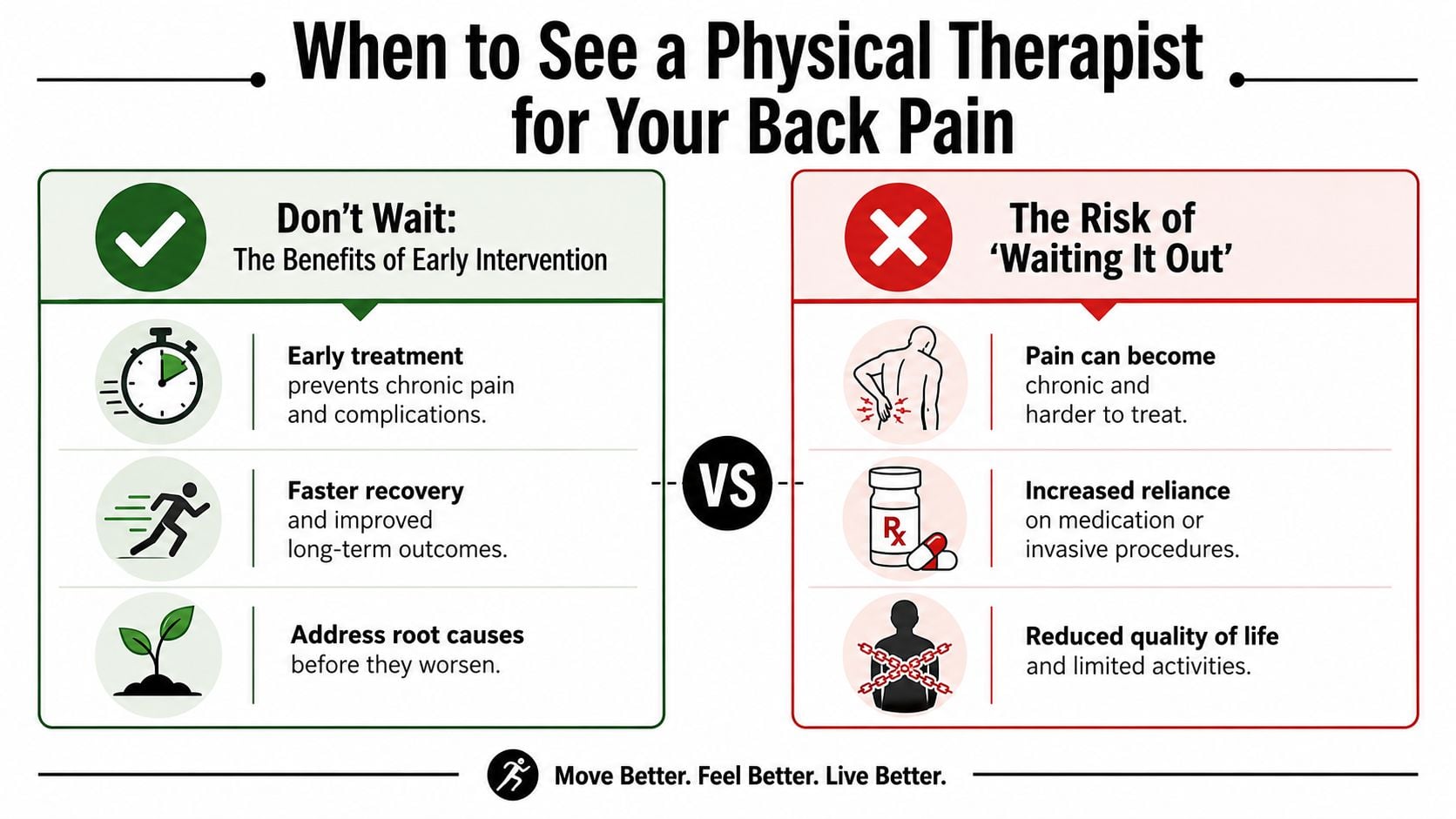
“Wait and see” sounds reasonable. Sometimes it is. But for many people, waiting turns a manageable problem into a stubborn one.
A large-scale analysis summarized by Bay State Physical Therapy found that starting physical therapy within the first two weeks of acute low back pain was associated with significantly lower downstream use of injections, imaging, and surgery, along with lower total healthcare costs. That doesn't mean every sore back needs same-day treatment. It does mean early, targeted care is often the smarter move when symptoms are limiting you.
Signs it's time to book
If your back pain is changing how you move, train, sleep, commute, or work, it's worth getting assessed. That includes pain that keeps returning whenever you ramp up mileage, lift heavier, sit longer, or travel.
Here are common reasons to stop guessing and get evaluated:
- Pain with routine movement. Bending, sitting, standing up, rolling in bed, or getting out of the car feels guarded or sharp.
- Symptoms that aren't settling. You're a few days in and still modifying everything.
- Recurring flare-ups. The pain improves, then comes back with the same run route, gym session, desk week, or parenting task.
- Reduced confidence. You're avoiding exercise because you're worried you'll make it worse.
If you want more practical self-management ideas while deciding on next steps, this post on how to relieve chronic lower back pain can help you think through common patterns.
When waiting makes less sense
Boston patients often wait because they assume back pain is normal wear and tear. But delayed care can let compensations settle in. You stop hinging well, tighten up around the painful area, and lose confidence loading the trunk, hips, and legs.
Practical rule: If you're changing your normal routine to protect your back, that's usually enough reason to get assessed.
When you should seek medical care first
Some symptoms need medical evaluation rather than routine PT scheduling.
- Bowel or bladder changes
- Progressive weakness
- Severe or worsening neurologic symptoms
- A sudden major loss of function that feels out of proportion
A good PT clinic will tell you that clearly. Responsible back pain physical therapy in Boston isn't about treating everything. It's about helping the right patients start care early and directing the wrong patients to medical workup quickly.
What to Expect at Your First PT Visit in Boston
The first visit should feel less like a generic intake and more like a focused investigation. Good back pain care starts with pattern recognition. What movements hurt, what activities calm things down, and what your body does when you try to move normally.
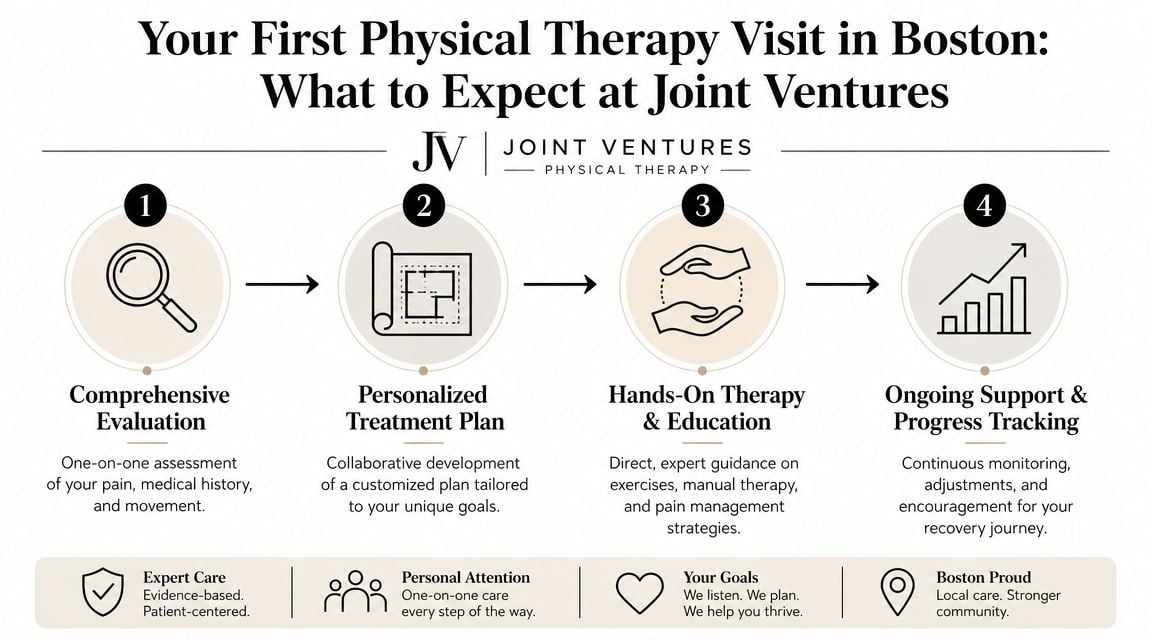
Step one is listening for the right details
Your therapist should ask more than “Where does it hurt?” The useful questions are specific.
- What started it. Training increase, deadlift session, long drive, desk week, new baby, move, fall, or no clear trigger.
- What aggravates it. Sitting, standing, extension, flexion, rotation, morning stiffness, running hills, rowing, lifting.
- What your goals are. Sleep better, commute without pain, return to gym training, finish a race block, pick up your child, work a full day comfortably.
Back pain with morning stiffness and back pain after repeated lifting may need very different loading strategies.
The physical exam should be active
A strong PT evaluation includes movement testing. You may be asked to bend, squat, lunge, rotate, balance, walk, or perform a hinge pattern. Your therapist may assess lumbar motion, hip mobility, trunk control, and how symptoms respond to repeated movements or position changes.
That active exam often tells us more than imaging in routine cases. A summary of guideline-based spine care notes that the American College of Physicians recommends nonpharmacologic care like physical therapy as first-line treatment for most low back pain, while the American College of Radiology generally reserves imaging for people with signs of serious underlying conditions.
Many patients are relieved to learn they don't necessarily need imaging before starting care.
A visit should also include screening for the signs that suggest you shouldn't stay on the routine PT track. That's how a good clinician protects you while still moving care forward.
This short video gives a helpful picture of how physical therapy can guide recovery:
You should leave with a plan, not just exercises
By the end of the visit, you should know:
- What category your pain seems to fit. Mechanical irritation, mobility deficit, load intolerance, movement coordination issue, or a mixed picture.
- What you can keep doing. Work, walking, gym modifications, training adjustments.
- What to avoid for now. Not forever. Just while symptoms are irritable.
- What the early treatment focus is. Calm symptoms, restore motion, rebuild tolerance to load, or all three in sequence.
That roadmap matters in Boston because people want to stay active while recovering. A good first visit doesn't just identify pain. It gives you a safe way forward.
Modern PT Treatments for Back Pain at Joint Ventures
Modern back pain treatment should do two jobs at once. It should help you move with less pain now, and build the strength and tolerance that let you get through a Boston workweek, commute, workout, or weekend without the same flare-up repeating.
Research reviews and clinical practice guidelines in a PMC review on chronic low back pain support supervised, individualized exercise with home practice as a core part of treatment. In practice, that means care should go beyond passive relief. Heat, soft tissue work, or a quick stretch can be useful early, but they do not rebuild bending tolerance, lifting capacity, or confidence with movement.
What each treatment method is trying to do
At Joint Ventures, treatment usually combines a few methods based on what is limiting you most. One patient needs pain relief to get moving again. Another needs load progression because symptoms keep returning during normal activity.
| Treatment | What It Is | Best For |
|---|---|---|
| Manual therapy | Hands-on techniques to improve movement tolerance and reduce guarding | Painful stiffness, limited mobility, difficulty bending or rotating |
| Therapeutic exercise | Structured strength and control work for trunk, hips, and lower body | Rebuilding capacity, improving support, preventing repeat flare-ups |
| Mobility training | Targeted drills that restore motion where you're restricted | People who feel blocked, tight, or asymmetrical in daily movement |
| Trigger point dry needling | A tool some clinicians use to address muscular irritability in selected cases | Muscle-dominant pain patterns and high protective tension |
| Aquatic therapy | Guided exercise in water to unload painful structures while keeping you active | High irritability, deconditioning, or patients who tolerate land-based loading poorly |
| Education and activity modification | Clear guidance on pacing, lifting, sitting, training, and symptom response | Anyone who wants to recover without shutting life down |
Manual therapy often helps at the start, especially if your back feels locked up or every movement triggers guarding. It can make bending, walking, or getting out of a chair easier the same day. For patients who want a clearer sense of how hands-on treatment fits into rehab, this overview of manual physical therapy explains how we use it alongside exercise rather than in place of it.
Exercise is what usually changes the long-term picture. Depending on the pattern, that may include trunk endurance work, hip strengthening, repeated movements, carries, hinge retraining, split-stance control, or return-to-run progressions. The goal is not to chase fatigue. The goal is to improve what your back can handle.
Some tools are more situation-specific. Dry needling can help if muscular guarding is driving the problem. Aquatic therapy gives people with high pain irritability a way to stay active without forcing land-based loading too soon. Education ties the whole plan together because a good program should answer practical questions like how long to sit, how to train around symptoms, and how to modify lifting without shutting activity down.
What tends to work and what tends to stall out
Passive care alone often feels good and then fades. A generic sheet of exercises can miss the mark just as easily.
The best results usually come from a mix of symptom relief, movement work, and progressive loading that changes as your irritability changes. Joint Ventures provides one-on-one PT and OT in Greater Boston, with services that include trigger point dry needling, aquatic therapy, workplace ergonomics, running performance, and Titleist golf evaluations. That range matters because back pain does not show up the same way in a desk worker, a runner, or someone training between Red Line commutes and long hours on their feet.
Why the home program matters
Home exercise is the bridge between visits.
Clinical reality: A back that only feels better on the treatment table usually isn't ready for Boston life.
A useful home program is short enough to follow and specific enough to help. Early on, that may mean repeated movements, breathing and bracing drills, and a few mobility exercises. Later, it may shift toward carries, deadlift pattern retraining, anti-rotation work, and graded return to lifting or running.
The right plan must also account for your actual week, as a graduate student in Kenmore, a Seaport commuter, and a recreational rower on the Charles all face different constraints and different recovery strategies.
Why Your Recovery Depends on Personalized Care
Back pain gets called “nonspecific” so often that people assume treatment should be generic. That's the wrong takeaway. Nonspecific doesn't mean random. It means the pain often doesn't trace back to one neat structural diagnosis. The response to movement, load, sleep, stress, training volume, and work demands still varies from person to person.
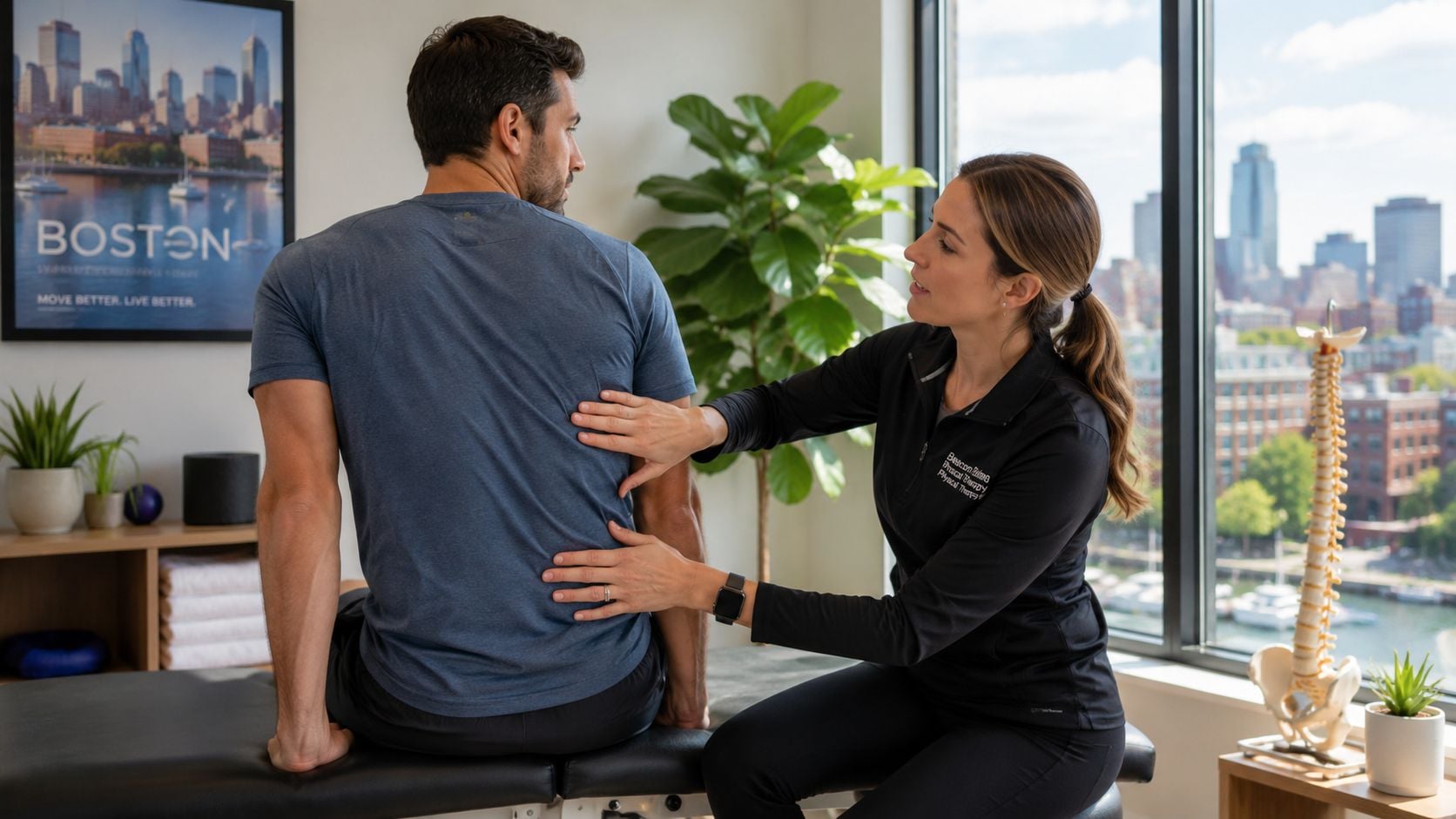
A 2023 analysis in PMC found that for chronic low back pain, which makes up over half of PT cases, outcomes depend more on whether care is individualized and reassessed over time than on the clinician's post-professional training level alone. That's an important point for Boston patients comparing clinics. Credentials matter, but they don't replace attentive progression and course correction.
Why one plan won't fit every Boston patient
Consider how different these patients are:
- A marathon trainee who gets pain late in long runs and after sitting.
- A desk-based professional whose symptoms build through the week and spike on travel days.
- A parent in Brookline or Allston who hurts most while lifting a child, carrying gear, or twisting at home.
- A golfer who feels pain with rotation and follow-through.
Each person may say “my low back hurts,” but the driver, aggravating factors, and loading plan can differ completely.
What personalized care looks like in practice
A useful back pain PT plan should be adjusted based on what your body does, not what a template says. That means:
- Reassessing symptoms regularly instead of assuming the first plan is always the right one
- Progressing exercises on purpose so strength and tolerance improve
- Modifying around real life like commute length, race calendar, shift work, or parenting demands
- Tracking functional goals such as sitting tolerance, lifting confidence, return to running, or gym capacity
The right question isn't “What exercise helps back pain?” It's “What dose of which exercise helps your back pain right now?”
That's why back pain physical therapy in Boston works better when the care model gives the clinician time to watch movement closely, test responses, and change the plan when needed.
Your Local Joint Ventures Clinic in Greater Boston
Convenience matters when your back is bothering you. If getting to care is difficult, people delay visits, cancel follow-ups, and lose momentum. In Boston, location can be the difference between staying consistent and dropping off after one appointment.
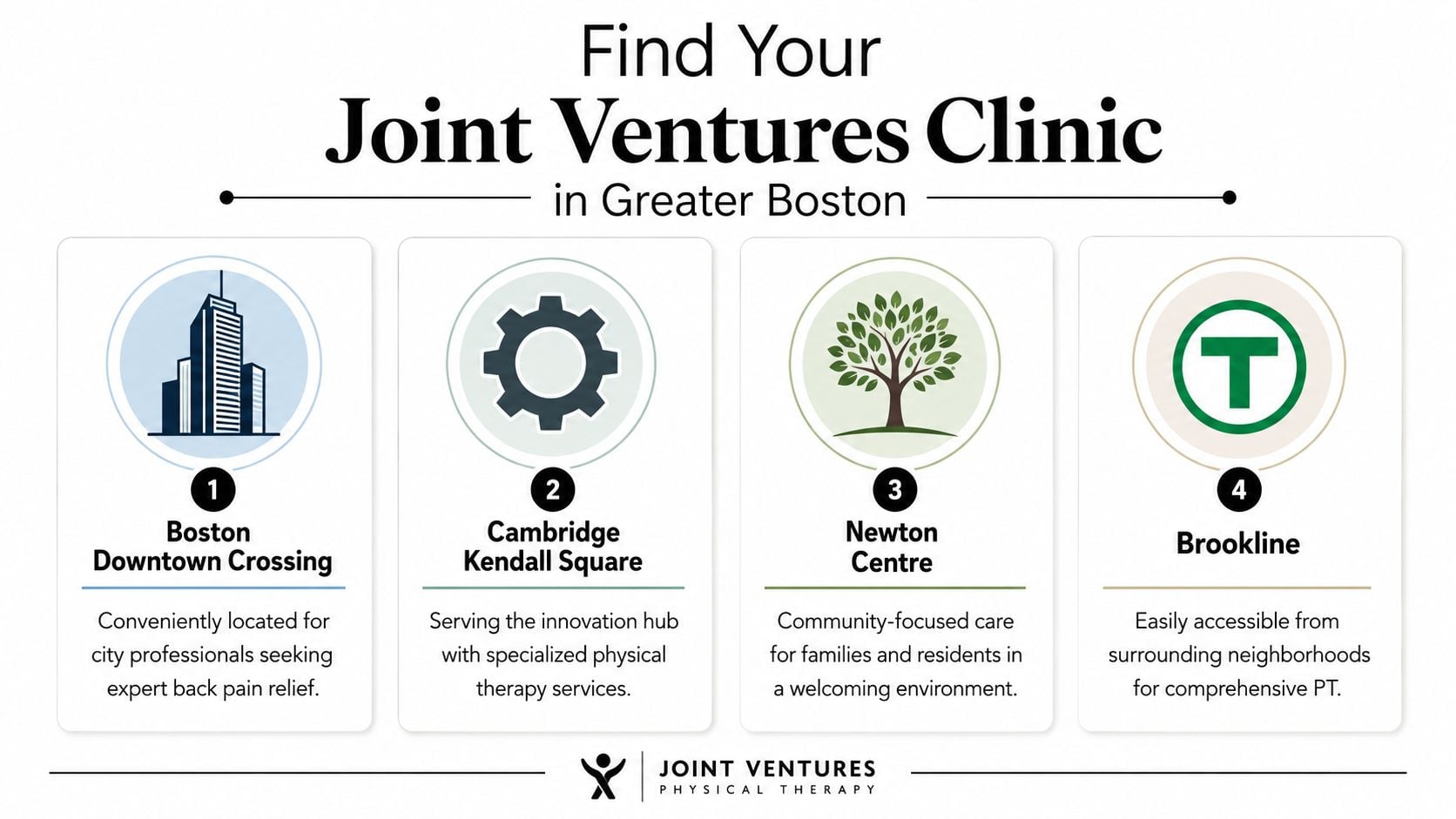
For many patients, the right clinic is the one that fits naturally into the day. That may mean a visit before work, after a commute, or near the places you already spend time. Joint Ventures locations serve neighborhoods and work hubs across Greater Boston, including Back Bay, Kenmore Square, Fort Point and Seaport, Downtown Boston, Brookline, Allston, and surrounding communities.
Which location tends to fit which lifestyle
- Back Bay works well for professionals, shoppers, and residents who want care close to busy city blocks and commuter routes.
- Kenmore Square makes sense for students, Fenway-area athletes, and people training near the river or local gyms.
- Fort Point and Seaport is a practical option for office workers and residents who want care near work before heading home.
- Downtown Boston is useful for commuters who want something central and easy to reach.
- Brookline and Allston access points can be a strong fit for neighborhood-based care and people balancing family schedules.
Make the first step simple
If you're looking for back pain physical therapy in Boston, the move is straightforward. Book an evaluation, let the team verify insurance benefits, and start with a one-on-one assessment that clarifies what's driving your symptoms and what to do next. Removing the admin friction matters when you're already juggling work, training, and everyday life.
Your Back Pain Questions Answered
Do I need a doctor's referral first
Many Massachusetts patients can start physical therapy through direct access, but coverage details can vary by plan. The simplest move is to contact the clinic and have the front desk confirm what your insurance requires before your first visit.
How long does back pain recovery take
It depends on the irritability of your symptoms, how long the pain has been present, and what activities you're trying to return to. Some people improve quickly once they start moving better and loading the right patterns. Others need a longer progression because the issue involves deconditioning, repeated flare-ups, or sport-specific demands.
What does an evidence-based program usually include
An evidence-based back pain PT program typically uses manual therapy, therapeutic exercise, and mobility training to reduce pain, restore function, and improve overall strength. In practice, that means you should expect active treatment, not just passive modalities.
Do you work with runners, lifters, and active adults
Yes. That's especially relevant in Boston, where many patients want to stay engaged with marathon training, gym routines, golf, rowing, and other active hobbies while recovering. If you want self-guided ideas before your visit, these best exercises for lower back pain relief offer a helpful starting point.
Will someone help me understand billing and insurance
A strong clinic should make benefits and authorizations easier to manage. If you want a broader look at how PT billing systems work behind the scenes, Happy Billing's PT solutions provide a useful industry reference point.
Where can I read more in-depth educational content
For deeper clinical education on injuries, recovery, movement, and performance, visit Highbar Health. That's the right place for broader educational content, while local scheduling and neighborhood-based care decisions belong here in Boston.
If back pain is changing how you work, train, sleep, or move around the city, book an evaluation with Joint Ventures Physical Therapy. A one-on-one visit can help you identify what's driving the pain, what you can safely keep doing, and what kind of treatment plan fits your Boston routine.