A lot of people who search for dry needling Boston are in the same spot. Their pain isn't severe enough to stop life completely, but it's stubborn enough to keep showing up anyway. It's the calf that tightens halfway through a Charles River run, the neck that never relaxes after a week of laptop work in Back Bay, or the jaw tension that turns a stressful month into headaches and poor sleep.
By the time most patients ask about dry needling, they've usually already tried stretching, foam rolling, massage, or “giving it time.” Sometimes those help. Sometimes they don't. What often changes the picture is a more precise approach that targets the muscle dysfunction keeping the problem active, then uses that relief to get you moving better again.
Why Bostonians Are Turning to Dry Needling
You see the pattern all over Boston. A runner is a few weeks into marathon training and the same calf keeps tightening on longer runs. A graduate student spends hours at a laptop and starts waking up with neck pain and tension headaches. A parent carries a child, sits too much, lifts when there is time, and ends the week with a hip that never quite settles down.
These problems rarely start as dramatic injuries. They build from repetition, limited recovery, and muscles that stay guarded longer than they should. By the time someone asks about dry needling, they are often dealing with pain that is annoying, persistent, and disruptive enough to change how they run, work, sleep, or exercise.
Dry needling keeps coming up for a simple reason. It can reduce muscle irritability quickly enough to create a better window for movement, strengthening, and retraining. In clinic, that often means a patient can turn their head more easily, load a squat with less pinching, or push off during a run without the same sense of restriction.
That does not make it a cure-all.
The trade-off is straightforward. Dry needling can be very effective for the right problem, but the benefit tends to last longer when it is paired with the rest of a treatment plan. If a stiff thoracic spine, weak hip control, training error, or work setup is feeding the issue, those factors still need attention. The needle helps calm the barrier. Rehab changes why it kept returning.
That is one reason Boston patients are interested in it. People here want treatments that fit into real life and help them get back to a goal. Sometimes that goal is finishing a long run along the Charles without compensating. Sometimes it is getting through a full workday in the Seaport without upper trap pain building by noon. Sometimes it is picking up a child, getting through a commute, or returning to the gym without feeling like the same spot will flare again.
Used well, dry needling is a practical tool. It is often the step that helps progress start again when stretching, foam rolling, and rest have stopped changing the picture.
Understanding Dry Needling vs Acupuncture
Dry needling is not acupuncture. That's the most important place to start.
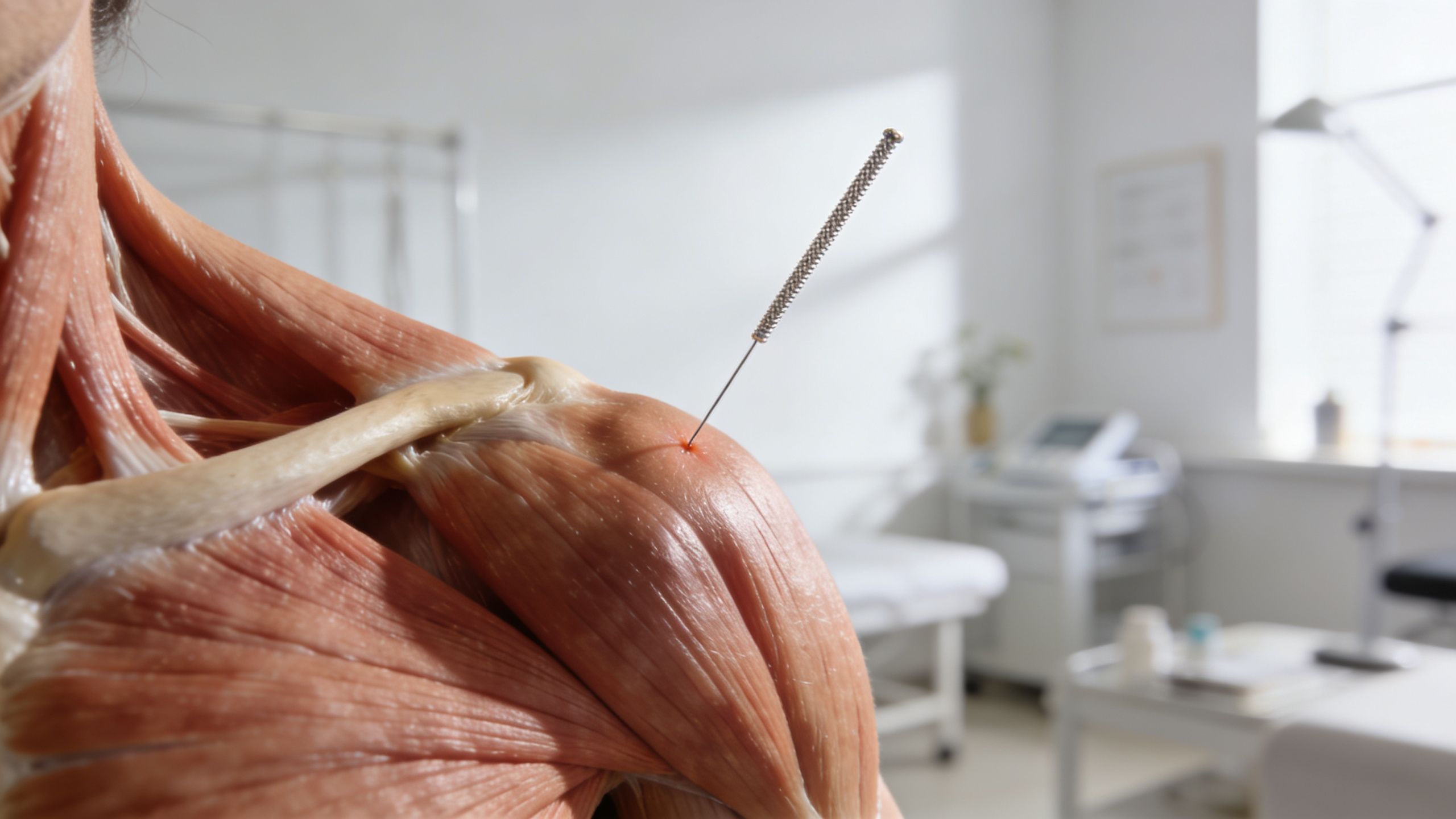
Dry needling is a modern, Western neuromusculoskeletal intervention that targets myofascial trigger points, tissue restrictions, and pain-related muscle dysfunction using a thin filiform needle, as described by Boston PT and Wellness. The goal is to provoke a local twitch response, influence pain processing, and reduce pain so you can participate more effectively in rehabilitation.
What dry needling is doing
In plain terms, your physical therapist uses a very thin needle to reach a tight, irritable part of a muscle. That spot may be contributing to pain, stiffness, reduced range of motion, or a feeling that the muscle never fully shuts off.
When the needle reaches the right area, you might feel one of a few things:
- Very little at insertion because the needle is fine
- A quick twitch or cramp-like response from the muscle
- A deep ache that fades quickly
- Less tension afterward when you stand up, walk, lift, or turn your head
That twitch response often sounds alarming when patients hear about it for the first time. In practice, it's usually brief. Clinically, it helps confirm that the therapist has reached the irritable tissue being targeted.
How it differs from acupuncture
The tool looks similar. The framework is different.
| Approach | Dry needling | Acupuncture |
|---|---|---|
| Clinical model | Western neuromusculoskeletal care | Traditional Chinese Medicine framework |
| Primary target | Trigger points, painful soft tissue, movement dysfunction | Meridian-based concepts and energy flow |
| Typical use in PT | To reduce pain and muscle guarding so rehab works better | Different therapeutic tradition and treatment logic |
A short visual can make that easier to picture in real clinical terms.
The simplest way to think about it is this. Acupuncture and dry needling may use a similar instrument, but they are not the same treatment, and they are not based on the same clinical reasoning.
Is Dry Needling Right for Your Boston Lifestyle
The answer depends less on whether the technique sounds interesting and more on what's driving your pain.
For active people in Boston, dry needling is usually most helpful when there's a clear soft-tissue component. A marathon trainee may have a stubborn calf or glute trigger point that keeps returning despite mobility work. A desk-based professional in the Financial District may have neck and shoulder guarding that never fully settles because the underlying muscles stay overactive. A patient with TMJ symptoms may have jaw, neck, and upper trap tension that responds well when treatment is paired with more specific rehab.
Boston examples that fit well
A runner training on the Esplanade might come in saying, “It's not a true injury. It just always feels tight.” That's often where dry needling can help. If a myofascial trigger point is changing stride mechanics or making it hard to load normally, reducing that irritability can open the door to better strength work and smarter mileage progression.
A Seaport tech worker might describe the opposite problem. No race on the calendar. No major injury. Just a neck that locks up by Thursday and a shoulder blade area that burns during meetings. In that case, dry needling may be useful as part of a broader plan that also addresses posture tolerance, thoracic mobility, and load capacity through the workweek.
Where it can help and where it won't
For active populations, the decision is condition-specific. The Method PT's discussion of manual therapy and dry needling notes that the strongest signal is usually short-term pain relief, making it a reasonable adjunct for a runner with a myofascial flare-up or a patient with TMJ pain, but not a replacement for load management or jaw-specific therapy.
That distinction matters.
Often a good fit
- Localized muscle pain: Persistent knots, bands, or trigger points
- Movement limited by guarding: Pain that makes it hard to rotate, squat, lift, or run normally
- Adjunct to rehab: When pain is blocking exercise progress
Usually not enough on its own
- Training errors: Too much mileage, too soon
- Jaw issues without TMJ-specific care: Needling alone won't teach better joint mechanics
- Postpartum recovery: Pelvic floor and core rehab still matter
- Recurrent pain patterns: If the underlying strength or control issue isn't addressed, symptoms often return
Good candidates tend to ask better questions
The best question isn't “Does dry needling work?”
It's “Is dry needling the right tool for my specific problem right now?”
If your pain improves briefly with massage, stretching, or heat but comes back as soon as you run, sit, or lift again, that often signals a bigger rehab opportunity. The pain may be muscular, but the lasting fix usually involves what you do after the muscle calms down.
Your Dry Needling Session at Joint Ventures
You come in because your calf keeps tightening halfway through a Charles River run, or your upper traps lock up by 3 p.m. at your desk. The first visit should answer the practical questions fast. What tissue is involved, whether dry needling makes sense, and what the plan is after the needles come out.
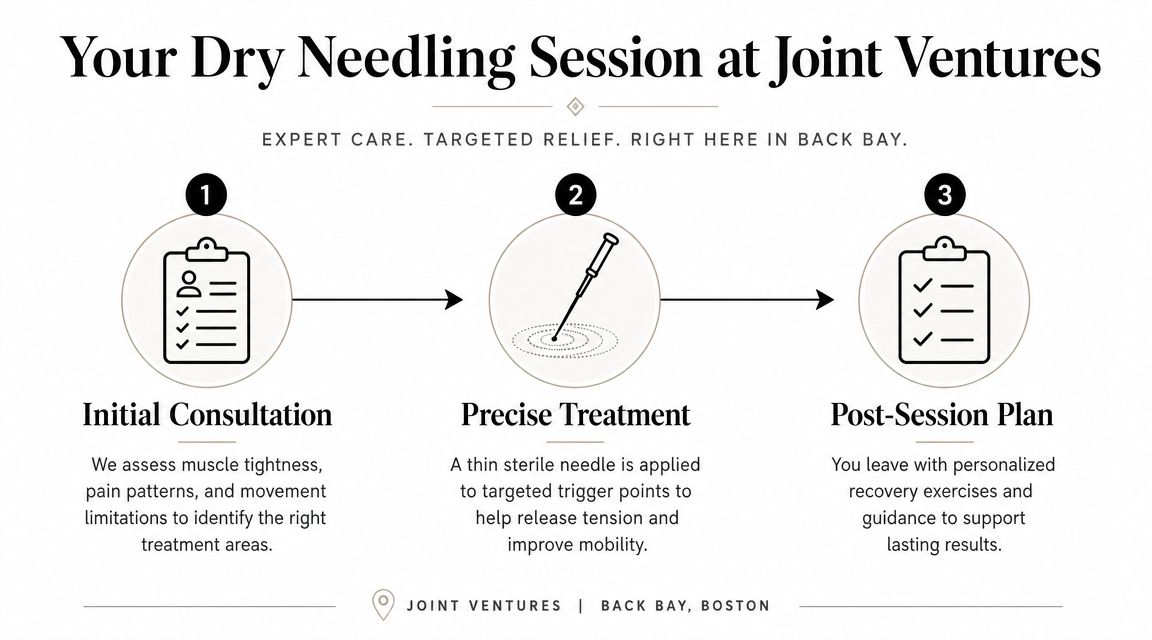
Step one is the assessment
Dry needling starts with an evaluation, not a needle.
Your therapist asks where the pain is, what triggers it, how long it has been going on, and what you need your body to do again. For one patient, that means climbing Beacon Hill stairs without hip pain. For another, it means turning the head comfortably during a long commute or getting through a lifting session without a shoulder pinch.
Then we test movement, strength, and tissue irritability. We palpate the area, look for referral patterns, and check whether the painful spot is the driver or just reacting to something else. That matters because needling the sorest muscle is not always the right call.
If you're new to PT, this guide on how to prepare for your first physical therapy appointment can help you know what to bring and expect.
Step two is the treatment itself
Once the target muscle is selected, the needle is placed into the tissue with a specific purpose. Some patients feel almost nothing going in. Others feel a quick twitch, pressure, or a brief cramp-like response. None of those sensations are unusual, and we explain them before we start.
The treatment itself is usually short. Dry needling is commonly one part of a full PT visit, not a stand-alone appointment where you lie still for an extended period. The goal is to reduce guarding or sensitivity enough to make the rest of the session more productive.
That trade-off is important. Needling can calm an irritable muscle quickly, but the effect lasts longer when we pair it with the right movement work.
Step three is what happens right after
After treatment, we retest the movement that was limited before. If your neck rotates farther, your squat feels less blocked, or your jaw opens with less tension, we use that window right away.
You may move into:
- Targeted exercise to hold onto the new range
- Manual therapy or mobility work if the tissue now tolerates it better
- Load progression such as return-to-run drills, strength work, or TMJ control exercises
Some soreness afterward is normal. Most patients describe it as workout-like soreness that settles within a day or two. If a patient is training hard, commuting long hours, or sensitive to post-treatment soreness, we factor that in and dose treatment accordingly.
Finding a Qualified Dry Needling Provider in Boston
Dry needling is skill-dependent. That's the part patients should take seriously.
A needle in the wrong hands isn't the same as a needle in trained hands. The difference comes down to anatomy knowledge, tissue selection, sterile technique, safety screening, and clinical judgment about when not to needle.

What qualified training looks like
In Boston, representative dry needling education includes a 27-hour, lab-based program covering safe insertion and removal, case-based application for upper and lower extremity plus cervical and lumbar regions, and CDC/OSHA-informed precautions, according to this Boston dry needling training course description. The same training context emphasizes gross anatomy, risk screening, clean needle protocols, and psychomotor competency.
That matters most in more sensitive regions such as the neck and torso, where precision and patient selection are critical.
Questions worth asking before you book
If you're comparing clinics for dry needling Boston, ask direct questions:
- What formal dry needling training has the clinician completed?
- Do they screen for risks and explain consent clearly?
- Do they use single-use sterile filiform needles?
- Will dry needling be part of a full rehab plan, or is it being sold as the whole treatment?
Those answers tell you a lot.
A clinic page like Joint Ventures' trigger point dry needling service can help you confirm that dry needling is offered within physical therapy care rather than presented as an isolated wellness add-on.
What should make you cautious
Be careful with messaging that sounds too easy. If a provider talks only about benefits and avoids discussion of soreness, bruising, risk screening, or alternatives, that's not a good sign. So is any pitch that treats dry needling like a universal answer for every diagnosis.
Safe dry needling starts before the needle ever touches the skin. It starts with screening, anatomy, and a clear reason for using it.
Integrating Dry Needling into Your Recovery Plan
The most useful way to think about dry needling is as a window-opener.
It may reduce pain and guarding quickly enough that you can finally do the exercises, movement retraining, and strength work that were too painful or too stiff before. That's why the treatment often feels most effective when it's paired with a broader plan, not when it's chased as a stand-alone fix.

What it unlocks
Boston's academic medical centers are actively researching dry needling, including a BIDMC/MGH study comparing real dry needling with sham needling for painful trapezius trigger points using a single-use needle, as described on the BIDMC research page. That work reflects how dry needling has become part of multidisciplinary care used alongside manual therapy and exercise to modulate pain and accelerate return to function, not as a stand-alone cure.
In practice, that usually means one of these sequences:
- Pain calms down first, then strength improves
- Range of motion improves, then mechanics improve
- Guarding decreases, then confidence returns
What works better than needling alone
If the tissue quiets down but nothing changes in how you load, sit, run, lift, clench, or recover, symptoms often circle back. Lasting progress usually comes from pairing the short-term change with specific follow-up care.
That might include:
- manual physical therapy for joint and soft-tissue restrictions
- strengthening for the calf, hip, jaw, core, or shoulder
- return-to-run progression
- pelvic floor rehab
- workplace ergonomics and movement breaks for desk-heavy jobs
For deeper educational content on injury recovery, movement, and anatomy, visit Highbar Health. That's the better place for broader clinical education, while local care decisions should focus on what fits your Boston routine and goals.
Common Questions About Dry Needling Treatment
Does it hurt
Usually less than people expect. The needle itself is very fine. The part patients notice more often is the twitch response or deep ache when the target muscle reacts. Afterward, mild soreness can happen, and it often feels similar to post-workout soreness.
How many sessions will I need
There isn't one standard answer. Some patients notice a useful change quickly. Others need it used periodically within a larger plan of care. The more important question is whether each session is helping you move better, train better, or tolerate daily life better.
Is it covered by insurance
Coverage varies by plan and billing structure. In many physical therapy settings, dry needling is folded into the overall visit rather than treated like a separate spa-style service. The practical move is to ask the clinic to verify benefits before your first appointment so you know what to expect.
Is it good for every diagnosis
No. That's one reason a real evaluation matters. Dry needling can be a strong tool for certain muscular pain patterns, but it doesn't replace diagnosis-specific rehab, progressive loading, or activity modification when those are the main drivers.
What should I wear
Wear clothing that gives access to the region being treated and lets you move easily afterward. For example, shorts help for calf, quad, or hip treatment. A tank top or loose shirt may help for shoulder or upper back treatment.
Book Your Dry Needling Consultation in Boston
If you've been dealing with a muscle knot, recurring neck tension, jaw pain, running-related tightness, or a stubborn soft-tissue problem that keeps slowing you down, dry needling may be worth considering. The key is using it for the right reason, in the right tissue, with the right follow-up plan.
In Boston, that means looking for care that fits your actual week. Maybe you need treatment near Back Bay before work, in Kenmore Square between classes, in Fort Point/Seaport near the office, or Downtown where commuting is easier. Maybe your goal is simple relief. Maybe it's getting through Marathon prep, returning to lifting, or finally breaking the cycle of pain and guarding that keeps interrupting progress.
The next step should be straightforward. Book an evaluation, get a real assessment, and find out whether dry needling belongs in your plan or whether another approach makes more sense. Good physical therapy doesn't force a technique onto every patient. It matches the tool to the person.
If you're ready to talk through your symptoms and next steps, book a consultation with Joint Ventures Physical Therapy.