
A lot of people in Boston wait too long to ask about pelvic floor symptoms.
It's the runner who notices leaking on strides along the Charles but tells herself it's probably normal. It's the Seaport professional who feels pelvic heaviness after long desk days and strength classes. It's the new parent in Back Bay who assumes pain, pressure, or difficulty returning to exercise just needs more time. In practice, these symptoms are common, treatable, and worth addressing early.
Your Guide to Pelvic Floor PT in Boston
If you're searching for pelvic floor physical therapy boston, you're probably not looking for a textbook explanation. You want to know whether what you're feeling is something a PT can help, what care looks like in a Boston clinic, and how quickly life can start to feel more manageable.
The need is real. One in three U.S. women experiences a pelvic floor disorder annually, and search interest keeps climbing. Tufts Medicine notes that searches for “pelvic floor therapy” have increased by 56% in the last five years, and it also reports a 50% to 60% improvement rate, with many patients noticing positive change by the fourth session when care is consistent, according to Tufts Medicine's pelvic floor health article.
That matters in Boston, where people tend to stay active even when symptoms show up. They keep commuting, lifting, running, parenting, and sitting through demanding workdays. The problem is that pushing through usually doesn't solve pelvic floor dysfunction. It often makes people feel more frustrated because they're working hard and still leaking, clenching, or avoiding activity.
Why Boston patients often delay care
Some people assume pelvic floor PT is only for postpartum women. Others worry the first visit will feel awkward or overly invasive. Many do not realize that symptoms like urinary urgency, constipation, pelvic pain, painful sex, or pressure with exercise fit squarely within physical therapy.
Practical rule: If a symptom is changing how you exercise, work, travel, or feel in your body, it's worth an evaluation.
Boston patients also tend to do homework before booking. If you want a simple at-home starting point while you're learning more, these Lake City PT pelvic floor resources can help you understand basic exercises and common concerns.
What good local care should feel like
A strong Boston-area pelvic health experience should feel private, specific, and practical. You shouldn't leave with vague reassurance or a generic sheet of Kegels. You should leave understanding what's likely driving your symptoms and what the next few visits are meant to change.
That's especially important for people balancing city life. When your schedule already includes meetings, transit, workouts, or childcare, treatment needs to fit real life, not an idealized version of it.
What Is Pelvic Floor Physical Therapy Really
Pelvic floor physical therapy is functional rehab, not a one-note strengthening program.
Think of the pelvic floor as a dynamic foundation at the base of your core. These muscles support pelvic organs, help with bladder and bowel control, contribute to sexual function, and coordinate with breathing and deeper abdominal muscles when you lift, run, cough, or move through the day.
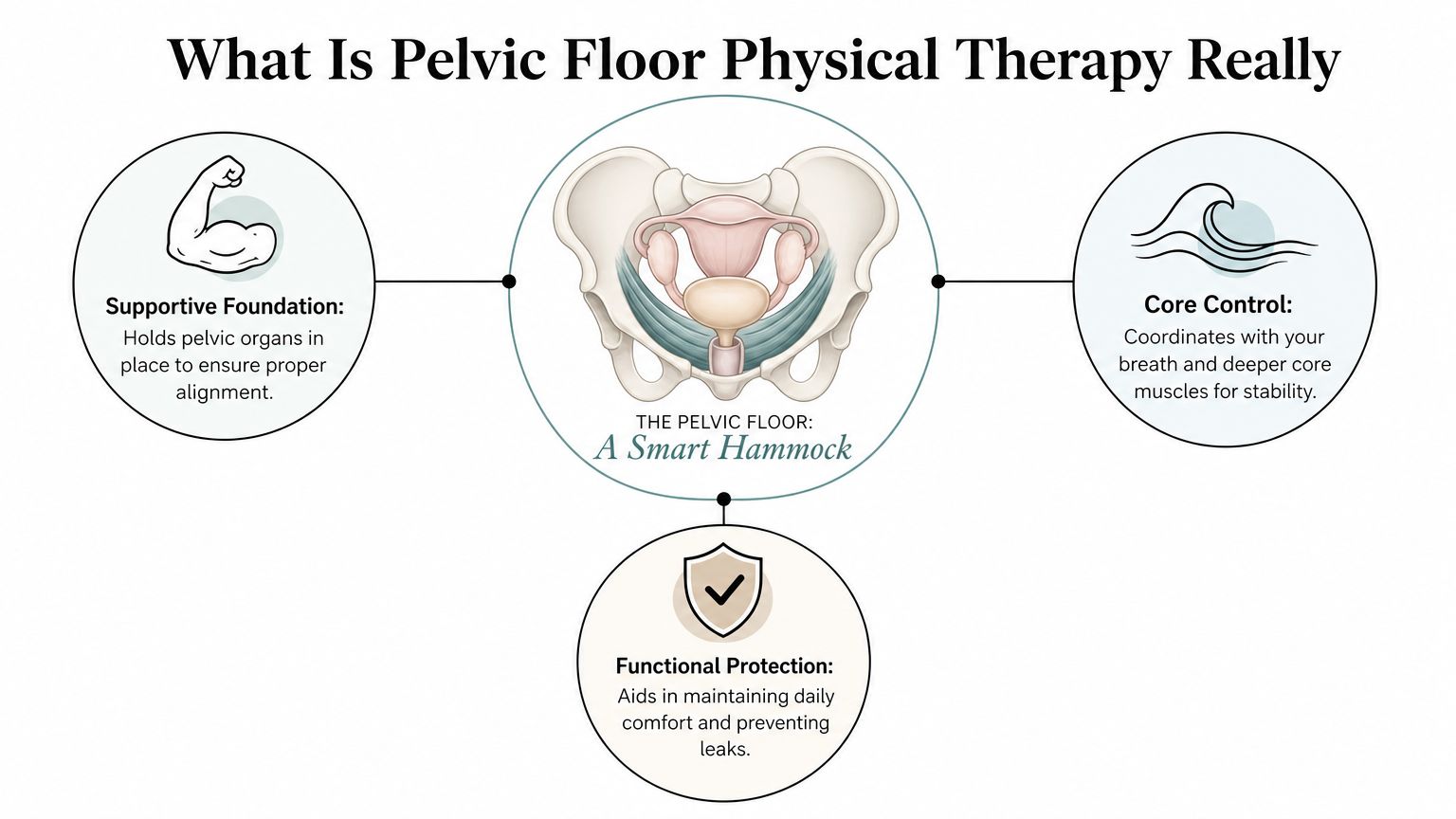
It's not just Kegels
A lot of patients arrive assuming the solution is to make the muscles stronger. Sometimes strength matters. Often it's only part of the picture.
Brigham and Women's Faulkner Hospital describes the clinical goal as functional restoration, with care that evaluates muscle tone, strength, and endurance, then retrains coordination between contraction and elongation. That matters because symptoms can come from poor neuromuscular control or hypertonicity, not just weakness, as noted by Brigham and Women's Faulkner Hospital.
If a muscle system is already overworking, cueing harder squeezing can backfire. Patients with pelvic pain, constipation, or pain during intercourse often need the opposite first. They need better relaxation, better pressure management, and better timing.
What therapists are actually retraining
In a good pelvic floor plan, the question isn't “Can you contract?” It's closer to this:
- Can you relax fully: Some people guard all day without realizing it.
- Can you coordinate with breath: Breath-holding and pressure bracing often feed symptoms.
- Can you tolerate real tasks: Running, deadlifting, carrying a car seat, or sitting through a workday all test the system differently.
A more detailed local explainer on that process is available in Joint Ventures' article on what pelvic floor therapy is.
Pelvic floor rehab works best when treatment matches the actual problem. Tight muscles, poorly timed muscles, and underperforming muscles do not need the same plan.
That distinction is why experienced pelvic floor PT feels more precise than one might expect.
Common Conditions We Treat in Our Boston Clinics
Symptoms don't usually arrive in neat categories. A postpartum patient may also be trying to return to lifting. A runner may have urgency plus hip pain. A desk worker may notice pelvic pain, constipation, and trouble relaxing the abdomen after long seated days.
Pregnancy and postpartum recovery
This is one of the most common reasons people seek pelvic floor PT in Boston, especially when they want a realistic path back to exercise and daily activity.
Common concerns include:
- Leaking with impact: often during running, jumping, or even sneezing
- Pelvic pressure or heaviness: especially with walking, lifting, or longer days on your feet
- Abdominal and core recovery: including coordination challenges after pregnancy
- Pain with return to intimacy or exercise: which people often underestimate for too long
If you're in that phase, Joint Ventures has a local postpartum-focused resource on pelvic floor therapy after pregnancy.
Bladder, bowel, and sexual health concerns
These symptoms are common, but people still hesitate to bring them up. They shouldn't.
A pelvic floor PT may help when you're dealing with urinary urgency, urinary frequency, constipation, incomplete emptying, painful sex, or pelvic pain that seems disconnected from any obvious orthopedic injury. In many cases, the issue isn't isolated to the pelvis. Hip stiffness, trunk mechanics, pressure strategy, and nervous system guarding all matter.
Some patients also benefit from broader lifestyle support when hormonal or metabolic concerns overlap with pelvic symptoms. For readers exploring nutrition structure alongside medical care, a personalized PCOS meal plan can be a useful adjunct resource.
Pain and performance issues in active Bostonians
Boston has a large population of runners, lifters, students, and professionals who expect a lot from their bodies. Pelvic floor symptoms often show up in that group as “small” issues first. A little leakage on tempo runs. Groin or pelvic tension during heavy lifts. Tailbone pain from sitting at work, then pain again during training.
That overlap matters because pelvic floor PT is rarely just about the pelvic floor in isolation. Boston-area programs describe a whole-body model that can include bowel, urinary, and sexual dysfunction across life stages and genders, with progress measured by symptom-specific function, not just muscle contraction on an exam. For deeper educational content that goes beyond this local guide, visit Highbar Health.
If your symptom shows up during something meaningful to you, training, commuting, parenting, travel, work, it belongs in the treatment plan.
That's the difference between generic rehab and rehab that transfers to daily Boston life.
Your First Pelvic Floor PT Visit What to Expect
The first appointment is usually much more conversational and much less intimidating than people expect.

It starts with your story
Your therapist will ask about symptoms, history, goals, and the patterns you've noticed. That includes practical details such as when symptoms started, what activities aggravate them, what you've already tried, and what you need to get back to. For a Boston patient, that might mean commuting without urgency, running without leakage, lifting without pressure, or getting through a seated workday with less pain.
Boston's major medical systems set a clear standard here. Brigham and Women's states that first visits are done in a private room, include a thorough history, and that any internal pelvic exam is performed only with patient consent, according to Brigham and Women's Rehabilitation Services.
The assessment is usually whole-body
Pelvic floor rehab should not begin and end at the pelvis. Your therapist may look at:
- Breathing pattern: especially if you brace or hold your breath under effort
- Posture and ribcage position: because pressure strategy matters
- Hip and trunk mobility: common drivers in active adults
- Movement tasks: squat, step, balance, transfer, or symptom-provoking motions
A quick prep guide can help reduce uncertainty before day one. Joint Ventures shares one here on how to prepare for your first physical therapy appointment.
Internal assessment is optional and consent-based
An internal exam can provide useful information in some cases. It may help assess tone, tenderness, coordination, and muscle recruitment more directly. It is not mandatory for every patient, and it is never something that should feel pressured or rushed.
You are allowed to ask questions, decline any part of the exam, and move at a pace that feels manageable.
For some patients, treatment begins with education, breathing work, external assessment, and movement training alone. That's still legitimate pelvic floor PT.
This short video gives a helpful overview of what that first appointment can feel like in practice.
Our Evidence-Based Treatment Approach
A good treatment plan should help you handle real life in Boston. That means getting through a Red Line commute without bracing the whole ride, lifting a child into a car seat in Southie, sitting through a long hospital or tech workday, or returning to a run along the Charles without second-guessing every symptom.
Pelvic floor rehab works best when it is specific to the problem in front of us. A patient with urgency and pelvic tension needs a different plan than a postpartum runner with leaking, or a cyclist with pain after longer rides. The goal is not to throw every technique at the issue. The goal is to choose the few approaches that fit your symptoms, your exam findings, and the activities you want to get back to.
What treatment often includes
In Boston clinics that treat pelvic health well, care usually blends hands-on treatment, movement retraining, and a home plan you can realistically follow between meetings, school pickups, and workouts.
- Manual therapy and soft tissue work: Useful when pain, guarding, or tissue irritability is keeping the area sensitive.
- Biofeedback: Helpful if you are not sure whether you are relaxing, bearing down, or gripping too hard.
- Strength and coordination training: Best when it matches a real task such as lifting, running, coughing, or getting through a gym session.
- Breathing and pressure management: Often a key piece for lifters, runners, rowers, and people who stay tense through the trunk and pelvic floor all day.
Some patients need symptom calming first. Others need more load, more strength, and a clearer return-to-activity plan. Good care accounts for that trade-off.
Common dead ends
Patients usually arrive after trying strategies that sounded reasonable but did not match the actual problem.
| Approach | Why it falls short |
|---|---|
| Doing frequent Kegels on your own | More contraction can worsen symptoms if the pelvic floor already has too much tension |
| Chasing only the painful area | Pain often involves pressure control, hip function, trunk strength, and nervous system sensitivity |
| Stopping exercise completely | Short-term rest can help, but too much avoidance often lowers confidence and tolerance for normal activity |
This matters for active professionals. A Back Bay attorney, a Fenway student, and a Seaport parent may all have pelvic floor symptoms, but their day-to-day demands are different. The treatment plan has to hold up in their actual schedule, not just during a 45-minute visit.
At Joint Ventures, that often means one-on-one sessions with a clinician who can adjust the plan as symptoms change, activity builds, or setbacks show up. Progress is rarely linear. A strong program leaves room for symptom flares, work stress, menstrual-cycle changes, postpartum demands, or a return to sport that needs to slow down for a week.
For patients also dealing with stiffness, reduced activity tolerance, or fear around movement, broader strategies can help support rehab. BionicGym's approach to arthritis offers one example of how people can stay active while keeping symptoms manageable.
The best plan usually makes daily tasks feel easier before it pushes performance. Once the system is less guarded and better coordinated, exercise tends to go better too.
Finding the Right Pelvic Floor Therapist in Boston
Not every clinic is set up the same way. If you're comparing options for pelvic floor physical therapy boston, focus less on marketing language and more on how care is delivered.
What to look for
A strong fit usually includes these basics:
- One-on-one visits: You want uninterrupted time, not a handoff model.
- Experience with your specific issue: Postpartum return to running is different from chronic pelvic pain or bowel dysfunction.
- A whole-body lens: If a clinic only talks about Kegels, keep looking.
- Convenient city access: Consistency is much easier when care fits your route to work or home.
Convenient Joint Ventures Locations in Boston
| Location | Neighborhood | Ideal For |
|---|---|---|
| Back Bay | Back Bay | Professionals, runners, and residents near Copley and the South End |
| Kenmore Square | Kenmore/Fenway | Students, university athletes, and Fenway-area patients |
| Fort Point/Seaport | Fort Point/Seaport | Seaport professionals, hybrid workers, and active adults |
| Downtown Boston | Downtown | Commuters, financial district professionals, and patients using central transit routes |
Questions worth asking before you book
Ask direct questions. Will you stay with the same therapist for the full visit? Is internal work optional? Do they regularly treat postpartum athletes, pelvic pain, bladder issues, or male pelvic floor symptoms if that's relevant to you?
A busy Boston schedule can derail good intentions fast. The most effective clinic is often the one that combines strong pelvic health skill with a location and scheduling setup you can realistically stick with.
Boston Pelvic Health FAQs
How soon should I start pelvic floor PT
Start when symptoms begin affecting your day. If leaking changes your run along the Charles, pain makes sitting through a Back Bay workday hard, or postpartum pressure is not settling, it is reasonable to get evaluated rather than wait it out.
Early care is often simpler care. In many cases, a prompt evaluation helps us calm symptoms, sort out what is driving them, and build a focused multi-visit plan if needed. That matters after pregnancy, after surgery, and for active adults trying to stay consistent with work, commuting, and exercise in Boston.
How long until I notice improvement
That depends on the problem we are treating and how long it has been there. Bladder urgency or mild postpartum symptoms may shift fairly quickly. Pelvic pain, constipation, painful intercourse, or symptoms tied to lifting and running often take longer because we are addressing muscle coordination, habits, breathing patterns, and load management at the same time.
I tell patients to look for steady direction, not overnight change. You should understand what we are working on, what to practice at home, and what progress should look like from one visit to the next.
Is pelvic floor PT only for women or postpartum patients
No. Pelvic floor PT is for adults across genders and life stages.
In our Boston clinics, that includes postpartum patients, runners, lifters, men with pelvic pain or urinary symptoms, people recovering after surgery, and professionals dealing with bladder, bowel, or sexual health concerns. The treatment plan changes based on the person in front of us, not on a narrow patient category.
Do I need to be comfortable with an internal exam
No. Internal assessment can be helpful in some cases, but it is only one option.
Your care should start with consent and a clear explanation of why any exam is being offered. External assessment, breathing mechanics, posture, hip and core function, symptom behavior, and movement testing often give us useful information, especially at the first visit. If internal work is appropriate, you can ask questions, decline it, or choose to revisit it later.
What about insurance and referrals
Coverage and referral rules depend on your insurance plan. The practical move is to contact the clinic before your appointment and ask the front desk to check benefits, visit limits, and whether a referral is required.
At Joint Ventures Physical Therapy, patients can ask those questions before booking or before their first visit. That helps you avoid surprises and choose a location that fits your schedule in Back Bay, Kenmore Square, Fort Point/Seaport, Downtown, or nearby Boston neighborhoods.