
If you live or work downtown, your symptoms usually fit your schedule. A Financial District workday can leave you with jaw tension, headaches, or a neck that feels locked by late afternoon. A run along the waterfront can turn a small hip or knee issue into the thing you think about every time you climb stairs. And if you're dealing with vertigo or balance trouble, even getting through a crowded T station can feel like the hardest part of the appointment.
That's why physical therapy downtown Boston has to do more than offer a convenient address. It has to fit real city life. You need care that respects your time, understands how downtown routines create specific problems, and gives you uninterrupted attention when you finally step into the clinic.
Your Guide to Expert Physical Therapy in Downtown Boston
Some patients come in after weeks of trying to “be good” on their own. They've changed shoes, bought a new desk setup, stretched between meetings, or taken a break from training. The pain settles for a day or two, then returns when life goes back to normal.
Downtown Boston rewards consistency, but your body notices repetition faster than your calendar does. Long screen hours, rushed commutes, uneven sidewalks, race training, lifting, parenting, and stress all stack together. A generic handout rarely solves a problem that was built by that many moving parts.
At our Water Street clinic, the difference starts with 1-on-1 care. You're not rotating through a crowded gym floor or splitting your visit with three other patients. You get time with a clinician who listens, watches how you move, and builds treatment around what your week looks like.
Practical rule: If your rehab plan doesn't account for your commute, your work posture, your training load, or your home responsibilities, it probably won't hold up outside the clinic.
That matters downtown because the goals are rarely abstract. You want to sit through a presentation without back pain. You want to run the Harborwalk without calf tightness taking over. You want to stop clenching your jaw through deadlines. You want to feel steady getting on and off the train.
We also know Boston patients have options. Downtown Physical Therapy and Rehab has been part of Boston's PT community since 1983 and has served local neighborhoods for more than four decades, with headquarters at 125 Lewis Wharf and a broad set of rehab services, according to Fusion Physical Therapy Partners' update on Downtown PT. That long history says something important about this market. Boston patients pay attention to quality, fit, and follow-through.
Our approach is built for that standard. Not rushed care. Not one-size-fits-all programming. Focused treatment that makes sense for professionals, athletes, postpartum patients, and active adults who need their care to work in the middle of downtown life.
Specialized Care for the Demands of City Life
A downtown clinic shouldn't just treat “pain.” It should treat the patterns that come with city living. Jaw tension from all-day clenching is different from a runner's overuse problem. Postpartum pelvic floor symptoms need a different approach than dizziness triggered by head movement in a crowded environment.
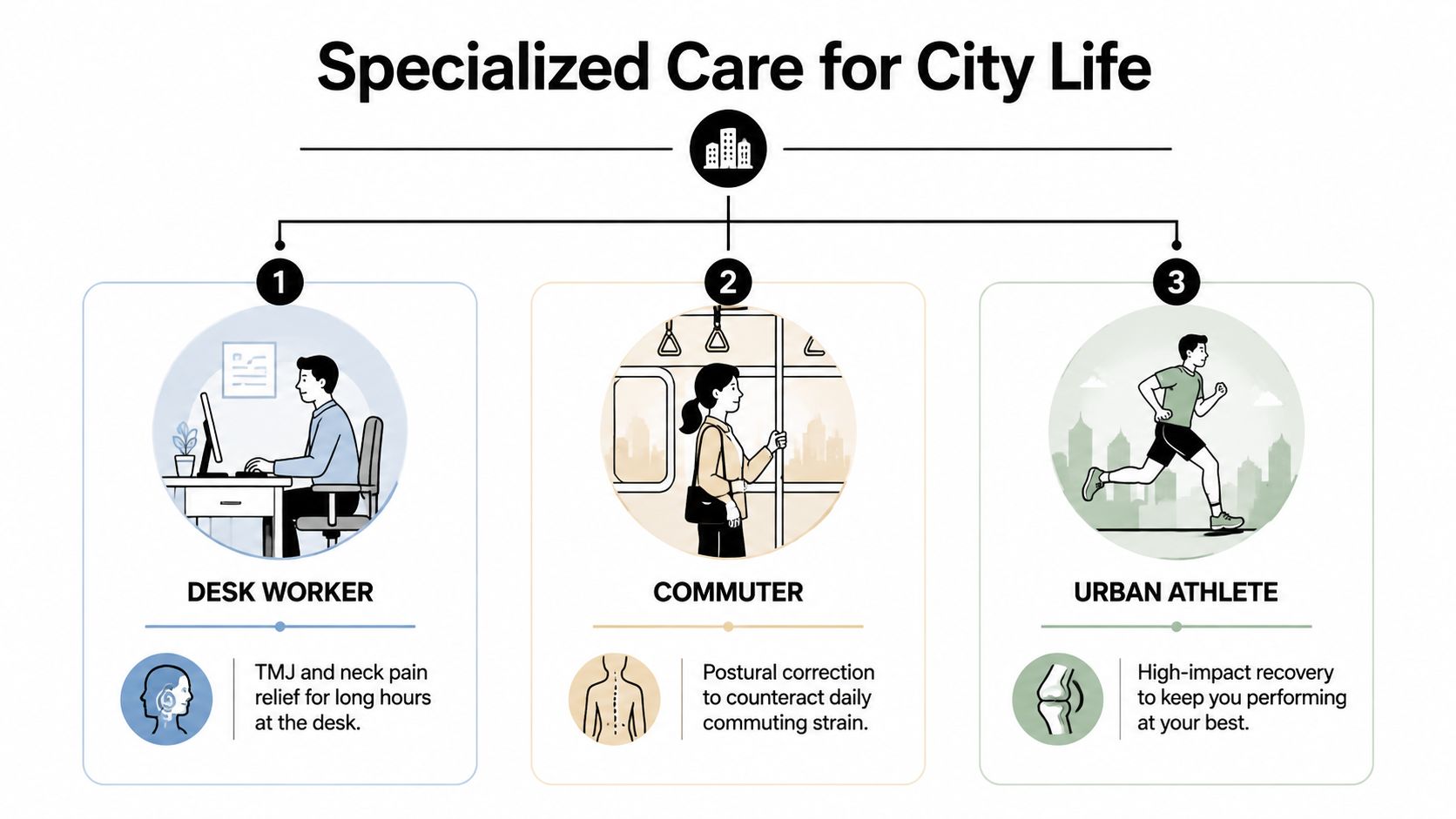
What city patients usually need
For desk workers, the issue often isn't just “bad posture.” It's the combination of laptop positioning, stress, reduced movement variety, and muscle guarding. That's where services like TMJ treatment, dry needling, orthopedic care, and workplace ergonomics become more useful than generic stretching advice.
For postpartum professionals, privacy and logistics matter almost as much as the treatment plan. Wellness in Motion reports a 35% surge in pelvic dysfunction cases in major cities, with 73% of patients delaying care due to logistical challenges, and notes that a 1-on-1 model can deliver an 88% resolution rate compared with 55% from standard PT. In practice, that means the format of care matters. If someone is already delaying treatment because life is full, double-booked care usually doesn't help.
For patients with vertigo or balance issues, the city itself can amplify symptoms. Noise, visual motion, escalators, and crowded platforms all raise the difficulty level. In those cases, vestibular rehab has to be specific and progressive, not vague reassurance to “take it easy.”
If stress is part of what keeps your symptoms flaring, some people also benefit from simple outside supports between visits. Resources like tools to manage anxiety can complement treatment when jaw tension, breath holding, or symptom vigilance are part of the bigger picture.
Downtown Boston PT services and conditions treated
| Specialty Service | Commonly Treated Conditions |
|---|---|
| TMJ-focused physical therapy | Jaw pain, clenching, headaches, facial tension, limited jaw opening |
| Trigger point dry needling | Persistent muscle tightness, guarded movement, neck and shoulder pain |
| Pelvic floor physical therapy | Postpartum symptoms, pelvic floor dysfunction, return to running or exercise |
| Vestibular and balance therapy | BPPV, dizziness, disequilibrium, motion sensitivity, confidence with walking |
| Orthopedic and sports rehab | Running injuries, overuse issues, post-surgical recovery, joint pain |
| Workplace ergonomics | Desk-related neck pain, back pain, shoulder strain, repetitive stress symptoms |
| Aquatic therapy and performance care | Low-impact progression, return to activity, conditioning support |
What works and what usually falls short
What works is matching the tool to the reason your symptoms keep showing up.
A downtown professional with jaw pain may need manual therapy, dry needling, movement retraining, and changes in how they tolerate long desk hours. A postpartum runner may need pelvic floor care that also respects her goal of getting back to impact. A dizzy patient may need positional treatment first, then guided progression into real-world motion.
What usually falls short is generic care that treats everyone like they have the same problem.
A useful treatment plan should feel like it was built for your workday, your training, and your obstacles. If it could be handed to ten strangers without changing much, it's too broad.
For patients who want deeper clinical reading on topics like running injuries, rehab planning, or movement mechanics, that educational layer belongs on Highbar Health, where the long-form anatomy and recovery content lives. The local clinic visit should stay focused on your goals in Boston, not broad textbook explanations.
Your First Visit at Our Water Street Clinic
Individuals feel more at ease starting PT when they understand what to expect. The first visit shouldn't feel mysterious or rushed. It should feel organized, specific, and comfortable.

Before you arrive
Once you've scheduled with our Downtown Boston location, we'll help you prepare so the visit runs smoothly. Wear comfortable clothing that lets us see the area we're assessing. If your issue shows up during running, lifting, or work tasks, it can help to bring the shoes, bag, or other item tied to the problem.
Some patients come in worried that they'll spend the whole session filling out forms and repeating their story. That's not the goal. We want enough background to understand the problem, then we want to watch how you move.
During the evaluation
Your evaluation starts with your history, but it doesn't end there. We look at what hurts, what triggers it, what you've already tried, and what you need to get back to. Then we assess the movement patterns, strength, mobility, coordination, and task demands that seem to be driving the issue.
For TMJ dysfunction, that level of specificity matters. This overview of Boston PT providers and TMJ care notes that Orthopedic Clinical Specialists using evidence-based dry needling and manual therapy can reduce pain by 45-60% within 4-6 visits and achieve 85% functional improvement in jaw opening after 8 weeks. Those results don't come from guessing. They come from focused assessment and targeted treatment.
What you leave with
You should leave the first appointment with clarity.
That means:
- A working explanation of what we think is driving your symptoms
- A plan of care that matches your schedule and goals
- A first set of priorities for what to do, what to modify, and what not to worry about
- A sense of progression so you know how treatment will build over time
Good PT doesn't just answer “What hurts?” It answers “Why does it keep happening in your week?”
Some patients begin hands-on treatment and exercise on day one. Others need more testing and planning before we push forward. Either way, the session is built around useful next steps, not filler.
Navigating Insurance and Access in Downtown Boston
Even strong treatment plans can fall apart if the logistics are messy. Downtown patients don't usually avoid care because they don't care about recovery. They avoid it because the process feels uncertain, the commute feels annoying, or insurance feels like one more task on an already crowded list.

Insurance questions should get answered early
The practical move is to verify benefits before your plan of care gets underway. Our administrative team helps patients understand coverage, expected responsibilities, and whether authorizations are needed. That removes a lot of the uncertainty that makes people delay booking.
If you want a separate general resource before scheduling anywhere, this guide can help you verify your 2026 health insurance provider status. It's a useful starting point when you want to understand in-network status and what to ask before your first visit.
For clinic-specific coverage details, our insurance resources page is the place to start.
Getting to the clinic without adding stress
Access matters more than many clinics admit, especially for vestibular patients. Bay State PT's Boston location page discusses that 62% of vestibular patients in urban areas cite transportation as a barrier, and highlights the value of guidance from nearby MBTA stops plus scheduling that accommodates patients who may feel dizzy or unsteady during peak travel times.
That lines up with what we see downtown. If you're already worried about motion sensitivity or balance, the route to care shouldn't feel like another obstacle.
A few practical points help:
- Use familiar transit routes if dizziness is part of the issue. Predictability helps.
- Ask about timing if rush-hour crowds worsen symptoms.
- Choose a clinic near your actual routine, not a location that only looks convenient on paper.
- Bring questions up early if building access, stairs, or walking distance are part of the challenge.
Why convenience alone isn't enough
A nearby address helps, but it's not the whole answer. Patients stay with care when the scheduling, the billing support, and the treatment style all fit together. That's especially true downtown, where missed time has a high cost.
The easiest clinic to reach isn't always the easiest clinic to stick with. Consistency usually depends on clear insurance answers, realistic scheduling, and a plan that feels worth showing up for.
Meet Your Downtown Boston Physical Therapy Team
The clinic experience changes when you know who's treating you. Credentials matter, but so does treatment style. Downtown patients usually want someone who can connect the dots quickly, explain what they're seeing, and adapt care to a demanding week.

Boston sets a high bar for clinical practice. Mass General's Physical Therapy Department reports 180 total physical therapists on staff, with more than 93 board-certified clinical specialists, or over 51% of the team. It describes the department as “a vibrant, progressive and patient-centered department, at the leading edge of physical therapy science.” That environment shapes the expectations patients bring into outpatient care across the city.
What that standard looks like in a neighborhood clinic
In a downtown outpatient setting, specialist-level care should still feel approachable. You shouldn't need a lecture to understand your plan. You should get a clinician who can assess precisely, explain clearly, and make useful decisions in real time.
That's especially important for the patients we often see here:
- Runners and active adults who need progression, not just pain relief
- Professionals with desk-related symptoms who need treatment that fits work demands
- Postpartum patients who want privacy, focus, and a return-to-activity plan
- Patients with dizziness or TMJ symptoms who need targeted care rather than broad exercise lists
You can browse the broader clinician roster on our team page, which is helpful if you want to explore specialties and backgrounds before booking.
The people matter as much as the plan
A good downtown PT team usually has a shared mindset. They don't chase symptoms in isolation. They look at the work setup, the commute, the training volume, the stress level, and the specific task you're trying to return to.
That human piece is hard to fake. Patients feel it in the questions we ask. They feel it in whether the session is collaborative or scripted. They feel it when the plan changes because their week changed.
A quick look inside the broader care approach helps too.
What most patients want is simple. They want to be taken seriously. They want a clinician who understands downtown Boston life. And they want a plan that makes sense for the body they use every day, not the body someone assumes they have on paper.
Take the Next Step Towards Recovery
If you've been putting this off, the main question isn't whether your symptoms are “bad enough.” It's whether they're interrupting how you work, train, parent, commute, or move through the city.
The right fit for physical therapy downtown Boston is care that gives you uninterrupted time with an expert clinician, practical scheduling, and a plan built around your actual goals. That could mean getting through the workday without jaw pain, returning to running without guessing, or feeling steady enough to get around downtown confidently again.
If you're ready to move forward, book an appointment at the downtown clinic. If you're not quite there yet, start with an insurance check so you know what your options look like before committing.
For deeper educational content on injury mechanics, rehab concepts, and recovery topics beyond the local clinic visit, head to Highbar Health. That's where the broader learning belongs. Your clinic visit should stay focused on getting you better.
Common Questions About Physical Therapy in Boston
Do I need a doctor's referral to start PT in Massachusetts
Many patients can begin PT through direct access, but insurance requirements can vary. The fastest answer is to contact the clinic and have the front desk confirm what your specific plan needs.
How long is each appointment
What matters most is whether you get meaningful one-on-one time with your therapist. If you're comparing clinics, ask whether your clinician stays with you for the full visit.
What kind of results can I expect for vertigo
For vestibular disorders like BPPV, Professional Physical Therapy's Financial District page notes that the Epley maneuver offers up to 90% resolution in 1-2 sessions, and that a 6-week program of gaze stabilization exercises can reduce Dizziness Handicap Inventory scores by 75-90%. The key is getting the right diagnosis and matching treatment to the problem.
Is there anything I can do outside the clinic to support recovery
Yes. Sleep, stress management, and pacing matter more than is commonly understood. If you want a plain-language refresher on how rest supports recovery, these body's essential sleep insights are worth reading.
If you live or work downtown and want focused, 1-on-1 care for pain, dizziness, pelvic floor symptoms, sports rehab, or performance goals, Joint Ventures Physical Therapy is a practical next step. Book your evaluation and get a plan that fits your schedule, your neighborhood, and the way you move through Boston.