
You’re training along the Charles, trying to keep your Boston Marathon build on track, and your knee or shin starts talking back. Or you’re sitting through long workdays in the Seaport, then standing up with a back that feels older than it should. In Boston, that combination is common. People here move a lot, work hard, commute in bursts, and often wait too long before getting help because they don’t want to lose momentum.
Aquatic therapy can be the bridge between “I need to rest” and “I need to keep moving.” It isn’t just pool exercise. In the right setting, it’s a structured form of rehabilitation that reduces stress on painful tissue while still letting you rebuild strength, coordination, and confidence. For an active city like Boston, that matters. Runners, university athletes, postpartum patients, desk workers, and active older adults often need a way to train around pain rather than stopping.
Your Local Guide to Aquatic Therapy in Boston
A lot of people searching for aquatic therapy Boston are in the same spot. They’ve already tried to push through. Maybe they iced the ankle, stretched the hip, skipped a few runs, or switched chairs at work. The pain eased a little, then came back as soon as normal life resumed.

That’s where pool-based rehab changes the conversation. Aquatic therapy dates back to Roman times, and Boston-area providers have refined it with features like variable-speed underwater treadmills and water temperatures around 90 degrees Fahrenheit, which can help patients start moving within days of injury with minimal risk compared with early land-based therapy, as described by Boston Sports Medicine’s overview of aquatic physical therapy. For the right person, that means less waiting around and more purposeful movement early in recovery.
Why Boston patients tend to benefit
Boston has a high concentration of people who don’t fit neatly into one category. A runner may also work a Financial District desk job. A college student in Kenmore may also be rehabbing a surgery. A new parent in Back Bay may also be trying to return to lifting, cycling, or classes.
Aquatic therapy works well in that reality because it gives your therapist more room to scale load. Some patients need less impact. Others need movement without swelling getting worse. Others need a way to rebuild balance before they trust the leg again.
Local reality: In Boston, rehab has to fit around commutes, workdays, class schedules, and training cycles. Treatment only works if you can actually keep doing it.
Access matters as much as treatment quality
A good aquatic plan isn’t only about the pool itself. It also depends on logistics, scheduling, and whether the care feels practical for your week. That’s one reason local visibility matters. If you’re comparing clinics, resources on Google Business Profile optimization can help you understand why accurate hours, services, and local information make it easier for patients to find the right provider quickly.
If you live or work near Back Bay, Kenmore Square, Fort Point, the Seaport, Downtown Boston, Brookline, or Allston, convenience often decides whether rehab becomes consistent. That consistency is what gets people back to running, lifting, commuting comfortably, or getting through a workday without guarding every movement.
The Science of How Water Accelerates Healing
Aquatic therapy works because water changes the rules of movement. On land, your joints take full load, swelling can make motion feel stiff, and strengthening often irritates the exact tissue you’re trying to calm down. In the pool, your body gets a different mechanical environment.
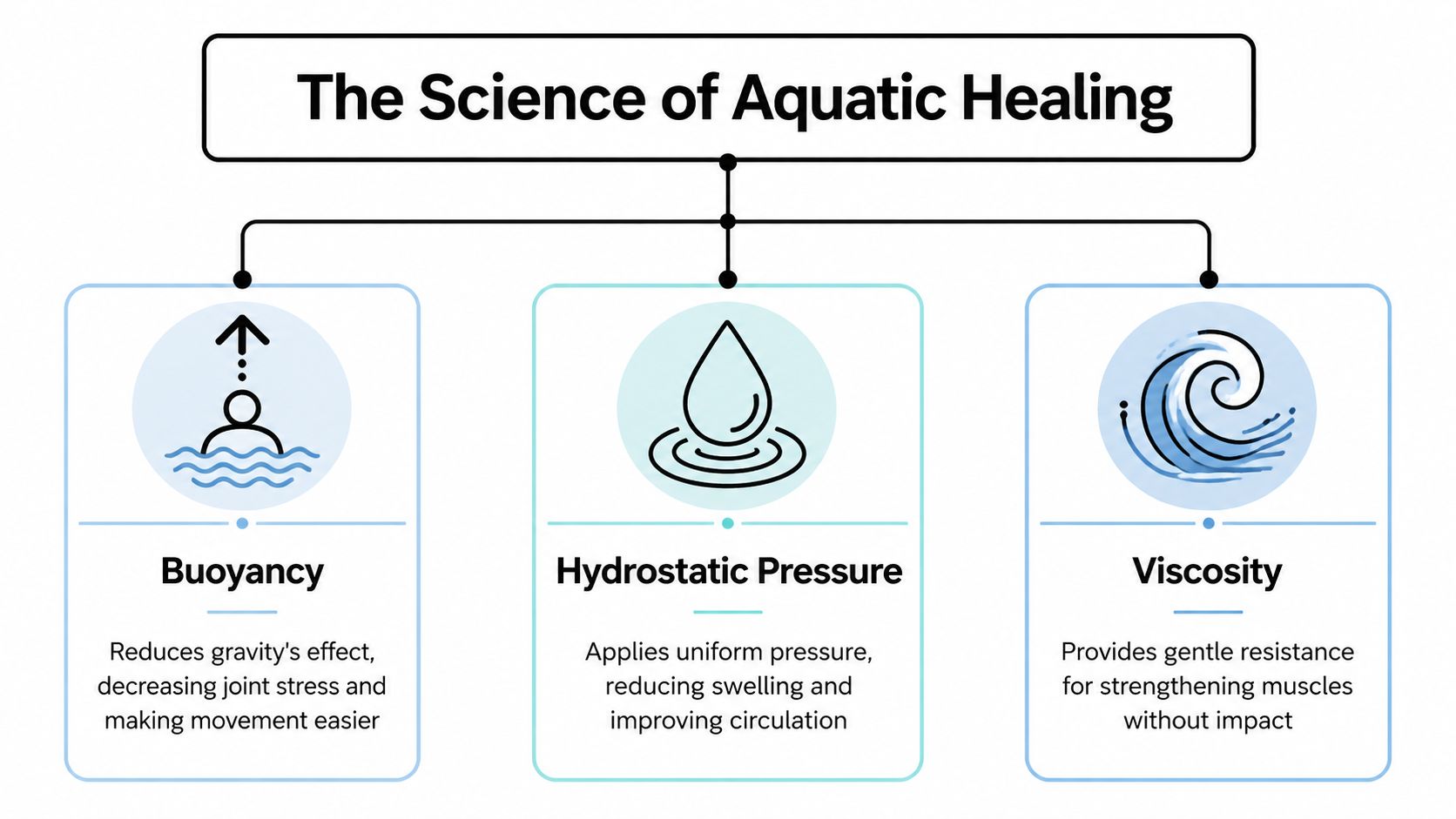
The easiest way to understand it is to think about three forces working in your favor at once. Buoyancy unloads you. Hydrostatic pressure compresses you evenly. Viscosity gives you resistance without impact. According to Boston Ability Center’s aquatic physical therapy explanation, shoulder-depth immersion can reduce effective body weight by up to 90%, hydrostatic pressure helps reduce swelling, and water provides 12 times more resistance than air.
Buoyancy makes painful movement possible
If walking, squatting, stair climbing, or balancing hurts on land, buoyancy changes the starting point. The water supports part of your body weight, so the joint doesn’t have to absorb the same load.
That matters for people with post-op restrictions, flare-ups, and painful gait patterns. The movement that feels sharp or guarded on land often becomes tolerable in the water. Once a person can move with less pain, the therapist can work on mechanics instead of just trying to get through the motion.
A runner coming back from a lower leg injury is a good example. On land, even easy mileage may be too much. In the pool, the body can rehearse gait, rhythm, and stride mechanics without the same impact cost.
Hydrostatic pressure helps calm the system
Hydrostatic pressure is the even pressure water applies around the body. Patients usually notice the effect before they know the term. The joint feels less puffy. The limb feels lighter. Movement feels smoother.
This is one reason aquatic work often fits well for swelling, post-surgical stiffness, and the “tight and protective” feeling many people describe after injury. You’re not fighting gravity in the same way, and the water gives the body a more supported environment.
Water acts like a gentle, full-body compression layer. For the right patient, that can make early motion feel far less threatening.
Viscosity gives you controlled strengthening
On land, strength work often jumps quickly from “too easy” to “too irritating.” Water gives you a more gradual ramp. Move slowly, and the resistance stays manageable. Move faster, and the challenge increases.
That makes aquatic therapy useful when someone needs strengthening but can’t yet tolerate jumping, running, loaded carries, or heavier gym work. It’s also helpful for people relearning control after surgery or after a period of moving around pain.
Here’s what that looks like in practice:
- For deconditioned patients: Simple walking, marching, and balance drills become meaningful exercise without heavy joint stress.
- For athletes: Direction changes, resisted gait, and treadmill work can restore movement quality before full return to field or road.
- For chronic pain patients: Water lets the nervous system accept movement again because the body doesn’t interpret every repetition as a threat.
Warm water changes behavior too
The pool environment matters. Warmer therapeutic water often lets people relax enough to move normally. That sounds simple, but it’s clinically useful. If someone is guarding every step, stretching harder on land usually isn’t the answer. A supported environment is.
A patient with back pain from long office days may not need “more toughness.” They may need a setting where trunk rotation, hip motion, and walking mechanics feel safe again. The pool often provides that reset.
What water does well, and what it doesn’t
Aquatic therapy is excellent for reducing pain during movement, restoring early confidence, and building a base for the next phase of rehab. It is not the final stop for most active people.
You still have to return to land. You still have to tolerate stairs, pavement, lifting, carrying, and sport-specific demands. The pool works best when it’s used strategically, not as an escape from progress.
Is Aquatic Therapy Right for Your Condition
The best candidates for aquatic therapy usually have one thing in common. They need movement, but land-based loading is either too painful, too early, or too sloppy to be useful yet.
That includes plenty of Boston patients. Think of the Fenway-area athlete after ACL surgery, the Seaport professional with chronic low back pain, the Brookline adult who wants to keep walking despite arthritis, or the postpartum parent who wants to exercise without feeling more pressure and soreness afterward.
Conditions that often respond well
Some diagnoses stand out because the pool solves a practical problem that land can’t solve right away.
- Post-surgical knee rehab: Early gait work, range of motion, and confidence often come easier when body weight is reduced.
- Running injuries: Water can preserve movement patterns and conditioning when impact isn’t ready.
- Low back pain: Supported movement often helps patients stop bracing and start moving more normally.
- Arthritis: Joints that dislike compressive loading often tolerate water exercise much better.
- Balance and vestibular issues: The pool gives a safer setting for practicing movement and weight shifting.
- Pelvic floor and postpartum symptoms: Lower-impact exercise can be a better starting point than returning straight to bootcamp, lifting, or running.
Where the pool has a real edge
For some problems, aquatic therapy is more efficient early on.
A runner with a bone stress injury or significant flare-up may not be ready for pavement, but complete rest can leave them feeling stiff, frustrated, and deconditioned. Water-based gait work lets them keep a training rhythm without the same impact forces.
For chronic low back pain, the value is different. Many Boston professionals spend hours sitting, then try to “make up for it” with intense exercise. That usually backfires if the body is already guarded. The pool offers a middle ground where rotation, walking, and trunk control can return without the same irritation.
What works: matching the environment to the tissue’s tolerance.
What doesn’t: forcing normal land training onto a body that isn’t ready for it yet.
Recovery Comparison Post-Operative ACL Rehab
| Milestone (Post-Op) | Land-Based PT Approach | Aquatic Therapy Enhanced Approach |
|---|---|---|
| Early walking practice | Often limited by pain, swelling, and fear of loading | Water support can make gait practice smoother and less guarded |
| Range of motion work | Can feel stiff and uncomfortable on a treatment table or gym floor | Warm water often helps patients move with less guarding |
| Strength rebuilding | Starts with low-load drills and careful progression | Water resistance allows strengthening without the same joint compression |
| Balance retraining | May feel unstable and intimidating early on | The pool offers a safer place to challenge weight shift and control |
| Return to functional movement | Progress depends on how well swelling and pain are controlled | Earlier comfortable movement can improve confidence heading into land-based work |
Who may need a different plan
Aquatic therapy isn’t automatic just because pain is present. Some patients need direct land exposure sooner because their goals are highly specific. A field athlete who’s already tolerating loading may need more cutting, deceleration, and power work on solid ground. A swimmer with shoulder pain may still benefit from the pool, but not every pool exercise will match the demands of their sport.
The key question isn’t “Is water better than land?” The key question is “What environment lets you train the right thing, at the right stage, with the least aggravation?”
Good signs that aquatic therapy could fit
If any of these sound familiar, an aquatic consult is worth considering:
- You know movement helps, but land exercise flares you up.
- Your pain drops when weight is reduced.
- Swelling or stiffness is limiting progress.
- You’re recovering from surgery and need a lower-risk bridge back to normal walking or exercise.
- You want to maintain some conditioning while protecting an injury.
For Boston patients trying to stay active through work, training, and family life, that bridge can make rehab feel realistic again instead of all-or-nothing.
What to Expect at Your Aquatic Therapy Appointment
Most first-time patients aren’t worried about the exercise itself. They’re worried about the unknowns. What do you wear? Do you need to be a swimmer? Is the therapist with you? Will it feel like rehab or like a generic water class?
The process is much more structured than people expect.
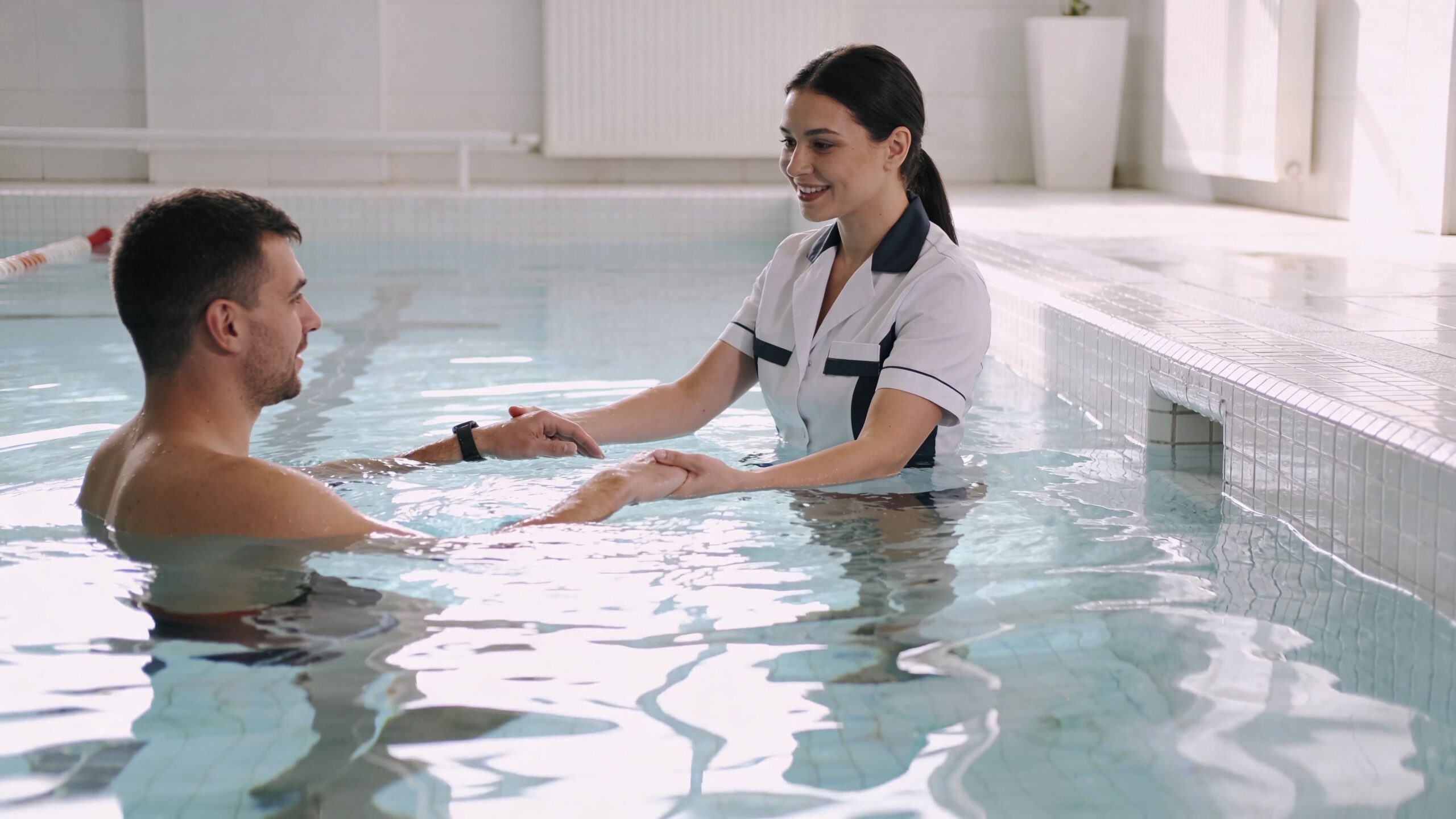
It starts with an evaluation, not a pool workout
Your first step is deciding whether aquatic therapy is the right tool. A therapist reviews your injury history, current irritability, movement limitations, goals, and schedule. If land-based rehab is already the better fit, that should be said clearly.
If the pool does make sense, the first visit is usually focused on safety, tolerance, and movement quality. The goal isn’t to exhaust you. It’s to find out what improves when load and impact are reduced.
Patients who want a better sense of logistics beforehand can review how to prepare for your first physical therapy appointment.
Your first session usually feels more personal than expected
In a good aquatic session, you’re not left alone to improvise. The therapist guides the plan, watches how you move, and adjusts the session based on pain, fatigue, balance, and confidence.
That often starts with a simple sequence such as:
- Water entry and orientation: Getting comfortable with the environment, the depth, and the support available.
- Baseline movement checks: Walking, shifting weight, stepping, or gentle range-of-motion work.
- Targeted exercises: Based on your problem, not a one-size-fits-all routine.
- Cool-down and carryover: Reviewing what your body tolerated and how that affects the next session.
If you’ve been afraid to move since surgery or after a bad flare, this part matters. Patients often realize quickly that movement doesn’t have to feel dangerous.
The techniques are specific, even if they look simple
Some aquatic methods have formal names because they’re built around distinct treatment goals. According to Spaulding Rehab’s aquatic therapy overview, Bad Ragaz uses water resistance and buoyancy to retrain muscles for gait symmetry and can improve balance scores by up to 40% after 6 to 8 sessions, while Ai Chi uses breathwork in warm water to reduce chronic pain perception by over 35%.
For patients, the important part is what those techniques feel like.
- Bad Ragaz: useful when a therapist wants to restore coordinated motion and improve control through the trunk and limbs.
- Ai Chi: useful when pain, tension, and nervous system overprotection are keeping the body stuck.
- Underwater treadmill work: useful when walking or running mechanics need to return gradually.
Here’s a look at aquatic rehab in motion:
What patients often get wrong
The most common misconception is that aquatic therapy is only for people who are very limited. It can be gentle, but it can also be demanding in a controlled way.
Another misconception is that if something feels better in the pool, you should stay there indefinitely. That’s not the point. The pool helps restore clean movement, reduce threat, and rebuild capacity. Then those gains need to transfer back to stairs, sidewalks, gyms, offices, and sports.
Some of the best aquatic sessions don’t look dramatic. The movement is cleaner, pain is lower, and the patient leaves feeling more capable than they did walking in.
What to bring and how to think about the visit
Keep it simple.
- Swimwear that stays in place: You want to move without fussing with clothing.
- A towel and dry change of clothes: Especially important before heading back to work or class.
- Any braces or post-op instructions: Your therapist needs the full picture.
- A realistic mindset: Early sessions are about response, not showing toughness.
For many patients, the first big win is psychological. They test movement they’ve been avoiding and realize the body can do more than they thought. That shift is often the start of real progress.
Enhance Performance and Prevent Injury in the Pool
Aquatic therapy isn’t only for people who are hurt. In Boston, plenty of athletes use the pool because they’re trying to stay available, not because they’re sidelined.
That matters for marathon runners managing training load, club athletes trying to recover between hard sessions, and adults who want to keep lifting, playing, and competing without collecting the same overuse problem every season.
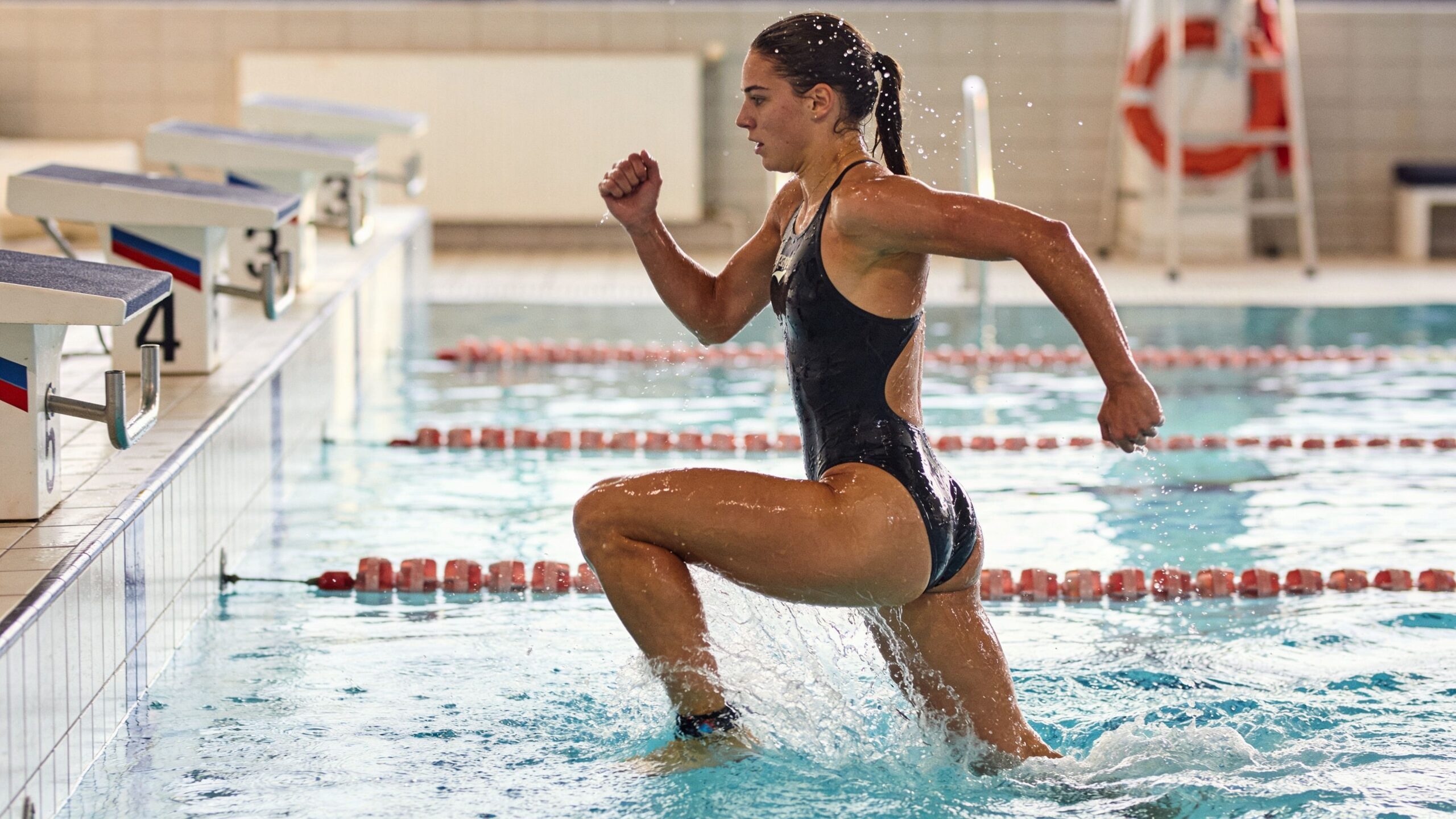
Why performance athletes use the pool before they’re injured
The pool gives you a way to add work without adding the same impact cost. For runners, that can mean aerobic sessions or recovery days that don’t beat up the legs. For court and field athletes, it can mean controlled movement and conditioning when the training week is already heavy.
This is especially useful in Boston weather cycles. Winter training tends to tighten people up. Spring race prep often stacks volume fast. Summer leagues create repeated stop-start loading. The pool gives athletes one more way to manage demand instead of swinging between overtraining and total rest.
Good use cases for active Boston patients
A few scenarios come up often:
- Boston Marathon prep: If your legs are carrying fatigue but you still want purposeful movement, water sessions can support recovery days.
- College athletics: Athletes can train movement quality when soreness or minor irritation makes full land intensity a poor choice.
- Golf and rotational sports: The pool can help maintain conditioning and trunk control while reducing compressive stress.
- Masters and adult fitness athletes: It’s a practical option when you want to keep training through joint irritability instead of shutting down for weeks.
Aquatic work also fits well alongside broader prevention planning. If you’re trying to train consistently instead of reacting to every flare-up, this guide on how to prevent sports injuries is a useful next step.
What works for performance, and what doesn’t
What works is using the pool with intent. Active recovery. Gait quality. Low-impact conditioning. Controlled strength and balance work. Technical rehearsal without unnecessary pounding.
What doesn’t work is treating the pool like a magic replacement for your sport. If you’re a runner, you still need land exposure. If you play a cutting sport, you still need force absorption and directional control on solid ground. If you golf, you still need rotational power and sequencing outside the water.
Practical rule: use the pool to reduce stress, preserve rhythm, and extend training consistency. Don’t use it to avoid the specific work your sport eventually requires.
Part of a bigger performance plan
For some athletes, aquatic therapy fits alongside running analysis, golf-specific evaluation, strength progressions, mobility work, or return-to-sport testing. The point isn’t to add random services. The point is to solve the exact bottleneck that keeps showing up.
In that context, Joint Ventures Physical Therapy offers aquatic physical therapy as one option within a wider Boston-based rehab and performance mix that also includes running performance, pelvic floor care, vestibular treatment, TMJ therapy, and sport-specific evaluations. That matters when your goal isn’t just “feel better,” but “get back to doing my thing well.”
For the athlete who wants more durable training, the pool can be less about rehab and more about keeping the entire season intact.
Begin Your Aquatic Therapy Journey in Boston
If you’ve read this far, you probably don’t need more general information. You need to know whether aquatic therapy makes sense for your body, your schedule, and your goals.
That decision usually becomes clear quickly in an evaluation. If you need a lower-impact environment to move with less pain, reduce guarding, rebuild confidence, or maintain conditioning while an injury settles down, the pool may be the right starting point. If your body is already ready for direct land loading, a therapist should tell you that too.
Where access matters in Greater Boston
Convenience changes adherence. If care is hard to reach, people skip it. If it fits the route between home, work, class, and training, people stay consistent.
That’s why Boston location matters. Patients often look for care near Back Bay, Kenmore Square, Fort Point, the Seaport, Downtown Boston, Brookline, and Allston because those neighborhoods line up with real life. Commuters, students, healthcare workers, office professionals, and runners all need treatment that doesn’t turn into another logistical burden.
A practical next step
If you want local details about the service itself, review aquatic physical therapy at Joint Ventures. That’s the simplest way to see whether pool-based rehab fits what you’re dealing with right now.
For broader clinical education on injury recovery, movement, and specialty care, visit Highbar Health. Highbar houses the deeper educational content, while local Joint Ventures care stays focused on getting Boston-area patients into the right plan efficiently.
When it’s worth booking now
Consider scheduling if any of these apply:
- You’ve been told to rest, but complete rest isn’t helping.
- Land exercise keeps flaring the same area.
- You’re post-op and want a lower-stress way to start moving.
- You’re training and need a smarter recovery option.
- You want clear guidance instead of guessing.
For many patients, the hardest part is getting started. Once the right environment is in place, progress tends to feel less chaotic and more measurable.
Answers to Your Aquatic Therapy Questions
Practical questions stop people from booking far more often than clinical questions do. That’s especially true with aquatic therapy Boston searches, because many clinic pages discuss benefits and skip the actual barriers. Insurance, referrals, scheduling, and basic logistics matter.
A Boston market review noted that transparency around insurance and scheduling is a major gap, and highlighted that some providers help patients with authorizations, offer clearer cost information, and provide early and late hours for working professionals and students, as described in this local aquatic therapy access overview. That’s the kind of information patients usually want up front.
Is aquatic therapy covered by insurance
Sometimes yes, sometimes no. Coverage depends on your plan, your benefits, whether authorization is required, and how the service is billed. The right move is to verify before your first visit rather than assume it works the same as standard physical therapy.
What helps is working with a clinic team that will walk you through the authorization process instead of leaving you to sort it out alone.
What if my plan doesn’t cover it
Ask for clear pricing and next-step options. Some patients pay out of pocket for a portion of care. Others combine aquatic visits with land-based sessions. Others find that authorization is available once documentation is submitted properly.
The key is clarity. If a clinic can’t explain the process in plain language, that’s a problem.
Do I need a doctor’s referral
Sometimes. It depends on your insurance requirements and your medical situation. If you’ve had surgery, your surgeon’s protocol may also shape the plan. If you’re not sure, ask before booking so there aren’t surprises.
Do I need to know how to swim
No. Aquatic therapy is not swim training. Many patients never put their face in the water and don’t need swimming skills at all. The session is controlled, supervised, and adjusted to your comfort level.
What should I bring
Bring swimwear, a towel, dry clothes, and any relevant post-op paperwork or brace instructions. If you use orthotics, assistive devices, or a specific brace on land, mention that too. The therapist needs the full picture.
Are early or late appointments available
In many cases, yes. That’s important in Boston because people often need to fit rehab around train schedules, hospital shifts, classes, childcare, or long office days. Flexible scheduling can be the difference between finishing a plan and dropping out halfway.
How do I know if I should start with aquatic therapy or regular PT
You don’t need to solve that alone. A good evaluation sorts out whether the pool gives you a real advantage or whether land-based treatment is the better first step. The best recommendation is the one that matches your current tolerance and your actual goals.
Is aquatic therapy only for severe injuries or older adults
No. It can help those groups, but it also fits athletes, postpartum patients, runners, balance patients, and professionals whose symptoms are limiting normal activity. The right question isn’t about age or fitness level. It’s whether the water environment helps you move better right now.
Will I stay in the pool for my whole recovery
Usually not. Often, aquatic therapy is a phase within a larger rehab plan. It’s used to reduce pain, restore motion, build confidence, and create momentum. Then the work shifts toward land-based strength, function, and return to sport or daily life.
What if I’m nervous about being in pain during the session
That’s common, especially after surgery or after a long flare. The session should be adjusted in real time. You’re not expected to push through sharp pain just to “get your money’s worth.” The value comes from choosing the right amount of challenge, not the maximum amount.
If you’re ready for clear answers and a plan that fits real Boston life, book an evaluation with Joint Ventures Physical Therapy.