
If you're leaking on a run along the Charles, feeling a dragging pressure after walking Beacon Hill, or dealing with pelvic pain after a long day seated in the Seaport, you're not imagining it and you aren't alone. A lot of active people in Boston push through these symptoms for months because they assume it's part of training, postpartum recovery, aging, or desk work.
It isn't.
Pelvic floor symptoms are common, but they aren't something you have to organize your life around. The right evaluation can connect problems that seem unrelated, like urinary urgency, hip tension, tailbone pain, constipation, pain with intimacy, or that heavy feeling during workouts. For active Bostonians, that matters because these issues don't stay confined to the pelvis. They show up in your stride, your lifting mechanics, your sleep, your confidence on the T, and your ability to get through a workday without constantly scouting the nearest bathroom.
Why Pelvic Health is Crucial for Your Active Boston Life
Boston has a way of exposing problems quickly. Marathon training adds impact. Commuting adds sitting. Carrying a baby up a brownstone staircase adds load. Even a good strength program can flare symptoms when pressure management is off.
That’s why pelvic floor physical therapy Boston shouldn't be viewed as a last resort. It’s often the missing piece for people who are already doing a lot right.

Performance matters, not just symptom control
A runner may notice leakage only during speed work. A new parent may feel stable walking through Back Bay, then feel pressure when lifting a stroller. A finance professional might be fine at rest but develop pelvic pain after long seated stretches and a hard evening workout.
These aren't separate stories. They often point to the same issue: the pelvic floor isn't coordinating well with breathing, core control, hips, and load.
A 2023 Journal of Women's Health Physical Therapy finding summarized here reported that 25 to 45% of female athletes report pelvic floor issues impacting performance. That number matters in a city full of runners, lifters, recreational league athletes, and postpartum patients trying to return to activity.
Pelvic health care isn't only about stopping symptoms. It's about restoring confidence during movement.
Boston life creates specific demands
What works for an active Boston patient is rarely a generic handout of Kegels. If you're training for a race, returning to CrossFit, managing a desk-heavy job in Fort Point, or figuring out exercise after birth, the plan has to match your schedule and your goals.
For postpartum patients, I often recommend pairing pelvic PT guidance with practical education on safe exercise after a cesarean, especially when you're trying to distinguish normal healing from signs that your body needs more support.
Boston also has a gap between awareness and care. Many websites talk about postpartum recovery or general pelvic pain, but fewer address return to running, impact tolerance, lifting mechanics, or sport-specific progression. For active adults, that's a real trade-off. General advice may calm symptoms temporarily, but it often doesn't prepare you for the actual demands of your life.
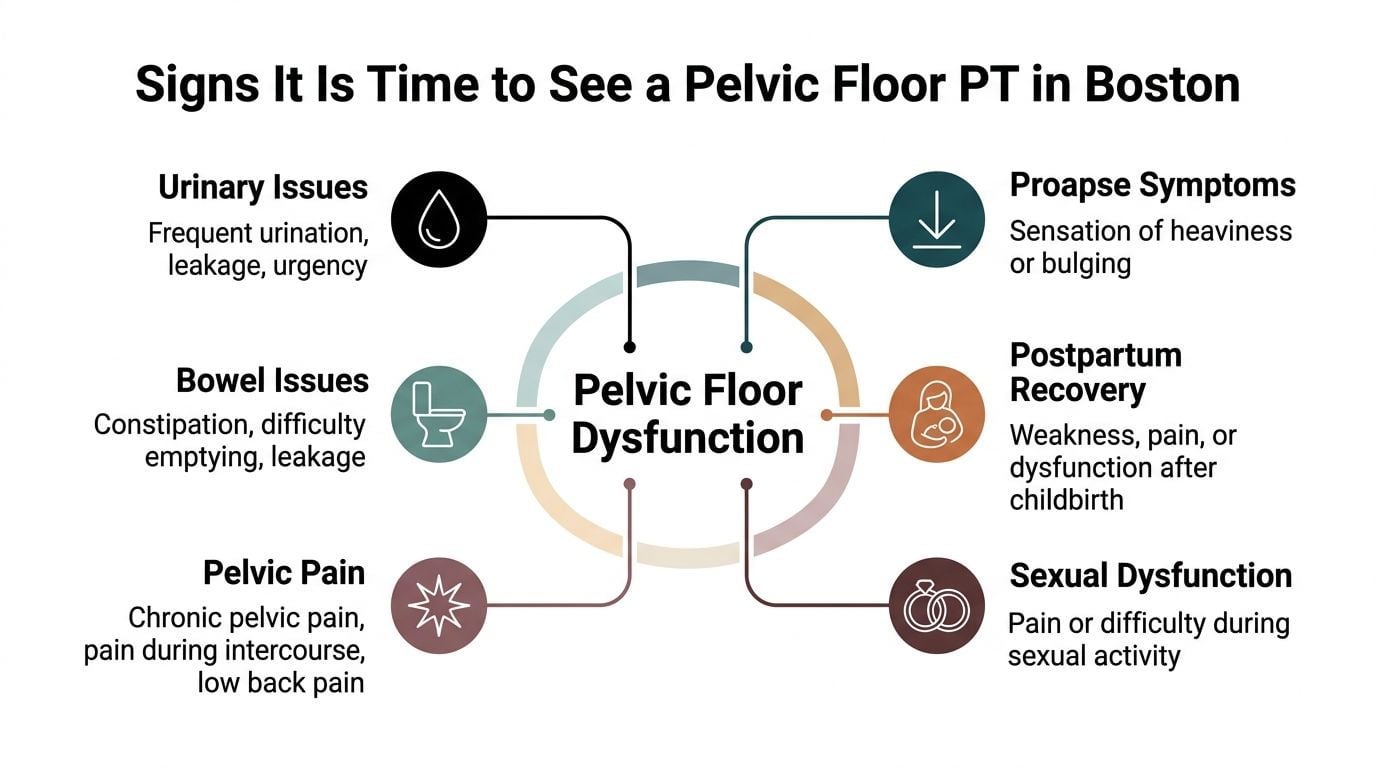
Signs It Is Time to See a Pelvic Floor PT in Boston
You finish a run along the Charles, head into a meeting in Back Bay, and realize you already planned the nearest bathroom stops for the rest of the day. Or you get through a lift, a HIIT class, or a long commute and notice pressure, pain, or leakage that was not there a few months ago. That is usually how this starts for active adults in Boston. Not with a medical label, but with the sense that your body is no longer tolerating normal life or training the way it should.
I hear that every week in clinic. Patients rarely ask whether they have pelvic floor dysfunction. They ask why they cannot run, lift, sit, recover, or have sex without symptoms.
Bladder symptoms that show up during real life
Leakage, urgency, and frequent bathroom trips often show up under load first. You may be fine at home, then leak when you cough in the middle of a workday, feel a sudden urge during a workout, or need to stop twice on a short walk.
Common signs include:
- Leaking with impact or effort, such as running, jumping, lifting, laughing, or sneezing
- Urgency that feels hard to control, even when your bladder is not very full
- Going more often than you used to, enough that it changes your commute, work routine, or exercise plan
These symptoms are common. They are not something you have to train around forever. They also do not automatically mean you need more Kegels. In many active patients, the issue is timing, coordination, breath control, or too much tension through the pelvic floor and abdominal wall.
Pain that keeps returning
Some Boston patients never leak. Pain is their first clue.
That pain may feel like burning, aching, pulling, heaviness, tailbone pain, low back pain, groin pain, deep hip pain, or pain with intimacy. It may flare after rowing, cycling, squatting, sitting through a long commute, or spending a full day at a desk and then trying to work out after.
Pelvic floor problems often present like orthopedic issues. I see patients who were told it was only a hip problem, only an SI joint issue, or only tight hip flexors. Sometimes those areas are involved. Sometimes the missing piece is pressure management and pelvic floor muscle function, which is why symptoms keep returning after stretching, massage, or general exercise changes.
If you are trying to figure out whether post-workout symptoms are ordinary soreness or a sign that something needs attention, this article on pelvic pain after exercise is a useful starting point.
Heaviness, pressure, or the feeling that something is off
This symptom is easy to dismiss because patients do not always have the words for it. They say, "I feel heavy by the end of the day," or "Something feels like it is dropping," or "Long walks and standing make me feel swollen."
Pay attention if that feeling shows up:
- after running or impact exercise
- late in the day
- while carrying a child, groceries, or work gear
- during bowel movements
- after prolonged standing
Heaviness does not mean you need to avoid activity. It does mean your body may need better support, better load management, and a plan that matches what you are asking it to do.
Bowel symptoms and pain with intimacy
Pelvic floor issues also affect bowel function and sexual function. Constipation, straining, incomplete emptying, bowel leakage, pain with penetration, and pain after intercourse all belong in a pelvic health evaluation.
Patients often separate these symptoms into different boxes and try to solve each one on its own. That usually slows progress. The pelvic floor has to contract when needed, relax when needed, and coordinate with breathing, the abdominal wall, and the hips. If that system stays guarded or out of sync, bowel and intimacy symptoms often follow.
Postpartum and post-surgical changes that deserve more than wait-and-see advice
Symptoms after pregnancy, birth, C-section, hysterectomy, abdominal surgery, or a period of reduced activity are worth assessing early, especially if you want to return to exercise with confidence. The trade-off is simple. Waiting may be reasonable for short-term healing, but waiting too long often lets compensation patterns settle in.
For new parents, this is often the point where "I thought this was normal" starts interfering with lifting the stroller, carrying the baby, sleeping, walking for exercise, or getting back to running. If that sounds familiar, our guide to postpartum pelvic floor therapy and recovery can help you understand what deserves follow-up.
A good rule in clinic is straightforward. If symptoms are changing how you move, train, work, travel, or feel in your body, it is time for a pelvic floor PT evaluation. Early treatment is often simpler than trying to fix a problem after months of avoiding movements, guessing with internet advice, or pushing through symptoms that keep getting louder.
Common Causes and Risk Factors for Bostonians
Boston patients don't fit one mold. The common thread isn't age or gender. It's load. How much you're asking your body to handle, how often you're asking, and whether the system underneath that load is coordinating well.
The local need is broadening. As Brigham and Women's rehabilitation services describe, Boston-area pelvic programs are expanding to serve all genders for concerns like incontinence, constipation, and pelvic pain. The same source notes that 40 million women are affected yearly nationally, while provider shortages continue. That mismatch is one reason many people in Greater Boston spend a long time trying to self-manage before getting specialized care.
Athletes and highly active adults
Running, field sports, court sports, rowing, cycling, strength training, and high-impact classes all increase demand on pressure control and pelvic stability. That doesn't make exercise bad for the pelvic floor. It means technique and capacity have to match the task.
A BU or Northeastern athlete might notice symptoms only in-season. A marathoner may develop pelvic pain only when mileage climbs. A recreational lifter may bear down hard under load and create repeated pressure the pelvic floor can't manage well.
Here are the trade-offs I see most often:
- Pushing through impact symptoms: This can keep conditioning high in the short term, but it often reinforces compensation patterns.
- Stopping all exercise: Symptoms may calm briefly, but capacity usually drops, and return to sport gets harder.
- Modifying with a plan: Usually the most effective option. Keep what your body tolerates, change what it can't yet handle, then rebuild.
Pregnancy and postpartum recovery
Pregnancy changes breathing mechanics, abdominal pressure, hip loading, and tissue demands. Postpartum recovery adds sleep disruption, lifting, feeding positions, and a fast return to real life before the body is ready.
Seated posture matters more than many people realize. If you're pregnant and spending long hours at a desk or in transit, resources like the way you sit matters during pregnancy can be useful because positioning affects pressure, back comfort, and how supported you feel through the day.
For new parents in Boston, symptoms often show up during practical tasks rather than exercise first. Stroller lifting, stair climbing, baby carrying, and prolonged feeding positions can all expose a system that's not yet sharing load well. For more local postpartum guidance, this postpartum pelvic floor therapy article is a good next step.
Desk workers and commuters
A lot of pelvic floor pain patients are active and also sit most of the day. That's common in the Seaport, Downtown, Cambridge tech corridors, and financial offices.
Sitting itself isn't the villain. The issue is often a combination of prolonged compression, breath holding, bracing, shallow breathing, hip stiffness, glute underuse, and stress. Then the person gets up and tries to run, lift, or take a fitness class on top of a system that's been gripping for hours.
If your symptoms build through the workday and flare during exercise, the problem usually isn't just exercise.
Surgery, orthopedic history, and whole-body compensation
Past abdominal surgery, C-section, hernia repair, hip surgery, back pain episodes, and even chronic ankle or knee issues can change how the pelvic floor works. The body adapts. Sometimes it adapts well. Sometimes it starts borrowing motion and stability from areas that are already overloaded.
This is why pelvic health in Boston can't be reduced to a single patient profile. The postpartum runner, the desk-bound attorney, the college athlete, and the active older adult may all arrive with different stories and the same underlying problem: the pelvis is being asked to do more than it can currently coordinate.
Your First Visit for Pelvic Floor PT at Joint Ventures
Many individuals feel some level of uncertainty before their first visit. That's normal. They wonder whether the appointment will feel awkward, whether they'll have to do an internal exam, whether they need special preparation, or whether the therapist will understand athletic goals rather than just basic symptom management.
The first visit should answer those concerns, not intensify them.
It starts with conversation, not an exam table
A strong evaluation begins with context. That means talking through your symptoms, your training or activity history, work demands, surgeries, pregnancies, bowel and bladder patterns, pain triggers, and what you want to get back to.
For one person, success means running the Boston Marathon without leakage. For another, it means sitting through a full workday without pelvic pain. For someone else, it means intimacy without guarding or being able to lift a child without pressure.
That conversation changes the exam. It tells us what systems to test and what situations matter most.
A full overview of the service is available on the pelvic health therapy page at Joint Ventures, including the kinds of concerns pelvic rehab can address.
The assessment looks beyond the pelvis
A pelvic floor evaluation isn't just about the pelvic floor. It usually includes how you breathe, how your rib cage moves, posture, abdominal wall function, hip mobility, back mobility, balance, squat mechanics, gait, and the way you manage pressure during effort.
Sometimes the key finding is obvious. Sometimes it isn't. A runner's leakage may improve when we change exhalation timing. A postpartum patient's heaviness may link strongly to abdominal wall coordination. A desk worker's pelvic pain may be driven by glute underuse and persistent gripping.
The body doesn't separate pelvic symptoms from the rest of movement, so the evaluation can't either.
Internal assessment is optional, consent-based, and often useful
When appropriate and with explicit consent, an internal assessment can provide information you can't get from an external exam alone.
According to Foundations Pelvic Health's description of pelvic evaluation, expert pelvic PT assessment may include external and internal examination and use validated tools such as the PERFECT scheme, which stands for Power, Endurance, Repetitions, Fast contractions, Every Contraction Timed. That approach helps identify the root cause more accurately than external-only assessment.
That matters because symptoms can come from several different patterns:
- Weakness: The muscles can't generate enough force.
- Poor endurance: They can contract, but not sustain effort.
- Poor coordination: The timing is off, especially during coughs, lifts, and impact.
- Overactivity: The muscles are too tense to relax well, which can drive pain, constipation, and painful intimacy.
- Mixed presentations: Very common, especially postpartum and in active adults.
You are never required to do an internal exam to begin care. If it's not the right fit for you on day one, there are still many useful things to assess and treat. But when consent is given, internal assessment often sharpens the plan significantly.
Expect a private setting and clear next steps
A good first visit shouldn't leave you wondering what just happened. It should end with a working explanation of your symptoms and a practical plan.
That plan may include a few focused home exercises, behavior changes, breathing drills, bowel or bladder strategies, gym modifications, return-to-run criteria, or manual therapy recommendations. It should also tell you what to keep doing. Not just what to avoid.
This video offers a useful look at pelvic floor rehab concepts and can make the process feel more familiar before your appointment.
What usually helps and what usually doesn't
A few realities are worth stating plainly.
| Approach | What tends to happen |
|---|---|
| Doing random online Kegels | Helps some people, irritates others, and often misses the actual cause |
| Ignoring symptoms until race season ends | Usually leads to more compensation and less confidence |
| Getting a full, individualized assessment | Clarifies whether the problem is weakness, tension, timing, or a mix |
| Only treating pain where you feel it | Often gives short-lived relief if pressure, breathing, and hip mechanics aren't addressed |
The first visit is where uncertainty gets replaced by a strategy. For most patients, that's the biggest relief.
Your Personalized Pelvic Health Treatment Plan in Boston
Treatment works best when it matches the actual driver of symptoms. If the issue is overactivity, more strengthening may backfire. If the issue is poor timing during impact, stretching alone won't fix it. If scar mobility, hip mechanics, or breath holding are part of the picture, the plan has to include them.
That’s why pelvic floor physical therapy Boston should feel individualized from the first few visits forward.
Manual therapy when pain and restriction are part of the problem
For patients with pelvic pain, hip tightness, tailbone pain, scar sensitivity, or pain with intimacy, hands-on treatment can help reduce guarding and improve movement options.
This may include:
- Myofascial release: To address tension in surrounding tissues.
- Trigger point release: For painful or overactive muscle bands.
- Scar mobility work: Helpful after abdominal or pelvic surgery.
- Visceral or connective tissue techniques: Used selectively when mobility restrictions seem to affect symptoms.
The goal isn't just temporary relief. It's to lower the system's threat response so you can move more normally and tolerate strengthening and activity again.

Biofeedback and motor retraining for leakage, urgency, and prolapse symptoms
Some patients understand the concept of a pelvic floor contraction but can't feel whether they're doing it well. Others contract when they need to relax, or hold tension all day without realizing it.
That’s where biofeedback can be useful. Per BIDMC's pelvic floor therapy overview, biofeedback can yield a 75% symptom reduction for incontinence and prolapse, and trigger point dry needling shows 80% efficacy in chronic pain cohorts. These tools work best when folded into a personalized plan rather than used as standalone treatment.
Biofeedback gives real-time information. Patients can see whether they are relaxing, contracting, sustaining, or coordinating correctly. That changes learning fast, especially for people who have been told to "just do Kegels" but never knew if they were doing them effectively.
Clinical reality: Isolated exercises often fail because they don't teach timing, relaxation, or pressure management in the movements that actually trigger symptoms.
Exercise that matches your real life
Pelvic rehab exercise shouldn't stop at lying on a table. It has to transfer into walking, lifting, running, carrying, squatting, and getting through a full workday.
A treatment plan might include:
- Breath and pressure drills: To reduce bearing down during effort.
- Core and hip integration: To share load better across the system.
- Impact progression: For people returning to running or jumping.
- Mobility work: When stiffness is forcing compensation.
- Bowel and bladder routines: For urgency, frequency, and constipation patterns.
For men dealing with pelvic pain, urinary symptoms, or performance concerns, this guide to men's pelvic floor physical therapy can add useful context.
When dry needling fits
Dry needling isn't for everyone, but it can be a strong option when chronic pain involves trigger points in the hips, glutes, adductors, low back, jaw, or pelvic region. This is particularly relevant when pelvic symptoms overlap with other specialties, like TMJ tension, athletic hip pain, or persistent guarding that hasn't changed with exercise alone.
This is also where a local, multidisciplinary mindset helps. One patient may need downtraining and bowel strategies first. Another may need running mechanics, glute loading, and urgency retraining. Another may need a combination of internal work, dry needling, and return-to-lift progressions. In Boston, where people often want to stay active through treatment rather than pause their lives, that flexibility matters.
Integrating Pelvic Health into Your Active Boston Life
The long-term goal isn't to make you dependent on appointments. It's to help you understand what your body responds to so symptoms stop dictating your choices.
That typically starts with a few simple changes done consistently.
Daily habits that support progress
Small changes often calm symptoms faster than people expect.
- Exhale with effort: During lifting, standing up, pushing a stroller uphill, or carrying groceries.
- Break up sitting: If your workday is desk-heavy, change position regularly and avoid locking into one posture for hours.
- Don't push through every urge: Urinary urgency usually gets worse when you rush every time.
- Stop straining on the toilet: Bowel emptying should feel easier, not like a workout.
- Respect symptom response after training: Mild muscle work can be fine. Pressure, burning, or heaviness that lingers is information.
Rehab and performance can belong together
This is especially important in Boston, where many patients aren't trying to return to a minimal baseline. They want to race, lift, golf, commute comfortably, or manage long hospital shifts and still train afterward.
Pelvic health often overlaps with services that active adults already seek out, including running analysis, strength progression, dry needling, TMJ care, and golf-specific screening. If your symptoms show up during rotation, impact, prolonged standing, or high effort, your rehab plan should reflect that. The pelvic floor doesn't operate in isolation, and your treatment shouldn't either.
One practical point matters here. You don't need to wait until symptoms become severe. The earlier you address leakage, heaviness, pelvic pain, or bowel issues, the easier it usually is to restore confidence and normal training patterns.
Keep learning, then act
If you want a deeper educational breakdown of pelvic health topics, anatomy, and recovery principles, visit Highbar Health. That’s the right place for broader clinical education. If you're looking for care in Greater Boston, the next step is a local evaluation that connects those principles to your actual routine.
You should be able to run the Charles, walk through Back Bay, work in the Seaport, train in Kenmore, or carry your child up your front steps without planning around symptoms. If you're dealing with leakage, pressure, pain, urgency, constipation, or intimacy-related discomfort, don't keep guessing.
If pelvic symptoms are affecting how you train, work, commute, or recover, book an evaluation with Joint Ventures Physical Therapy. Care is available across Greater Boston, including Back Bay, Kenmore Square, Fort Point and Seaport, Downtown Boston, Brookline, and Allston, with 1-on-1 treatment built around your goals and your daily life.