You wake up, swing your feet onto the floor, and your calves feel like they’ve been shrink-wrapped overnight. Or maybe you finish a run, stand up from your desk, or carry your toddler across the room and notice that one leg feels tight, stubborn, and oddly heavy. That’s a common way leg muscle stiffness shows up.
The term “stiffness” often encompasses various sensations. Tightness. Soreness. Cramping. Limited motion. A sense that the leg just won’t move normally. Those sensations can overlap, but they’re not identical. That’s where people often get stuck. If you don’t know what you’re feeling, it’s hard to pick the right fix.
As physical therapists, we think of stiffness as your muscle and surrounding tissue resisting movement more than you want it to. Sometimes that’s protective and temporary. After a hard workout, your body may be guarding. Other times, it points to a movement problem, a strength deficit, a gait compensation, or an issue somewhere else in the chain.
Introduction to Leg Muscle Stiffness
Leg muscle stiffness can show up in the calves, hamstrings, quads, hip flexors, or even in the small muscles that help control your ankle and foot. It might feel worse first thing in the morning, after sitting, or during the first few minutes of exercise.

A simple way to think about it is this. Your leg works like a spring. You want enough firmness to create force when you walk, climb stairs, or run, but not so much resistance that motion feels blocked. Too loose can feel unstable. Too stiff can feel restricted.
What stiffness usually feels like
Some people describe it as a “pull.” Others say the leg feels wooden, locked, or slow to warm up. You may notice:
- Morning tightness: The first steps are the worst.
- After-sitting stiffness: You stand up and need a minute before the leg feels normal.
- Exercise-related restriction: The leg doesn’t loosen until late in the workout, or it tightens more as you go.
- One-sided symptoms: One calf, one hamstring, or one hip feels consistently different.
Why it matters
Stiff muscles don’t just feel annoying. They can change how you move. That can affect stride length, squat depth, balance, and how load travels through the knee, ankle, hip, and low back.
Practical rule: If a leg feels stiff once after a hard effort, that’s usually a recovery issue. If it keeps changing how you walk, train, or get through the day, treat it like a movement problem.
The good news is that leg muscle stiffness is often very workable. The most useful approach isn’t random stretching. It’s knowing what kind of stiffness you’re dealing with, screening for warning signs, and matching the right treatment to the right cause.
Causes and Red Flags of Leg Muscle Stiffness
Not all leg stiffness comes from the leg itself. That’s one of the biggest reasons people spin their wheels with calf stretches and foam rolling that only help for a few hours.
Common reasons your leg feels stiff
The obvious cause is overuse. A jump in running, lifting, walking, or even standing can leave muscle tissue more guarded than usual. Travel days, long desk days, poor sleep, and low recovery can do the same.
Other common drivers include:
- Training load that changed too fast: New mileage, hills, speed work, or return to exercise after time off.
- Reduced movement variety: Sitting for long periods, repetitive work positions, or doing the same workouts over and over.
- Strength deficits: Weak glutes, calves, or hamstrings can make other muscles overwork.
- Movement mechanics: Limited ankle motion, poor hip control, or a stride pattern that overloads one side.
A lot of people also have trouble telling whether a muscle is shortened or just working too hard. That distinction matters. If you want a better feel for that difference, this guide on tight vs taut muscles is helpful.
The overlooked driver of one-sided stiffness
If one leg always feels tighter, don’t assume that side just “needs more stretching.” Muscle imbalances from pelvic asymmetry often drive unilateral leg stiffness by shortening inside leg muscles and stretching outer ones, leading to compensatory gait patterns and downstream pain (David Hall article on pelvic asymmetry and pain patterns).
That means your tight calf or hamstring may be reacting to a pelvis that isn’t moving or loading evenly. In the clinic, this often shows up as:
- one foot turning out more than the other
- a recurring side-to-side shift during squats
- repeated hamstring or calf symptoms on the same leg
- stiffness that returns quickly after stretching
Why biomechanics matter
Your body is excellent at getting the job done, even with a poor setup. If the hip doesn’t extend well, the calf may push harder. If the glutes don’t control the pelvis, the hamstrings may grip. If the ankle is restricted, the knee or foot may take the hit.
That’s why two people can say, “My calves are always tight,” while needing very different treatment. One may need load management. The other may need pelvic control and gait retraining.
A stiff leg is sometimes the messenger, not the source.
Red flags that mean don’t just stretch it
Most routine stiffness improves with movement, recovery, and a sensible exercise plan. Some symptoms deserve a medical or physical therapy evaluation sooner rather than later.
Watch for these warning signs:
- Sudden major swelling: Especially if one leg looks noticeably different.
- Visible deformity or bruising: That raises concern for a strain or tear.
- Numbness or tingling: Particularly if it travels below the knee or comes with weakness.
- Difficulty bearing weight: If the leg feels unstable or painful enough that walking changes sharply.
- Pain at rest or at night: Especially if it isn’t tied to movement.
- Shortness of breath or chest symptoms: That needs urgent medical attention.
A useful self-check question
Ask yourself this: Does the stiffness improve as I move, or does movement make it rapidly worse?
Mild post-exercise tightness usually warms up. More serious issues often stay the same, worsen quickly, or come with swelling, weakness, or altered sensation.
That question won’t diagnose the problem, but it helps you separate “I need recovery” from “I need help.”
Assessing the Severity of Leg Muscle Stiffness
Before you try to fix stiffness, measure it. You don’t need fancy equipment to start. A few simple tests can tell you whether this feels irritating but manageable, or whether it’s limiting force, motion, and confidence.
Start with a daily rating
Use a 0 to 10 stiffness scale once in the morning and once after activity.
- 0: No stiffness
- 1 to 3: Mild awareness, doesn’t change movement much
- 4 to 6: Noticeable restriction, takes time to loosen
- 7 to 10: Strong limitation, changes walking, training, or daily tasks
Keep the language simple. “Left calf 5 on waking, 2 after walking” is enough. Consistency matters more than perfect detail.
Compare side to side
One of the most useful screens is symmetry. Try these basic checks:
Heel raises
Stand near a wall or counter. Perform controlled single-leg heel raises on each side. Notice height, control, cramping, and whether one calf feels blocked.Knee-to-wall ankle check
Face a wall, place one foot back slightly, and drive the knee toward the wall without the heel lifting. Compare how easily each ankle moves.Hip hinge test
Stand tall and hinge at the hips like you’re closing a car door with your glutes. If one hamstring grabs early or one calf tugs hard, that’s useful information.Sit-to-stand
Stand up from a chair without using your hands. Watch whether you shift away from one leg.
What normal calf stiffness can look like clinically
Researchers measured gastrocnemius muscle stiffness in healthy adults using ultrasound elastography. In healthy adults, resting gastrocnemius stiffness averages 24.0 kPa (95% CI: 22.7–25.3) and contracts to 99.5 kPa (95% CI: 92.3–106.7) (normative gastrocnemius stiffness values in healthy adults).
That’s not a home test, but it gives useful context. Healthy muscle isn’t floppy. It has baseline stiffness, and it becomes much stiffer when working.
Normative Gastrocnemius Stiffness Values
| Condition | Average Stiffness (kPa) | 95% CI |
|---|---|---|
| Resting | 24.0 | 22.7-25.3 |
| Contracted | 99.5 | 92.3-106.7 |
How to interpret your home findings
If your leg feels stiff but you can still move well, load well, and symptoms ease after a warm-up, you’re probably dealing with a manageable mobility and recovery issue.
If you notice any of these patterns, pay closer attention:
- One side consistently feels weaker or less mobile
- You can’t warm out of it
- Stiffness keeps returning at the same point in activity
- You’re changing your gait to avoid it
What matters most: Track trends. A single bad day means less than a repeatable pattern over several days.
A simple severity framework
Here’s a practical way to sort what you’re feeling.
| Pattern | What it usually suggests |
|---|---|
| Stiff only after hard exercise | Recovery issue |
| Stiff every morning, better after movement | Mobility and load tolerance issue |
| Stiff on one side with repeated compensation | Biomechanics or asymmetry issue |
| Stiffness plus numbness, swelling, or weakness | Needs professional evaluation |
Your notes don’t need to be fancy. A phone note with “morning stiffness, side, activity trigger, and whether it warmed up” is usually enough to make the next step much clearer.
Immediate Self Care Techniques for Stiff Legs
The first goal isn’t to force flexibility. It’s to calm the tissue down, restore motion, and help the leg tolerate movement again. Think “reduce resistance,” not “win the stretch.”
Foam rolling that actually makes sense
For hamstring-related stiffness, foam rolling can help in the short term. Acute foam rolling can lower hamstring stiffness by 10 to 20% and increase hip flexion range of motion by 5 to 10 degrees per session (hamstring stiffness and range of motion findings).
A good routine looks like this:
- Hamstrings: Roll from just above the knee to below the sit bone. Move slowly. Pause on tender spots, but don’t pin yourself there aggressively.
- Calves: Roll from Achilles area up toward the back of the knee. Turn the leg slightly inward and outward to catch different fibers.
- Outer hip support work: If the leg feels stiff because of compensation, rolling around the hip can reduce guarding upstream.
Keep pressure tolerable. If you tense up while rolling, you’re probably overdoing it.
Active mobility beats passive forcing
Gentle movement usually works better than long, aggressive holds when a leg is cranky.
Try this sequence:
- Ankle pumps: Point and pull the foot for smooth repetitions.
- Marching in place: Easy, controlled movement to warm the hips.
- Short walking bouts: A few minutes around the house often helps more than staying still.
- Supported calf stretch: Lean into a wall with the heel down, but back off before the stretch becomes pain.
If you want more ideas for safe home mobility, this article on how to loosen tight muscles gives a practical overview.
For soreness plus stiffness
A lot of people use “stiff” when they’re also dealing with training soreness. Those overlap, but they’re not identical. If you’re sorting out recovery tools, this guide on the best way to reduce muscle soreness adds useful context around what helps after harder efforts.
Helpful guardrails
Use these self-care rules:
- Choose gentle over intense: The leg should feel easier after, not angry.
- Work in short bouts: A few brief sessions during the day often beat one long session.
- Don’t chase pain: Sharp, hot, or zinging symptoms are not “good release.”
- Adjust for your situation: Postpartum patients, older adults, and anyone recovering from recent injury should use extra support, smaller ranges, and slower progressions.
If a self-care tool helps for an hour but the same stiffness returns every day, your body is asking for a better plan, not more pressure.
Progressive Exercises to Reduce Leg Muscle Stiffness
The best long-term fix for leg muscle stiffness usually isn’t more stretching. It’s a progression. First you restore motion. Then you build control. Then you teach the leg to store and release force again.
That’s the part many people skip. They go from “my calf is tight” straight to hard workouts, then wonder why the stiffness keeps circling back.
Early on, it helps to see the flow visually.
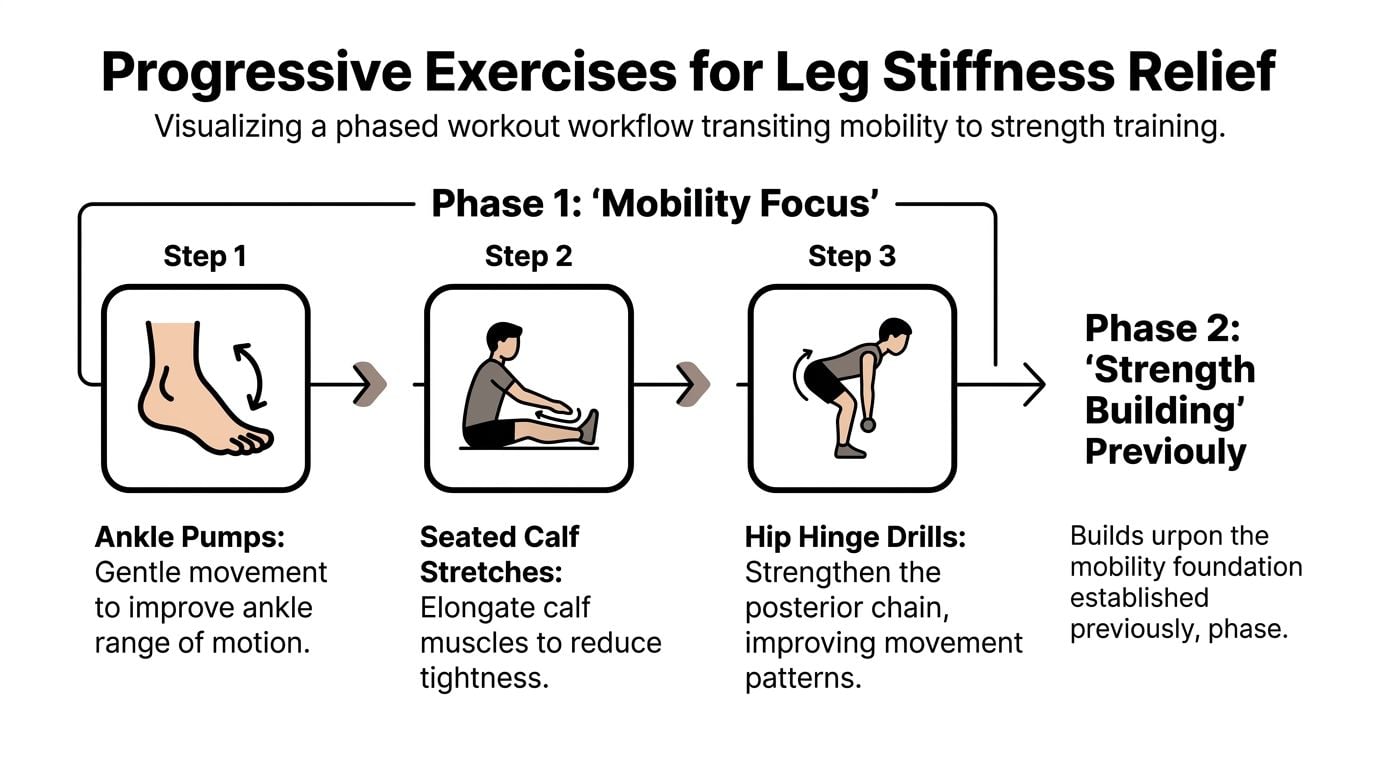
Phase 1 mobility focus
This phase is for the leg that feels guarded, restricted, or slow to warm up.
Ankle pumps
Lie down or sit with your leg supported. Point the foot away, then pull it back toward you in a smooth rhythm.
Use these when:
- first getting out of bed
- after sitting
- before walking or training
The purpose is simple. You’re giving the ankle and calf a low-threat movement signal.
Seated calf stretch
Sit tall, place the leg out in front, and use a strap or towel around the forefoot if needed. Pull until you feel a stretch, not pain.
Good form cues:
- keep the knee position intentional
- avoid rounding your whole spine to chase range
- breathe normally
Hip hinge drills
Stand with hands on hips, soften the knees, and push the hips back while keeping your back neutral. This teaches the posterior chain to share load better.
A stiff calf or hamstring often isn’t just “tight.”” Sometimes it’s overworking because the hips aren’t contributing well.
Phase 2 build strength and control
Once the leg moves more freely, add exercises that make it dependable under load.
A short movement demo can help some readers connect the form cues to the actual motion.
Dynamic lunges
Use a small range at first. Step forward or backward and control the lowering phase. If the front calf or rear hip feels tight, stay in a range you can own.
Banded monster walks
Place a loop band around the legs and take controlled lateral steps. This wakes up the hip stabilizers that often reduce strain on the lower leg.
If you want a broader menu of hip-focused options, this collection of glute exercises is a useful reference.
Eccentric heel drops
Stand on a step, rise up, then lower one heel slowly below the edge if tolerated. This is a classic way to build calf capacity without relying on speed.
Stop if you get:
- sharp pain
- sudden weakness
- symptoms that worsen with each repetition
Phase 3 restore spring and power
In this phase, the leg starts behaving like a spring again instead of a rigid lever.
A biomechanics study looking at leg stiffness in jump performance found that plyometric progressions targeting ankle and knee stiffness, like drop jumps at 30 to 50 cm heights, can restore leg spring constant by 10 to 15% weekly in older adults (counter-movement jump leg stiffness research).
That doesn’t mean everyone should start with plyometrics. It means force storage and release matter, especially once the basics are back.
Loaded squats
Keep the motion controlled. If both heels stay down and the knees track well, you’re likely in a productive range.
Single-leg deadlifts
These expose asymmetry quickly. Use a wall, dowel, or light support if balance is limited. The goal is clean hip control, not impressive depth.
Low-level plyometrics
For people who are ready, small hops, snap-downs, or carefully introduced drop jump progressions can train the leg to absorb and return force. Think of this as tuning a spring. Too little tension and it collapses. Too much and it stops moving well.
How to progress safely
Don’t rush phases based on motivation. Progress based on response.
Move forward when:
- morning stiffness is lower or more manageable
- warm-up time gets shorter
- you can load the leg without compensation
- symptoms settle within a normal recovery window after exercise
Hold or regress when:
- one side keeps dominating
- stiffness escalates the next morning
- your gait changes
- the area feels more irritable instead of stronger
Build range you can control. Then build strength in that range. Then add speed.
A clinic-backed way to think about the timeline
In practice, people improve fastest when they stop guessing and start layering the right inputs. Mobility work creates space. Strength work gives the body a reason to keep that space. Power work makes the result usable in real life.
That’s why random stretching often gives temporary relief, while a progression gives staying power.
When to Seek Physical Therapy Evaluation
Home care is appropriate for many mild cases of leg muscle stiffness. But there’s a line where trying to self-manage becomes inefficient, and sometimes risky.
Signs you shouldn’t wait on
Consider a physical therapy evaluation if:
- Stiffness lasts more than two weeks
- Pain is sharp, severe, or keeps escalating
- You have numbness or tingling
- You can’t bear weight normally
- The problem keeps returning despite good home care
- You’ve had surgery, a major injury, or a complex medical history
These aren’t just inconveniences. They usually mean the issue is more than simple post-exercise tightness.
Why earlier help often works better
Persistent stiffness changes movement. Once that happens, your body starts building workarounds. You may shorten your stride, offload one side, rotate the foot out, or avoid ankle motion without realizing it.
The longer that pattern sticks around, the more other structures pick up extra load. That’s when a calf issue can become a knee issue, or a hamstring issue can start irritating the low back.
What to bring to an evaluation
You don’t need perfect records. A few notes help a lot:
- Where you feel it
- When it started
- What makes it better or worse
- Whether it warms up with activity
- Any swelling, weakness, numbness, or gait changes
A good PT will use that information along with strength, mobility, balance, and movement testing to sort out whether the stiffness is local, compensation-driven, or related to something more systemic.
Questions worth asking
Ask direct questions like:
- What do you think is driving this stiffness?
- Is the muscle the problem, or is it compensating for something else?
- What movements should I avoid for now?
- What should I expect to change first?
You should leave with a plan that makes sense, not a generic printout and guesswork.
If your leg stiffness is changing how you walk, train, or trust the limb, that’s enough reason to get it assessed.
Joint Ventures PT Interventions and Timelines
When leg stiffness doesn’t respond to basic self-care, treatment works best when it matches the actual driver. Sometimes the priority is tissue irritability. Sometimes it’s motor control. Sometimes it’s how the pelvis, hip, foot, and calf are sharing load.
What treatment may include
A physical therapy plan can involve:
- Manual treatment: Hands-on work to improve mobility and reduce guarding.
- Dry needling: Often used to address irritated trigger points and improve muscle activation.
- Aquatic therapy: Helpful when weight-bearing is uncomfortable or the leg needs movement with less load.
- Neuromuscular electrical stimulation: Sometimes used to improve activation when a muscle isn’t contributing well.
- Exercise progression: The anchor of the whole plan. Relief without load tolerance usually doesn’t last.
For readers comparing approaches, manual physical therapy is one commonly used option for restoring motion and reducing protective muscle guarding.
Why positioning matters during rehab
One subtle but important treatment detail is exercise position. Quadriceps fatigability decreases in extended knee angles compared to flexed ones, allowing longer sustained contractions and optimizing exercise outcomes by adjusting joint positions (research on joint angle and muscle fatigability).
That matters in clinic. If a patient’s quad tightens or fatigues quickly, changing knee or hip position can make strengthening more effective and less provocative. Small setup changes often determine whether an exercise feels productive or irritating.
What progress usually looks like
A realistic timeline is based on pattern change, not magic. In early visits, patients often notice one or two of these first:
- less morning stiffness
- shorter warm-up time
- easier walking after sitting
- less side-to-side asymmetry during simple drills
Later improvements usually include stronger push-off, better squat depth, improved balance, and more confidence with training.
A clinic such as Joint Ventures Physical Therapy can combine one-on-one evaluation, targeted exercise progression, and services like dry needling or aquatic therapy when those fit the presentation. That’s most useful when symptoms are recurring, one-sided, or clearly affecting performance.
What makes timelines faster or slower
Progress tends to move faster when:
- the issue is caught early
- the patient tracks symptoms
- the home program is simple enough to follow
- treatment targets the source, not just the sore spot
Recovery tends to drag when someone keeps testing the leg with hard workouts, chases aggressive stretching, or ignores asymmetry that keeps reloading the same tissues.
The right treatment plan should feel explainable. You should know what you’re working on and why it matches your symptoms.
Conclusion and Next Steps
Leg muscle stiffness is common, but it isn’t one-size-fits-all. Sometimes it’s a normal response to load. Sometimes it’s your first clue that a joint isn’t moving well, a muscle group isn’t pulling its weight, or your body has drifted into compensation.
Start simple. Track when the stiffness shows up, compare side to side, and notice whether movement helps. Use short bouts of mobility and sensible self-care instead of trying to force the leg loose. If symptoms calm down, build from mobility into strength and then into more dynamic work.
If the stiffness is one-sided, keeps returning, changes your gait, or comes with numbness, swelling, or weight-bearing trouble, don’t keep guessing. That’s when a skilled evaluation can save you time and frustration.
A good daily checklist is straightforward:
- move a little before judging the leg
- note morning stiffness
- use gentle mobility first
- strengthen what you’ve opened up
- pay attention to asymmetry
You don’t need to fix everything in one week. You need the right direction, followed consistently.
If your leg still feels stiff, guarded, or unreliable, Joint Ventures Physical Therapy offers one-on-one physical therapy across Greater Boston for orthopedic rehab, sports rehab, pelvic health, vestibular care, aquatic therapy, and dry needling. A focused evaluation can help you figure out whether the problem is local tissue tightness, a movement compensation, or something higher up the chain, then turn that into a practical plan you can follow.