
Somewhere along the line, your back pain stopped feeling like a simple strain and started acting like an unwanted routine. It complains when you get out of bed, tightens up during your commute, nags through a workday, and makes you think twice before a run, a lift, or even a long walk.
That pattern is frustrating, but it is also common. The good news is that chronic lower back pain is rarely improved by doing nothing and hoping it fades. It responds better to the right kind of movement, the right progression, and the right match between your symptoms and your treatment.
Why Your Chronic Lower Back Pain Isn't Going Away
If your back has hurt for months, it is easy to assume something must still be badly damaged. In many cases, that is not how pain works.
Pain is a protective output from the nervous system. Tissue matters, of course, but pain is not a perfect “damage meter.” A back can become sensitive. Muscles guard. Joints stiffen. Sleep gets worse. Stress climbs. You move less, then load too much on a better day, and the cycle keeps going.
Rest helps less than often thought
Complete rest can calm a severe flare for a brief window, but it is rarely the answer for persistent back pain. Long stretches of inactivity often make the back more guarded, less conditioned, and more reactive to normal daily loads.
That matters because back pain is not rare. In the US, 39% of adults reported back pain in the past three months, and 16 million adults live with chronic back pain that limits daily activities. Globally, the WHO reported 619 million cases in 2020, with a 7.5% point prevalence worldwide (PMC review on chronic low back pain prevalence).
When that many people are dealing with the same problem, the takeaway is not hopelessness. It is validation. If your back keeps hurting, you are not broken and you are not failing.
The pattern around your pain matters
I look for three things in chronic cases:
Sensitivity
Your back reacts strongly to positions, stress, poor sleep, or sudden spikes in activity.Deconditioning
The muscles that support your trunk, hips, and pelvis have stopped sharing load well.Mismatch
You may be doing “good” exercises, but not the right ones for your presentation.
A bed setup can also shape how your back feels first thing in the morning. If sleep is part of your pain pattern, a practical guide on the best mattress for back pain can help you think through support and sleeping posture in a more useful way.
Chronic pain often improves when you stop chasing a miracle stretch and start building tolerance, strength, and confidence in stages.
First Steps for Calming a Pain Flare-Up at Home
When your back flares, the goal is not to “fix” everything in a day. The goal is to turn the volume down enough that you can keep moving without aggravating it.
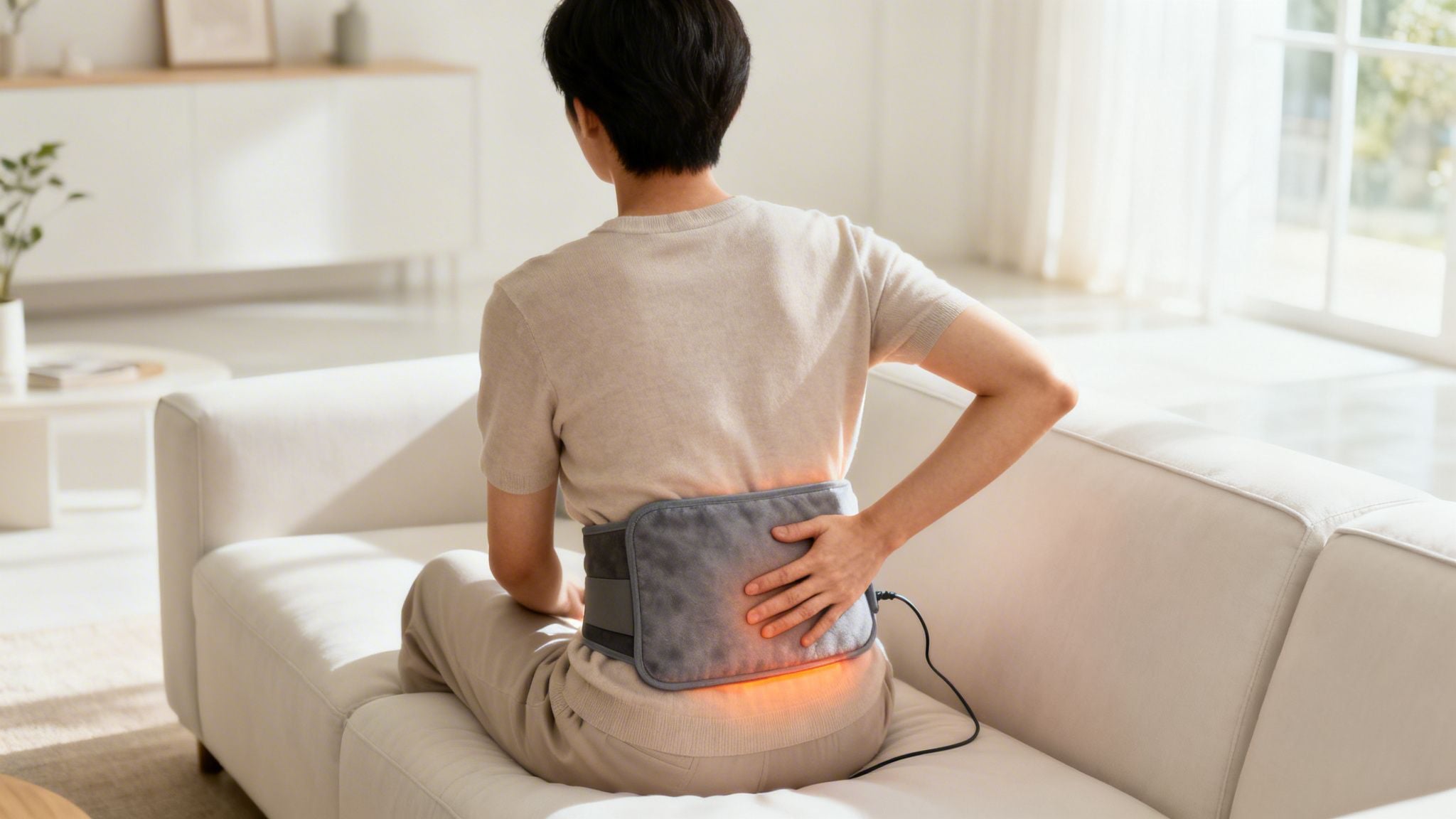
Use heat and ice with a purpose
Heat is often useful when the back feels stiff, guarded, or “locked up.” It can relax muscle tone and make gentle movement easier.
Ice tends to make more sense after activity if the area feels hot, irritated, or freshly aggravated.
Consider this approach:
| Situation | Better first choice | Why |
|---|---|---|
| Morning stiffness | Heat | Helps loosen a guarded back |
| Spasm after sitting too long | Heat | Encourages relaxation and easier movement |
| Symptoms feel stirred up after activity | Ice | Calms irritation |
| You are unsure which helps | Try both on separate days | Your response matters more than theory |
Do not stay in one position while using either. The primary benefit comes when the back feels calm enough for light movement afterward.
Change positions before pain builds
People often wait too long. They sit until the ache becomes a burn, or stand until they are shifting side to side.
Try these adjustments sooner:
For sitting
Put both feet on the floor. Sit on your sit bones, not your tailbone. A small support behind the low back can help.For standing
If one spot is aggravating, place one foot on a low step or alternate your stance.For sleeping
Side sleeping with a pillow between the knees or back sleeping with support under the knees can unload a sensitive spine. If you want ideas for positioning, these bed support pillows show common ways people create better support at night.
Relative rest works better than full shutdown
The sweet spot is less irritating activity, not zero activity.
That might mean shorter walks, lighter chores, fewer repeated bends, and more frequent breaks. It does not mean spending the day in bed unless your clinician has told you otherwise.
A useful pacing approach looks like this:
Pick a baseline
Choose an amount of activity you can do without a major spike later.Repeat that amount consistently
Do not double it just because today feels good.Increase gradually
Build from consistency, not optimism.Watch the next-day response
Mild soreness is usually acceptable. A major flare means the dose was too high.
Gentle motion usually beats aggressive stretching
During a flare, hard stretching can irritate a sensitized back. Start with small, easy movements that feel safe.
Options often include walking, pelvic tilts, short-range knee-to-chest movements, or repeated motions that feel relieving rather than provocative. If your whole body feels stiff, our guide on how to loosen tight muscles can help you think beyond the painful spot and address the surrounding areas that may be feeding the problem.
If a home strategy gives short relief but your pain returns every time you sit, run, lift, or sleep, that usually means you need a better long-term plan, not more intensity.
Your Progressive Therapeutic Exercise Plan
Many individuals searching for how to relieve chronic lower back pain get handed a random list of stretches. That is not enough. Your back needs a progression.
The strongest exercise plans are matched to the person in front of us, not copied from a general handout. Classification-based exercise, where treatment is customized to movement patterns like directional preference or motor control issues, has shown moderate to high success rates. It can reduce pain by up to 15 points on a 100-point scale, and some cohorts showed 66% of patients maintained gains at 5 years (classification-based exercise evidence).
Start with this progression only if the exercises feel tolerable and your symptoms are stable enough for movement. If an exercise sharply worsens symptoms, stop and get it assessed.
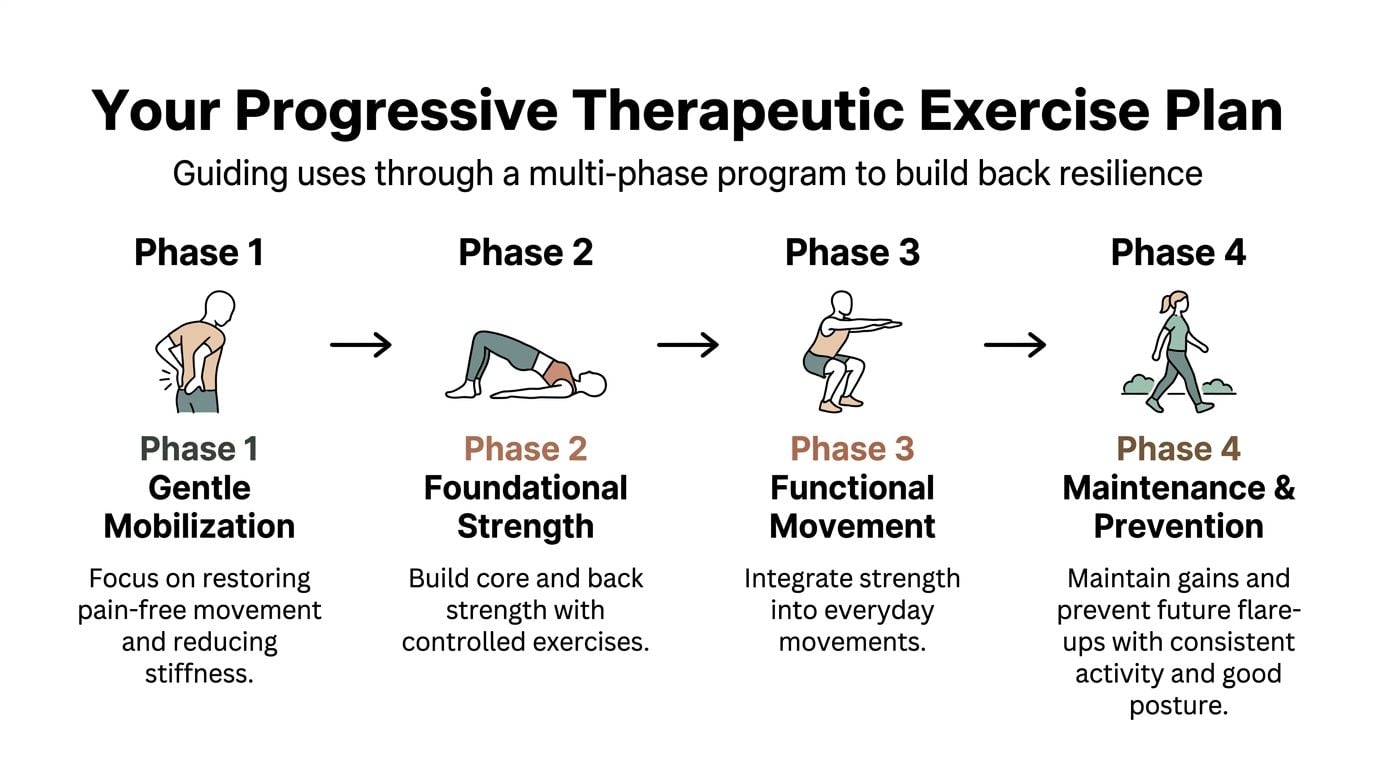
Phase 1 with calm control
This phase is about restoring movement and re-establishing support around the spine.
Pelvic breathing with pelvic floor awareness
Lie on your back with knees bent. Inhale through your nose and let the rib cage expand. Exhale slowly and think about gently lifting through the pelvic floor and lower abdomen without bracing hard.
Why it helps: this improves pressure control and reconnects the deep system that supports the trunk.
This matters more than many people realize. The link between chronic lower back pain and pelvic floor dysfunction is often missed, especially in postpartum patients and active women.
Pelvic tilts
On your back, gently rock your pelvis so your low back flattens a little into the floor, then release. Keep the movement small.
Why it helps: it reduces guarding and helps you find spinal motion without threat.
Knee fall-outs
Stay on your back with knees bent. Let one knee drift slightly outward while keeping your pelvis quiet, then return.
Why it helps: this teaches low-load hip movement while your trunk stays controlled.
Phase 2 with strength that carries over
Once your back tolerates basic control work, build endurance in the hips, trunk, and pelvic region.
To see the movements in action, this video is a helpful visual guide.
Glute bridge
Lie on your back with knees bent. Tighten your glutes and lift your hips without pushing into a big arch.
Why it helps: stronger glutes reduce the load your low back has to manage during standing, stairs, running, and lifting.
Regression: make it a small lift.
Progression: add a longer hold or march in place at the top if that is comfortable.
Bird-dog
Start on hands and knees. Reach one leg back, then add the opposite arm if you can keep your trunk steady.
Why it helps: this teaches your body to control motion across the trunk while the arms and legs move. That is what daily life demands.
A common mistake is lifting too high. Length matters more than height.
Side-lying hip work
Clamshells or a small side leg lift can be useful if your hip control is poor.
Why it helps: many chronic back pain cases involve hips that do not share force well. The low back ends up compensating.
A stronger back is rarely built by training the back alone. Hips, abdomen, breathing mechanics, and pelvic floor control all influence how the low back feels under load.
A note about planks
Planks can be helpful, but they are not mandatory and they are not always the right starting point. In some people, especially those dealing with pelvic floor symptoms, bracing hard through a long plank can create more pressure than control.
If planks aggravate your back, use a regression:
- forearms elevated on a bench or couch
- shorter holds
- exhale during the effort
- stop before shaking turns into breath-holding
Phase 3 with real-world movement
In this phase, your exercise plan starts to look like your life again.
Sit-to-stand or box squat
Stand up from a chair without using momentum, then sit back with control.
Why it helps: this builds confidence with one of the most repeated daily tasks. It also prepares you for deeper squat patterns.
Hip hinge drill
Use a dowel, broomstick, or your hands on your hips. Practice bending at the hips while keeping the trunk organized.
Why it helps: many people with chronic back pain have lost confidence in bending. A hinge lets you load the hips instead of folding through an irritated low back.
Step-ups and carries
Step-ups build single-leg control. Carries train trunk endurance in a way that translates well to groceries, kids, and commuting.
Why they help: life is uneven. Single-leg and loaded tasks expose weak links quickly.
Phase 4 with maintenance that keeps you active
Once symptoms settle, do not stop everything.
A maintenance plan usually includes:
- one or two mobility drills that reliably make you feel better
- two or three strength exercises for trunk and hips
- regular walking or cardio
- return-to-sport progressions based on your actual goals
For runners, that might mean building mileage gradually and adding hip strength. For lifters, it often means lowering load temporarily while cleaning up control and tolerance. For desk workers, it means your program has to include movement breaks or your symptoms will keep circling back.
How to judge whether the plan is working
Do not judge progress only by pain in the moment. Look at function.
Better signs include:
- you recover faster after activity
- you sit or stand longer before symptoms start
- your flare-ups feel less intense
- your confidence around movement improves
A good plan is not pain-free every day. It is progressively less limiting.
Exploring Advanced Treatments and Manual Therapy
Home care matters, but there is a limit to what individuals can do alone. Some backs need skilled hands, better assessment, or a more specific treatment target.
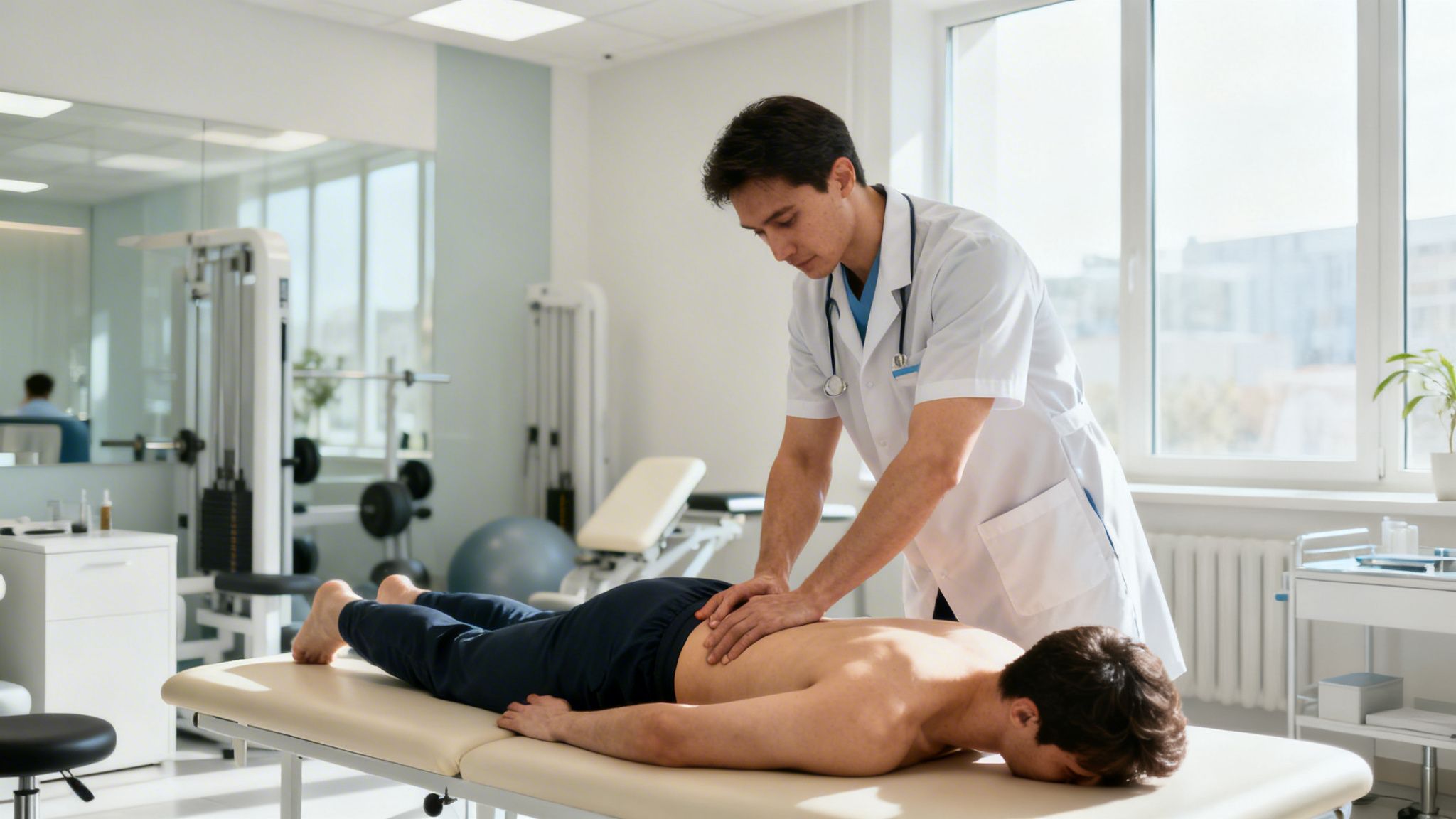
What manual therapy is for
Manual therapy is not just rubbing sore muscles or trying to “put something back in place.” In good care, it is used to improve mobility, decrease protective tension, and make movement training easier.
That may include:
- joint mobilizations for a stiff segment
- soft tissue work for guarded muscles
- spinal manipulation when it fits the presentation
- movement re-education immediately afterward
The key is what happens after the hands-on work. If treatment ends at the table, results rarely last. If it helps you move better into exercise, it becomes useful.
For a closer look at what this includes, this overview of manual physical therapy breaks down how skilled hands-on treatment fits into a broader plan.
Dry needling and aquatic therapy have specific roles
Trigger point dry needling can help when muscular guarding is stubborn and keeps blocking progress. It is a tool, not a cure. I like it when a muscle stays overactive despite good exercise progressions and load management.
Aquatic therapy is another smart option for people whose symptoms ramp up too quickly on land. Water can reduce the load enough for walking, balance work, and strengthening to feel possible again.
These approaches work best when they serve a purpose. The purpose might be pain reduction, improving tolerance to exercise, or allowing someone to restart movement with less fear.
Some patients need a different lane altogether
Not every chronic back pain case is the same. A subset of patients has vertebrogenic pain, where the source is tied to specific endplate changes seen on MRI. For those eligible patients, the Intracept Procedure has shown strong results. In Level I RCTs, 65% to 69% achieved at least a 50% reduction in pain, with many sustaining improvement at 5 years (Intracept success data).
That does not mean everyone with back pain needs a procedure. It means diagnosis matters. A person with pelvic floor involvement, a directional preference pattern, vertebrogenic pain, or severe movement avoidance may all say, “My back hurts,” but they do not need the same treatment.
What a clinic can add beyond YouTube
A clinic can identify what is driving your pain and what is merely coexisting with it. That is the difference between trying more exercises and doing the right exercises.
One option is Joint Ventures Physical Therapy, which provides one-on-one physical therapy and also offers services such as dry needling and aquatic therapy for patients whose chronic back pain needs a more individualized plan.
How to Build a Resilient Back for the Long Term
Most back pain plans fail for one reason. They stop as soon as symptoms calm down.
A resilient back is built by what you do after the flare, not just during it.

Your work setup matters more than your chair brand
For active professionals and athletes, prevention often comes down to how they spend the hours between workouts. Up to 70% of chronic pain cases are linked to prolonged postures, and combining ergonomic assessments with targeted PT interventions like dry needling has been shown to cut recurrence by as much as 50% in sports rehab populations (ergonomics and recurrence data).
That does not mean you need a perfect workstation. It means you need a setup you can change often.
Try this:
- Screen height so you are not living in a forward head posture
- Feet supported instead of dangling
- Keyboard close enough that your shoulders can relax
- Position changes built into the day before discomfort starts
Movement snacks beat one heroic workout
A hard gym session does not erase ten hours of stillness.
For many people, the better formula is:
- short walks between work blocks
- brief mobility resets
- strength work done consistently
- a realistic progression back to sport or training
If you train hard, treat recovery and load progression like part of your program, not an afterthought. The runner returning from a back flare should not jump straight to prior mileage. The lifter should not test heavy deadlifts just because symptoms are quieter this week.
Maintenance is not failure
People sometimes think tune-up visits or periodic reassessment mean they are dependent on care. I see it differently. They are using a smart maintenance strategy.
The goal is not to avoid using your back. The goal is to keep exposing it to the right amount of load so it stays adaptable.
That may mean a periodic movement screen, ergonomic check-in, running evaluation, or refresh of your home program when life changes. New parenthood, marathon prep, a move, a desk-heavy job, and a return to lifting all change the demands on your spine.
When to See a Physical Therapist in Boston
Sometimes the question is not how to relieve chronic lower back pain at home. The question is whether home care is enough.
A major reason to get help is simple. A 2025 systematic review found that only about 1 in 10 common treatments for low back pain is effective. For chronic low back pain, the few options supported by moderate-certainty evidence include exercise, spinal manipulative therapy, and taping (2025 review on effective low back pain treatments).
That means guessing your way through random fixes is not a great plan.
Red flags that need prompt medical attention
Seek medical care quickly if back pain comes with:
- New bowel or bladder changes
- Progressive weakness
- Numbness that is spreading or severe
- Loss of balance tied to leg weakness
- Significant pain after a fall or trauma
- Fever or other signs that suggest illness with back pain
Those situations need medical evaluation before a standard exercise plan.
Yellow flags that mean it is time for a PT
A lot of people do not have red flags. They just have pain that keeps stealing normal life.
See a PT if:
- your pain keeps cycling back
- sleep is consistently disrupted
- sitting, standing, running, lifting, or caring for your kids feels limited
- you are avoiding movement because you no longer trust your back
- the exercises you found online are not matching your symptoms
Individualized orthopedics matters at this point. If you want to understand what a focused musculoskeletal evaluation involves, this overview of ortho physical therapy is a useful starting point.
What a good PT visit should feel like
You should leave with more than a printout.
A strong visit usually includes:
- a clear explanation of your pain pattern
- testing that identifies helpful versus aggravating movements
- a home plan that is specific enough to follow
- progressions based on your goals, not generic timelines
- honest trade-offs about what to push, pause, or modify
If you are in the Boston area, convenience matters too. Chronic pain care works better when appointments fit into real life, especially if you are balancing work, training, parenting, or a commute.
Frequently Asked Questions About Chronic Back Pain
Do I need an MRI for chronic lower back pain
Not always. Imaging can be helpful in the right case, especially when symptoms suggest a specific diagnosis or when a medical procedure is being considered. But imaging does not automatically explain pain, and it does not replace a good movement assessment.
If your symptoms are straightforward and mechanical, treatment often starts with function, not scans.
Is it safe to run or lift with chronic back pain
Often, yes, with modifications.
The better question is whether your current dose matches your current capacity. Instead of stopping everything, reduce volume, range, speed, or load. Then rebuild. A graded return usually works better than a complete shutdown followed by an aggressive comeback.
Could my pelvic floor be part of this
Yes, especially if you are postpartum, have pelvic heaviness, leaking, pain with core work, or a sense that your abdomen and back never quite coordinate well.
The connection is often overlooked, yet pelvic floor dysfunction contributes to 30% to 50% of chronic lower back pain cases in women. Customized interventions that address this link, including specific core work paired with options like aquatic therapy or dry needling, can reduce pain by 40% to 60% in this group (pelvic floor and chronic back pain connection).
What if stretching keeps making me worse
That is a clue, not a failure. You may need more stability, a different directional approach, or better load management rather than more flexibility work.
How long does it take to feel better
There is no single timeline. What matters is direction. If you are moving better, flaring less often, and getting more of your life back, the plan is working.
If chronic lower back pain has started to shape your schedule, your workouts, or your confidence, Joint Ventures Physical Therapy offers one-on-one care across Greater Boston with clinicians who treat orthopedic injuries, chronic pain, pelvic floor issues, sports rehab, and related movement problems through individualized plans built around your actual goals.