
Alright, let's talk about what's going on with your hand. When you're trying to get a handle on carpal tunnel syndrome, the best place to start is often with simple, consistent changes to your daily life. Our goal is to take pressure off that aggravated nerve without jumping straight to shots or surgery.
This usually means doing some gentle exercises to get the nerve moving better, making smart adjustments to your workspace, and using a wrist splint at night to keep everything in a neutral, happy position while you sleep.
Understanding That Nagging Wrist Pain
Here in the clinic, we see this every single day. It’s that frustrating numbness, tingling, or weakness in your hand that starts as a small annoyance but quickly begins to mess with everything, from your focus at work to getting a decent night's sleep.
If you're nodding your head right now, you’re probably dealing with carpal tunnel syndrome. And you're definitely not alone—it's one of the most common nerve-related issues we treat.
So, what's really happening in there? Think of your wrist as having a narrow passageway, which we call the carpal tunnel. The median nerve runs right through it, providing sensation to your thumb, index, middle, and part of your ring finger. The trouble starts when that tunnel gets crowded and the nerve gets squeezed.
What Causes the Squeeze?
Pressure on the median nerve can build up for a lot of different reasons. In our experience, it's rarely one single thing but a combination of factors. Carpal tunnel is a classic example of a Repetitive Strain Injury (RSI), and that's a great place to start thinking about it.
Common culprits we see in our patients include:
- Repetitive Hand Motions: This is the big one. Hours of typing, using a mouse, or any job that involves a lot of forceful or repeated gripping puts you at risk.
- Underlying Health Conditions: Things like thyroid imbalances, rheumatoid arthritis, and diabetes can cause swelling that narrows the tunnel space.
- Anatomy: It's not fair, but some of us are just born with a smaller carpal tunnel, making us more likely to experience compression.
- Pregnancy: The fluid retention that's so common during pregnancy is a well-known cause of increased pressure within the wrist.
We always tell our patients: "Don't just focus on the pain. Focus on the pattern. When does it hurt most? After typing? In the middle of the night? That pattern tells us exactly what needs to change."
Recognizing the Symptoms
The symptoms usually sneak up on you. You might first notice them at night, waking up with a "pins and needles" feeling and an urge to shake your hand out. This happens because most of us bend our wrists when we sleep, which adds even more pressure on the nerve.
As the condition progresses, you might start to experience:
- Tingling or numbness in your thumb and first few fingers.
- Pain that feels achy or sharp and sometimes shoots up your forearm.
- A feeling of weakness or clumsiness—suddenly, gripping a coffee mug or buttoning a shirt feels surprisingly difficult.
To get you started, here's a quick overview of the most effective natural strategies we recommend to our patients every day.
Your Quick Guide to Natural Carpal Tunnel Relief
| Strategy | What It Does | Best For |
|---|---|---|
| Exercises & Stretches | Improves nerve and tendon gliding, reducing irritation. | Mild to moderate symptoms; preventing flare-ups. |
| Ergonomics | Reduces repetitive strain by optimizing your workspace. | Anyone who works at a desk or does repetitive tasks. |
| Night Splinting | Keeps the wrist in a neutral position to prevent nighttime compression. | Waking up with numb or tingling hands. |
| Pain Relief Modalities | Manages acute pain and inflammation. | Flare-ups and immediate symptom relief. |
| Lifestyle Changes | Addresses systemic inflammation that can contribute to swelling. | Long-term management and overall health. |
Understanding what’s causing these signals is the first and most important step. It shifts you from feeling frustrated and confused to being empowered with the knowledge to fight back. Getting this foundation right is key before we dive into the specific treatments we use to help our patients.
Gentle Movements That Create Lasting Relief
When you're dealing with carpal tunnel, the idea of moving your hand and wrist can feel a little scary. But the right kind of movement is exactly what your body needs. The goal isn't to push through pain; it's to gently create more space for that compressed median nerve.
Think of it this way: the median nerve has to glide through a narrow tunnel in your wrist. Repetitive motions and sustained postures cause traffic jams, irritating the nerve every time it tries to move. Our job, as physical therapists, is to clear that traffic and help the nerve slide freely again. These are the foundational exercises we teach every day in the clinic, and they're simple enough to do almost anywhere.
Why Movement Is Medicine for Your Wrist
Before jumping into the exercises, it’s helpful to understand why they work. This isn't just random stretching. We're focused on two key principles:
- Nerve Gliding: These are specific, sequenced movements designed to gently "floss" the median nerve. This helps it move more smoothly through the carpal tunnel, breaking up any minor restrictions that are causing irritation.
- Muscle Lengthening: The muscles in your forearm that flex your wrist and fingers get notoriously tight, especially from activities like typing or gripping. This tightness pulls on the structures around the carpal tunnel, making an already crowded space even smaller. Gentle stretching is our tool for releasing that tension.
This cycle of repetitive strain leading to compression is what causes the numbness, tingling, and pain you’re feeling.
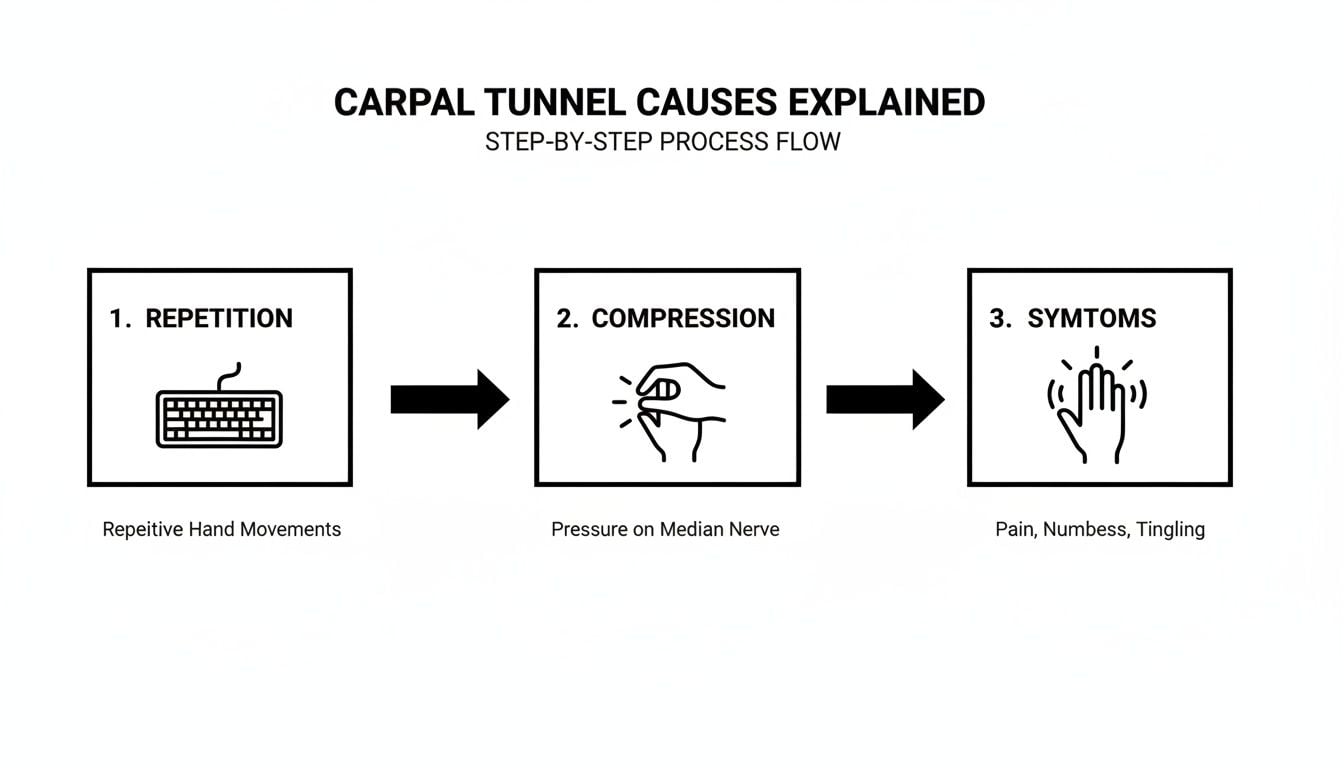
Breaking this cycle with targeted movement is one of the most effective first steps you can take.
Nerve Gliding Exercises Your Wrist Will Love
Let's start with our favorite nerve glide. The key here is to move slowly and deliberately. This is not about aggressive pulling; it should be a smooth, controlled sequence.
Start by making a loose fist with your thumb resting on the outside. From there, slowly uncurl and straighten your fingers, keeping them together. Now, gently bend your wrist back so your palm faces forward. Next, while keeping your wrist back, stretch your thumb away from your fingers. To finish, gently turn your forearm so your palm faces up toward the ceiling. For a little extra, you can use your other hand to gently pull your thumb back slightly.
The entire sequence should feel fluid, like a slow-motion dance for your hand. Hold each position for just a second or two before moving to the next. We typically have our patients aim for 5-10 repetitions, a few times throughout the day. If you feel any sharp pain or a significant increase in your symptoms, stop immediately and back off.
Gentle Stretches for Forearm Relief
After you’ve done some nerve gliding, you can work on lengthening those tight forearm muscles—the ones that do all the heavy lifting with gripping, typing, and carrying.
A good stretch should feel like a mild, comfortable pull. Never push into sharp or stabbing pain. If it hurts, you’re doing too much.
Here are the two fundamental stretches we always start with:
- Wrist Extensor Stretch: Hold your arm straight out with your palm facing down. Use your other hand to gently bend your wrist downward, feeling a stretch on top of your forearm. Hold for 15-20 seconds.
- Wrist Flexor Stretch: Now, flip your hand over so your palm faces up. With your other hand, gently bend your wrist down toward the floor until you feel a comfortable stretch in the belly of your forearm. Hold for 15-20 seconds.
Repeat these stretches 2-3 times on each arm. And remember, proper form is everything. You can learn more about why that is in our guide on the effects of stretching.
A few minutes of mindful movement spread throughout your day can make a world of difference. It's the consistency that brings lasting relief.
Rethinking Your Daily Habits and Environment

We often see patients who are doing all their exercises perfectly but still struggle with that nagging pain and numbness. The missing piece? It’s almost always their daily setup.
The small, repetitive movements we do all day long—typing, scrolling, gripping—are what add up and keep that median nerve irritated. This is about auditing your day-to-day to reduce that constant, low-level strain. We’re not asking you to stop doing your job or your hobbies, just to work smarter.
Mastering the Neutral Wrist
The single most important habit you can build is maintaining a neutral wrist. This is the position where your wrist is straight, not bent up toward the ceiling (extended) or down toward the floor (flexed).
When your wrist is straight, the carpal tunnel has the most possible space, taking pressure off the median nerve.
Think of a garden hose. A straight hose lets water flow freely. Put a sharp kink in it, and the flow stops. Bending your wrist is like kinking that hose. Your goal is to keep it as straight as possible, whether you’re typing, cooking, or driving.
Look at your hand right now. Is your wrist bent to hold your phone? Is it angled up to use your mouse? The first step is just becoming aware of these little habits.
Setting Up Your Workspace Like a Pro
If you work at a desk, your workstation is ground zero for wrist strain. We help patients with this all the time, and a few simple adjustments can make a world of difference in your daily symptoms.
Here’s our go-to checklist for a great ergonomic setup:
- Chair Height: Start with your feet flat on the floor, knees at about a 90-degree angle. Your hips should be just a touch higher than your knees.
- Elbow Angle: Adjust your chair so your elbows are bent at a relaxed 90-degree angle, with your forearms parallel to the floor. This allows your wrists to stay straight while you type.
- Monitor Placement: Position the top of your screen at or just below eye level. This stops you from craning your neck, which can cause problems all the way down to your wrists.
- Keyboard and Mouse: Pull them close. Reaching for them forces your wrists into that bent-up position we’re trying to avoid.
Our team often performs on-site assessments to create a perfectly optimized workspace. You can find out more about our philosophy and workplace ergonomics services for individuals and companies.
Choosing the Right Tools
Your keyboard and mouse are extensions of your hands. If they don’t fit right, they can become your worst enemies.
I once treated a graphic designer who had terrible flare-ups despite being diligent with her stretches. The culprit? A tiny, flat mouse that forced her hand into an awkward claw grip for hours on end. Switching to a vertical mouse that actually fit her hand was the game-changer.
Making sure your mouse fits your hand is non-negotiable for keeping a neutral wrist. You can even use a mouse size finder tool to get it right. Ergonomic keyboards, which are often split or tented, are also a fantastic way to keep your wrists from bending inward.
Activity Modification Beyond the Desk
Carpal tunnel isn’t just for office workers. We treat gardeners, mechanics, musicians, and new parents every day. The principles are exactly the same: find the activity that’s causing the pain and modify it.
- Gardening? Look for tools with thicker, padded handles to reduce how hard you have to grip.
- Knitting? Take frequent breaks to stretch. Pay attention and make sure you aren't holding your wrists in a bent position for long stretches.
- Lifting? Whether it’s a box or your toddler, try to lift with your palms open and facing up. Use your forearms and biceps, not just your hands and wrists.
The key is to start paying attention. When you feel that tingling or ache, ask yourself: "How can I do this differently? Can I keep my wrist straight? Can I loosen my grip?" These small, consistent changes are what lead to real, lasting relief.
Effective Nighttime Care and Home Remedies

If you’ve ever found yourself waking up at 2 AM with a numb, tingling hand and the desperate urge to shake it back to life, you’ve hit on one of the classic signs of carpal tunnel syndrome. It’s incredibly common, and for a simple reason.
Most of us unknowingly curl our wrists into a bent position while we sleep. This posture compresses the carpal tunnel, effectively squeezing the median nerve for hours. The good news? Your downtime—especially the 8 hours you spend asleep—can become your most powerful tool for healing.
The Game-Changing Habit of Nighttime Splinting
Wearing a neutral wrist splint to bed is one of the single most effective things you can do at home. Both research and our own clinical experience show it provides major relief for people with mild to moderate symptoms.
A splint simply holds your wrist straight. This neutral position creates the most space inside the carpal tunnel, giving your median nerve a much-needed break from all that pressure. It’s a completely passive way to get ahead of the inflammation while you sleep.
We’ve had patients struggle for months, only to find relief within just a few nights of consistent splinting.
Think of it like this: you wouldn't try to heal a sprained ankle by walking on it all day. Splinting at night gives your wrist that same protected environment, allowing the nerve to recover and inflammation to settle down.
Choosing the Right Splint for the Job
You can find splints at any pharmacy, but not all of them are right for carpal tunnel. As physical therapists, here’s what we tell our patients to look for:
- Insist on a "Neutral" Splint: The goal is to keep your wrist straight, not bent up or down. Avoid the "cock-up" splints that hold you in extension, as they can sometimes increase pressure.
- Find the Metal Stay: A rigid support, usually a metal bar running along your palm, is non-negotiable. This is what physically stops you from curling your wrist.
- Prioritize a Good Fit: It should feel snug, not painfully tight. You shouldn't feel any pinching, and it definitely shouldn't cut off circulation. Make sure you can still wiggle your fingers. Most use Velcro straps to let you dial in the fit.
The Classic Debate: Ice Versus Heat
Beyond splinting, the other question we get every day is about ice versus heat. The answer really depends on what your wrist is telling you.
- Ice for Acute Flare-Ups: If your wrist is angry, swollen, and painful after a long day of typing or yard work, reach for an ice pack. Applying one for 15–20 minutes helps reduce that swelling and can numb the sharp pain. Just remember to wrap it in a thin towel—never put ice directly on your skin.
- Heat for Chronic Stiffness: If your wrist feels more achy and stiff, especially first thing in the morning, a heating pad or a warm soak can feel great. Heat helps relax those tight forearm muscles and boosts blood flow. Apply it for 15–20 minutes right before you do your gentle stretches.
As a rule of thumb, never use heat if you can see visible swelling. That can make the inflammation worse.
Self-Massage for Forearm Relief
Your forearm muscles work hard all day, and when they get tight, they pull on the very tendons that run through your carpal tunnel. A little self-massage can work wonders to release that tension and reduce the strain on your wrist.
Using your opposite thumb, apply firm but gentle pressure into the muscles of your forearm. Start up near your elbow and slowly work your way down toward your wrist. When you hit a tender spot or a "knot," just hold steady pressure for about 30 seconds until you feel it start to let go.
Make sure to work on both the palm side and the back side of your forearm. Just a few minutes of this each day can make a surprising difference in how your wrist feels. These are the kinds of home remedies that empower you to take control of your recovery, 24/7.
Knowing When to Seek Professional Help
We’re huge proponents of starting with conservative care. For many people, the exercises, ergonomic changes, and home remedies we’ve covered are enough to make a real difference. But it's just as important to know when it's time to call in the pros.
Think of it as knowing the difference between "I can manage this" and "I need some backup." Our goal is to make sure you know when to make that call.
Listening for the Red Flags
Mild, occasional tingling is one thing. But sometimes, your body sends signals that are too serious to ignore. These are the red flags we tell our patients to watch for. If you notice any of them, it's time to stop self-managing and make an appointment.
- Constant, Unrelenting Numbness: If that pins-and-needles feeling in your fingers just won't quit, it’s a sign the nerve compression is becoming more significant.
- Visible Muscle Wasting: This is a big one. Look at the fleshy part of your thumb pad on both hands. If the one on your affected side looks smaller or has a sunken-in appearance, that’s a major warning sign of chronic nerve compression called thenar atrophy.
- Frequent Dropping of Objects: We're not talking about being a little clumsy. If you find yourself consistently dropping your keys or a coffee mug because your grip just gives out, that points to significant muscle weakness.
- Loss of Sensation: Are you having trouble feeling the difference between hot and cold water with your fingertips? Or fumbling with buttons because you can't feel them properly? This is a serious symptom.
These signs suggest the median nerve isn't just irritated—it's potentially being damaged. Pushing through these symptoms is never the right move.
When to See a Physical or Occupational Therapist
So, when is it time to book an appointment with a PT or OT? Honestly, the sooner the better. You don't need to wait for a major red flag.
You should come see us if:
- You’ve tried the home strategies for a few weeks without any real change.
- Your symptoms are starting to interfere with your work, hobbies, or sleep.
- You’re not sure you're doing the exercises or stretches correctly.
During your first visit, we perform a thorough evaluation that goes far beyond your wrist. We'll look at your neck, shoulder, and entire arm to find the true source of the compression. We use specific clinical tests to confirm nerve involvement and then create a personalized plan. This often includes manual therapy, advanced exercises, and targeted treatments from specialists in hand and upper extremity therapy.
A good therapist is like a detective for your body. We don't just treat the symptom—we trace the issue back to its source by connecting your anatomy, your habits, and your history to build a plan that actually works for you.
Partnering with Your Doctor
We work closely with primary care physicians and specialists. Seeing your doctor is especially important if you're experiencing any of those red flag symptoms we mentioned. They can help rule out other medical issues that can mimic or contribute to carpal tunnel.
Your doctor is also the gatekeeper for certain diagnostic tests. The most common one for carpal tunnel is a nerve conduction study (NCS). This test measures the speed of electrical signals through your median nerve. A significant slowdown as the nerve passes through the carpal tunnel is the classic hallmark of the condition. While not always necessary, an NCS can provide a definitive answer in complex or stubborn cases.
Ultimately, knowing your body and knowing when to ask for help is the most important part of this process. That's why we're here.
Frequently Asked Questions About Carpal Tunnel
In the clinic, we talk about carpal tunnel every single day. And honestly, we encourage the questions. When you understand what’s happening inside your wrist—and why—you’re in a much better position to fix it.
Here are the straightforward, no-fluff answers to the questions we hear most often from our patients.
Can Carpal Tunnel Just Go Away on Its Own?
This is the big one, and the honest PT answer is: it’s not likely, but the context matters.
If your symptoms are directly tied to a temporary situation, like the fluid retention common during pregnancy, there's a good chance they'll resolve after you give birth. In that case, the cause disappeared, so the symptoms could, too.
But for most people, carpal tunnel is a problem of repetitive strain. It’s built up over months or years from our daily habits at the keyboard, in the workshop, or on the go. Those habits don’t just vanish. Ignoring the numbness and hoping for the best usually allows the nerve compression to get worse, making it a bigger problem to solve later. Catching it early is always the best strategy.
How Long Until I Feel Better with Natural Treatments?
This is where consistency really pays off. How quickly you feel relief depends on two things: how irritable your nerve is to begin with, and how dedicated you are to the plan.
Based on what we see with our patients, here’s a realistic timeline:
- 1-2 Weeks: Most people notice the first changes at night. With consistent nighttime splinting and a few key ergonomic adjustments, that frustrating tingling and numbness often starts to fade, letting you sleep through the night. That’s a huge first win.
- 2-4 Weeks: As you stick with your nerve glide exercises and stretches, you should start feeling a difference during the day. Things like typing, holding your phone, or gripping a coffee mug become less painful.
- 1-3 Months: This is where the changes become more permanent. By now, the exercises have had time to improve the nerve's mobility, and your new habits have significantly reduced the daily strain. This gives the nerve and surrounding tissues the time they need to truly calm down.
Remember, this isn't a race. Everyone’s timeline is a little different. The key is to notice and appreciate the small improvements along the way—like making it through a workday without that familiar ache, or finally getting a full night of uninterrupted sleep.
What Is the Difference Between Carpal Tunnel and Tendonitis?
This is an excellent question, because the symptoms can feel incredibly similar at first. Both can cause wrist pain, and both are often triggered by overuse. The key difference is the tissue that's actually causing the problem.
- Carpal Tunnel Syndrome: This is a nerve problem. Specifically, the median nerve gets compressed in that narrow tunnel in your wrist. This is what leads to those classic nerve symptoms: numbness, tingling, a “pins and needles” sensation, and sometimes weakness in the thumb, index, and middle fingers.
- Wrist Tendonitis: This is a tendon problem. Tendons are the tough, fibrous cords connecting your muscles to your bones. When they get inflamed from overuse, you get tendonitis. The pain is usually sharper, more localized to a specific spot, and gets worse when you use that particular muscle. You typically won't get that widespread numbness and tingling.
A simple way to think about it: If your fingers feel like they’re buzzing or falling asleep, it’s more likely carpal tunnel. If you have a sharp, specific pain when you twist your wrist a certain way, it might be tendonitis. Of course, an experienced physical therapist can perform hands-on tests to tell you for sure.
Should I Be Taking Vitamin B6?
We see this one online a lot. The theory is that vitamin B6 is crucial for nerve health, so more of it should help.
Here’s our professional take: we don’t recommend it. The research supporting high-dose B6 for carpal tunnel is weak at best. More importantly, taking massive doses of vitamin B6 can cause its own nerve damage—a condition called peripheral neuropathy—with symptoms that can mimic carpal tunnel. You could accidentally make things much more confusing.
If you’re genuinely worried about a nutritional deficiency, your first step should be a conversation with your doctor. They can run tests and give you safe, personalized advice. For most people with a reasonably balanced diet, a B6 deficiency isn't the root cause. Your time and energy are better spent on the strategies we know work: splinting, ergonomics, and the right exercises.
Feeling informed and ready to take the next step? If you're tired of "waiting it out" and want a clear, personalized plan to get relief, we're here to help. The team at Joint Ventures Physical Therapy is ready to partner with you. Let’s figure this out together. Schedule your appointment today.