Let's be honest. When most people hear "physical therapy," they think of recovering from an injury or surgery. It's about getting back to "normal" so you can do daily activities without pain. And for that, traditional PT is fantastic.
But for athletes and active folks like us, "normal" is just the starting line.
What Is Sport Performance Physical therapy
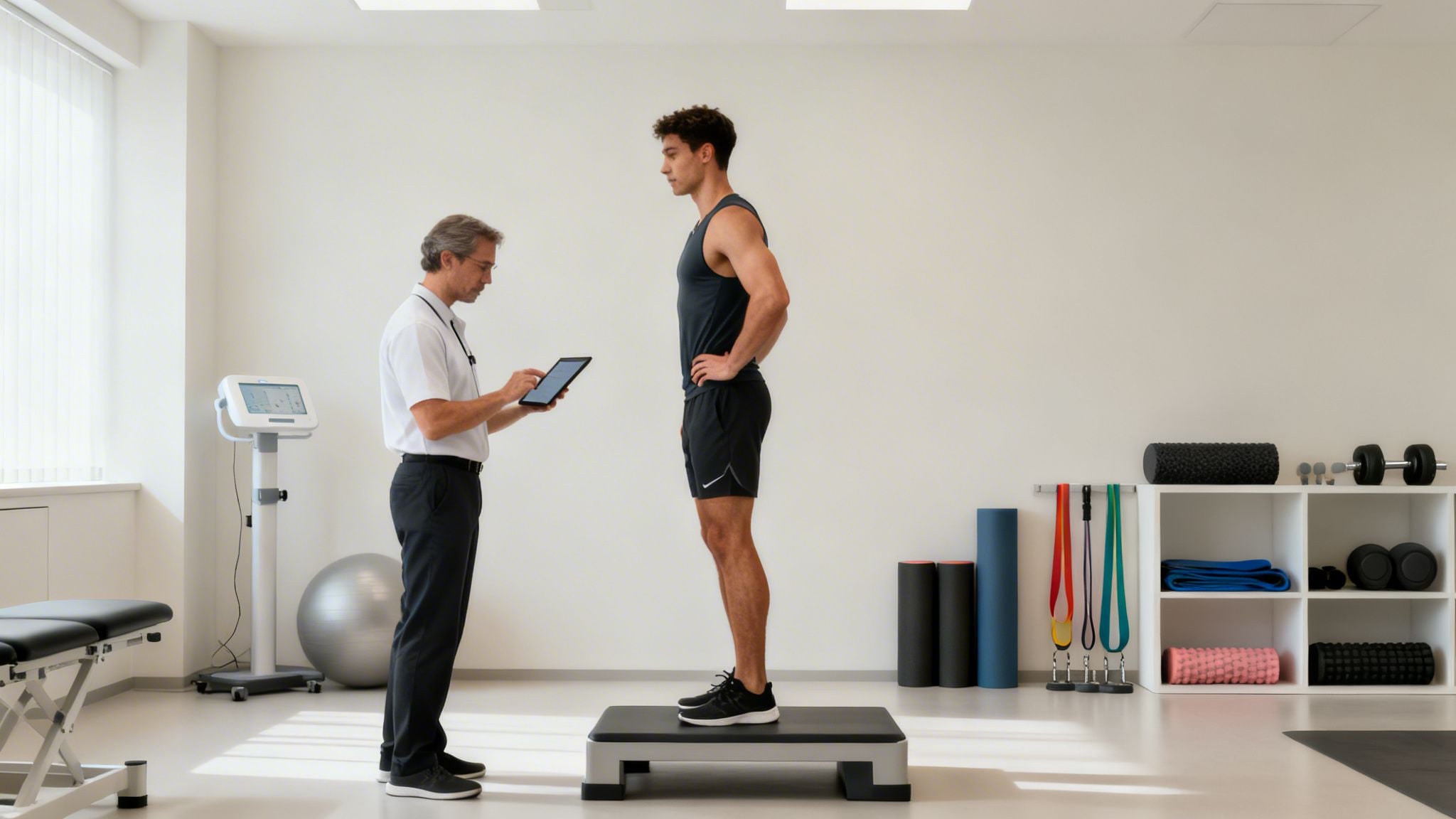
Sport performance physical therapy picks up right where traditional rehab often leaves off. It asks a totally different question: "How do we make you stronger, faster, and more durable than you were before?"
Think of it this way. Traditional PT is the repair shop that gets your car back on the road. Sport performance PT is the high-performance tuning garage that gets it ready for race day.
It's about bridging the critical gap between basic rehabilitation and elite conditioning. We use data-driven methods to fine-tune your body's mechanics for optimal output and durability.
This is for the runner who doesn't just want their knee to stop hurting—they want to shave minutes off their personal best. It’s for the lifter who wants to hit a new PR without that nagging shoulder pain creeping back in.
To make the distinction crystal clear, let's look at how these two approaches compare.
Traditional PT vs Sport Performance PT At a Glance
This table breaks down the key differences, showing how sport performance PT builds on traditional rehab to deliver next-level results.
| Attribute | Traditional Physical Therapy | Sport Performance Physical Therapy |
|---|---|---|
| Primary Goal | Pain reduction, restore normal function. | Optimize athletic output, prevent future injury. |
| Focus | Treating the specific injured area. | Analyzing and improving the entire kinetic chain. |
| Patient Profile | Post-injury, post-surgery, chronic pain. | Active individuals, athletes, weekend warriors. |
| End Point | Return to daily activities without pain. | Return to sport at a higher level of performance. |
| Methodology | Primarily therapeutic exercise and modalities. | Biomechanical analysis, strength & conditioning. |
While both are valuable, sport performance PT is specifically designed to meet the demands of your sport and build a body that can withstand them.
Beyond Just Treating Pain
Here’s a scenario we see all the time: an athlete comes in with a recurring hamstring strain that flares up every time they sprint. We know that the problem isn't always the hamstring itself.
Instead, that strain is often a symptom of a deeper issue. We dig in to find the root cause, which could be anything from:
- Hidden Weaknesses: A weak core or glutes that aren't firing properly can force your hamstrings to do all the work.
- Mobility Restrictions: If your hip flexors are tight, your running mechanics change, putting a massive strain on your hamstrings.
- Inefficient Movement: Poor running form can create tiny, repetitive stresses that add up until something finally gives.
This is exactly where our expertise comes in. While sports medicine and rehab get you back in the game, our performance-focused approach ensures you stay there and excel. We connect the dots that others miss.
Our job is to uncover what’s holding you back—whether it’s causing pain right now or just limiting your potential—and give you a clear roadmap to building a more powerful, resilient body.
Is Sport Performance PT Right For You?
There's a common misconception that this level of specialized care is only for professional athletes. We hear it all the time, but it’s just not true. Sport performance physical therapy is for anyone who is driven by a goal, whether you’re getting paid to play or just passionate about your own fitness.
It’s for the runner gearing up for their first Boston Marathon. It’s for the high school soccer player with scholarship dreams who needs an edge. It’s for the CrossFit athlete chasing a new personal record and the busy parent trying to safely get back to a fitness routine they love.
If you feel like you’ve hit a frustrating plateau or have a nagging ache that just won’t quit, you’re in the right place. Our job is to dig in, figure out the why behind it, and give you a clear plan to break through.
Real-World Scenarios We See Every Day
This isn't just about theory; it’s about real people getting real results. The principles of sports performance PT apply to almost any activity. Here are just a few examples of the people who walk through our doors:
- The Golfer: They want to add 20 yards to their drive but their back aches after every round. We can pinpoint the exact mobility and stability issues in their swing that are leaking power and causing pain.
- The Post-ACL Athlete: A soccer player who finished their post-op rehab but still feels a step slow on the field. We design a specific return-to-sport program that hones in on agility, cutting mechanics, and building back explosive power to restore their confidence.
- The Cyclist: They can’t shake that persistent knee pain on long rides along the Charles. A detailed analysis can uncover problems with their bike fit, cleat position, or muscle imbalances that are the real culprit.
Our mission is to meet you exactly where you are and provide the expert guidance to get you where you want to go—safely, effectively, and with a plan you can trust. We help solve the puzzles holding your performance back.
The Growing Need for Specialized Care
The demand for this kind of focused approach isn't just something we feel in our clinic; the numbers tell the story. Sports injuries account for over 3.5 million cases among youth in the US each year, and targeted PT can reduce the risk of long-term issues by as much as 60%.
The market reflects this reality, with North America driving over 40% of a global industry that’s growing by the billions. You can learn more about the physiotherapy market growth on Technavio if you want to dig into the data. This trend highlights a major shift: active people are no longer settling for just being "pain-free." They want to be robust, resilient, and ready for whatever challenge comes next.
Your Comprehensive Performance Evaluation
A great plan starts with a great assessment. This is where we part ways with the typical physical therapy experience right from the start. You won't find any rushed, 15-minute evaluations here, where you feel more like a number on a clipboard than a person.
Our sports performance evaluation is a comprehensive, one-on-one deep dive into you as an individual and an athlete. We go far beyond just looking at where it hurts. Instead, we analyze the entire kinetic chain—from your feet to your neck—because in the human body, everything is connected. It’s a methodical process that helps us build a complete picture of how you move.
This approach isn't just for elite athletes. We use this detailed analysis for everyone, from competitive marathoners to weekend fitness enthusiasts.
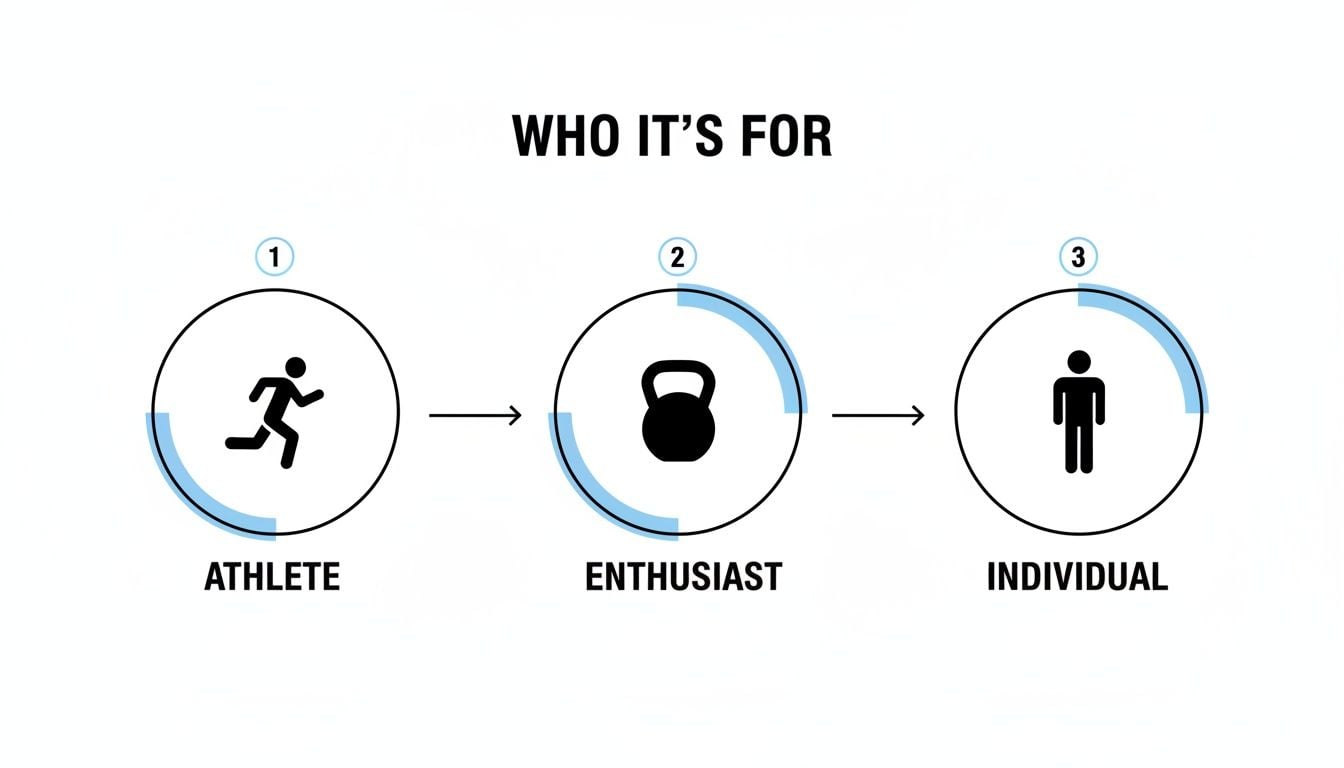
As you can see, the process is built around your specific goals, whether you're trying to set a new personal record or just getting started on your fitness journey.
What We Actually Look For
Our evaluation is built on a few key pillars. Think of it less like a generic checklist and more like detective work, where each test gives us another clue to find the root cause of the problem.
The process includes:
- Detailed Movement Screening: We’ll guide you through fundamental movements like squats, lunges, and overhead reaches. This isn't just a pass/fail test; we're looking for subtle asymmetries and faulty mechanics that show us how your body compensates under load.
- Targeted Strength Testing: We need to find out not just if you're strong, but where you're strong. Pinpointing specific weaknesses in your core, hips, or shoulders gives us a clear target for your program.
- Mobility Assessments: Your body might be holding onto hidden restrictions you don't even notice. We’ll check your joint mobility from head to toe to find areas that are silently robbing you of power and efficiency.
A thorough evaluation also means getting objective numbers to set a baseline and track your progress. For example, using a one-rep max calculator can help quantify your strength. These metrics aren't just for show; they give us a clear starting point to build from.
Connecting The Dots For You
Most importantly, our evaluation begins with a real conversation. We want to hear about your training history, your biggest frustrations, and what you ultimately want to achieve. That context is everything.
We explain what we’re seeing in real time and why it matters. That recurring hamstring strain you’ve been fighting? We’ll show you how it actually stems from poor core stability or limited hip mobility on the opposite side.
Connecting these dots is the key. It’s how we create a plan that solves the real problem, not just chases the symptoms. For athletes like runners, a detailed movement screen can reveal tiny inefficiencies in their stride that add up over miles. If you're curious about how we break down running mechanics, you can learn more in our guide to what is gait analysis.
This is how we build a plan that truly works for you.
Building Your Personalized Treatment Plan
Once we've finished a thorough evaluation and have a crystal-clear picture of your goals, we get to work building your plan. We don't believe in one-size-fits-all programs. Your treatment plan is a specific roadmap where every single intervention is chosen for a reason, designed to build on the last and get you back to performing your best.
This is a partnership. We bring our expertise to the table, and you bring your goals. Together, we build a plan that not only works but also makes sense to you, so you understand the "why" behind every exercise and treatment.
Targeted Strength And Conditioning
Your strength program won't look like a generic workout you’d pull from a fitness app. It’s built entirely around the physical demands of your sport and your body’s unique mechanics. We’re not just trying to make you stronger in general; we’re making you stronger in the exact ways that matter for your performance.
For a hockey player, that could mean building rotational power for a harder slap shot and lateral strength for more explosive skating. For a runner, it might be developing bulletproof hamstrings and a rock-solid core to hold your form through the final miles of a race.
The key pieces of your program will include:
- Sport-Specific Exercises: We go beyond the basic gym lifts, incorporating movements that directly translate to what you do on the field, court, or track.
- Targeted Weakness Correction: If your evaluation uncovered weak glutes or poor shoulder stability, those become a priority. Fixing these hidden energy leaks is often the quickest path to seeing real performance gains.
- Progressive Overload: Your program evolves as you do. We'll systematically dial up the challenge to ensure you keep getting stronger, faster, and more resilient.
Rebuilding Movement From The Ground Up
It’s one thing to build strength, but using it efficiently is another game entirely. This is where movement retraining comes in. Pain and performance plateaus are often just symptoms of faulty movement patterns we've picked up over time without even realizing it.
Our goal is to make efficient, powerful movement feel like second nature again. We break down complex actions—like a golf swing, a running stride, or a cutting motion—and rebuild them piece by piece.
We use specific tools to help you rewire these patterns. Video feedback is a huge one, letting you see exactly what we're seeing in real-time. By pairing that visual with our verbal and hands-on cues, we help you feel the difference between an inefficient movement and a powerful, athletic one.
Advanced Hands-On Techniques
Sometimes, your muscles and joints just need a more direct approach to unlock their full potential. Our hands-on manual therapy techniques are designed to do exactly that. These aren’t just feel-good treatments; they are precise, targeted interventions that create real, measurable changes in your body.
We might use techniques like:
- Joint Mobilizations: Skilled, gentle movements that restore normal motion to a stiff joint, which can immediately improve your flexibility and reduce pain.
- Soft Tissue Manipulation: Using our hands or specialized instruments, we can release scar tissue and adhesions that are restricting muscle function.
- Trigger Point Dry Needling: This is a highly effective tool for releasing stubborn muscle knots (trigger points) that cause pain and limit mobility. It helps "re-set" the muscle, restoring its normal function almost instantly.
These hands-on treatments are never just a standalone fix. We always pair them with corrective exercises to make sure the new mobility you gain actually sticks. This integrated approach is backed by a growing body of evidence. For instance, post-ACL reconstruction patients in intensive PT regimens don't just regain strength 25% faster; they also slash their reinjury risk by 50%. Performance services like gait analysis can improve running economy by 4-6%, which could shave minutes off a marathon time.
You can read more on the impact of physical therapy on Precedence Research to see how this is changing the game for athletes across the board.
A Deeper Dive Into Running And Golf Performance
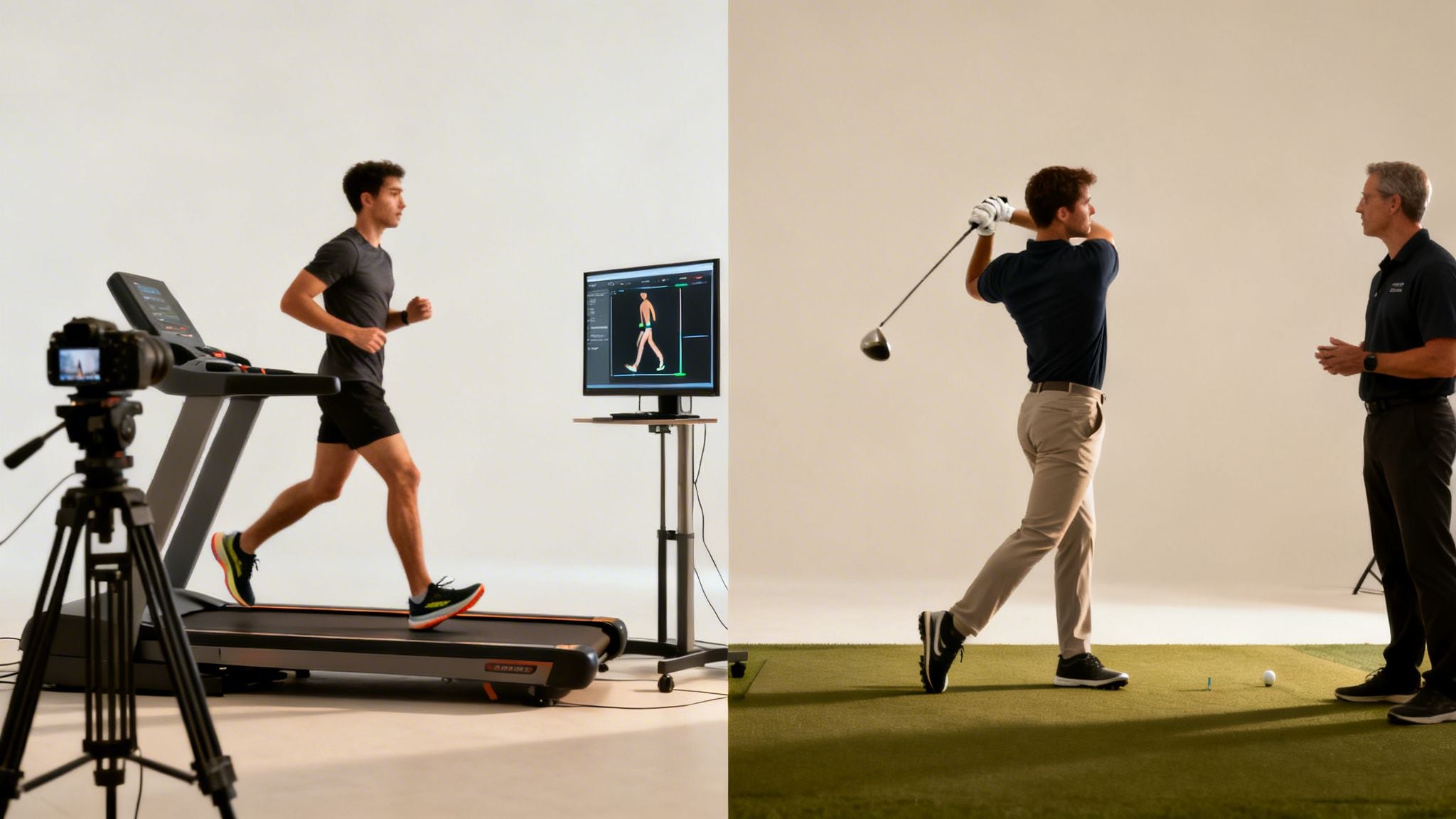
While the principles of sports performance PT apply to just about any activity, some sports demand an even more specialized approach. For dedicated runners and golfers, tiny inefficiencies in movement can lead to nagging injuries and frustrating performance plateaus. In these cases, a generic plan just won't cut it.
This is where we go deeper. We’ve developed specific programs that get to the heart of what makes these athletes tick, using science-backed analysis to provide a clear roadmap for improvement.
The Running Performance Evaluation
For runners, efficiency is everything. Whether you're training for a marathon or just logging miles along the Esplanade, every single foot strike matters. Our Running Performance Evaluation is designed to break down your unique running gait and find opportunities for you to become faster, stronger, and more resilient.
It starts with us filming you run on a treadmill from multiple angles. Using slow-motion video analysis, we get a frame-by-frame look at your mechanics, identifying things you'd never be able to see or feel on your own.
This analysis helps us pinpoint common energy leaks like:
- Overstriding: Reaching your foot too far out in front of you. This acts like a brake with every step and puts tremendous stress on your knees and hamstrings.
- Poor Cadence: Taking too few steps per minute, which increases impact forces and reduces your overall running economy.
- Excessive Vertical Movement: Bouncing up and down too much, wasting energy that should be propelling you forward.
After the analysis, we don't just hand you a report. We sit down with you, walk through the video, show you exactly what we see, and give you specific drills and cues to start improving your form right away.
The Titleist Performance Institute (TPI) Screen
Golf is a game of incredible precision, and the golf swing is one of the most complex movements in all of sports. It requires a unique blend of mobility, stability, and power. Even small physical limitations can have a huge impact on your swing and lead to all-too-common frustrations on the course.
That’s why we use the Titleist Performance Institute (TPI) screen. It’s a series of 16 sport-specific tests that directly connect how your body moves to how you swing a golf club.
This isn’t about changing your swing style; it’s about giving your body the ability to execute your swing more efficiently. For instance, the screen might reveal that your "coming over the top" fault isn’t a technique problem at all, but a result of a stiff mid-back (thoracic spine) that simply won’t allow you to rotate properly.
Similarly, "losing your posture" through the swing could be caused by poor core stability or an inability to separate your upper body from your lower. Once we identify the physical limitation, we can give you targeted exercises to fix it. This approach can provide crucial insights and tailored programs to help golfers achieve swing pain-free golf and back pain solutions, ensuring they can enjoy the game without discomfort. If you're serious about your game, our Titleist Performance Evaluation can be a true game-changer.
These specialized programs show just how vital targeted sports performance physical therapy is becoming. In fact, the global Sports Medicine & Physiotherapy Market is projected to grow from USD 13.68 billion in 2026 to USD 23.41 billion by 2032, a clear sign that athletes are increasingly seeking expert guidance to push their boundaries.
How To Choose The Right Physical Therapist
Finding the right physical therapist is probably the biggest decision you’ll make on your journey. It’s not about finding the cheapest option or the clinic closest to your house; it’s an investment in your health and your ability to get back to the activities you love.
A flashy website doesn't tell you what your care will actually feel like. To find a PT who truly understands athletes, you have to dig a little deeper. You’re looking for a partner—someone who feels like a coach and is as invested in your goals as you are.
What To Look For In A Clinic
When you start looking at clinics, your focus should be on the experience. Your time is valuable. You shouldn’t be spending half of it in a crowded gym waiting for your therapist’s attention. The best clinics are built around one-on-one care.
Here are the questions you absolutely need to ask any potential clinic:
- Will I get one-on-one care? You need to know if your entire session is with a licensed Doctor of Physical Therapy. It’s common in high-volume clinics to be passed off to an aide after a quick check-in. Don't settle for that.
- Do they understand my sport? Ask if they have a track record of treating runners, golfers, lifters, or whatever your sport is. Look for clinicians with specific certifications and real-world experience.
- What does the first evaluation look like? It should be a true deep dive, lasting at least an hour. A thorough PT will want to analyze your movement, test your strength, and have a real conversation about your history and goals.
- Do they create a personalized plan? You should never, ever be handed a generic sheet of exercises. Your plan needs to be built for you, and it should change as you get stronger.
Your physical therapist should be a partner who empowers you. They should not only treat your issue but also educate you on the 'why' behind your plan, giving you the tools to manage your own health for years to come.
The Non-Negotiables For Your Care
Ultimately, this comes down to trust. You need a therapist who listens, who has a clear plan, and who has the specific skills to help you reach your goals. At our clinic, we believe every patient deserves a certain standard of care, period.
We promise three things to every person who walks through our doors:
- Uninterrupted Time With an Expert: Your appointment time is all yours. You will have the focused, one-on-one attention of a Doctor of Physical Therapy from start to finish.
- A Focus on Education: We want you to understand your body better. We take the time to explain what we’re doing and why, so you feel confident and in control of your recovery.
- Supportive Teamwork: Our front desk and administrative team handle the insurance and billing details so you can focus 100% on your care.
Choosing the right partner for your sport performance physical therapy is crucial. By asking these questions, you can find a clinic that won’t just help you recover, but will help you come back stronger, faster, and more resilient than before.
Frequently Asked Questions
We hear a lot of great questions from athletes and active people trying to decide if this is the right path for them. We've put together the most common ones to give you the clear, straightforward answers you're looking for.
Do I Need A Doctor's Referral To Start Physical Therapy?
No, you don't. Massachusetts is a Direct Access state, which is great news for patients. It means you can book an evaluation directly with us to get started on your goals right away, without needing a referral. This lets us jump on an issue before it becomes a bigger problem.
While some insurance plans might eventually ask for a physician's signature to cover ongoing treatment, our administrative team is here to help. We'll verify your benefits and handle all those details for you. Our priority is getting you on the path to improvement as quickly and smoothly as possible.
How Is This Different From Personal Training?
That's a fantastic question, and it's an important distinction. A great personal trainer is an expert in creating effective fitness programs to help you reach your goals. We actually work with many wonderful trainers throughout the city.
As Doctors of Physical Therapy, we are licensed healthcare professionals who specialize in biomechanics and the musculoskeletal system. Our real expertise is in diagnosing the root cause of pain and movement dysfunction.
We bridge the gap between medical care and peak fitness. A trainer builds strength; we build a resilient foundation first, identifying and correcting the underlying issues that could lead to injury down the road.
We can tell you why your shoulder hurts when you press overhead. Then, we give you a plan that not only gets rid of the pain but makes you stronger and safer in that movement for the long haul.
How Long Will It Take To See Results?
This is unique to every single person, but our goal is for you to feel a difference right from day one. It’s not uncommon for patients to feel immediate relief or improved movement after just one session, especially with hands-on manual therapy or trigger point dry needling.
When it comes to performance, you'll often notice positive changes in your movement quality within the first few sessions as we work on motor control. But significant strength gains and major performance breakthroughs take consistent, dedicated work over several weeks.
We set clear, measurable goals together from the very start. We constantly track your progress with objective tests to make sure we're on the right path and that your investment in sport performance physical therapy is paying off. You'll always know where you stand and what we're working toward next.
Ready to invest in your health and unlock your true athletic potential? The expert team at Joint Ventures Physical Therapy is here to build the personalized plan you need to move past pain and achieve your goals. Schedule your one-on-one evaluation today.