
We all breathe without thinking. But here's something we see every day in our clinic: most people, even seasoned athletes, are leaving performance on the table simply because they're not breathing with intention.
Proper breathing isn't just about getting air in and out. It's a skill. And when you learn how to use it correctly, it can make you stronger, more stable, and far more resilient in your workouts. Trust us, this is one of the most powerful changes you can make.
Your Breath Is a Superpower for Better Workouts

Think of your breath as the engine that powers every single move you make. Whether you're pulling a heavy deadlift or running along the Charles River, the way you inhale and exhale directly impacts your body's efficiency and power.
As physical therapists, this is a cornerstone of our practice. We watch athletes unlock new PRs and patients recover faster from injuries, often just by mastering this one fundamental skill. It’s about making your body work smarter, not just harder.
The Connection Between Breath and Core Stability
Here’s a fact that surprises a lot of people: your main breathing muscle, the diaphragm, is also a critical part of your core. It acts as the "roof" of your core canister, working in concert with your abs, back muscles, and pelvic floor to create stability from the inside out.
When you take a full, deep belly breath, your diaphragm contracts downward. This creates intra-abdominal pressure, which acts like a natural weightlifting belt, supporting your spine and protecting it from injury.
Good breathing isn’t just for your lungs. It's an active process that engages and reinforces your core, giving you the stability needed to lift heavier and move with confidence.
Most people, however, are shallow "chest breathers." This pattern completely bypasses that powerful internal support system. Instead, it relies on smaller, less effective muscles in your neck and shoulders, which can lead to a host of problems we treat all the time:
- Reduced Core Engagement: Your spine is left vulnerable, increasing the risk of back pain and injury, especially under load.
- Neck and Shoulder Tension: Chronically overworking these small muscles is a common culprit behind that nagging stiffness and discomfort many people feel.
- Poor Oxygen Exchange: Chest breathing is inefficient. It limits how much oxygen you can bring in, starving your muscles when they need it most.
Learning to breathe from your diaphragm is the first step toward building a truly functional and resilient body. It creates the stable base you need for everything else.
Why Your Breathing Pattern Matters
Your breathing does more than just move air—it sends powerful signals to your nervous system.
Fast, shallow breaths trigger a "fight-or-flight" response. This is great for a true emergency or a max-effort sprint, but if it becomes your default breathing pattern during exercise, you'll burn out quickly.
On the other hand, slow, deep, and controlled breathing activates your "rest-and-digest" system, signaling safety and promoting recovery. It's why taking a few deep breaths can make you feel instantly more focused and calm.
The goal during exercise is to match your breathing strategy to the task. You want to fuel your muscles with oxygen without sending your body into a state of unnecessary stress. This balance is what separates a draining workout from a truly productive one. It's the difference between hitting a wall and pushing right through it.
From sports performance to injury recovery, this principle is fundamental. For a deeper look at how we apply this with athletes, you can explore our approach to sports medicine and rehab. Mastering your breath is truly the foundation of better movement and better health.
Mastering Diaphragmatic Breathing as Your Foundation
Before we get into breathing strategies for a heavy squat or a fast mile, we have to start with the absolute foundation: your diaphragm. Far too many of us are chronic "chest breathers," relying on the small, inefficient muscles in our neck and shoulders to do the work. This isn't just a bad habit. It’s a direct path to neck pain, a less responsive core, and leaving performance on the table.
When a client comes into the clinic—whether they're a high-level athlete or recovering from surgery—one of the first things we do is reconnect them with their diaphragm. Think of it as hitting the reset button on your body's most basic pattern. Getting this right calms your nervous system, improves how oxygen gets to your muscles, and builds the stable core you need for literally every other movement.
What Is Diaphragmatic Breathing?
So what exactly is this "belly breathing" we're talking about? It's simply the way you were designed to breathe from birth. The diaphragm is a big, dome-shaped muscle that sits right at the base of your lungs. When you inhale correctly, it contracts and flattens downward, creating a vacuum that pulls air deep into the lower parts of your lungs.
That downward movement also gently pressurizes your abdomen, which is the key to creating real core stability. On the exhale, the diaphragm just relaxes and moves back up, pushing air out. It’s an incredibly powerful and efficient system that many of us have simply forgotten how to use.
The goal isn't to force your belly out. It's to allow your breath to travel deep enough to expand your entire core—front, sides, and back—like a balloon filling with air in all directions.
This 360-degree expansion is what creates true core stiffness and protects your spine. It's a total game-changer.
A Simple Drill to Find Your Diaphragm
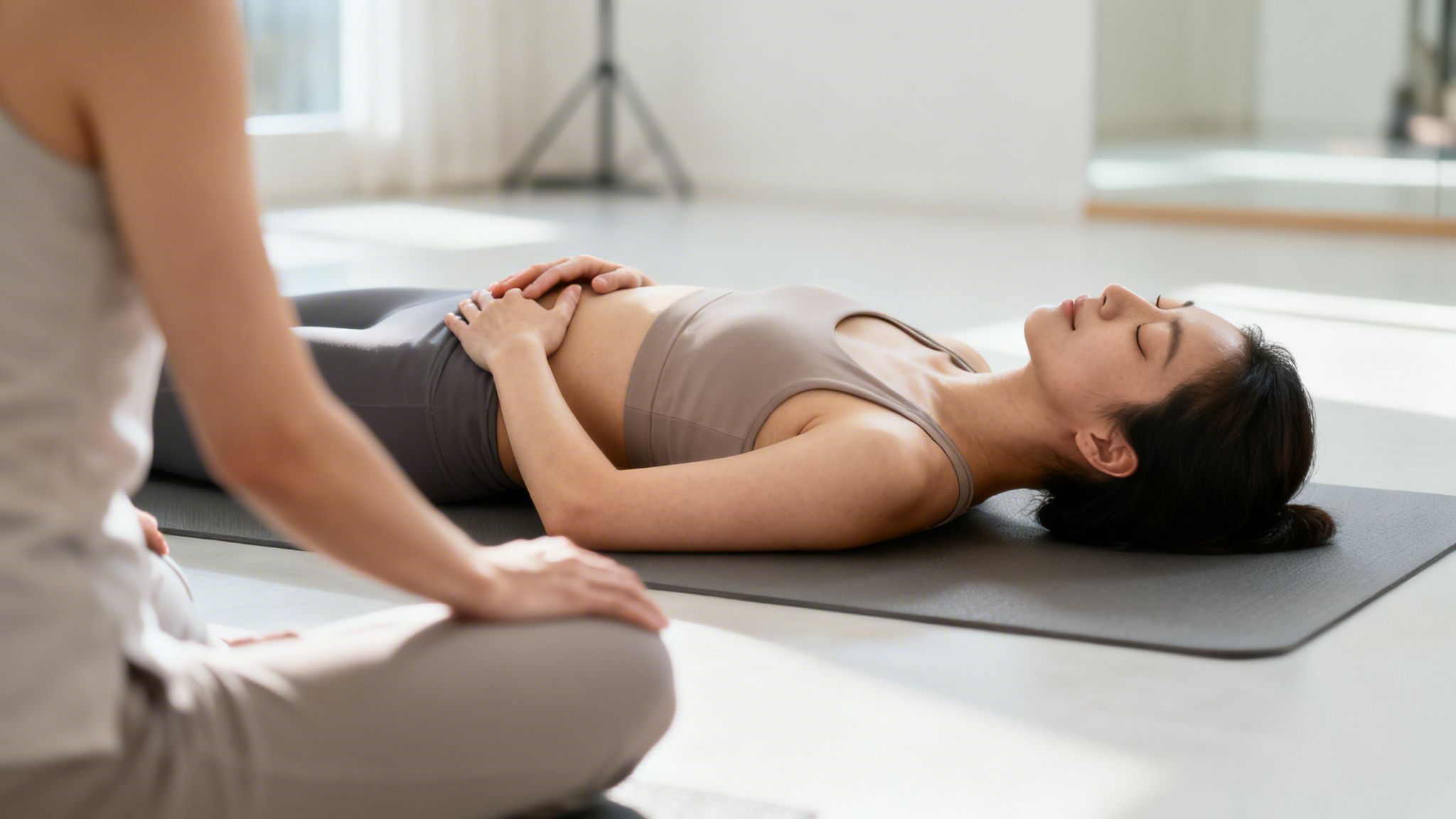
Let's get you to feel this for yourself. The easiest way to reconnect is by lying on your back with your knees bent and feet flat on the floor.
- Place one hand on your upper chest and the other on your belly, right below your ribs.
- Close your mouth and take a slow, quiet inhale through your nose. Aim to send that air down toward your bottom hand.
- The hand on your belly should rise, while the hand on your chest stays pretty still.
- Exhale slowly through your mouth and feel the hand on your belly fall naturally.
Don't try to muscle it. The key here is to relax and guide the breath, not force it. This simple drill helps quiet those overactive neck muscles and lets your diaphragm finally do its job.
The power of this focused breathing goes beyond just mechanics; it directly taps into your body's stress response. This is a massive factor for athletes. For instance, a landmark study with collegiate athletes revealed that guided diaphragmatic breathing significantly cut down on stress and anxiety markers. By breathing at a structured pace of just 4-6 breaths per minute, the athletes were able to maintain respiratory efficiency even under pressure. It's a potent tool for performance. You can dig into the full study on diaphragmatic breathing's impact on athlete stress.
Progressing Your Diaphragmatic Breath
Once you can do this comfortably lying down, it's time to add a challenge. The end goal is to make this your automatic breathing pattern, no matter your position.
From Sitting to Standing
First, practice in a chair. Sit up tall with your feet flat and your back supported. Go back to the hand-on-belly drill, focusing on that deep, expansive breath without letting your shoulders creep up toward your ears.
Once that feels solid, try it standing. This is often where things get tricky, as old habits and gravity try to pull you back into chest breathing. Stay patient and gently redirect your focus back to your core.
A few cues we use with clients:
- The Balloon: Imagine a balloon deep in your abdomen. Every inhale fills it up—expanding forward, out to the sides, and into your low back.
- The Umbrella: Picture your lower ribs as an umbrella. As you inhale, the umbrella opens in all directions. As you exhale, it closes.
- The Belt: Loosely wrap a belt or a resistance band around your lower rib cage. As you breathe in, try to create pressure against the band in a 360-degree circle.
Mastering this foundational skill is more than just an exercise; it’s a full system upgrade. It builds a more stable core, takes the strain off your neck and shoulders, and gets your body ready to handle the demands of any workout. Before you can worry about how to breathe during exercise, you have to relearn how to breathe, period.
Syncing Your Breath With Your Workout
Think about it: a heavy squat and a 5K run along the Esplanade demand completely different things from your body. It only makes sense that your breathing strategy should adapt. This is where we get into the practical, nitty-gritty details of matching your breath to your movement—not just for better performance, but for safety, too.
Knowing how to breathe during exercise isn't about one single rule. It's about having a toolbox of techniques and knowing which tool to grab for the job.
Breathing for Strength Training
When you're lifting weights, your breath is your best friend for creating core stability. The most fundamental rule we teach in the clinic is to exhale on exertion. It's a simple concept that makes a world of difference.
- Inhale during the easier part of the movement. This is typically the lowering or "eccentric" phase. Think about lowering into a squat or bringing a barbell down to your chest during a bench press.
- Exhale during the hardest part. This is the lifting or "concentric" phase. Breathe out forcefully as you stand up from the squat or press the weight up.
This pattern helps you generate power while keeping your core engaged and your blood pressure from spiking unnecessarily. It’s the go-to method for about 90% of the strength training you'll do.
But what about those really heavy, one-rep-max attempts? This is where you might hear about holding your breath. This technique, the Valsalva maneuver, involves taking a big diaphragmatic breath, holding it, and bracing your core against it. It creates immense intra-abdominal pressure, which can stabilize your spine for a super heavy lift.
The Valsalva maneuver is a tool for advanced lifters performing maximal efforts, not a general-purpose strategy. For most people, most of the time, consistently exhaling on exertion is safer and more effective.
Using it improperly or for too long can spike your blood pressure significantly, so we only recommend it for experienced lifters under specific, very heavy loads.
Breathing for Cardio and Running
For endurance activities like running or cycling, the goal shifts from creating maximal stability to finding a sustainable rhythm. This is where rhythmic breathing comes into play. You want to sync your breath with your cadence to improve efficiency and stave off those dreaded side stitches.
A side stitch is essentially a cramp in your diaphragm. It often happens when your breathing is shallow, rapid, and out of sync with your movement. Establishing a pattern can prevent this.
- 2:2 Pattern: This is a great starting point for moderate-intensity cardio. Inhale for two steps (or pedal strokes), then exhale for two steps.
- 3:3 Pattern: For a slower pace or a warm-up, you can extend the rhythm. Inhale for three steps and exhale for three steps.
This diagram breaks down the mechanics of the deep diaphragmatic breath you'll want to use for these patterns.
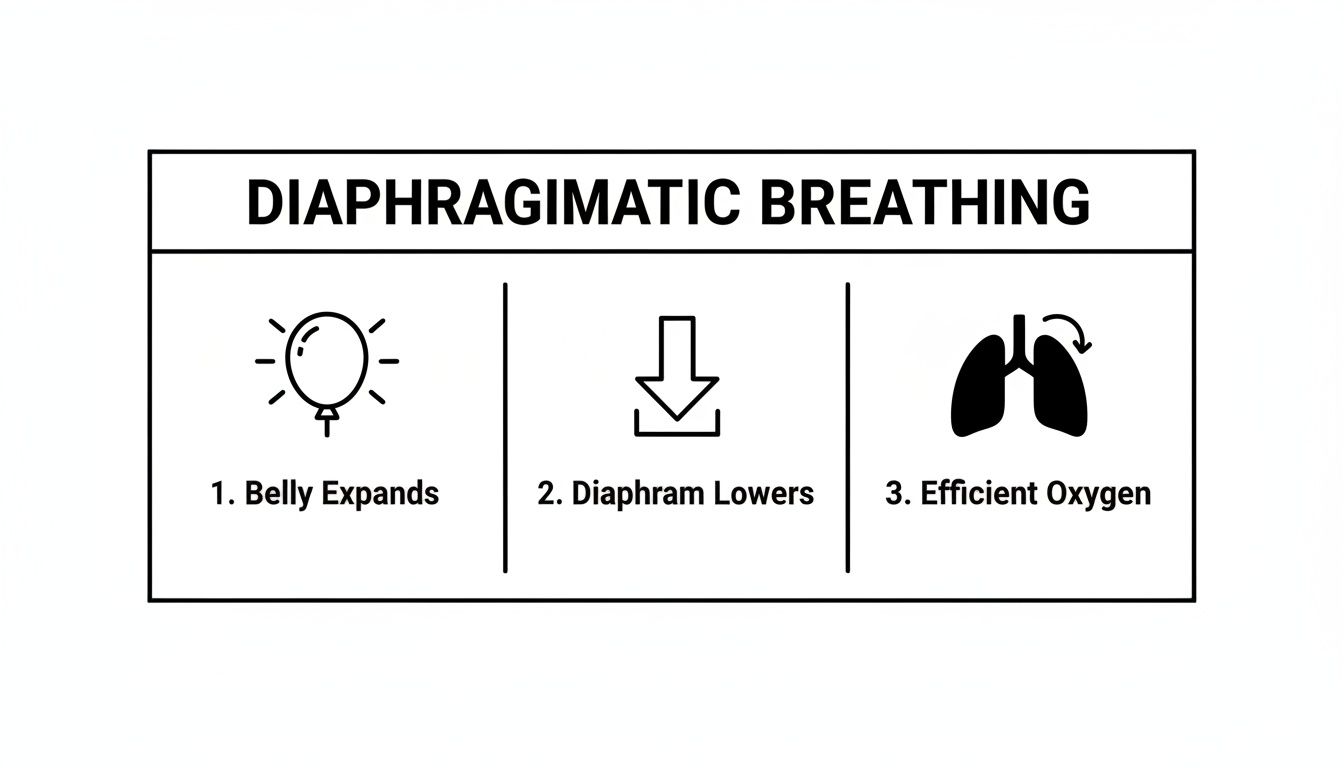
The key takeaway here is how a proper inhale causes your belly to expand and diaphragm to lower. That’s the engine of efficient oxygen exchange for endurance.
For runners, this is especially critical. Up to 40% of runners deal with exercise-induced breathlessness, but strategic breathing can be a game-changer. Research has shown that slower, deeper breathing can improve your gas exchange by up to 25% and shifts the workload from easily fatigued accessory muscles to your powerful diaphragm. This directly cuts down on fatigue and can turn a struggle-fest into a strong, smooth run.
Of course, syncing your breath is just one piece of the puzzle. We often find that breathing issues are linked to other mechanical habits. You can read our guide on how to improve running form to see the bigger picture.
Breathing for HIIT and Mindful Movement
High-intensity interval training (HIIT) and mindful practices like yoga or Pilates have their own unique breathing demands.
For HIIT, the challenge is managing your breath during the intense "on" periods and using it to recover quickly during the "off" periods.
- During the work interval: Don't hold your breath! Keep a steady, powerful breathing pattern. A forceful exhale can help you power through movements like kettlebell swings or burpees.
- During the rest interval: This is your chance to recover. Immediately switch to slow, deep diaphragmatic breaths. Inhale through your nose and take a long, slow exhale through your mouth to bring your heart rate down and prepare for the next round.
In yoga and Pilates, the breath is the movement. Here, the focus is on a slow, controlled, and deliberate breath to guide you through each posture. The cue is often to inhale to lengthen and expand, and exhale to deepen a stretch or engage your core. This mindful connection is what helps build control, stability, and body awareness.
To make it even simpler, here's a quick cheat sheet for matching your breathing to your workout.
Breathing Techniques for Your Workout
| Exercise Type | Breathing Strategy | Why It Works |
|---|---|---|
| Strength Training | Exhale on exertion (the lift); Inhale on the easier part (the lower). | Creates core stability and manages pressure for safe, powerful lifts. |
| Cardio & Running | Rhythmic Breathing (e.g., 2:2 or 3:3 pattern). Inhale and exhale for a set number of steps. | Promotes efficiency, prevents diaphragm cramps (side stitches), and ensures steady oxygen supply. |
| HIIT | Forceful exhales during work; Slow, deep inhales/exhales during rest. | Maximizes power output during intense intervals and speeds up heart rate recovery between them. |
| Yoga & Pilates | Slow, deliberate breaths synced with movement. Inhale to lengthen, exhale to deepen or engage. | Connects mind and body, improves control, and enhances mobility and stability. |
Think of this table not as a set of rigid rules, but as a starting point. The more you practice, the more intuitive these patterns will become.
Using Breathwork to Accelerate Your Recovery
Your workout isn’t really over when you do your last rep. The real work—recovery—is just beginning. Most people immediately think about foam rolling or a protein shake, but there's a much faster way to kickstart that process: your breath.
Think about what's happening in your body during a tough workout. Your heart is pounding, muscles are firing, and your nervous system is completely ramped up in a "fight-or-flight" state. To actually recover, you have to signal to your body that the threat is gone.
Deliberate breathwork is the most direct way to flip that switch into "rest-and-digest" mode, telling your body it's time to repair.
Shifting Your Nervous System Post-Workout
After your final sprint or last set, the goal is simple: down-regulate your sympathetic nervous system (fight-or-flight) and turn on your parasympathetic nervous system (rest-and-digest).
The easiest way to do this is by focusing on long, slow exhales. A prolonged exhale directly stimulates the vagus nerve, a key player in the parasympathetic system. This simple action helps slow your heart rate, lower your blood pressure, and tells your tense muscles it's safe to relax.
Your recovery doesn’t begin in an hour—it begins with your next breath. Intentionally slowing your exhale after a workout is like hitting a 'reset' button for your entire nervous system.
This isn't just for athletes. We use these exact same principles in the clinic with patients dealing with chronic pain, whose nervous systems are often stuck on high alert. The calming effect is profound and something anyone can benefit from.
The Power of the Cyclic Sigh
One of the most effective techniques we teach for this is called cyclic sighing. It's an incredibly powerful pattern you can do anywhere, right after your workout ends.
Here’s the breakdown:
- Take a full, deep inhale through your nose.
- Without exhaling, take another quick, sharp "sip" of air through your nose to pack your lungs completely.
- Finally, let it all go with a long, slow, controlled exhale through your mouth until you feel empty.
Just one to three rounds of this can create a noticeable shift. You'll feel a sense of calm as your heart rate starts to drop more quickly. The double inhale helps pop open any collapsed air sacs (alveoli) in your lungs, while that long exhale triggers the all-important rest-and-digest response.
The research here is compelling. A 2023 study found that just five minutes of daily cyclic sighing was more effective at improving mood and lowering resting respiratory rate than mindfulness meditation. Over 28 days, participants practicing cyclic sighing reported a 28% greater increase in positive feelings. You can see the full findings on breathwork's impact on mood for yourself—it’s a potent tool.
Putting It All Together in Your Cool-Down
So, how do you work this into your existing routine? The next time you finish a workout, don’t just grab your phone or rush off. Take two to five minutes for this simple practice.
- Find a comfortable spot to sit or lie down.
- Perform 3-5 rounds of cyclic sighing.
- Follow that with a couple of minutes of gentle diaphragmatic breathing—inhaling through your nose and exhaling slowly through your mouth.
This small time investment pays off. By calming your nervous system right away, you can help reduce inflammation, decrease muscle soreness, and set yourself up for better sleep—all of which are critical for coming back stronger.
This practice is also fantastic for managing daily stress outside the gym. To build on this, you can explore other breathing exercises for anxiety relief that support both recovery and mental calm. Think of it as another tool in your well-being toolkit, ready whenever you need it.
When You Might Need a Physical Therapist for Breathing
While the breathing techniques we've covered are fantastic tools for most people, sometimes dysfunctional breathing isn't just a bad habit. It can be a sign of an underlying issue that really needs a professional eye.
If you find yourself consistently winded by light activity, feel pain when you breathe, or have certain health conditions, it's always a good idea to get checked out. Here in the clinic, we see breathing as a vital sign. The way you breathe tells us a story about how your entire body is functioning.
Knowing when to ask for help is a sign of strength, not weakness.
After Surgery or Injury
Recovering from surgery or a significant injury often throws your breathing patterns for a loop. Pain, protective guarding, and just plain moving less can all lead to shallow, inefficient chest breathing that sticks around long after the initial healing is done.
This isn't just uncomfortable; it can genuinely slow down your recovery. We work with post-operative patients to:
- Re-establish diaphragmatic breathing: To get the diaphragm moving properly again, which helps manage pain and improve core function.
- Manage pressure safely: Teaching you how to breathe during simple movements (like getting out of bed) to avoid straining your incision or injured area.
- Gradually reintroduce activity: Using your breath as a guide to ensure you're not pushing too hard, too soon.
A physical therapist can provide a structured plan to restore normal breathing mechanics, helping you get back on your feet faster and with more confidence.
Chronic Pain and Breathing Dysfunction
If you live with chronic pain—whether it's back pain, neck tension, or headaches—there's a good chance your breathing pattern is involved. Pain causes the body to tense up, leading to a constant state of shallow breathing and a perpetually "on" nervous system.
This creates a vicious cycle where pain causes poor breathing, and poor breathing makes the pain worse.
For many of our chronic pain patients, addressing their breathing is the first and most important step. It helps down-regulate the nervous system, release chronic muscle tension, and provides a tool for managing flare-ups.
We help you break this cycle by retraining your breath to signal safety to your body. This simple change can dramatically reduce muscle tension, especially in the neck, shoulders, and back.
Pelvic Floor and Core Issues
Think of your diaphragm and your pelvic floor as working together like a piston. When you inhale, your diaphragm lowers, and your pelvic floor should relax and lengthen. When you exhale, they both rise.
When this sync is off, it can contribute to or worsen pelvic floor dysfunction. We see this often in postpartum women and in individuals with issues like incontinence or prolapse. A PT specializing in pelvic health can assess this relationship and teach you how to coordinate your breath with pelvic floor exercises for much better results.
Complex Cases We See in the Clinic
Beyond these common scenarios, we integrate breathing assessments into many other specialty areas because it's so fundamental to movement and stability.
- TMJ and Jaw Pain: Clenching your jaw is often linked to holding your breath or using accessory neck muscles to breathe. Retraining your breath can take significant strain off your jaw.
- Balance Issues and Vertigo: Your vestibular system, which controls balance, is closely linked to your breathing. In fact, many people with balance disorders develop anxious, shallow breathing patterns. If you're struggling with dizziness, learning how to stay calm and grounded with your breath is a key part of recovery. You can learn more about our approach to vertigo and dizziness in our detailed guide.
- Running Performance: For runners, inefficient breathing isn't just about getting winded. It can lead to poor form, increased injury risk, and hitting a performance plateau. We analyze breathing as a core component of running gait.
Effective recovery involves more than just rest. Beyond breathwork, understanding other strategies to help you recover faster from workouts can further enhance your post-exercise routine and support long-term fitness. If any of these situations sound familiar, a targeted evaluation can make all the difference.
Common Breathing Questions Answered
We hear it all the time in the clinic: "Am I breathing the right way?" It's a great question, and the confusion around how to breathe correctly during exercise is more common than you'd think.
Let's clear up some of the biggest questions we get from clients, straight from a PT's perspective.
Should I Breathe Through My Nose Or My Mouth?
This is easily the most frequent question we're asked, and the honest answer is: it really depends on the intensity of your workout.
For lower-intensity activities and warm-ups, inhaling through your nose is your best bet. Think of your nose as a high-tech filtration system—it warms, humidifies, and cleans the air before it ever hits your lungs. This is a game-changer in the cold, dry air we get during a Boston winter. Nasal breathing also naturally promotes the deep, diaphragmatic breathing we’re looking for.
As you start working harder, though, you’ll reach a point where your nose just can't pull in enough air. That's completely normal. At higher efforts, you'll have to switch to mouth breathing to meet your body's oxygen demand.
A hybrid approach works wonders for moderate cardio. Try inhaling through your nose to get all those filtering benefits, then exhaling through your mouth to fully empty your lungs and blow off carbon dioxide.
What Causes a Side Stitch When I Run?
That sharp, stabbing pain right below your ribs? The dreaded side stitch. It’s a cramp in your diaphragm—your primary breathing muscle—and it can stop a great run dead in its tracks.
Most side stitches boil down to a few common culprits:
- Shallow, rapid chest breathing: This pattern overworks the diaphragm, causing it to fatigue and cramp up because it can't move through its full range.
- Erratic breathing patterns: When your breathing is out of sync with your stride, it puts uneven stress on the ligaments connecting your diaphragm to your internal organs.
- Eating too close to your workout: A full stomach can physically push up against your diaphragm, restricting its movement.
The fix? Focus on deep, rhythmic belly breathing. Try to sync your breath to your foot strikes—like inhaling for two steps, then exhaling for two steps. This creates a predictable rhythm that helps the diaphragm work more efficiently. If you feel a stitch coming on, slow down your pace and focus on a long, full exhale to help the muscle relax.
Is It Safe to Hold My Breath When Lifting Weights?
This is an excellent question that touches on a more advanced lifting technique known as the Valsalva maneuver. This involves holding a deep breath to build up immense intra-abdominal pressure, which helps stabilize the spine for a maximal-effort lift.
For an elite powerlifter attempting a one-rep max, this brief, controlled breath-hold is a critical tool for spinal safety. The trade-off, however, is a significant spike in blood pressure.
For the vast majority of people doing general strength training, the answer is no. You should not be holding your breath. The safest and most effective strategy is to "exhale on exertion." Breathe out forcefully during the toughest part of the movement—like when you push the bar off your chest in a bench press. This provides all the core stability you need without the risks tied to the Valsalva.
At Joint Ventures Physical Therapy, we believe understanding how your body works is the key to moving better and feeling stronger. If you're struggling with breathing mechanics, pain, or just want to dial in your performance, our team is here to build a plan that gets you to your goals. Schedule an appointment today and let's get you moving forward.