First off, huge congratulations on your new baby! We know it’s an incredible time, but let’s be real—it can also be a confusing one for your own body. Amidst all the joy and the marathon of diaper changes, it’s wicked easy to feel like you’re living in a body that isn’t quite yours anymore.
If you’re leaking when you sneeze, feeling a sense of heaviness down there, or just don’t feel as strong as you used to, you are not alone. Here in our Boston physical therapy clinics, we talk to new moms every single day who feel this way. They’re over the moon about their baby but are also quietly dealing with physical changes no one ever warned them about.
This is where postpartum pelvic floor therapy comes in. Think of us as your support system—it’s a focused, compassionate way to help you heal, rebuild your core foundation, and feel confident in your body again. We're here to look out for you.
Your Body Has Been Through a Lot—It's Okay to Ask for Help
You might be wondering if what you’re experiencing is “normal.” While things like leaking, pelvic pressure, and discomfort are incredibly common after childbirth, they absolutely do not have to be your new normal. Let's get that straight right now.
These symptoms are simply signals from your body that your pelvic floor—that group of muscles supporting your bladder, uterus, and bowels—needs some dedicated attention to recover its strength and coordination.
You Are Truly Not Alone in This
It’s so easy to feel like you’re the only one, but these issues are way more widespread than people talk about. In fact, research shows that right after delivery, nearly 49% of new mothers are bothered by at least one symptom of pelvic floor dysfunction.
Even years down the road, about one-third of all women still deal with these challenges. That’s the mom at the playground who avoids jumping on the trampoline with her kids, or the friend who holds back from a full-belly laugh. This isn't just a statistic; it’s a shared experience.
Your body has accomplished something amazing. It deserves dedicated, expert care to recover fully. Postpartum physical therapy isn’t about “bouncing back”—it’s about building a stronger, more resilient foundation for your long-term health. We've got your back.
To give you a better idea of what new moms often come to see us for, here is a quick look at some common postpartum pelvic floor symptoms.
Common Postpartum Pelvic Floor Symptoms
| Symptom | What It Might Feel Like | Is It Common? |
|---|---|---|
| Urinary Incontinence | Leaking urine when you cough, sneeze, laugh, or exercise. | Yes, wicked common. |
| Pelvic Organ Prolapse | A feeling of heaviness, bulging, or pressure in the vagina. | Yes. |
| Diastasis Recti | A visible bulge or "doming" in the middle of your abdomen. | Yes. |
| Pain with Sex | Discomfort, pain, or tightness during or after intercourse. | Yes. |
| Pelvic & Back Pain | Aching in your low back, hips, or pelvic region that won't go away. | Yes. |
| Bowel Issues | Difficulty with bowel movements or accidental leakage. | Yes. |
Seeing these issues listed out can be validating. They are real, they are common, and most importantly, they are treatable.
What to Expect From This Guide
Think of this guide as a conversation with a physical therapist who truly gets it. We want to demystify what’s happening in your body and show you how therapy can be a powerful step toward feeling like yourself again. For a broader look at what your body needs after childbirth, exploring a list of postpartum recovery essentials can also be a big help.
Our goal is to give you clear, supportive information so you can make empowered decisions for your health. We'll walk you through what your pelvic floor is, what happens during your first PT visit, and what you can do at home. Let’s get you on the path to feeling strong and supported.
Understanding Your Postpartum Pelvic Floor
So, what exactly is the pelvic floor?
The easiest way to picture it is a strong, woven hammock of muscles sitting at the base of your pelvis. This structure is incredibly important—it’s what supports your bladder, uterus, and bowels.
Pregnancy and childbirth, whether you had a vaginal delivery or a C-section, put this muscular hammock through a serious endurance test. Think of it like a trampoline that had a heavy weight on it for nine months and then went through a massive stretching event. It’s completely natural for it to feel tired, stretched, and less supportive afterward.
Our goal here is to connect the dots between what you’ve been through and what you might be feeling now. Understanding your body is the first step toward reclaiming your strength.
This chart shows how your body changes, the path toward healing, and exactly where expert care like postpartum pelvic floor therapy fits into your recovery.
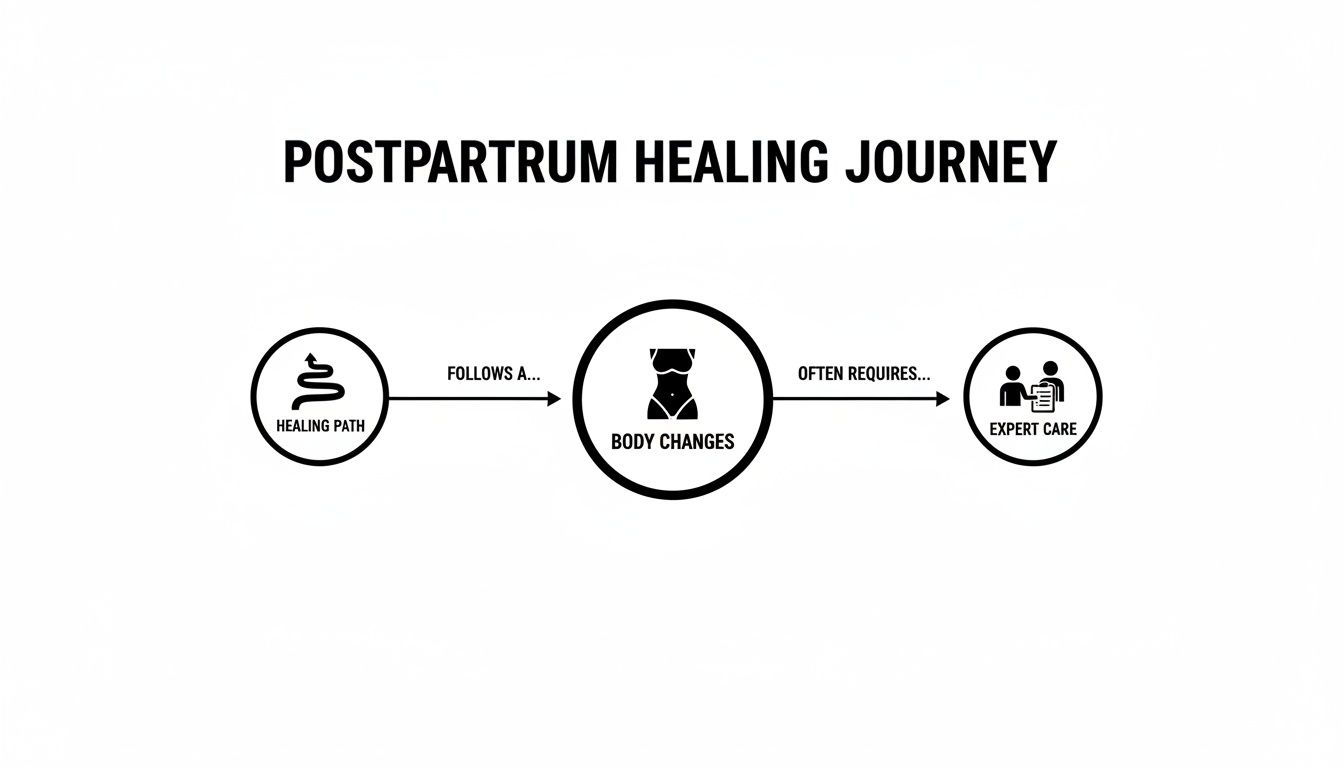
As you can see, the journey forward involves acknowledging these changes and seeking expert guidance to restore your body’s function and strength.
Common Postpartum Pelvic Floor Problems
After birth, the pelvic floor muscles need time and the right kind of care to get their tone and coordination back. When they aren’t firing on all cylinders, you might start to notice some new and frustrating symptoms.
These are just signals that your core system needs support. They are also the very issues we help women overcome every single day. We know how to fix this stuff.
Some of the most common problems include:
- Urinary Incontinence: This is that frustrating leak—small or large—that happens when you cough, sneeze, laugh, or try to exercise. It occurs because the muscles that act as a "gate" for your bladder are weak and can no longer stay shut under pressure.
- Pelvic Organ Prolapse (POP): This often feels like a heaviness, pressure, or even a bulge in your vagina, especially at the end of a long day. It happens when the weakened "hammock" can't support the pelvic organs anymore, letting them shift downward.
- Diastasis Recti (Abdominal Separation): This is the thinning and widening of the connective tissue between your "six-pack" muscles. You might see a bulge or "doming" down the middle of your belly when you try to sit up. This separation directly impacts your core strength and stability.
It’s crucial to remember that while these issues are incredibly common, you do not have to live with them. They are treatable conditions.
The goal of pelvic floor therapy postpartum isn't just about doing endless Kegels. It’s about re-establishing the entire core system—your diaphragm, deep abdominals, and pelvic floor—so they work together seamlessly, just like they’re designed to.
How Pregnancy and Birth Contribute
Let's look at the mechanics of how this all happens. During pregnancy, the constant weight of your growing baby puts sustained pressure on your pelvic floor muscles. At the same time, hormones like relaxin soften your ligaments and tissues to prepare for birth, which further reduces structural support.
Then comes the delivery itself, which is a major event for your body, whether it's a vaginal birth or a C-section.
- Vaginal Delivery: The muscles of the pelvic floor have to stretch tremendously to allow the baby to pass through. This can lead to overstretching, muscle tears, or even nerve damage that affects how well the muscles can contract and relax.
- C-Section Delivery: Even though a C-section avoids the stretching of the vaginal muscles, the pelvic floor has already been strained by 9 months of pregnancy. Plus, a C-section is major abdominal surgery that disrupts the deep core system and its connection to the pelvic floor.
Understanding these factors is the first step toward true healing. Your body didn't fail you. It just performed an incredible athletic feat and now needs a specialized recovery plan to get back to full strength.
The Proven Benefits of Postpartum Pelvic Therapy
After everything your body has been through, you’re probably wondering if physical therapy can really fix things like leaking or that feeling of pelvic pressure. From our experience in our Boston clinics, and from what the research shows, the answer is a confident "yes."
Guided pelvic floor therapy postpartum is about so much more than just managing symptoms. It’s about restoring function, getting rid of pain, and helping you feel like yourself again. This is about retraining an entire system of muscles to work together correctly so you can live your life without second-guessing every laugh or jump.
The Evidence Supporting Postpartum PT
It's one thing for us to tell you how well this works, but the research backs it up. Professional guidance simply leads to a better, faster recovery.
One major study highlighted this perfectly. It found that new moms who went through pelvic floor physical therapy had significant improvements compared to those who only received standard postpartum care. The therapy group saw a major decrease in pelvic floor issues, while the other group saw no real change over 12 weeks.
The numbers really speak for themselves:
- 72.2% of women in the physical therapy group felt better after just 12 weeks.
- In contrast, only 50% of women in the standard care group felt the same.
This kind of data confirms what we see every single day in our practice: targeted therapy gets to the root cause of the problem instead of just hoping it goes away on its own.
Waiting for pelvic floor issues to resolve on their own is like trying to fix a strained muscle without any guidance. A physical therapist gives you the exact blueprint to rebuild strength and coordination efficiently and safely, leading to better, more reliable outcomes.
More Than Just Physical Recovery
The impact of pelvic floor therapy postpartum goes way beyond muscle strength. It’s about reclaiming your quality of life.
When you’re not worried about leaking or dealing with discomfort, you can be more present with your baby, your partner, and all the activities you love. Our approach to pelvic health therapy is built on proven, evidence-based methods—not a one-size-fits-all plan. We create a program based on your unique body, your birth experience, and your personal goals.
You can expect benefits that truly change your day-to-day life:
- Restored Bladder and Bowel Control: This means no more leaking when you cough, sneeze, or have to run for the bus in Kenmore Square.
- Reduced Pelvic Pain: We work to address discomfort during intercourse or that general pelvic ache so you can feel comfortable in your own body again.
- Improved Core Strength: Properly healing diastasis recti and rebuilding deep core stability helps you feel stronger and reduces that nagging back pain.
- Greater Confidence: The peace of mind that comes from trusting your body again is probably the most important benefit of all.
Here at Joint Ventures, our patient care is founded on these effective treatments. We're here to make sure your recovery is guided by methods that are proven to deliver real, lasting results.
What to Expect at Your First PT Appointment
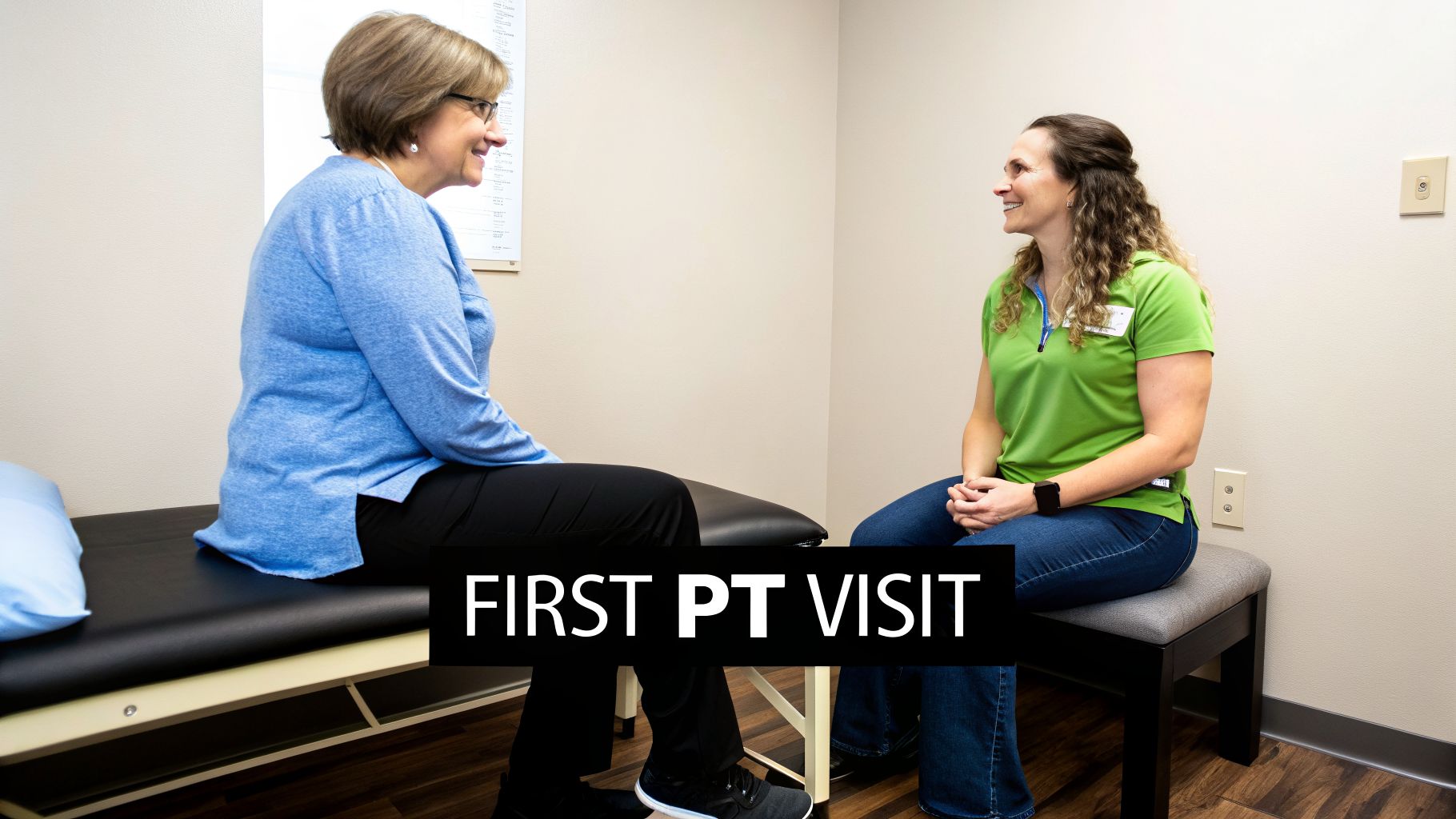
We get it. Walking into any medical appointment for the first time can feel a little nerve-wracking, especially for something as personal as pelvic floor therapy. Our goal is to make this first step feel comfortable, supportive, and truly empowering.
Your entire journey with us is built on trust, and we want you to know that you are always in control. This isn’t a rushed, impersonal visit. Your first appointment is all about creating a safe space for us to talk, listen, and understand what’s going on.
Starting with Your Story
The most important part of your first visit is the conversation. We start by simply listening. We’ll sit down together in a private room and give you the time and space to share your story—no interruptions.
There's no rigid checklist of questions to get through. We want to hear about your pregnancy, your birth experience, and what your postpartum recovery has felt like. What are your biggest concerns right now? What are your goals?
This conversation is the foundation. It helps us understand your physical symptoms, of course, but also your life and what you want to get back to doing—whether that’s running without leaking or just lifting your baby without pain.
A Whole-Body Approach to Assessment
After we talk, we'll move on to the physical assessment. Many people assume postpartum pelvic floor therapy is only about, well, the pelvis. But that’s just one piece of a much bigger puzzle. We take a whole-body approach because everything is connected.
Your therapist will look at a few key things:
- Your Posture and Alignment: We'll observe how you stand and sit to see how your body is adapting to the new demands of motherhood.
- Your Breathing Patterns: We’ll check how you’re using your diaphragm. Proper breathing is the true foundation of core and pelvic floor function.
- Your Core Strength: This includes assessing for diastasis recti and seeing how well your deep abdominal muscles are firing.
- Your Hips and Back: We'll look at the range of motion and strength in your hips and spine, since any issues there directly impact your pelvis.
This big-picture view helps us connect the dots and find the root cause of your symptoms. For more tips, check out our guide on how to prepare for your first physical therapy appointment.
The whole point of the evaluation is to connect your story, your symptoms, and how your body is moving. It’s a collaborative process where we figure out the 'why' behind what you're feeling, together.
The Internal Assessment Explained
A thorough pelvic floor evaluation may include a gentle internal assessment. We know this can sound intimidating, but it is truly the gold standard for understanding exactly how your pelvic floor muscles are working. It is always your choice, and you are in control the entire time.
First, this is not like a gynecological exam—there are no stirrups or speculums. Your therapist uses one gloved finger to gently assess the muscles for:
- Strength: Can your muscles contract effectively?
- Endurance: Are they able to hold that contraction?
- Coordination: Can they contract and—just as importantly—can they relax fully?
- Tenderness: Are there any specific points of tension or pain?
This assessment gives us precise information that we simply can’t get from the outside. It’s what allows us to create a treatment plan that is 100% specific to your body’s needs. We explain every single step before we begin and will never proceed without your full consent. Your comfort is our absolute priority.
Your Personalized Postpartum Recovery Plan
Once we've completed your initial evaluation, we have a clear picture of your starting point. Now, we build your road map to recovery. This is where your active healing truly begins.
At our Boston clinics, we partner with you to create a plan that’s built for your body, your birth experience, and your goals. This isn't a one-size-fits-all handout; it's a focused strategy to get you feeling strong, confident, and like yourself again.

Beyond Kegels: A Modern Approach to Healing
When most people hear pelvic floor therapy postpartum, they immediately think of Kegels. While learning to properly contract your pelvic floor is part of the story, it’s only one small piece of a much larger puzzle.
A truly effective recovery plan is far more comprehensive. Our approach at Joint Ventures focuses on restoring the crucial teamwork between your diaphragm (your main breathing muscle), your deep abdominals, and your pelvic floor. They're designed to work together as a system.
To get that system back online, we use a combination of modern, evidence-based techniques. Here’s a look at what we might include in your plan.
Elements of Your Personalized Therapy Plan
| Treatment Method | What It Is | How It Helps Your Recovery |
|---|---|---|
| Targeted Exercise | Specific movements to strengthen and coordinate the pelvic floor, deep core, hips, and back. | This goes way beyond basic Kegels to rebuild your entire support system, improving stability and overall function. |
| Manual Therapy | Hands-on techniques to release muscle tension, mobilize scar tissue (C-section or perineal), and improve tissue mobility. | This helps reduce pain, release tightness that could be causing dysfunction, and restore proper muscle function. |
| Biofeedback | Technology that uses small sensors to help you "see" your pelvic floor muscles working on a screen in real time. | It's an incredible learning tool that builds a stronger mind-muscle connection and confirms you're doing exercises correctly. |
| Breathing Mechanics | Retraining your breathing to properly engage your diaphragm, which works in sync with your pelvic floor. | Correct breathing is the foundation of core stability. It helps manage internal pressure and supports your pelvic organs. |
It's clear that awareness around this kind of specialized care is growing. In fact, online searches for "pelvic floor therapy" have jumped by 56% in recent years. This highlights a critical need, as demand for qualified therapists is rising faster than the supply.
In countries like France, this therapy is already standard practice. The government there prescribes 10 PT visits for every woman after childbirth—a model that truly prioritizes postpartum health. You can learn more about the growing need for pelvic therapy and its global importance.
Making It Work for You: A Practical Home Program
We know life with a new baby is hectic. That’s why your recovery plan has to be practical and fit into your real life—not the other way around. We won’t give you a long, complicated list of exercises that takes an hour you don't have.
Instead, we focus on efficiency. Your home program will likely be just a few high-impact exercises designed to be done in short bursts, often just 10-15 minutes a day.
We also teach you how to integrate these new movement patterns into your daily routine, like:
- How to breathe correctly when you lift your baby out of the crib.
- How to engage your core when you’re pushing the stroller up a hill in Beacon Hill.
- How to maintain good posture while you’re feeding or carrying your little one.
Your recovery plan is a partnership. We provide the expertise and the tools, but your progress happens with the small, consistent efforts you make each day. We're here to cheer you on and adjust the plan every step of the way.
This approach ensures we’re not just chasing a symptom; we’re treating your whole body. Our goal is to get you back to running along the Charles, lifting your child without a second thought, and living your life with strength and confidence.
Your Questions About Postpartum Pelvic PT Answered
Starting something new when you’re navigating life with a new baby can feel overwhelming. We hear the same questions from new moms across our Boston clinics who are curious about postpartum pelvic floor therapy but aren't sure where to begin.
Let's clear up some of the most common questions we answer every day.
When Is the Best Time to Start Pelvic floor Therapy Postpartum?
This is the first question on most people’s minds. The straightforward answer is you can begin as soon as you get clearance from your doctor or midwife, which is often around your 6-week postpartum checkup. This timeline gives your body an initial window to heal from delivery.
But here’s the most important part: it is truly never too late.
We work with women who are months, and even years, postpartum and help them find lasting relief. The physical demands of pregnancy and childbirth don't just vanish. If you're still experiencing symptoms, no matter how long it's been, therapy can make a significant difference. The "best" time is simply when you're ready to invest in your own recovery.
Does Insurance Cover Pelvic Floor Therapy?
Yes, in most cases, it does. Pelvic floor physical therapy is a recognized medical specialty, just like PT for a knee or shoulder injury. It is the standard of care for diagnosed conditions like urinary incontinence, pelvic pain, or diastasis recti.
Our administrative team at Joint Ventures will verify your insurance benefits for you before your first appointment. This ensures you have a clear picture of your coverage right from the start, with no surprises. We handle the logistics so you can focus completely on your healing.
Think of it this way: your health insurance covers care to help your body recover and function properly. Your pelvic floor is a critical part of your body's function, and therapy to restore it is essential healthcare, not an optional luxury.
Do I Need Pelvic PT if I Had a C-Section?
Yes, absolutely. It's a common misconception that pelvic floor therapy is only for those who've had a vaginal birth, but a C-section is a very important reason to see a pelvic floor PT.
Remember, your pelvic floor still supported the weight of a growing baby for nine months, which can lead to weakness and dysfunction on its own. On top of that, a C-section is major abdominal surgery. The incision cuts through layers of tissue and muscle that are foundational to your core stability.
A PT who specializes in pelvic floor therapy postpartum is uniquely qualified to help you with:
- Scar Mobilization: We use gentle, hands-on techniques to ensure your C-section scar heals properly, preventing it from becoming tight, painful, or adhered to deeper tissues. This improves mobility and can even reduce the "shelf" appearance some women notice.
- Restoring Deep Core Function: We'll guide you in reconnecting with your deep abdominal muscles in a way that respects your healing incision instead of stressing it.
- Managing Pressure: We teach you how to breathe and move to protect both your healing abdomen and your pelvic floor during daily activities.
It’s easy for new moms to feel like they don't have a voice when it comes to their health concerns. Learning how to advocate for yourself with your healthcare provider is a powerful skill that ensures you get the care you deserve.
Will the Exercises Be Difficult or Time-Consuming?
We understand that your time and energy are more limited than ever. Our goal is to create a recovery plan that is both highly effective and realistic for your life right now. We prioritize quality of movement over quantity.
You won't leave your appointment with a list of 20 complex exercises that take an hour to complete. A typical home program will involve just a few targeted movements that take about 10-15 minutes a day.
Even more importantly, we focus on integration. We teach you how to use your body better during the tasks you’re already doing. This means learning to engage your core correctly when lifting the car seat, breathing to support your pelvic floor when pushing the stroller, and finding better posture while feeding your baby. This approach makes your recovery a sustainable part of your daily life, not just another item on your to-do list.
At Joint Ventures Physical Therapy, we're committed to providing you with the personalized, one-on-one care you deserve on your postpartum journey. If you’re ready to feel strong, confident, and supported, we’re here to help. Schedule an appointment at one of our convenient Boston-area locations by visiting us at https://jointventurespt.com.