
Somewhere between the Charles River loop and a long day at your desk, your body starts sending small signals. Your shoulder feels tight when you reach overhead at the gym. Your stride feels uneven halfway through a training run. Your jaw gets sore by the end of the workday. Nothing is dramatic, but something isn’t quite right.
That’s a common reason people search for physical therapy Kenmore Square Boston. Not because they’re seriously injured, but because they want to keep moving well, stay active, and avoid losing momentum. In a neighborhood shaped by Boston University students, Fenway-area professionals, runners, and active older adults, that mindset makes sense. The community here typically doesn’t want to wait until a minor issue becomes the reason they stop doing what they enjoy.
Beyond Injury Proactive Care in Kenmore Square
A lot of people still assume physical therapy starts after pain, surgery, or a doctor’s referral. In practice, many movement problems show up earlier. A runner notices one side loading harder than the other. A student-athlete feels slower cutting and changing direction. A desk-based professional near Kenmore starts waking up stiff and can’t shake it with stretching alone.
Those are valid reasons to get evaluated.

When you’re not injured but not moving your best
The old model treats PT like a repair shop. You wait for pain, then you come in for help. That works when you’re post-op or clearly hurt, but it misses a big group of active Bostonians who are dealing with lower-level issues that affect performance and consistency.
That includes people who:
- Feel off during training: Your mileage is fine, but your body doesn’t feel smooth or efficient.
- Keep getting the same flare-up: Neck tension, hip tightness, jaw pain, or dizziness keeps returning.
- Want better movement quality: You’re healthy enough to exercise, but not moving as well as you should.
- Can’t afford downtime: You have races, classes, work demands, or family responsibilities that don’t leave room for avoidable setbacks.
Wellness-focused PT fits that middle ground. It’s for maintenance, performance, and course correction before your body forces the issue.
Practical rule: You don’t need to be in major pain to benefit from a movement assessment. You just need a reason your body isn’t matching your goals.
Why Kenmore Square is the right setting for this approach
Kenmore isn’t a neighborhood where people sit still for long. It’s transit-heavy, schedule-packed, and full of people trying to fit training, work, and recovery into the same week. That’s exactly why proactive care matters here.
The Kenmore Square clinic at 648-660 Beacon Street, Boston, MA 02215 sits directly at the Kenmore Green Line stop and is described as one of the most transit-accessible physical therapy clinics in the city, with hours that support busy schedules for athletes, students, and professionals according to Beaming Health’s Kenmore Square clinic listing.
That convenience matters more than people think. A proactive plan only works if you can show up, fit it into your week, and make it part of how you take care of yourself long term.
What Exactly Is Wellness Physical Therapy
Think of wellness physical therapy the same way you think about dental cleanings or routine car maintenance. You don’t wait for a cavity to become unbearable. You don’t wait for your engine to fail in the middle of Storrow Drive. You handle smaller problems early because prevention is easier than repair.
Your movement system works the same way.
Scheduled care for how you move
Wellness PT is structured care for people who want to stay ahead of pain, stiffness, and performance drop-off. The point isn’t to treat a major injury episode. The point is to identify the smaller issues that often come first, such as mobility restrictions, strength asymmetries, balance changes, tissue overload, recovery bottlenecks, and movement habits that keep asking the same body part to do too much.
A wellness visit often makes sense if you’re:
- Training for an event: Marathon prep, a return to rec sports, or a new lifting cycle
- Coming off a demanding season of life: Travel, long work hours, postpartum demands, or a stretch of inconsistent exercise
- Managing a recurring issue: TMJ tension, dizziness, pelvic symptoms, or low-grade joint irritation
- Trying to age actively: You want to keep hiking, lifting, golfing, walking fast, or traveling without your body feeling unreliable
If you want a local overview of how these visits are structured, the wellness visit program page gives a practical look at the service.
What wellness PT addresses before it turns into a bigger problem
Reactive care asks, “How do we get you out of pain?” Wellness care asks, “What keeps pulling you toward pain, and how do we change that now?”
That difference matters.
A runner may not have an injury diagnosis, but they may have a clear drop in hip control late in a run. A golfer may not have acute shoulder pain, but they may be forcing motion from the wrong segment. A parent carrying a child and working at a laptop may not be “injured,” yet they may be accumulating enough strain to create the same neck issue every few weeks.
Small movement problems rarely stay small if your schedule, training volume, and daily habits keep reinforcing them.
What tends to work and what usually doesn’t
The people who do best with wellness PT usually treat it like skilled guidance, not passive rescue.
What works:
- Consistency: Periodic check-ins beat waiting until symptoms spike.
- Specific exercise: A few targeted drills done well outperform random stretching from social media.
- Load management: Training hard is fine. Training hard without adapting your plan usually isn’t.
- Clear goals: “I want to run pain-free” is good. “I want to tolerate hill work and long runs better” is better.
What doesn’t work:
- Chasing soreness only: If you only respond to pain, you miss the setup behind it.
- Doing everything: More exercises don’t equal better results.
- Ignoring your routine: Desk setup, sleep, training schedule, and recovery habits still matter.
- Assuming fitness cancels dysfunction: Strong people can still move poorly.
Wellness PT vs Rehabilitation PT at Joint Ventures
Wellness care and rehabilitation care overlap, but they’re not the same service with different marketing. They solve different problems. One is proactive. The other is restorative.
If you’re trying to decide where you fit, the clearest starting point is your reason for coming in.
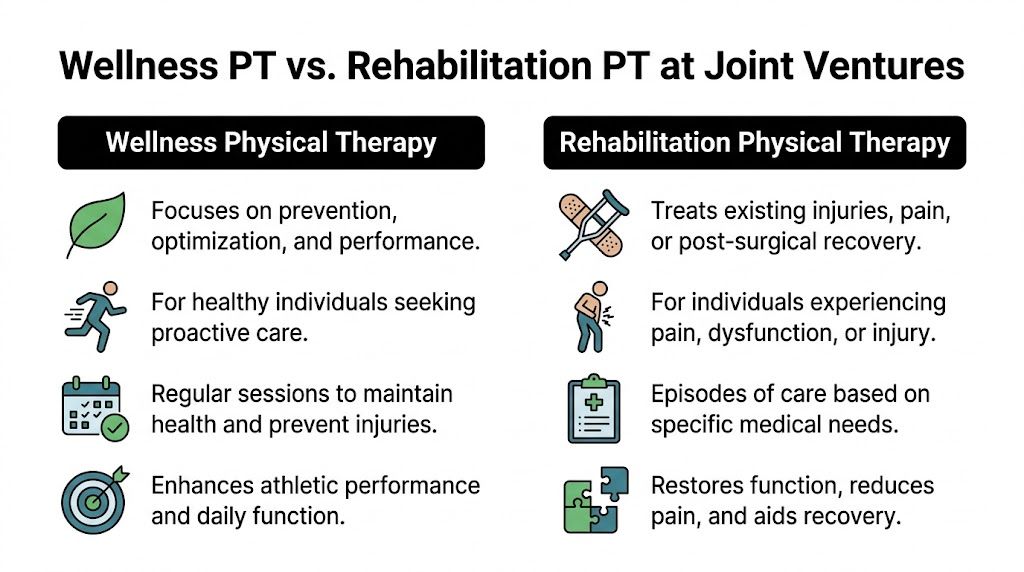
The practical difference
| Category | Wellness physical therapy | Rehabilitation physical therapy |
|---|---|---|
| Primary goal | Improve movement quality, maintain performance, reduce risk of future setbacks | Restore function after injury, pain episode, or surgery |
| Typical reason for visit | You feel limited, uneven, stiff, or plateaued | You’re in pain, recently injured, or recovering from a procedure |
| Patient mindset | “I want to stay ahead of this.” | “I need to get back to baseline.” |
| Session emphasis | Screening, performance support, mobility, control, education | Tissue healing, pain reduction, strength rebuilding, return to activity |
| Care timing | Ongoing or periodic | Usually tied to a defined episode of care |
That distinction helps set expectations. If you rolled your ankle last week and can’t load it well, rehab is the right lane. If your ankle has felt unstable for months and you want to stop it from becoming the next injury, wellness care may be the better fit.
Where they overlap
A lot of people move between the two. Someone may start in rehab after surgery, recover well, then shift into a maintenance plan to support running form, gym programming, or sport-specific demands. Another person may come in for a wellness visit, uncover a more active issue, and transition into rehab because the body needs a more focused treatment phase first.
That’s normal. Bodies don’t follow neat categories.
Good PT matches the plan to the problem. It doesn’t force every patient into the same template.
The care model matters
At the Kenmore Square location, care is delivered in a true 1-on-1 physical therapy model with uninterrupted 45 to 60 minute sessions with a licensed Physical Therapist, according to the Kenmore Square location page. That matters in both rehab and wellness care, because the work often depends on watching movement closely, making real-time biomechanical adjustments, and building a plan around the person in front of you rather than rotating them through a generic circuit.
For active people, that difference is easy to feel. Group-style care can leave important details unaddressed. One-on-one care gives the clinician time to catch what your body does when it squats, lands, rotates, breathes, or fatigues.
Key Wellness Services at Our Kenmore Square Clinic
Wellness PT only makes sense if it connects to real services people can use. In Kenmore Square, that means care that matches the neighborhood. Runners need gait and load guidance. Golfers need movement screens that connect to swing demands. Desk workers need more than a handout. Patients with TMJ, vestibular issues, or pelvic floor concerns often need steady maintenance, not just one treatment episode.

Running and performance support
Kenmore Square is a natural home base for Boston runners. If you train along the Charles, use local gyms, or build your year around race cycles, wellness PT can help you keep small faults from becoming missed weeks.
A proactive running visit often focuses on:
- Form review: Looking at how you load, rotate, and control impact
- Mobility bottlenecks: Commonly hips, ankles, thoracic spine, and big toe mechanics
- Strength gaps: Especially where one side is doing more work than the other
- Training decisions: Adjusting workload, surfaces, recovery, and progression
A performance-minded screen helps. You may not need “rehab” in the traditional sense. You may need a smarter way to tolerate volume and intensity.
Titleist evaluations and rotational athletes
Golf is another area where wellness care makes sense. Rotational sports ask a lot from the spine, hips, shoulders, and rib cage. If one area stops moving well, another area often starts taking on more stress than it should.
For golfers, a proactive visit can identify whether your limitations are coming from mobility, control, balance, or sequencing. That matters if your goal is to play more consistently without letting a swing-related irritation become a season-long problem.
Tune-ups for desk workers and active professionals
Plenty of people in Kenmore aren’t competitive athletes. They’re active professionals trying to balance commuting, laptop hours, strength training, and maybe a pickup game or weekend long run. Their issue usually isn’t lack of motivation. It’s accumulated stiffness, low-grade overuse, and inconsistent recovery.
These tune-up visits are useful for people who notice:
- Neck and shoulder tension that returns after heavy computer days
- Hip or back stiffness that changes how they lift or run
- Hand, wrist, or upper-extremity irritation from repetitive work and device use
- A drop in movement confidence even though they’re still staying active
If you like tracking movement habits between visits, some patients also use outside resources such as physical therapy tools from FeedbackRobot to organize exercises and self-monitoring. That doesn’t replace an evaluation, but it can help people stay more consistent with what they’ve been given.
Ongoing support for pelvic health, TMJ, and balance concerns
Some problems don’t need emergency care, but they do benefit from expert follow-up. That’s often true with pelvic floor symptoms, jaw tension, dizziness, and balance-related concerns. People may improve, then drift, then improve again. A wellness model gives them a way to check in before things slide too far.
That’s especially useful when symptoms are influenced by stress, work posture, training shifts, travel, sleep disruption, or changes in routine.
Maintenance care isn’t doing less. It’s doing the right amount at the right time so you don’t keep starting over.
The Kenmore Square location is directly at the Kenmore Green Line stop and serves all age groups with extended hours that support athletes, students, and professionals, as noted in Beaming Health’s clinic profile. For people trying to fit health into a packed Boston schedule, easy access is part of what makes proactive care realistic.
What to Expect During Your Wellness Session
A good wellness session doesn’t feel like a rushed screening. It should feel like focused clinical time built around your goals, your training history, and the way your body is behaving right now.

The first conversation is about your life, not just symptoms
The visit usually starts with context. What are you trying to do that feels harder than it should? What have you stopped doing, modified, or tolerated for too long? For an active Boston patient, that could mean marathon prep, lifting, returning to tennis, staying comfortable at work, or getting through the day without jaw tension or dizziness interfering.
That conversation matters because wellness PT is goal-driven. A shoulder issue means something different in a swimmer, a parent lifting kids, and a desk worker who also plays tennis on weekends.
For a practical walkthrough before your first visit, this guide on how to prepare for your first physical therapy appointment can help you arrive ready.
Then we look at how you actually move
Generic advice typically proves insufficient. People often come in after trying stretches, random online mobility drills, or workouts that didn’t match the problem. What they needed was a trained set of eyes on their movement.
In a wellness session, that may include observing:
- How you squat, hinge, rotate, balance, or reach
- What changes under load or fatigue
- Where mobility stops and compensation begins
- How your breathing, posture, and control affect the task
The point isn’t to create a long list of flaws. The point is to find the few factors that explain the pattern.
The best sessions simplify things. If your plan feels overly complicated, it probably won’t stick.
Care is one-on-one for the full visit
At the Kenmore Square clinic, the model is true 1-on-1 physical therapy, with uninterrupted 45 to 60 minute sessions delivered by a licensed Physical Therapist, and that format supports real-time biomechanical adjustments and specialized treatments such as Trigger Point Dry Needling, according to the Kenmore Square location information.
That setup changes the quality of the session. You’re not bouncing between providers. You’re not spending half the visit doing unsupervised exercises in a crowded space. Every part of the hour can be used to assess, treat, coach, and refine.
Here’s a short look at that hands-on model in action.
You leave with a plan you can actually use
A useful wellness session ends with clear next steps. That may include a small set of exercises, recovery guidelines, movement cues for training, ergonomic changes, or a recommendation for follow-up timing based on your goals. If hands-on work makes sense, that can be part of the visit too.
What usually works best is a plan that feels realistic in Boston life. You need something that fits around commute time, work hours, classes, family demands, and training. If the plan ignores that reality, compliance drops fast.
This is also the section where one local option belongs in the conversation. Joint Ventures Physical Therapy offers one-on-one physical and occupational therapy in Greater Boston, including services such as running performance, pelvic health, vestibular care, TMJ treatment, dry needling, aquatic therapy, concussion baseline screening, orthotic fitting, and wellness visits.
Booking Your Wellness Appointment in Kenmore Square
Choosing a PT provider for wellness care is different from choosing one after a major injury. You’re not just asking, “Can they treat pain?” You’re asking whether the clinic can help you stay active, move better, and catch problems early without wasting your time.
That narrows the field fast.
What to look for before you book
A strong wellness PT fit usually comes down to four criteria:
- One-on-one care: You want direct attention from a licensed clinician, not a handoff-heavy experience.
- Relevant specialties: Runners, golfers, desk workers, vestibular patients, pelvic health patients, and TMJ patients don’t all need the same lens.
- Location that fits your routine: If it’s hard to get to, consistency becomes the first thing to fail.
- A proactive mindset: The visit should focus on prevention, performance, and long-term movement quality, not only symptom response.
Administrative support matters too. If you’re trying to understand coverage or how practices handle payer enrollment more broadly, resources like this overview of insurance credentialing for therapists can give useful background on the systems behind access to care.
Why Kenmore Square works for busy Boston schedules
For people living, studying, or working near Fenway, BU, Back Bay, or the Charles, the Kenmore location is practical because it’s easy to reach and easier to fit into a normal week. Early and late availability matter when you’re trying to protect your training or your workday instead of rearranging your whole life around an appointment.
If you’re ready to schedule, use the Kenmore Square location page for booking details. The clinic is located at 660 Beacon Street, Boston, MA 02215, and appointments can also be scheduled by phone at 617-536-1161.
If you’ve been waiting for pain to become “serious enough,” that’s usually your sign to come in sooner, not later.
For a deeper clinical dive into specific conditions, visit our educational portal at Highbar Health.
If you’re looking for practical, local guidance on physical therapy Kenmore Square Boston, book a wellness or rehab appointment with Joint Ventures Physical Therapy. It’s a smart next step if you want to stay active, clean up the movement issues that keep returning, and build a plan that fits real Boston life.