When an injury stops you from doing what you love, it’s easy to think terms like sports medicine and rehab are reserved for the pros. But that’s not how we see it. The truth is, this specialized field of physical therapy is for anyone who wants to move, compete, and live without pain—and come back stronger than before.
What Is Sports Medicine and Rehab Anyway?
So, what does that actually mean for you? Let's cut through the clinical jargon. Sports medicine and rehab isn't just a list of exercises we hand you. It’s a partnership. You bring us your goals, your frustrations, and your story. We bring the deep expertise to figure out the root cause of what’s holding you back.
Think of your body like a high-performance car. When a tricky engine light comes on, you don’t go to a general mechanic. You find a specialist who understands that specific engine inside and out. A sports physical therapist is that specialist for your body.
More Than Just Fixing the Pain
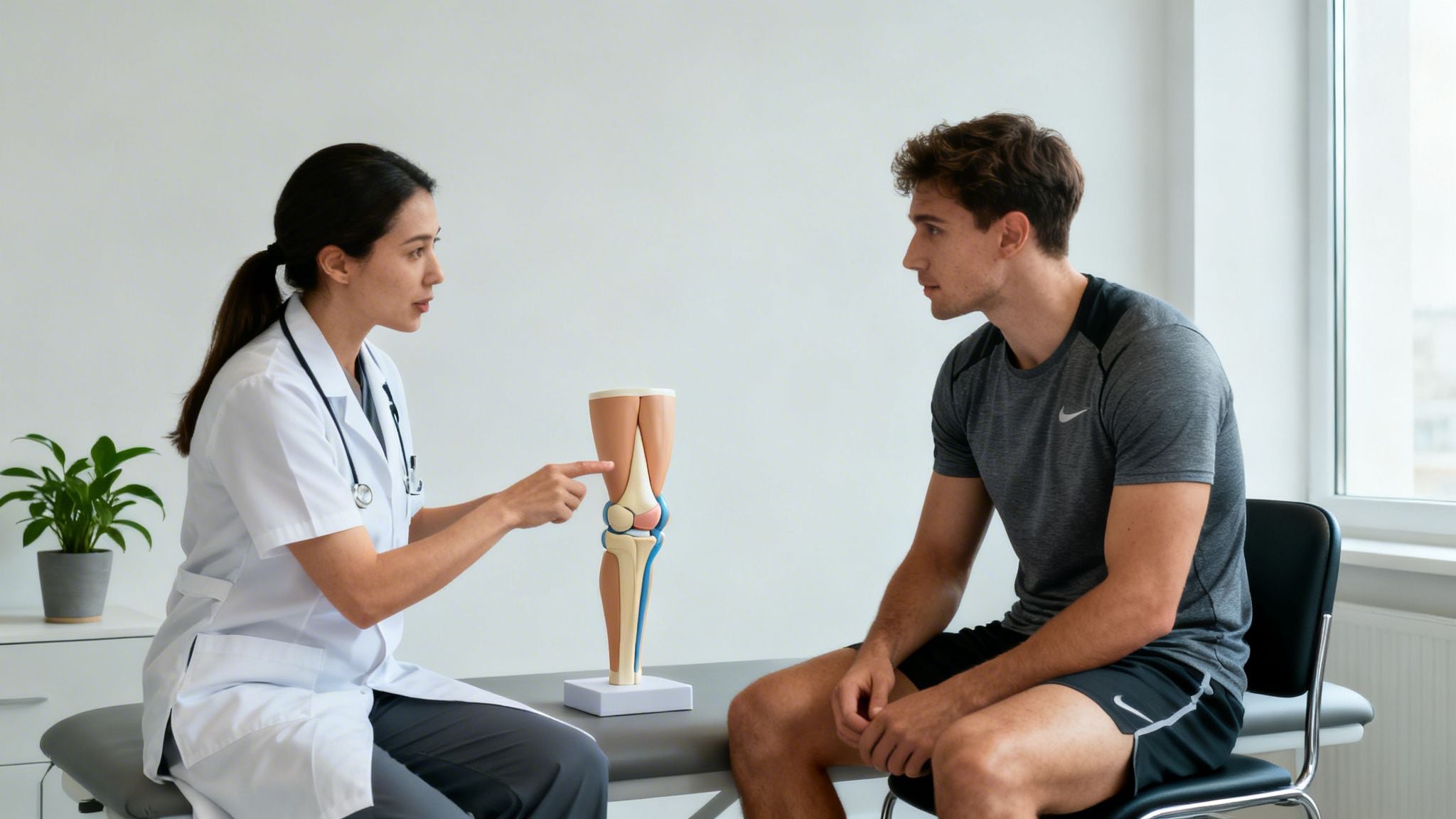
Our focus goes way beyond chasing the immediate pain. We’re obsessed with understanding the “why” behind your injury. By looking at your movement patterns, training habits, and unique goals, we build a recovery plan that’s actually made for you, not just your diagnosis.
This approach is built on a few core principles:
- Understanding Your Demands: We get what it takes to train for the Boston Marathon, play a round of golf, or just crush your weekly fitness classes. We know the specific stresses those activities place on your joints and muscles.
- Finding the True Source: That nagging knee pain might actually start with a weak hip or an unstable ankle. We act like detectives, looking at the entire kinetic chain to find the real culprit.
- Empowering You for the Long Run: Our goal isn't just to get you better—it's to teach you how to stay better. You’ll leave treatment with a clear understanding of your body and the tools to keep the same injury from happening again.
This proactive, specialized care is critical for athletes of all ages. Consider that every year in the U.S., more than 3.5 million children under 14 are injured playing sports. Of those, over 775,000 are serious enough to require an ER visit, which you can read more about in these sports medicine trends on towardshealthcare.com. This is exactly why expert guidance is so important for a safe recovery.
At its heart, sports medicine and rehab is about one thing: getting you back to what you love, moving with confidence, and feeling stronger than when you started. It's a collaborative process to help you reclaim your active life.
Common Injuries We Help People Overcome
If you’re an active person, you’ve probably felt it. That sharp, nagging pain on the outside of your knee during a run. The dull ache in your shoulder after a swim. The instability of a rolled ankle on the court.
You’re not alone. Every day, we see people walk through our doors dealing with the exact same frustrations.

Our job in sports medicine and rehab isn’t just to put a name to your injury. It's to understand the real problem—that hesitation before you cut on the field, that ache that ruins your post-workout high, or that frustrating stiffness that just won't go away. We get it, because we’ve helped countless athletes and active adults navigate these exact challenges.
Overuse Injuries That Creep Up on You
Many injuries we treat aren’t from one dramatic moment. They’re the slow burn—the result of repetitive stress that builds up over weeks or months.
Think of it like a car tire that’s slightly out of alignment. You won't notice it on a short drive, but over hundreds of miles, one side starts to wear down. The same thing happens in your body. Small imbalances in how you move can lead to big problems down the road.
Here are a few common overuse injuries we treat every day:
- Runner's Knee (Patellofemoral Pain Syndrome): This is that dull, aching pain behind your kneecap that flares up when you run, squat, or tackle a flight of stairs. It's often tied to muscle imbalances around the hips and quads.
- Rotator Cuff Tendinopathy: Swimmers, tennis players, and anyone doing overhead lifting knows this one well—a deep ache in the shoulder that makes it painful to lift your arm. It comes from repetitive strain on the tendons that stabilize the joint.
- Shin Splints: That throbbing pain along your shin bone is the classic sign of doing too much, too soon. It’s incredibly common when you suddenly ramp up your training without letting your body adapt.
- Lower Back Pain: For many active people, a persistent ache in the lower back is a constant, unwelcome companion. It often stems from a weak core, tight hamstrings, or poor lifting form. In many cases, self-care can make a big difference, like solving common back problems with foam rollers.
Acute Injuries From a Single Moment
Of course, we also see our share of acute injuries—the ones that happen in a split second. A bad landing, a sudden pivot, or an unexpected collision can bring your training to a dead stop.
These injuries are often scary and painful. Getting the right diagnosis right away is critical.
The most important step after an acute injury isn't to "walk it off." It's to get a clear diagnosis from a professional who can identify the extent of the damage and build a safe plan for recovery.
Some of the most frequent acute injuries include:
- ACL Tears: The classic sign is a "pop" in the knee during a sudden change of direction, often followed by major swelling and a feeling that the knee will "give out."
- Ankle Sprains: This happens when you roll your ankle, stretching or tearing the ligaments on the outside of the joint. It’s a staple injury for court and field athletes, with a recovery that can range from a few weeks to a few months.
- Muscle Strains: Think of a pulled hamstring while sprinting or a strained calf muscle from jumping. You’ll feel a sudden, sharp pain as the muscle fibers tear.
No matter what brought you here, our goal is the same. We listen, find the root cause of your pain, and build a plan to get you back to your life—stronger and more resilient than you were before.
What to Expect During Your First Visit
We know that walking into a new clinic can be a little intimidating. So let's talk about what actually happens during your first visit and how we make sure you feel supported and clear on the plan from day one.
The process starts before you even walk through our doors. When you call, our team takes care of all the insurance verification and scheduling details. Your only job is to focus on getting better.

Your Dedicated Hour
Your first appointment is a full, uninterrupted hour with your physical therapist. This is your time. We don't use aides or assistants for patient care, which means you get the undivided attention of an expert who is 100% focused on you and your recovery.
We start by listening. We want to hear your story. What happened? What does it feel like? Most importantly, what do you want to get back to doing? Whether your goal is running the Boston Marathon or just being able to play with your kids without pain, your goals are what drive the entire plan.
The most crucial part of your first visit is the conversation. It’s where we build a partnership and align on what a successful recovery looks like for you. You're the expert on your body; we're here to help you understand it better.
The Movement Assessment
After we talk, we'll move into a comprehensive movement assessment. This isn’t just about looking at the spot that hurts. We evaluate your body as a complete, interconnected system to find the root cause of the problem, not just chase the symptoms.
Here's what that typically involves:
- Observing Your Movement: We’ll watch how you walk, squat, bend, or perform other fundamental movements to spot any compensations or dysfunctional patterns.
- Testing Your Strength and Mobility: We will gently assess your range of motion and muscle function to pinpoint specific areas of weakness, tightness, or instability.
- Functional Testing: Depending on your injury and your goals, we may have you perform movements specific to your sport or daily life to see exactly where the breakdown is happening.
A common question is, "What should I wear?" Simple. Wear comfortable, athletic clothing you can move in, and that allows your therapist to easily see and assess the injured area. Think shorts for a knee issue or a tank top for a shoulder problem. For a few more tips, check out our guide on how to prepare for your first physical therapy appointment.
This entire evaluation is a team effort. We’ll explain what we’re seeing every step of the way and answer every question you have. A huge part of effective sports medicine and rehab is education. You will leave your first visit feeling heard, understood, and with a clear, actionable plan to get you started on your recovery.
Our Modern and Evidence-Based Treatment Toolkit
Once we understand your story and have a clear diagnosis, we get to work. This isn’t about a generic handout of exercises or a one-size-fits-all protocol. It’s about creating a plan that’s built specifically for you.
Our philosophy is simple: hands-on care to restore movement, followed by targeted exercise to make that progress stick. We combine skilled manual therapy with the right movements to rebuild your body’s strength and resilience. Here are some of the core methods we use to help you get better, faster.
Manual Therapy: The Hands-On Difference
Manual therapy is where our clinical expertise really shines. Think of it less like a massage and more like a highly skilled mechanic fine-tuning a precision instrument. We use our hands to feel for restrictions in your muscles, tissues, and joints, then apply specific techniques to get things moving correctly again.
These aren’t just random techniques; they’re targeted interventions.
- Soft Tissue Mobilization: We use this to break down scar tissue and stubborn adhesions in muscles and fascia that limit your movement and cause pain.
- Joint Mobilization: For a stiff back or a “stuck” shoulder, we use gentle, controlled movements to restore a joint’s natural glide and take the pressure off.
- Strain-Counterstrain: This is a gentle but powerful technique. We find a position of total comfort for your body to “reset” the neurological signals that keep a muscle in a constant state of spasm.
By getting our hands on the problem, we can create a window of opportunity—reducing your pain so you can actually perform the exercises needed for a full recovery.
Exercise Prescription: Movement as Medicine
After we’ve improved your mobility with hands-on work, we need to lock in those gains. That’s where exercise prescription comes in. We firmly believe that movement is medicine, but only when it’s the right movement, done the right way.
Your personalized exercise program is built to:
- Wake Up Weak Muscles: We pinpoint the specific muscles that aren’t doing their job—often the real source of the injury—and get them firing again.
- Build a Strong Foundation: We focus on core stability and strengthening the key support muscles around the injured area, making your entire system more robust.
- Retrain How You Move: Injuries often teach our bodies bad habits. We help you unlearn those compensations and move more efficiently, reducing the risk of the same problem coming back.
The goal isn’t just to make you stronger. It’s to give your body a better, more efficient strategy for handling the demands of your sport and your life.
A Snapshot of Our Treatment Approaches
Here's a quick look at some of our core therapies and how they help you recover and improve performance.
| Treatment Method | What It Is | Best For |
|---|---|---|
| Manual Therapy | Skilled, hands-on techniques to mobilize joints and soft tissues. | Restoring range of motion, reducing pain, and preparing the body for exercise. |
| Exercise Prescription | A customized program of targeted movements and strengthening. | Building stability, correcting muscle imbalances, and improving long-term resilience. |
| Dry Needling | Inserting a thin needle into a muscle trigger point to elicit a release. | Releasing deep, stubborn knots, reducing chronic muscle tightness, and providing rapid pain relief. |
| Aquatic Therapy | Performing exercises in a pool to reduce load on the joints. | Early-stage rehab, arthritis, or for anyone who struggles with weight-bearing exercise due to pain. |
These are just a few of the tools we use. Every treatment plan at Joint Ventures is unique, blending the right approaches to meet your specific goals.
Advanced Tools for Stubborn Issues
Sometimes, an injury is particularly stubborn and needs a little extra push. When that happens, we can bring in other advanced tools to speed up your healing. These are never a standalone fix, but they can be incredibly effective when part of a complete plan.
A few examples include:
- Trigger Point Dry Needling: For those deep, persistent muscle knots that won't release, dry needling can be a game-changer. A certified PT inserts a very thin needle into the trigger point, causing the tight muscle to twitch and then relax. This often provides immediate pain relief and restores normal muscle function.
- Aquatic Therapy: When land-based exercise is just too painful, the pool is the perfect place to start. The water’s buoyancy unloads your joints, allowing you to build strength and move with far less pain.
- Specialized Programs: We also have clinicians with deep expertise in specific areas, including Vestibular Therapy for dizziness and balance problems, and Pelvic Floor Rehab for pelvic health concerns. Our approach can also include practical tips for immediate care, like understanding how to wrap the knee for support and recovery.
More people than ever are committed to staying active for life, which is why the field of sports medicine is growing so quickly. The U.S. sports medicine market is projected to hit USD 3,779.8 million by 2034, driven by a boom in sports participation and an aging population that wants to stay fit. (You can see the full market research on imarcgroup.com). We’re proud to be a part of that movement, offering the expert care needed to get you back to doing what you love.
Beyond Rehab: Proactive and Performance Services
Good physical therapy isn't just about recovering from an injury—it's about becoming a more resilient and higher-performing athlete. This is where we shift from reactive care to proactive strategy, helping you not only stay healthy but also chase down new personal bests.
Think of it as an investment in your physical future. These services are built for active people who want to stay at the top of their game for the long haul. It's about being smart and strategic with your body so you can keep doing what you love for years to come.
Fine-Tuning Your Engine with Running Gait Analysis
For any runner, form is everything. A tiny, almost unnoticeable hitch in your stride can be the difference between a new PR and a nagging overuse injury. Our Running Gait Analysis is a complete deep dive into how you move, designed to make you a more efficient and durable runner.
We use slow-motion video to break down every single phase of your run—your foot strike, your cadence, your posture, everything. This isn't about forcing you into some textbook "perfect" form. It's about finding the specific opportunities within your mechanics to reduce stress on your joints and improve your running economy. We pinpoint the exact imbalances that could lead to shin splints or IT band syndrome and give you targeted drills to correct them.
A gait analysis is like a tune-up for your running form. By making small, specific adjustments, we can help you run faster, feel better, and dramatically lower your risk of injury.
Unlocking Your Potential on the Golf Course
Every golfer knows that a powerful, consistent swing is the holy grail. But physical limitations you’re probably not even aware of—like tight hips or a stiff mid-back—can completely sabotage your game and even lead to injury. That’s exactly what our Titleist Performance Institute (TPI) screen is designed to address.
This isn’t a golf lesson; it's a comprehensive body screen that assesses your mobility, stability, and strength specifically as they relate to the demands of the golf swing. Our TPI-certified therapists identify your body's physical restrictions and then build a personalized fitness plan to fix them. The goal is simple: get your body moving the way it needs to for a more powerful, repeatable swing.
Protecting Athletes with Concussion Baseline Screening
Concussions are a serious risk for anyone playing a contact sport. Our Concussion Baseline Screening is a critical proactive step for athlete safety. Before the season even starts, we run a series of tests to get a clear picture of your normal brain function, including your balance, reaction time, and cognitive processing. This becomes your personal baseline.
Then, if an athlete sustains a potential concussion during the season, we can re-test and compare the results directly to their baseline data. This gives medical professionals objective, data-driven information to make safer, more informed decisions about when it's truly appropriate to return to play. It takes all the guesswork out of a very serious injury. To learn more about preventing other common sports injuries, you can check out our article on building a robust ACL prevention program.
This focus on specialized services is a big part of why sports medicine is growing so quickly. North America, in fact, held a 37.2% revenue share of the global market back in 2022, largely because our healthcare systems are built to support this kind of advanced orthopedic rehab. Being at the center of innovation allows us to offer this higher level of care. You can find more details in these sports medicine statistics from Market.us.
Your Path from Injury Back to Your Sport
One of the first questions we always get is, "So, how long is this going to take?" It's a completely fair question. And the honest answer is: it depends. Every person, every injury, and every recovery journey is unique.
But that doesn't mean there isn't a plan. We follow a structured, evidence-based roadmap for every athlete we work with.
Think of it like building a house. You simply can't put up walls and a roof on a shaky, uneven foundation. It’s a recipe for disaster. You have to lay a solid foundation first, or the whole structure will eventually come crashing down. That's exactly how we approach your recovery.
Building Your Foundation for Recovery
The first phase of any sports medicine and rehab plan is all about that foundation. The immediate goal is to get your pain and inflammation under control. We need to calm the injured area down and manage any swelling to create a window of opportunity for real healing to begin.
During this stage, we lean heavily on gentle movement and hands-on manual therapy. Pushing too hard, too soon is one of the biggest mistakes an athlete can make. It’s like trying to build on that shaky ground—it only causes more irritation and sets your timeline back.
The initial goal is simple: create the best possible environment for your body to start the healing process. This phase is about patience and listening to your body, not pushing through the pain.
Once we’ve calmed things down and the initial pain has subsided, we can move on to the next critical step.
Restoring Mobility and Rebuilding Strength
With a stable foundation in place, we can start putting up the framework. In rehab terms, this means we systematically work to restore your full range of motion and then begin rebuilding strength, brick by brick.
We’ll work on regaining flexibility in the stiff joints and muscles surrounding your injury. At the same time, we'll introduce targeted strengthening exercises—and these are anything but random. They are prescribed specifically to fix the weaknesses that likely contributed to your injury in the first place.
As you get stronger, the exercises become more challenging and dynamic. This progressive loading ensures your body adapts safely, building a resilient structure that can handle the demands of your sport. For runners, this might also be when we take a deeper look into biomechanics, which you can learn more about in our guide on how to improve running form.
The Final Step: Return-to-Sport Testing
This is the final phase—putting the finishing touches on the house to make sure it’s move-in ready. We shift from general strength to sport-specific movements that directly mimic what you do on the field, court, or road. We're talking cutting, jumping, throwing, and sprinting.
But before we clear you for competition, there's one last, non-negotiable step: Return-to-Sport testing.
This isn't guesswork. It's a series of objective, data-driven tests that measure your strength, agility, power, and stability. We compare your injured side to your uninjured side to ensure you've met specific, research-backed benchmarks for a safe return.
This flowchart shows a few of our proactive services that, just like our return-to-sport testing, use objective data to keep you healthy and performing your best.
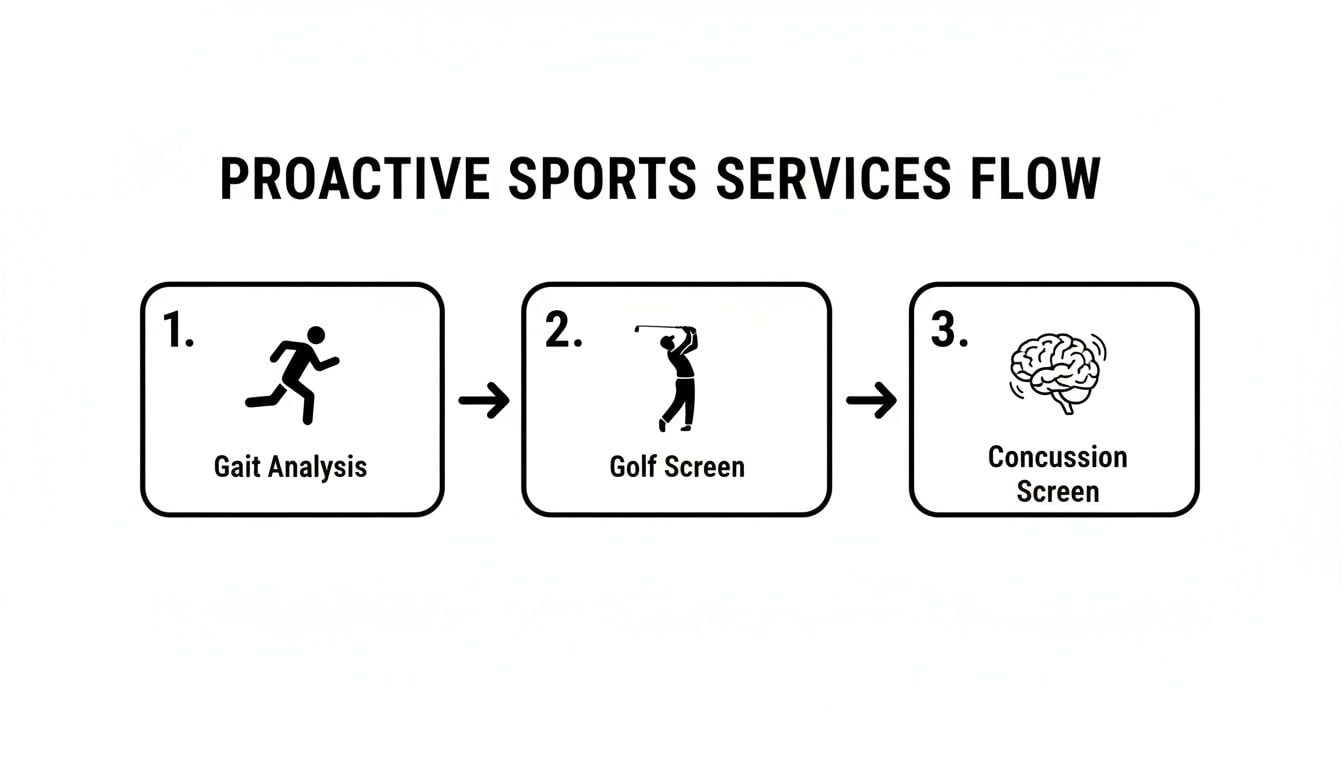
Passing these tests gives both you and your physical therapist the confidence that you’re not just healed, but truly prepared for the demands of your sport. This objective data dramatically reduces your risk of re-injury and ensures you can get back to competing at your highest level.
Common Questions About Sports Rehab
Before you book your first visit, you probably have questions. Here are the straight answers we give our patients every day when they ask about sports medicine and rehab.
Do I Need a Doctor’s Referral for Physical Therapy in Massachusetts?
No. Massachusetts is a “Direct Access” state.
That means you can book an appointment directly with one of our physical therapists without seeing a physician first. This lets you start your recovery immediately, which can make a huge difference in your outcome.
Our administrative team is fantastic and will handle the insurance details to ensure your visits are covered. You can just focus on getting better.
Being able to start PT right away is a game-changer. We can manage pain and begin the healing process sooner, which almost always leads to a faster and more complete recovery.
What Makes Your Clinic Different From Other PT Clinics?
It’s our commitment to true one-on-one care. Every single visit is a full 60 minutes spent exclusively with your licensed physical therapist.
No aides. No being passed off to another person. No splitting time with other patients.
This dedicated time is critical. It allows us to provide truly personalized treatment, listen to what’s working, and adjust your plan in real time. We believe it’s a higher standard of care, and it’s how we get you better, faster.
Is Sports Rehab Only for Serious Athletes?
Not at all. Our approach to sports medicine and rehab is for anyone who wants to move without pain—period.
We help people of all ages and abilities get back to the activities they love. That includes:
- The weekend warrior playing pickup basketball.
- The runner training for their very first 5K.
- The fitness fan trying to get back to their favorite spin class.
- The parent who just wants to play with their kids without wincing in pain.
If it moves you, it matters to us.
Ready to stop letting pain call the shots? The team at Joint Ventures Physical Therapy will create a personalized plan to get you moving with confidence again. Schedule your first one-on-one appointment and see what a difference our focused care can make. Visit us at https://jointventurespt.com.