
That sudden jolt. The screech of tires. The first thought that races through your mind after a car accident is almost always, "Am I okay?" Even if you manage to walk away feeling just a bit rattled, it's so important to understand what your body just went through. It absorbed a massive amount of force.
This is where auto accident physical therapy becomes essential. It's not just any physical therapy; it's a specific type of care focused on finding and treating the hidden damage that car crashes can cause. Our job is to stop those small, nagging aches from snowballing into serious, long-term problems.
Why You Need to Prioritize Your Health After an Accident

Right after a crash, your body goes into survival mode, flooding your system with adrenaline. This "fight or flight" response is incredible at what it does—helping you handle the trauma. One of its main side effects? It masks pain.
This is why so many people don't actually feel the true extent of their injuries until hours, days, or even a week later. You might feel fine going to bed, only to wake up unable to turn your neck, with a throbbing back, or a headache you just can't shake. This delay is completely normal, but ignoring those symptoms is a big mistake. We see it all the time.
The Problem with the "Wait and See" Approach
Thinking, "I'll just see how I feel in the morning" is one of the biggest gambles you can take with your health after an accident. Your car has bumpers and crumple zones built to absorb impact. Your body doesn’t. That force has to go somewhere, and it’s usually transferred right into your muscles, ligaments, and joints.
Think of it like this: A minor fender-bender might only leave a scratch on your car's bumper, but the whiplash effect can do a number on your neck. The damage to the car almost never reflects the damage done to the people inside it.
When these soft tissues get stretched or torn, your body's defense mechanism is inflammation. That process is exactly what causes the stiffness, pain, and muscle spasms that show up later. If you don't address it, that inflammation can lead to bigger issues down the road.
- Chronic Pain: An acute injury that isn't properly healed can easily turn into persistent pain that sticks around for months, or even years.
- Reduced Mobility: As your body tries to heal, scar tissue can form in a disorganized way. This limits your range of motion and makes simple things, like turning your head or bending over, feel stiff and difficult.
- Weakness and Instability: Trauma can cause the key muscles supporting your spine and joints to weaken or "turn off," making you much more susceptible to future injuries.
Taking a Proactive Step Towards Recovery
This is exactly why getting checked out by a physical therapist is so crucial, even if the accident seemed minor. A thorough evaluation can spot these underlying issues before they become major problems. We're trained to see the subtle signs of injury that often get missed in the first few days.
Seeking auto accident physical therapy isn't about looking for something wrong; it's about being proactive. It's the single best thing you can do to take control of your recovery right from the start. You're not just getting rid of pain—you're investing in your long-term health, ensuring that one brief accident doesn't compromise your quality of life for years to come.
What to Expect at Your First Physical Therapy Appointment
Walking into any medical office after a car accident can be overwhelming. We get it. But your first auto accident physical therapy appointment isn't a test—it's the first step in a partnership. Our only goal is to make you feel heard, understood, and confident from the moment you arrive.
You’ll spend the entire session, one-on-one, with your dedicated physical therapist. This isn't a clinic where you're handed off to an aide or left alone with a machine. Your time is your time. It’s all about getting to the root of what’s going on so we can build a plan that actually works.
The Conversation: Your Starting Point
The most critical part of your first visit is simply the conversation. We need to hear your story, and not just the clinical facts. Of course, we’ll cover the details of the accident—the speed, the direction of impact, and how you felt immediately after.
But just as important, we need to understand how this injury is impacting your life.
We'll ask questions like:
- Are you struggling to get a good night's sleep?
- Can you still lift your kids or carry in the groceries without pain?
- Does sitting at your work desk trigger your back or neck pain?
- Are you suddenly dealing with frequent headaches?
This conversation helps us connect the dots between the trauma of the crash and the real-world frustrations you're facing every day. It's also where we acknowledge that a car accident affects more than just your body. The mental and emotional toll is very real, with research showing that nearly half of all accident survivors experience symptoms of PTSD within six weeks.
The Hands-On Assessment: Uncovering the Cause
After we talk, your physical therapist will start a gentle, hands-on assessment. This isn’t about forcing you into painful movements. It’s a careful process of discovery designed to find the specific source of your symptoms.
Think of your therapist as a skilled detective for your body. We’re searching for clues—a muscle that isn’t firing correctly, a joint that feels stuck, or a specific movement that reproduces your pain. This helps us pinpoint exactly which tissues were injured in the crash.
During this physical evaluation, we'll look at your:
- Range of Motion: How well can you actually move your neck, shoulders, and back?
- Strength: Are there specific muscle weaknesses or imbalances that have developed?
- Palpation: We'll gently feel the muscles and joints to identify areas of tenderness, swelling, or protective muscle guarding.
- Functional Movement: We might ask you to do simple things, like standing up from a chair or reaching for something overhead, to see how your body is compensating.
This comprehensive evaluation is the blueprint for your recovery. By combining your story with our physical findings, we can create a personalized treatment plan that addresses your specific needs and gets you back to feeling like yourself again. For more tips on what to do before you come in, check out our guide on how to prepare for your first physical therapy appointment.
Common Injuries We Treat After an Auto Accident
Once the shock of a car accident fades, the real story begins to unfold in your body. Even a seemingly small fender-bender involves tremendous force, and it's often not until the next day—or even a few days later—that you start to feel the true effects.
Here in our clinics, we see it every day. The key is understanding that what feels like a simple ache can often be a more complex injury hiding underneath. Getting a proper diagnosis from a physical therapist is the absolute first step toward feeling like yourself again.
Our entire process is built on getting to the root cause. It’s a straightforward approach that prevents things from getting missed.
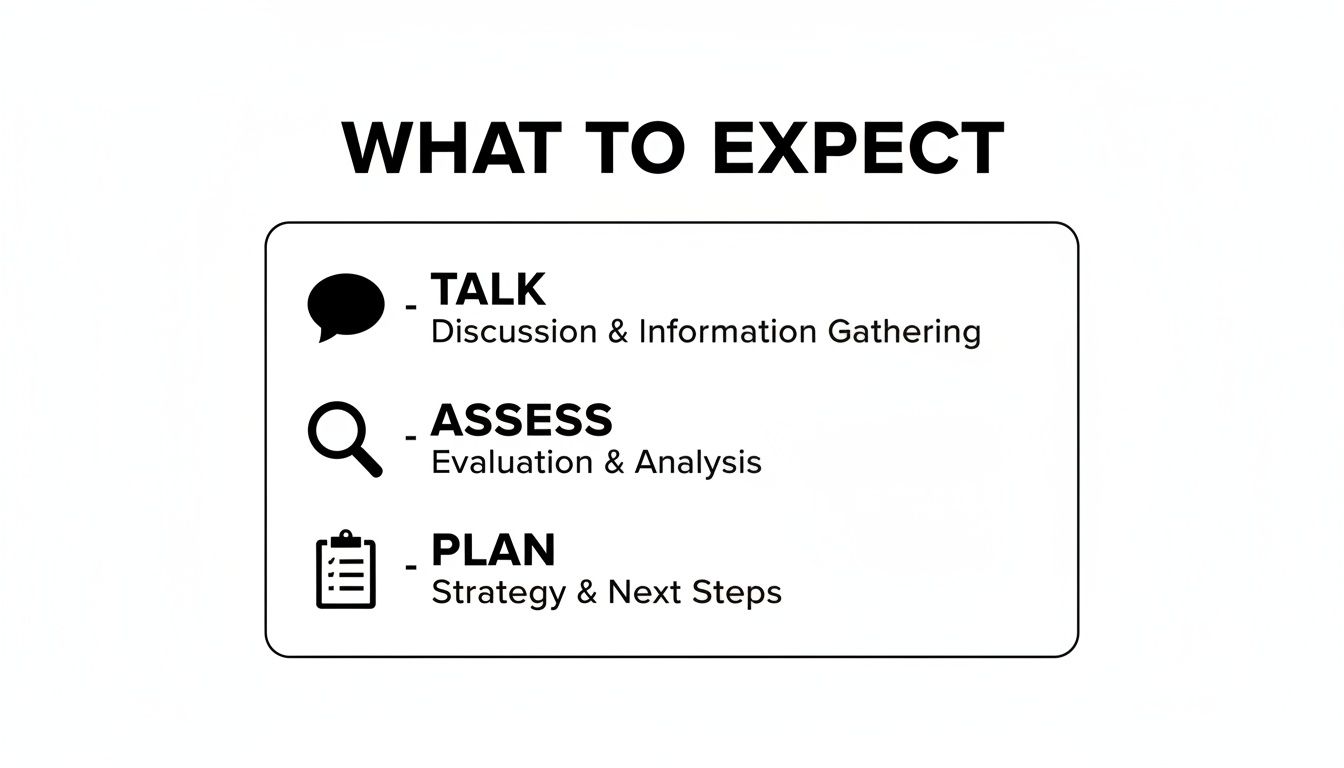
We listen to what happened, assess how your body is moving (and where it isn't), and then build a plan that targets the source of your pain.
Let’s walk through some of the most frequent injuries we encounter after a car crash.
Whiplash and Neck Injuries
Whiplash is the classic car accident injury, but it's widely misunderstood. It isn't just a "sore neck." It's a significant soft-tissue injury that happens when your head is violently snapped back and forth.
That rapid motion can stretch, strain, or even tear the muscles and ligaments supporting your neck and upper back. This can lead to a cascade of symptoms:
- Intense neck stiffness and a frustratingly limited range of motion.
- Headaches that seem to start right at the base of your skull.
- Pain that spreads down into your shoulders, upper back, or arms.
Auto accident physical therapy is the gold standard for whiplash recovery. We start with gentle, hands-on manual therapy to calm down the irritated muscles and then introduce very specific exercises to restore your mobility and strengthen the deep muscles that stabilize your neck.
Herniated Discs and Lower Back Pain
The sudden compression and twisting forces from a collision put incredible stress on your spine. This can cause one of the soft, gel-like discs between your vertebrae to bulge or rupture. We call this a herniated disc.
Think of your spinal discs as little jelly donuts sitting between the bones of your spine. An accident can squeeze them so hard that the jelly inside pushes out, and if it presses on a nearby nerve, you're going to feel it.
That nerve pressure is what causes the hallmark symptoms of a herniated disc, especially in the lower back. You might feel a sharp, shooting pain down your leg (often called sciatica), numbness and tingling, or even weakness in your foot. Our primary goal is to take that pressure off the nerve using targeted movements and core stabilization exercises that create more space for the nerve to heal.
Concussions and Vestibular Issues
You don’t have to hit your head to get a concussion. The same violent whiplash motion that injures your neck can cause your brain to impact the inside of your skull, disrupting normal brain function.
This jolt can also throw off your vestibular system—the delicate system in your inner ear responsible for balance and spatial awareness. The signs can be subtle but disruptive:
- Dizziness, vertigo, or just a constant feeling of being "off-balance."
- Nausea and a new sensitivity to light or sounds.
- Brain fog, memory issues, or trouble concentrating.
Our physical therapists are trained in vestibular rehabilitation. This involves specific head, neck, and eye exercises designed to help your brain and inner ear system recalibrate, which can dramatically reduce dizziness and restore your sense of stability.
Shoulder, Hip, and Joint Pain
In the split second of an accident, your body braces for impact. Your hands clench the steering wheel, your foot mashes the brake pedal, and your seatbelt pulls tight across your chest and shoulder.
While these instincts can save your life, they can also cause injury. We frequently see:
- Shoulder Pain: Often caused by the direct force of the seatbelt or from bracing your arms against the steering wheel. This can lead to rotator cuff strains and tears.
- Hip and Lower Back Pain: Resulting from the powerful bracing action of slamming on the brake. That force travels right up your leg into your hip and lower spine.
Physical therapy focuses on restoring normal joint movement, reducing inflammation, and strengthening the muscles around the joint to provide better support and prevent long-term issues.
For a broader look at the types of conditions we manage, check out our post on the most common injuries we treat in Boston.
Common Injuries After a Car Accident and How PT Helps
This table sums up the connection between a specific injury, what you might feel, and how a physical therapist can help you get back on track.
| Injury Type | Common Symptoms You Might Feel | How Physical Therapy Addresses It |
|---|---|---|
| Whiplash | Neck pain, stiffness, headaches, pain into shoulders | Manual therapy to reduce muscle spasm, gentle range of motion, and specific neck strengthening exercises. |
| Herniated Disc | Sharp pain in the back or leg (sciatica), numbness, tingling | McKenzie Method exercises for centralization, core stabilization, and traction to decompress the nerve. |
| Concussion | Dizziness, "brain fog," nausea, balance problems | Vestibular rehabilitation with head/eye coordination drills and balance training to recalibrate the inner ear system. |
| Shoulder Sprain | Pain with reaching overhead, weakness, clicking or popping | Rotator cuff strengthening, manual therapy for joint mobility, and exercises to improve shoulder blade mechanics. |
| Hip/Knee Pain | Deep ache in the hip or knee, pain with walking, sharp pain | Strengthening exercises for the glutes and quads, stretching for tight muscles, and hands-on joint mobilization. |
No matter the specific injury, our goal is always the same: reduce your pain, restore your function, and give you the tools to prevent the problem from becoming a chronic issue.
Building Your Personalized Recovery Roadmap

Because no two car accidents are the same, no two recovery plans should be, either. A generic, one-size-fits-all handout of exercises just doesn’t work. Your path to recovery is built from the ground up, based entirely on your specific injuries, your lifestyle, and what you want to get back to doing.
This plan isn't just a list of things to do; it’s a strategic, phased approach to healing. Think of it like a crew stabilizing a house after a storm. First, you have to control the immediate damage before you can start rebuilding. The same logic applies to auto accident physical therapy.
Phase 1: Pain and Inflammation Control
After a crash, your body’s first response is inflammation. It’s what causes the pain, swelling, and muscle guarding that makes it so hard to move. Our first job is to get that response under control so the real healing can begin.
This initial phase is all about pain relief and gentle, early movement.
- Manual Therapy: This is our hands-on work. We use specific soft tissue mobilization and gentle joint movements to ease muscle tension, improve blood flow, and reduce pain right at the source.
- Aquatic Therapy: For some, moving on land is just too painful at first. The natural buoyancy of water takes the pressure off your joints, allowing you to move and exercise without the strain of gravity. It’s a powerful tool for managing pain and starting to restore motion.
The timing here is critical. A 2023 study showed that accident victims who started physical therapy within two weeks were 50% less likely to have chronic pain six months later. You can read more about these crucial findings and see just how much of a difference early intervention can make.
Phase 2: Rebuilding Strength and Function
Once your initial pain and swelling have subsided, we shift into the active part of your recovery. This is where we start rebuilding your body's support systems, one precise movement at a time. The goal is to restore function, not just cover up symptoms.
This phase is built on three pillars:
- Restoring Mobility: We use targeted stretches and hands-on techniques to improve your range of motion, breaking down any scar tissue that's making you feel stiff and restricted.
- Rebuilding Strength: We don't just hand you a rubber band and walk away. We guide you through specific exercises designed to turn on and strengthen the exact muscles weakened by the crash, particularly the deep stabilizers in your neck and back.
- Improving Stability: Strength without control doesn't do you much good. This is where we teach your body how to use that new strength to stabilize your joints during daily activities, which is key to protecting you from re-injury.
This active phase is where you become the most important person in the room. We act as your coaches and guides, but you’re the one doing the work. Our one-on-one model means we are with you for every single rep, making sure your form is perfect and you’re getting the most out of every movement.
Phase 3: Getting You Back to Your Life
The final phase is all about making sure your recovery sticks. We shift the focus from the clinic to your real-world activities. We’ll simulate the demands of your life, whether that’s lifting your child, sitting through a meeting without pain, or getting back to your favorite sport.
This is also where we give you the tools and education to manage your body for the long run. You’ll leave with a clear home exercise program and the knowledge to prevent future problems. Our goal isn't just to get you better—it's to make you more resilient than you were before the accident.
Navigating Insurance and Claims with Confidence
After a car crash, the last thing you want to deal with is a mountain of paperwork and confusing calls with your insurance company. The administrative side of an accident can feel just as stressful as the injury itself. Our goal is to take that burden off your shoulders so you can focus on the one thing that truly matters—getting better.
Think of us as your partners in navigating this entire system. Our dedicated administrative team knows the ins and outs of auto insurance and is here to support you at every single turn. You’re not in this alone.
How Auto Insurance Covers Physical Therapy
Here in Massachusetts, the insurance system is set up to help you get the care you need, fast. Your auto insurance policy includes Personal Injury Protection (PIP), which is designed to cover your medical expenses after an accident, no matter who was at fault. And yes, this almost always includes physical therapy.
This means you can start your recovery without waiting for fault to be determined or for a settlement to be reached. It allows for immediate access to auto accident physical therapy so you can begin the healing process right away. We handle the direct billing to your auto insurance carrier, so you don't have to worry about paying upfront and waiting for reimbursement.
For more specifics, you can always find details on our accepted plans and billing process on our patient insurance resources page.
The Importance of Proper Documentation
While you're focused on your recovery, we're meticulously documenting every visit. These clinical notes are far more than just a record of your exercises; they are a critical part of your official medical record that tells the story of your recovery.
This detailed record serves two key purposes:
- For Your Insurance: It provides clear, objective proof to your insurance carrier that the physical therapy you're receiving is medically necessary and is directly helping you recover from the injuries sustained in the accident.
- For Any Legal Claims: If you are working with an attorney, our notes create a comprehensive timeline of your injury, your functional limitations, and your progress. This documentation is essential for demonstrating the full impact the accident has had on your life.
We take this responsibility seriously. Our thorough notes on your progress, challenges, and functional improvements build a strong, clear case for why your care is essential. It's our way of advocating for you behind the scenes.
As you move through your recovery, it can be helpful to understand the average settlement for car accident physical therapy claims to manage expectations. The economic impact of traffic accidents is staggering; in 2020 alone, they led to over two million emergency department visits and a total cost of around $430 billion in the U.S. Globally, 20 to 50 million people suffer non-fatal injuries from these incidents that result in long-term disability each year.
Research confirms that getting quality rehabilitation like physical therapy is vital for recovery and can help lower the long-term costs tied to chronic pain and disability. It’s an investment in your long-term health.
Your Car Accident Recovery Questions Answered
We get it. After a car accident, your mind is racing with questions on top of dealing with the physical pain. At our clinic, we’ve heard them all. We believe in giving you direct, clear answers so you can feel confident about your recovery.
Think of this as the FAQ we’d give you if we were sitting down together, covering the most common questions we get about auto accident physical therapy.
How Long Will I Need Physical Therapy After a Car Accident?
This is almost always the first question we’re asked. The honest answer? It’s entirely specific to you. There’s no predetermined number of visits or a universal timeline for getting better. Your recovery roadmap is shaped by a few key things.
The type and severity of your injuries, how your body naturally heals, your health before the accident, and how consistently you stick with your treatment plan all play a huge role. Every single person heals at their own pace.
For instance, a straightforward case of minor whiplash might only need 6 to 8 weeks of focused physical therapy to resolve. But a more complex injury, like a herniated disc that’s causing nerve pain or a significant tear in your rotator cuff, will understandably take several months of dedicated care to get your strength and full function back.
Our goal is never to keep you in therapy a day longer than necessary. We work with you to set clear, measurable goals from day one. In our one-on-one sessions, we are constantly reassessing your progress. We’ll be the first to celebrate with you when you’ve hit those goals and are ready to “graduate” from physical therapy.
Do I Need a Doctor's Referral for Auto Accident PT?
This is a great question, and it highlights a major advantage of getting care here in Massachusetts. Thanks to a policy known as Direct Access, you can come see a physical therapist for an evaluation without getting a referral from a doctor first. This is a game-changer after a car accident.
Getting started with treatment quickly is one of the biggest factors in a successful recovery. Direct Access cuts through the red tape, letting you get a professional assessment right away instead of waiting weeks for a doctor’s appointment. You can schedule an evaluation with us as soon as you’re ready.
Now, while you don’t need a referral to get started, your auto insurance policy might require one for ongoing coverage. Our administrative team are experts in navigating this. They’ll help you figure out your specific insurance requirements and, if needed, coordinate directly with your doctor to get all the necessary paperwork. This ensures your care continues without a hitch.
What Makes Your One-on-One Care Different?
This is a critical distinction and something we’re incredibly proud of. In many PT clinics, a single therapist juggles several patients at once, dividing their attention while people do exercises on their own. Our entire practice is built around dedicated, one-on-one sessions.
Here’s what that actually means for your recovery:
- Undivided Attention: For your entire appointment—whether it's 30, 45, or 60 minutes—you have the complete, focused attention of your clinician. No exceptions.
- Constant Feedback: This allows for real-time tweaks to your exercises, ensuring your form is perfect. This maximizes the benefit of every movement and prevents any further strain.
- In-Depth Manual Therapy: The success of hands-on techniques depends on the therapist’s ability to feel how your muscles and joints are responding. One-on-one care provides the time and focus needed for this precise, essential work.
After the trauma of an accident, this personalized focus makes all the difference. It means we listen more intently, understand your needs on a deeper level, and can adjust every single minute of your session to what your body needs that day. It’s the difference between being another patient on the schedule and being a person on a dedicated path to getting better.
My Car Barely Has a Scratch—Do I Really Need PT?
Yes. Absolutely. This is one of the most dangerous misconceptions out there. It’s a huge mistake to assume the amount of damage to your car reflects the amount of damage to your body.
Modern cars are engineered to crumple and absorb impact to protect the people inside. That bumper might look nearly perfect after popping back into place, but all that energy had to go somewhere. It was transferred through the car’s frame and, ultimately, into your body.
Even in a low-speed fender bender, the rapid jolt is more than enough to cause serious soft tissue injuries like whiplash or back strains. As we mentioned before, the adrenaline that floods your system after a crash is a powerful painkiller. Symptoms can easily be delayed by hours, days, or even a week.
Think of it this way: getting an evaluation is a low-risk, high-reward decision. You have a trained expert assess your musculoskeletal system for hidden damage before it can turn into a chronic, long-term problem. It's an essential check-up for your body's frame to ensure a minor incident doesn't sideline you for months.
At Joint Ventures Physical Therapy, we're here to be your partner in recovery, guiding you with expert care and clear answers every step of the way. If you've been in an accident and are ready to take control of your health, we're ready to help. Schedule your one-on-one evaluation today and start your journey back to feeling your best.