So, you’ve had rotator cuff surgery. That’s a huge step, and we're glad you're here. Now, you're probably asking, “What comes next?” When it comes to physical therapy after rotator cuff surgery, the two most important ingredients are patience and consistency. Our first job is to protect the great work your surgeon did, and only then can we start rebuilding your strength together.
Your Rotator Cuff Surgery Recovery Timeline
Alright, let's get into it. You're home from surgery with your arm in a sling, likely wondering how long it will be until you can get back to your life. We're not going to sugarcoat it—this journey takes time. But the good news is, with a smart, structured approach, you will get there. We've helped thousands of Bostonians do just that.
The first six to eight weeks are wicked important. This is the tendon-to-bone healing phase, and you just can’t rush it. Think of it like letting newly poured cement set. During this time, your main job is to protect that surgical repair. Any patience you show now will pay off massively down the road. It can also be helpful to understand the common discomforts about rotator cuff injuries, and how to diagnose or treat them to get a better sense of what your shoulder is going through.
Setting Realistic Expectations For Healing
Every single recovery is a little different. A smaller, less complex repair might have you feeling much better in about four months. A larger, more involved repair could take closer to a year before you’re back to high-level activities.
This isn't a race. Our job as your physical therapy team is to guide you through the process and help you recognize and celebrate every milestone along the way. We're in this with you.
Data shows just how much this timeline can vary. For patients who had arthroscopic surgery, about 31% achieved functional recovery in under three months. Another 40% hit that mark between three and six months. All told, a solid 72% of patients regained functional recovery within six months. As you might expect, younger patients and those with smaller tears often have a quicker comeback.
This table provides a general roadmap for what you can expect as you move through recovery.
Typical Rotator Cuff Recovery Milestones
This table outlines the general phases and key goals of recovery after rotator cuff surgery, giving you a clear roadmap of what to expect week by week.
| Phase | Typical Timeframe | Primary Goals & Activities |
|---|---|---|
| I. Maximum Protection | 0-6 weeks | Sling use, managing pain/swelling, passive range of motion (your therapist moves your arm), and protecting the repair. |
| II. Moderate Protection | 6-12 weeks | Weaning off the sling, starting active-assisted and active motion, and introducing very light strengthening. |
| III. Strengthening | 12-24 weeks | Progressing resistance exercises, improving neuromuscular control, and beginning functional movement patterns. |
| IV. Return to Activity | 6-12 months | Advanced strengthening, sport-specific or work-specific training, and a gradual return to full activity. |
Remember, these are just typical timelines. Your surgeon’s specific protocol and your own healing process will ultimately dictate your personal schedule. We’ll be there to guide you based on what your body is telling us.
The timeline below gives you another visual guide of what to expect, from the initial healing all the way to getting back into your routine.

As the infographic shows, the entire process is broken down into clear phases, each with its own focus and goals. Understanding this progression is key.
The biggest mistake we see is people trying to do too much, too soon. Your body needs time to heal the repair before we can ask it to get strong. Trusting the process is your greatest asset. We’re here to help you do just that.
Here’s a quick look at what we’ll be working toward together, step-by-step:
- Protecting the Repair: The first several weeks are all about letting that tendon heal securely to the bone. No exceptions.
- Restoring Motion: Once healing is well underway, we’ll gently start getting your shoulder moving again.
- Building Strength: After your motion returns, we focus on rebuilding the muscular support system around your shoulder.
- Returning to Life: The final phase is all about getting you back to everything you love—from carrying groceries from the Market Basket to getting back on the golf course.
The First 6 Weeks After Surgery: Protect The Repair
The first six weeks after your rotator cuff surgery are all about one thing: protecting the repair. We know it’s frustrating. You want to get moving, but right now, your only job is to let that tendon heal back to the bone.
Think of it this way: your surgeon just laid a new foundation. If you start building on it too soon, the whole structure can fail. Pushing it now is the fastest way to a major setback, and we’re here to make sure that doesn’t happen.
Making Peace With Your Sling

Let’s talk about the sling. It’s not just for show—it’s your shoulder’s single most important piece of protective gear. You need to wear it correctly and consistently. No exceptions. It holds your arm in a neutral, supported position, taking all the tension off the freshly repaired tendon.
You’ll be in this sling nearly 24/7, and yes, that includes while you sleep. It only comes off for three reasons: dressing, bathing, and your prescribed physical therapy exercises. It’s awkward, we get it. But from our experience, patients who are diligent with their sling have the smoothest recoveries.
Managing Daily Life, Pain, And Swelling
Doing everyday things with one arm is tough. We always tell our patients to prep their homes before surgery. Move things you use often to waist-level. Stock up on easy-to-make meals. Buy a few button-down or zip-up shirts. It makes a huge difference.
Pain and swelling are completely normal, especially in that first week. Your best defense is ice. A simple routine of icing for 15-20 minutes every couple of hours will do wonders for reducing inflammation and managing pain. This is a huge part of your initial physical therapy after rotator cuff surgery.
Don’t wait for the pain to get bad. It’s much easier to stay ahead of it than to chase it down. Stick to the schedule your doctor gave you for pain medication, especially for the first few days, and be religious with your icing.
Sleep is often the biggest challenge. Lying flat can put a painful pull on the shoulder repair. Many of our patients find that sleeping in a recliner or propped up with a mountain of pillows is the only way to get comfortable. The goal is to find that semi-upright sweet spot.
Your First Physical Therapy Session
Believe it or not, we’ll get you moving almost right away—but it’s not what you think. You should have your first PT appointment scheduled within a week or so of your surgery. If you’re not on the books yet, make that call today. You can get a sense of what to expect by reading our guide on how to prepare for your first physical therapy appointment.
Every exercise we do in this phase is passive. That means your therapist or your non-surgical arm does all the work. Your operated arm is just along for the ride.
- Pendulum Swings: You’ll lean forward, let your arm hang straight down like a rope, and use your body to create a slow, gentle circle.
- Passive External Rotation: Your physical therapist will have you use a small cane or your other hand to gently rotate your forearm outward. Your elbow stays glued to your side.
- Passive Flexion: While lying on your back, you’ll use your good arm to slowly lift your surgical arm up toward your head, only as far as is comfortable.
These movements are small, slow, and controlled. We’re not building strength. We’re just trying to keep your shoulder from getting stiff and to encourage blood flow for healing. You should never feel a sharp pain. This early work lays the groundwork for all the active recovery that comes next.
Regaining Motion and Starting Gentle Strengthening
You’ve made it through the toughest part—the initial weeks of just protecting the repair. The great news is that by week six, that repaired tendon has started to get a solid grip on the bone. Now, the real work of your physical therapy after rotator cuff surgery begins.
This next phase, typically from weeks six to twelve, is all about reclaiming your shoulder’s movement and gently waking up the muscles that support it. It’s a huge step. We’re moving from a period where we did all the work for you (passive motion) to a new phase where you start taking an active role. It’s a careful, calculated process, and we’re right there with you to make sure every movement is both safe and productive.
From Passive to Active-Assisted Motion
The shift from passive to active-assisted range of motion is a major milestone in your recovery. “Active-assisted” is just what it sounds like: your surgical arm starts to do some of the work, but it gets a helping hand—from your other arm, a pulley, or even a wall. This teamwork lets your muscles fire up without putting too much strain on the healing tendon.
A few classic exercises we introduce at this stage include:
- Pulley Exercises: Using an overhead pulley system, which we have in all our Boston clinics, you’ll let your good arm help lift your surgical arm. This gives you incredibly smooth, controlled motion.
- Table Slides: While sitting, you’ll rest your hand on a towel and slide it forward across a table, letting your body lean into the movement to gently increase the stretch.
- Wall Crawls: Facing a wall, you’ll “walk” your fingers up as high as you comfortably can. The wall provides the support your arm needs.
A key piece of advice we give every single patient: let the assistance do most of the work at first. Don’t try to power through it. The goal is to coax the shoulder into moving, not force it. Think of pain as your stop sign.
And don’t forget, as you start this process, your diet plays a huge role. Fueling your body with the right foods that help muscle recovery gives it the building blocks it needs to repair tissue and build new muscle.
Building a Strong Foundation for Your Shoulder
Regaining motion is crucial, but it’s only half the battle. We also need to start waking up the muscles that stabilize your shoulder blade, also known as the scapula.
Think of your shoulder blade as the foundation of a house. If that foundation is shaky, the rest of the house—your shoulder joint—will be unstable. So many people think rotator cuff rehab is only about the four cuff muscles, but the surrounding muscles are just as critical. These scapular stabilizers position your shoulder correctly, giving your rotator cuff a solid platform to work from. Strengthening them first is non-negotiable for a successful recovery.
We always begin with isometrics. These are exercises where you contract a muscle without actually moving the joint. Your physical therapist will position your arm and have you gently push into their hand without letting your arm move. It’s an incredibly safe and effective way to get those muscles firing again.
Introducing Light Strengthening
After a couple of weeks of active-assisted motion and isometrics, if everything is progressing well, we’ll start adding some light resistance. This is a genuinely exciting moment for our patients! It’s the first time you really feel like you’re building strength back.
Here’s how we typically layer things in:
- Isometrics: As mentioned, this is always the first step. These gentle contractions re-establish that mind-muscle connection.
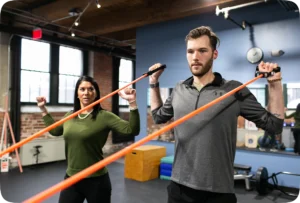
- Banded External Rotation: With your elbow tucked at your side, you’ll use a very light resistance band to rotate your forearm outward. This targets the rotator cuff muscles directly in a safe, controlled manner.
- Rows: Using a light band, you’ll perform rows, focusing on squeezing your shoulder blades together. This is a powerhouse exercise for scapular stability.
- Scaption: This involves lifting your arm in the “scapular plane”—about 30 degrees out from the front of your body—with either no weight or a very light dumbbell (1-2 pounds is the absolute max to start).
Form is everything. We would much rather you do five perfect reps with no weight than ten sloppy ones with a band that’s too heavy. Poor form allows the wrong muscles to take over, which can lead to impingement or other setbacks. Our one-on-one sessions are designed to ensure your form is spot-on for every single rep. For a deeper look at these movements, check out our guide on how to strengthen rotator cuff muscles.
This phase is all about quality over quantity. We’re building a solid base for the heavier work that will come later.
Building Functional Strength for Everyday Life
Alright, this is the phase where you really start to feel like yourself again. From about month three to six after your surgery, we shift from simply regaining motion to building real, usable strength. All that initial, careful work is about to pay off in your day-to-day life.
We’re moving past isolated movements and focusing on what we call functional strength. This is all about getting your shoulder ready for the things you actually do—swinging a golf club, reaching for a pot on the top shelf, or just carrying groceries from the car without giving it a second thought. It’s an exciting time, and our one-on-one sessions are geared entirely toward what you want to get back to doing.
Advancing Your Strengthening Program
By this point, the light resistance band exercises you’ve been doing should feel pretty manageable. Now, we’re going to build on that foundation, but we have to do it smartly. This is where we start introducing light weights and more dynamic movements.
It’s not just about lifting heavier; it’s about re-establishing control. A huge piece of this is neuromuscular control—basically, retraining your brain and muscles to communicate perfectly again. After surgery and a long time spent protecting the shoulder, that connection gets a little rusty. We literally have to teach your shoulder how to be a shoulder again.
Your physical therapist will guide you through this progression, which usually involves:
- Progressing Resistance: We’ll move you from the lighter resistance bands to heavier ones and then carefully introduce light dumbbells. We’re talking 3-5 pounds to start, nothing more.
- Compound Movements: Instead of just rotating your arm, we’ll start putting movements together, like combining a row with an external rotation.
- Challenging Stability: We might have you do exercises while standing on an unstable surface. This forces your core and all those tiny shoulder stabilizers to fire up and do their job.
This steady increase in demand is the signal your muscles and tendons need to get stronger. This is where the real transformation happens in your physical therapy after rotator cuff surgery.
We always tell our patients, “We’ve built the foundation, now we’re framing the house.” Every single exercise from here on out has a direct link to a real-world activity. It’s no longer just rehab; it’s training for your life.
The Power of a Solid PT Plan
This is the phase where the value of consistent, one-on-one physical therapy really becomes clear. The effort you put in now directly impacts your long-term results, and the data on this is overwhelming.
Success rates for rotator cuff surgery are incredibly high when paired with a dedicated PT program. The Hospital for Special Surgery (HSS), for example, reports success rates over 95% for small tears. Data from the Cleveland Shoulder Institute is just as telling: before surgery, patients rated their shoulder function at just 37% of normal with a pain score of 5/10. Two years later? They reported 79% function and a pain score of just 1/10. Physical therapy is the engine that drives those outcomes. You can read more about these impressive rotator cuff surgery outcomes from HSS.
What Functional Strengthening Looks Like
So, what does “functional” actually look like in the clinic? It means we start safely mimicking the exact motions you need to get back to your life.
Here are a few common examples of how we tailor exercises to a patient’s goals:
| Patient's Goal | Functional PT Exercise |
|---|---|
| Lifting a child or grandchild | Practicing a "floor-to-waist" lift with a light medicine ball, focusing on driving with the legs and core while the shoulder guides the weight. |
| Returning to the golf course in the Back Bay | Using a cable machine or resistance band to perform slow, controlled rotational movements that simulate the core and shoulder turn of a swing. |
| Putting dishes away in a high cabinet | Performing diagonal "P.N.F." patterns with a light dumbbell, moving the arm from the opposite hip up and out, toward the ceiling. |
| Carrying groceries from the North End market | Doing farmer's walks with kettlebells or dumbbells, concentrating on keeping the shoulder blade pulled back and down to maintain good posture under load. |
This phase is all about creative problem-solving. We'll ask, "What did you try to do this week that felt weak or unstable?" Then, right there in the clinic, we'll design an exercise to fix it. That's what personalized, goal-oriented recovery is all about.
Returning to Sports and High-Level Activities
You’ve put in months of hard work. Now, we can finally start talking about the finish line—getting back to the activities you love. For some, that’s teeing off at the golf course. For others, it’s just playing catch with their kids without a second thought.
This final phase, which often begins around the six-month mark, is where your dedicated physical therapy after rotator cuff surgery really pays off. But getting back in the game isn’t about hitting a specific date on the calendar. It’s about meeting performance benchmarks. Think of your physical therapist as your personal coach, testing your shoulder to make sure it’s truly ready for the demands of your sport.

What Does "Cleared for Sport" Actually Mean?
Getting the green light to return to play is a team decision between you, your surgeon, and your PT. It’s far more than just having good range of motion. We put your shoulder through a battery of tests to ensure it's strong, stable, and ready for action.
Before clearing you, we need to see a few key things:
- Symmetrical Strength: Your surgically repaired shoulder must be at least 90% as strong as your uninjured side. We confirm this with objective strength testing.
- Full, Pain-Free Motion: You need to be able to move your arm through its complete range of motion without pain or cheating with other muscles.
- Solid Neuromuscular Control: This is a big one. Your shoulder muscles must fire in perfect sync to react instantly and correctly to quick, unexpected movements.
The timeline for this varies widely. A multi-study review found athletes returned to their sport anywhere from four to seventeen months after surgery, with an overall success rate of 84.7%. Recreational athletes, not surprisingly, often get back quicker than elite competitors. And while progress can feel slow at first, data from one large registry showed functional recovery after arthroscopic rotator cuff repair (ARCR) hit 87% at six months and nearly 89% by one year. You can discover more insights about these recovery timelines in the published research.
Sport-Specific Drills and Rebuilding Confidence
Once you’ve met those baseline criteria, we get to the fun part: sport-specific training. We don’t just throw you back on the field. Instead, we break down the movements of your activity and rebuild them, piece by piece, in a safe and controlled way.
For a tennis player, that means we won't have you hitting 100 mph serves on day one. We’d progress like this:
- Shadow Swings: Practicing the motion with perfect form, but no racket or ball.
- Light Tossing: Reintroducing dynamic movement with gentle underhand and overhand throws.
- Plyometric Drills: Building explosive power with exercises like medicine ball chest passes against a rebounder.
A swimmer might start with dry-land exercises using resistance bands to mimic the pull phase of their stroke. A weightlifter would begin with extremely light overhead presses, focusing entirely on scapular stability. Every program is built for your specific goals.
One of the biggest hurdles we see at this stage is psychological. After months of protecting your shoulder, it’s completely natural to be hesitant to trust it again. A huge part of our job is helping you rebuild that confidence, one successful, pain-free movement at a time.
Staying at the Top of Your Game
Congratulations, you’re back. But the work isn’t over. The final step is a smart maintenance program to keep that shoulder strong and resilient for the long haul. Think of it as protecting your investment.
This usually means continuing with a few key strengthening exercises two or three times a week. We can also help you pinpoint and fix any faulty mechanics in your sport that might have contributed to the original injury. For more on that, take a look at our guide on how to prevent shoulder injuries. Our Boston-based team is here to be your long-term partner in health, helping you stay active and at the top of your game.
Of all the questions we get at our Boston PT clinics, the ones about rotator cuff surgery recovery are some of the most common. Over the years, we’ve helped thousands of people navigate this process, so we’ve heard just about every question there is.
Here are the answers to the ones that come up most often, straight from our team of physical therapists.
How Soon Should I Start Physical Therapy After Surgery?
You should have your first PT appointment lined up before you even have surgery, scheduled for within one week of the procedure. Don't wait.
Getting started with a physical therapist right away is critical. In those first few days, our main jobs are to help you manage pain and swelling, teach you how to protect the surgical repair, and begin the gentle, passive motion that keeps your shoulder from getting dangerously stiff.
If you wait too long, you’re fighting an uphill battle against stiffness and muscle atrophy that can make your recovery much, much harder than it needs to be. We work hand-in-hand with surgeons across the Boston area to make sure your therapy starts at the exact right time for your specific repair.
What Red Flags Should I Watch For During Recovery?
Some soreness after physical therapy is perfectly normal—that’s how you know you’re making progress. What isn’t normal is sharp, sudden pain that doesn’t fade with rest. That’s a clear warning sign.
Get in touch with your surgeon or physical therapist right away if you notice any of these things:
- A significant increase in swelling, redness, warmth, or any drainage from the incision site.
- Fever or chills, as these can be signs of an infection.
- A sudden "pop" or tearing feeling in your shoulder, especially if you feel new weakness afterward.
- Losing range of motion you previously had.
We want to hear from you if something feels off. There is no such thing as a silly question when it comes to your recovery. It’s always, always better to check in and be safe.
How Can Aquatic Therapy Or Dry Needling Help Me?
These are two excellent tools we often use at our clinics, but they serve very different purposes at different times in your recovery.
Aquatic therapy is a game-changer in the early phases. The buoyancy of the water takes the weight of your arm, letting you move the shoulder joint with far less pain and almost zero stress on the new repair. It's an incredible way to regain motion and build confidence when your shoulder is still too fragile for traditional land-based exercises.
We typically bring in trigger point dry needling much later in the rehab process. After months of protecting your shoulder, the muscles around your neck and shoulder blade inevitably get tight and develop painful knots. Dry needling is one of the fastest ways to release that built-up tension, which can unlock your flexibility and knock out lingering pain that’s holding you back.
Will My Shoulder Ever Feel 100% Normal Again?
This is the big one, isn't it? For the vast majority of our patients who commit to their PT program, the answer is a firm "yes." The success rates for rotator cuff surgery are very high—when combined with a great rehab plan.
But "100%" looks different for everyone. For one person, it might mean getting back to playing tennis three times a week. For someone else, it’s just being able to lift their grandchild without a twinge of pain.
Our job is to first understand your specific goals and then build the roadmap to get you there. It takes patience and a lot of consistent work, but a full return to the activities you love is a very realistic outcome.
Ready to start your recovery with a team that’s dedicated to your personal goals? At Joint Ventures Physical Therapy, we offer personalized, one-on-one care to guide you through every step of your journey. Let us help you move forward—book your appointment at one of our convenient Boston-area locations today.